
Applied Mathematics
Vol.06 No.04(2015), Article ID:56015,9 pages
10.4236/am.2015.64066
High Moments Jarque-Bera Tests for Arbitrary Distribution Functions
Gane Samb Lo1,2, Oumar Thiam2, Mohamed Cheikh Haidara2
1Laboratoire de Statistique Théorique et Appliquée (LSTA), Université Pierre et Marie Curie, Paris, France
2LERSTAD, Université Gaston Berger de Saint-Louis, Saint-Louis, Senegal
Email: gane-samb.lo@ugb.edu.sn, ganesamblo@ganesamblo.net, othiam@univi.net, mhaidara@univi.net
Copyright © 2015 by authors and Scientific Research Publishing Inc.
This work is licensed under the Creative Commons Attribution International License (CC BY).
http://creativecommons.org/licenses/by/4.0/



Received 5 February 2015; accepted 27 April 2015; published 28 April 2015
ABSTRACT
The Jarque-Bera’s fitting test for normality is a celebrated and powerful one. In this paper, we consider general Jarque-Bera tests for any distribution function (df) having at least 4k finite moments for k ≥ 2. The tests use as many moments as possible whereas the JB classical test is supposed to test only skewness and kurtosis for normal variates. But our results unveil the relations between the coeffients in the JB classical test and the moments, showing that it really depends on the first eight moments. This is a new explanation for the powerfulness of such tests. General Chi- square tests for an arbitrary model, not only normal, are also derived. We make use of the modern functional empirical processes approach that makes it easier to handle statistics based on the high moments and allows the generalization of the JB test both in the number of involved moments and in the underlying distribution. Simulation studies are provided and comparison cases with the Kolmogorov-Smirnov’s tests and the classical JB test are given.
Keywords:
Asymptotic Distribution, Asymptotic Statistical Tests, Normality Tests, Functional Empirical Processes

1. Introduction
In this paper, we are concerned with generalizations of Jarque-Bera’s (JB) [1] tests based on arbitrary first (4k) moments, k ≥ 2, rather than on the first eight ones as usual. (See [2] for a reminder of JB tests, page 69). We obtain general statistics that allow statistical tests for any distribution function G provided it has enough moments. For a reminder, the classical JB test belongs to the class of omnibus moment tests, i.e. those which assess simultaneously whether the skewness and kurtosis of the data are consistent with a Gaussian model. This test proves optimum asymptotic power and good finite sample properties (see [1] ). A detailed description of that test and related indepth analyses can be found in Bowman and Shenton, D’Agosto, D’Agostino et al., etc. (see [3] -[5] and [6] ).
Let  be a sequence of independent and identically distributed random variables (r.v.’s) defined on the same probability space
 . For each
 , the skewness and kurtosis coefficients related to the sample
  are defined by.
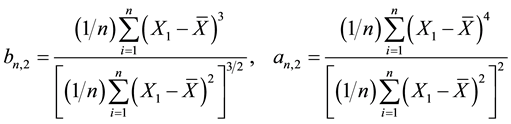 (1)
(1)
These statistics are designed to estimate the theoretical skewness and kurtosis given by  and
and 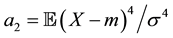 where
where  and
and  respectively denote the mean and the variance of X that is supposed to be nondegenerated. Here and in all the sequel,
  stands for the mathematical expectation with respect to the probability
 . Now, under the hypothesis:
H0: X follows a Gaussian normal law, we have  and
and  and the JB statistic
 (2)
(2)
has an asymptotic chi-square distribution with two degrees of freedom under the null hypothesis of normality. Jarque-Bera’s test consists in rejecting H0 when Tn is far from zero. We will find below that the constants 6 and 24 used in (2), actually, are closely related to the first four even moments of a  random variable which are 1, 3, 15 and 105 and a more convenient form of (2) is

Our objective here is to generalize JB’s test to a general df G by considering high moments ,
,  , with
 , instead of the first eight moments only. We base our methods on the remark that for a random variable
 , one has
 . (H1)
Actually, JB’s test only checks the third and fourth moments of X while the coefficients of the JB statistic (2) uses the first eight moments of X. Our guess is that we would have better tests if we are able to simultaneously check all the first (2k) moments for some k ≥ 2. To this purpose, we consider the following statistics, that is the normalized centered empirical moments (NCEM),
 (3)
(3)
where

are the  non-centered and the centered empirical moments. By the classical law of large numbers, the statistics in (3) are, for each fixed p, asymptotic estimators of
 , (4)
, (4)
whenever the (4p)th moment exists. Finally we consider C1-class functions  et
et  and denote
  and
and .
.
Our general test is based on the following statistics, for k ≥ 2,
 (5)
(5)
which almost-surely  tends to
 , (6)
, (6)
as . For an independent and identically distributed sequence
  of r.v.’s associated with a distribution function G having a finite 2k-moment, we will have by Theorem 1 below that

From such a general result, we are able to derive a normality test by using it with ,
,  for
for , and rejects normality for a large value of
 .
.
We are going to establish a general asymptotic normality of  for any df’s G with 4k finite moments. These results provide themselves efficient tests for an arbitrary d.f. Next, we will derive chi-square tests that generalize JB’s test for higher moments and for arbitrary df’s too.
Our results will show that these tests based on the 2k moments, need, in fact, the eight 4k moments for computing the variance. This unveils that the classical JB’s test is not based only on the kurtosis and the skewness but also on the sixth and the eighth moments. To describe the complete form of the Jarque-Bera method, put

The JB’s test for a  r.v. will be showed to derive from the following general law
 . (7)
. (7)
with the particular coefficients ,
,  and
and . This may be a new explanation of the powerfulness of the JB classical tests since a successful test of normality means that the sample is from a df having same first eight moments as the
  r.v., and this is very highly improbable for a non normal r.v..
As an illustration of what proceeds, consider a distribution following a double-gamma distribution
 of density probability
  with
with . This rv is
centered and has a kurtosis coefficient equal to 3. It is rejected from normality by the JB test. If only the skewned and kurtosis do matter, it would not be the case. Actually, the rejection comes from the parameters  and
and  that are very different from a standard normal distribution to this specific distribution.
The rest of the paper is organized as follows. In Subsection 2.1 of Section 2, we begin to give a concise of reminder the modern theory of functional empirical processes that is the main theoretical tool we use for finding the asymptotic law of (5). Next in Subsection 2.2, we establish general results of the consistency of (5) and its asymptotic law, consider particular cases in Subsection 2.3, propose chi-square universal tests in Subsection 2.4 and finally state the proofs in Subsection 2.5. We end the paper by Section 3 where simulation results concerning the normal and double-exponential models are given.
We here express that in all the sequel the limits are meant as  and this will not be written again unless it is necessary.
2. Results and Proofs
2.1. A Reminder of Functional Empirical Process
Since the empirical functional process is our key tool here, we are going to make a brief reminder on this process associated with , and defined for each
  by
by

where f is a real measurable function defined on  such that
 , (8)
, (8)
and
 (9)
(9)
It is known (see van der Vaart [7] , pages 81-93) that  converges to a functional Gaussian process
  with covariance function
 (10)
(10)
at least in finite distributions.  is linear, that is, for f and g satisfying (9) and for
 , we have
 .
.
This linearity will be useful for our proofs. We are now in position to state our main results.
2.2. Statements of Results
First introduce this notation for ,
,  , and
, and . Let fi and gi,
  be C1-functions with values in
 . Put
. Put  and
and  and
and ,
,  ,
,
 (11)
(11)
 (12)
(12)
 (13)
(13)
and
 (14)
(14)
Here are our main results.
Theorem 1 Let , for
, for . Then
 ,
,
where
 .
.
Corollary 1 (Normality test). Let X be a  r.v. and let, for all
 ,
,
Then
 ,
,
where
 ,
,
and
 .
.
2.3. Particular Cases and Consequences
2.3.1. A General Test
Let G be an arbitrary df with a 4kth finite moment for k ≥ 2, this is . We want to check whether a sample
  is from G. We then select C1-functions fi and gi,
  and compute the observed
value  of
of  and report the p-value of the test, that is
 where s2 is either the exact variance
  or its plug-in estimator

Our guess is that using a greater value of k makes the test more powerful since the equality in distribution of univariate r.v.’s means equality of all moments when they exist (see page 213 in [8] ). For k = 2, this result depends on the first eight moments. Then to find another df G1 for which the p-value exceeds 5% would suggest it has the same eight moments as G, which is highly improbable. Simulation studies in Section 0 support our findings. Remark that we have as many choices as possible for the functions the  and
and .
.
Unfortunately, in the simulation studies reported below, we noticed that the plug-in estimator  may hugely over estimate the exact variance and leads to accepting any data to follow that model, or significantly underestimate it and leads to reject data from the model itself. This is why we only use the exact variance here.
Now let us show how to derive chi-square tests from Theorem 1.
2.3.2. Generalized JB Test and Tests for Symmetrical df’s
Suppose that X is a symmetrical distribution. We have from Theorem 1 that
 (15)
(15)
Since X is symmetrical, that is  for
for , we may without loss of generality suppose that
  since replacing X by
  does affect neither the
  nor the
 . Then we have from (11) and (12) that

and

By reminding that  for
for  and
and , we observe that the product
  only includes functions
  with odd
  and then
 . Thus

where ,
,  and
and . We get
Corollary 2 Let  for
for  and G be a symmetrical df. We have
 . (16)
For a standard normal random variable, we get  and
and  and the normality JB’s test becomes a particular case of (16), which is a general chi-square test for an arbitrary df with 2p-finite moments.
Corollary 3 Let G be a Gaussian df. Then
 .
.
We see that we obtain an infinite number of tests for the normality. For example, for , we have,
 , etc.
2.4. A General Chi-Square Test
Consider (15) and put  and suppose that
 . We have
Corollary 4 Let  and
and  for
for . Then

converges in law to a  r.v..
r.v..
It is now time to prove Theorem 1 before considering the simulation studies.
2.5. Proofs
Since G has at least first 4k moments finite, we are entitled to use the finite-distribution convergence of the empirical function process  as below. Let us begin to give the asymptotic law of
 . By denoting
 , we have

where  is defined in (11) and where we used that the linearity of the empirical functional process. By observing that
 , we finally obtain
 . (17)
Now the law of  is given by

By the delta-method, we have

and then

and next, by noticing from 17 that  for all
 ,
,
 ,
,
 ,
,
where  is given in (12). By the very same methods, we have
 ,
,
 is stated in (13). The delta-method also yields

This completes the proof of the theorem. The proof of the corollary is a simple consequence of the theorem.
3. Simulation and Applications
3.1. Scope the Study
We want to focus on illustrating how performs the general test for usual laws such as Normal and Double Gamma ones. It is clear that the generality of our results that are applicable to arbitrary d.f.’s with some finite kth-moment  deserves extended simulation studies for different classes of df’s. We particularly have to pay attention to the choice of k and of the functions fi and gi, depending on the specific model we want to test.
In this paper, we want to set a general and workable method to simulate and test two symmetrical models. The normal and the double-exponential one with density . We expect to find a test that accepts normality for normal data and rejects double-exponential data and to confirm this by the Jarque-Berra test, and to have another test that exactly does the contrary.
Once these results are achieved, we would be in position to handle a larger scale simulation research following the outlined method. Specially, fitting financial data to the generalized hyperbolic model is one the most interesting applications of our results.
3.2. The Frame
We first choose all the functions fi equal to f0 and all the functions gi equal to g0. We fix k = 3, that is we work with the first twelve moments. As a general method, we consider two df’s G1 and G2. We fix one of them say G1 and compute  and the variance
  from the exact distribution function G1. We generate samples of size n from one the df’s (either G1 or G2) and compute
 . We repeat this B times
and report the mean value t* of the replicated values of  and report the
p-value . The simulation outcomes will be considered as conclusive if p is high for samples from G1 and low for samples from G2. The results are compared with those given by the Kolmogorov- Smirnov test (KST) and when the data are Gaussian, they are compared with the outcomes from JB’s classical test.
3.3. The Results
We consider the following cases: G1 is a Gaussian r.v ; G2 is double-exponential law
  with density probability
  and G3 is a double-gamma law
  with probability den-
sity .
.
Normal Model 
The choice  is natural since the Jarque-Berra test may be derived for our result for these functions and for
 . The model is determined by these following parameters:
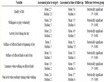
We recall that the variance of our statistic depends on the first 4k moments.
Simulation study.
Testing the model with  data gives the following outcomes for
and for n = 100,
and for n = 1000,
where JB is the classical Jarque-Berra statistic, pJB is the p-value of the JB test, KS is the Kolmogorov-smirnov statistic and pKS is the related p-value. Our model accepts the normality and this is confirmed by JB’s test and by the Klmogorov-Smirnov test (KST). The simulation results are very stable and constantly suggest acceptance.
Testing the double-exponential versus the normal model.
Recall that the values  for
for  are
are ,
,  ,
,  ,
, . Comparing these values with those of a normal model, it is natural to think that the test will fail since only the bp coincide and the test is only based on the moments. Indeed, using data from
  gives for n = 11
and for n = 22
Our test rejects the  model for n = 11 and JB’s test rejects it only for
 . We see here the advantage brought by the value k = 3 in our statistic. The KST has problems in rejecting the false
  even for n = 1000 that of Jarque-Berra.
Testing the double-gamma versus the normal model.
Let use  data with
  and
and . We have the outcomes for
and for n = 22
We have similar results. Ou test rejects the  model for n = 12 and JB’s test rejects it only for n ≥ 18. We see here the advantage brought by the value k = 3 in our statistic. Although the first four moments of a
  are 0, 1, 0 and 3, that is, the same of those of standard normal rv, this model is rejected. We already pointed out that the coefficients 4 and 6 are in fact based on the first eight moments and the discrepancy of moments higher than 4 results in the rejection.
Analysing the tables above, we conclude that our test performs better the JB’s test against a double-gamma df with same skewness and kurtosis than a normal df for small sample sizes around ten and this is real advantage for small data sizes. Even for k = 2, our test is performant for the small values n = 11 and n = 12.
Double-exponential model .
.
We point out that the statistic  does not depend on the
 . Then we only consider
  in the following. We always use
 . The model is determined by the following values.
Here, we do not have the Jarque-Berra test to confirm the results.
Simulation. Testing the model with  data gives the following outcomes, for n = 800.
The simulation results are very stable and constantly suggest acceptance.
Testing normal data. Using normal data gives
The  model is rejected. We noticed that the rejection of normal data is automatically obtained for large sizes here, when n is greater than 900. For n between 500 and 900, rejection is frequent but acceptance occurs now and then. Whe also noticed that the variance of
  are high and do not allow to reject normal data for small sizes. This leads us to consider other functions. Now consider the classes of functions
 .
.
We obtain good results for  with
with  and
and . In this case, the exact value of the statistic is 11.600. The double-exponential
  model is confirmed according to the following table
while the normal model is rejected as illustrated below:
It is important to mention here that the KST is very powerful is rejecting the normal model with double-ex- ponential and double-gamma data with extremely low p-value’s.
3.4. Conclusion and Perspectives
We propose a general test for an arbitrary model. The methods are based on functional empirical processes theory that readily provides asymptotic laws from which statistical tests are derived. They depend on an integer k such that the pertaining df has 4k first finite moments. We get two kinds of tests. A general one based on functions fi and gi,  , with an asymptotic normal law. We derive from these results chi-square tests that are valid for general df’s and that includes the Jarque-Berra test of normality. Both tests use arbitrary moments. We only undergo simulation studies for the first kind of test. Our simulation studies show high performance for nor- mality against other symmetrical laws such as double-exponential or double-gamma ones. For suitable choices of fi, gi, and k, the test performs well for small samples (n = 20) both for accepting the normal model and rejecting other models. We also show that for suitable choice of fi and gi, the test for the double-exponential model is also successful, but for sizes greater that n = 150. In upcoming papers, we will focus on detailed results on specific models and try to found out, for each case, suitable value of the parameters of the tests ensuring good performances for small data. A paper is also to be devoted to simulation studies for the khi-square tests and their applications to financial data.
References
- Jarque, C.M. and Bera, A.K. (1987) A Test for Normality of Observations and Regression Residuals. International Sta- tistical Review, 55, 163-172. http://dx.doi.org/10.2307/1403192
- McNeil, A.J., Frey, R. and Embrechts, P. (2005) Quantitative Risk Management: Concepts, Techniques and Tools. Princeton University Press, Princeton and Oxford.
- Bowman, K.O. and Shenton, L.R. (1975) Omnibus Contours for Departures from Normality Based on
![]() and b2. Biometrika, 62, 243-250.>http://html.scirp.org/file/9-7402640x247.png" class="200" /> and b2. Biometrika, 62, 243-250.
and b2. Biometrika, 62, 243-250.>http://html.scirp.org/file/9-7402640x247.png" class="200" /> and b2. Biometrika, 62, 243-250. - D’Agostino, R.B. (1971) An Omnibus Test for Normality for Moderate and Large Size Samples. Biometrika, 58, 341- 348. http://dx.doi.org/10.1093/biomet/58.2.341
- D'Agostino, R.B. and Pearson, E.S. (1973) Tests for Departure from Normality: Empirical Results for the Distributions of b2 and
![]() . Biometrika, 60, 613-622.>http://html.scirp.org/file/9-7402640x248.png" class="200" />. Biometrika, 60, 613-622.
. Biometrika, 60, 613-622.>http://html.scirp.org/file/9-7402640x248.png" class="200" />. Biometrika, 60, 613-622. - D’Agostino, R.B. and Tietjen, G.L. (1973) Approaches to the Null Distribution of
![]() . Biometrika, 60, 169-173. >http://html.scirp.org/file/9-7402640x249.png" class="200" />. Biometrika, 60, 169-173. http://dx.doi.org/10.1093/biomet/60.1.169
. Biometrika, 60, 169-173. >http://html.scirp.org/file/9-7402640x249.png" class="200" />. Biometrika, 60, 169-173. http://dx.doi.org/10.1093/biomet/60.1.169 - van der Vaart, A.W. and Wellner, J.A.(1996) Weak Convergence and Empirical Processes with Applications to Statis- tics. Springer, New-York.
- Loeve, M. (1977) Probability Theory I. Springer-Verlag, Berlin.
 and b2. Biometrika, 62, 243-250.>http://html.scirp.org/file/9-7402640x247.png" class="200" /> and b2. Biometrika, 62, 243-250.
 . Biometrika, 60, 613-622.>http://html.scirp.org/file/9-7402640x248.png" class="200" />. Biometrika, 60, 613-622.
 . Biometrika, 60, 169-173. >http://html.scirp.org/file/9-7402640x249.png" class="200" />. Biometrika, 60, 169-173.