

Applied Mathematics
Vol.06 No.02(2015), Article ID:53838,6 pages
10.4236/am.2015.62029
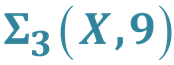
Idempotent and Regular Elements of the Complete Semigroups of Binary Relations of the Class
Barış Albayrak, Neşet Aydın
Çanakkale Onsekiz Mart University, Çanakkale, Turkey
Email: balbayrak77@gmail.com, neseta@comu.edu.tr
Copyright © 2015 by authors and Scientific Research Publishing Inc.
This work is licensed under the Creative Commons Attribution International License (CC BY).


Received 13 January 2015; accepted 1 February 2015; published 5 February 2015

ABSTRACT
In this paper, we take Q16 subsemilattice of D and we will calculate the number of right unit, idem- potent and regular elements α of BX (Q16) satisfied that V (D, α) = Q16 for a finite set X. Also we will give a formula for calculate idempotent and regular elements of BX (Q) defined by an X-semilattice of unions D.
Keywords:
Semilattice, Semigroup, Binary Relation

1. Introduction
Let X be a nonempty set and BX be semigroup of all binary relations on the set X. If D is a nonempty set of subsets of X which is closed under the union then D is called a complete X-semilattice of unions.
Let f be an arbitrary mapping from X into D. Then one can construct a binary relation
 on X by
 . The set of all such binary relations is denoted by
 and called a complete semi- group of binary relations defined by an X-semilattice of unions D.
We use the notations,
 ,
,
 ,
,
 ,
, .
.
A representation of a binary relation
 of the form
 is called quasinormal. Note that, if
 is a quasinormal representation of the binary relation
 , then
 for T,
 and
and .
.
A complete X-semilattice of unions D is an XI-semilattice of unions if
 for any
 and
and
 for any nonempty element Z of D.
Now,
 is said to be right unit if
 for all
 . Also,
 is idempotent if
 . And
. And
 is said to be regular if
 for some
 .
.
Let D', D'' be complete X-semilattices of unions and
 be a one-to-one mapping from D' to D''. A mapping
 is a complete isomorphism provided
 for all nonempty subset D1 of the se-
milattice D'. Besides that, if
 is a complete isomorphism where
 ,
,
 for all
 ,
,
 is said to be a complete
 -isomorphism.
Let Q and D' be respectively some XI and X-subsemilattices of the complete X-semilattice of unions D. Then

where
 complete isomorphism and
 . Besides, let us denote
 and
and

where


This structure was comprehensively investigated in Diasamidze [1] .
Lemma 1. [1] If Q is complete X-semilattice of unions and
 is the set all right units of the semigroup
 then
then .
.
Lemma 2. [2] Let X be a finite set, D be a complete X-semilattice of unions and
 be X-subsemilattice of unions of D satisfies the following conditions

Q is XI-semilattice of unions.
Theorem 1. [2] Let X be a finite set and Q be XI-semilattice. If
 is
is
 -iso- morphic to Q and
 , then

Theorem 2. [2] Let
 be a quasinormal representation of the form
 such that
 .
.
 is a regular iff for some complete
 -isomorphism
 , the following conditions are satisfied:

Let X be a finite set and
 be a complete X-semilattice of unions which satisfies the following conditions

The diagram of the D is shown in Figure 1. By the symbol
 we denote the class of all complete X- semilattice of unions whose every element is isomophic to an X-semilattice of the form D.
All subsemilattice of
 are given in Figure 2.
In Diasamidze [1] , it has shown that subsemilattices 1 - 15 are XI-semilattice of unions and subsemilattices 17 - 24 are not XI-semilattice of unions. In Yeşil Sungur [3] and Albayrak [4] , they have shown that subsemilattices 25 and 26 are XI-semilattice of unions if and only if ”. Also they found that number of right unit, idempotent and regular elements in subsemilattices.
In this paper, we take in particular,
 subsemilattice of D. We will calculate the number of right unit, idempotent and regular elements
 of
of
 satisfied that
 for a finite set X. Also we will give a formula for calculate idempotent and regular elements of
 defined by an X-semilattice of unions
 .
.

Figure 1. Diagram of D.
2. Results
Let
 be complete X-subsemilattice of D satisfies the following conditions

The diagram of the Q16 is shown in Figure 3. From Lemma 2 Q16 is XI-semilattice of unions.
Let
 denote the set of all XI-subsemilattice of the semilattice D which are isomorphic of the X-semi- lattice Q16. Then we get

Let
 be a idempotent element having a quasinormal representation of the form

Figure 2. All subsemilattice of D.

Figure 3. The diagram of the Q16.
 , such that
 . First we calculate number of this idempotent elements in
 .
.
Lemma 3. If X is a finite set and
 is the set all right units of the semigroup
 , then the number
 may be calculated by formula:

Proof. From Lemma 1 we have
 where
where
 is identity mapping of the set Q16.
For this reason
 in Theorem 1. Then we obtain

Theorem 3. If X is a finite set and
 is the set all idempotent elements of the semigroup
 , then the number
 may be calculated by formula:

Proof. By using Lemma 3 we have number of right units of the semigroup
 defined by
 for
for . Then number of idempotent elements of
 calculated
by formula . By using

we obtain above formula.

Now we will calculate number of regular elements
 having a quasinormal representation of the
form
 such that
 . Let
. Let
 be the set all regular elements of the
semigroup . By using
 we get
 . The number of all automorphisms of the semilattice Q16 is q = 4. These are

Then . Also by using

we get .
.
Theorem 4. If X is a finite set and
 is the set all regular elements of the semigroup
 , then the number
 may be calculated by formula:

Proof. To account for the elements that are in , we first subtract out intersection of
 ’s. Let
 . By using Theorem 2 and


We get
 which is a contradiction with
 ,
,
 ,
,
 ,
,
 are dis- joint sets. Then
 . Smilarly
 for
for . Thus we obtain

From Theorem 1 we get above formula.

Corollary 1. If X is a finite set, ID is the set all idempotent elements of the semigroup
 and RD is the set all regular elements of the semigroup
 , then the number
 and
and
 may be calculated by formula:

Proof. Let ID be the set of all idempotent elements of the semigroup . Then number of idempotent element of
 is equal to sum of idempotent elements of the subsemigroup defined by XI-subsemilattice of D.
 is given in Diasamidze [1] for
 . From Theorem 3 we have number of idempotent elements of the subsemigroup
 . Then the number
 may be calculated by formula
 . Similarly the number
 may be calculated by formula
 .
.

References
- Diasamidze, Ya. and Makharadze, Sh. (2013) Complete Semigroups of Binary Relations. Kriter Yayınevi, İstanbul, 524 p.
- Albayrak, B., Aydin, N. and Diasamidze, Ya. (2013) Reguler Elements of the Complete Semigroups of Binary Relations of the Class
![]() . International Journal of Pure and Applied Mathematics, 86, 199-216. http://dx.doi.org/10.12732/ijpam.v86i1.13
. International Journal of Pure and Applied Mathematics, 86, 199-216. http://dx.doi.org/10.12732/ijpam.v86i1.13 - Yeşil Sungur, D. and Aydin, N. (2014) Reguler Elements of the Complete Semigroups of Binary Relations of the Class
![]() . General Mathematics Notes, 21, 27-42.
. General Mathematics Notes, 21, 27-42. - Albayrak, B., Aydin, N. and Yeşil Sungur, D. (2014) Regular Elements of Semigroups
![]() Defined by the Generalized X-Semilattice. General Mathematics Notes, 23, 96-107.
Defined by the Generalized X-Semilattice. General Mathematics Notes, 23, 96-107.
 . International Journal of Pure and Applied Mathematics, 86, 199-216.
  . General Mathematics Notes, 21, 27-42.
 Defined by the Generalized X-Semilattice. General Mathematics Notes, 23, 96-107.