

Applied Mathematics
Vol.05 No.15(2014), Article ID:48599,15 pages
10.4236/am.2014.515219
Precise Asymptotic Distribution of the Number of Isolated Nodes in Wireless Networks with Lognormal Shadowing
Department of Mathematics, Sciences and Technology, Paine College, Augusta, USA
Email: lwang@paine.edu, ArgumedoA@paine.edu, WashingtonW@paine.edu
Copyright © 2014 by authors and Scientific Research Publishing Inc.
This work is licensed under the Creative Commons Attribution International License (CC BY).
http://creativecommons.org/licenses/by/4.0/



Received 1 June 2014; revised 5 July 2014; accepted 18 July 2014
ABSTRACT
In this paper, we study the connectivity of multihop wireless networks under the log-normal shadowing model by investigating the precise distribution of the number of isolated nodes. Under such a realistic shadowing model, all previous known works on the distribution of the number of isolated nodes were obtained only based on simulation studies or by ignoring the important boundary effect to avoid the challenging technical analysis, and thus cannot be applied to any practical wireless networks. It is extremely challenging to take the complicated boundary effect into consideration under such a realistic model because the transmission area of each node is an irregular region other than a circular area. Assume that the wireless nodes are represented by a Poisson point process with density n over a unit-area disk, and that the transmission power is properly chosen so that the expected node degree of the network equals , where
  approaches to a constant
  as
as . Under such a shadowing model with the boundary effect taken into consideration, we proved that the total number of isolated nodes is asymptotically Poisson with mean
 . The Brun’s sieve is utilized to derive the precise asymptotic distribution. Our results can be used as design guidelines for any practical multihop wireless network where both the shadowing and boundary effects must be taken into consideration.
Keywords:
Connectivity, Asymptotic Distribution, Random Geometric Graph, Isolated Nodes, log-Normal Shadowing

1. Introduction
Connectivity is one of the most fundamental properties of multi-hop wireless networks. It is the premise for enabling a network with proper functions. The path-loss model (also known as the unit-disk communication model) of wireless networks assumes that the received signal strength at a receiving node from a transmitting node is only determined by a deterministic function of the Euclidean distance between the two nodes. Under such a simple communication model, two nodes are directly connected if and only if their Euclidean distance is no more than a given threshold, and network connectivity has been well studied in the literature (e.g., [1] -[7] ). However, in reality, the received signal strength often shows probabilistic variations induced by the shadowing effects that are unavoidably caused by different levels of clutter (e.g., ubiquitous background noises and obstructions such as buildings and trees) on the propagation path. In order to better capture physical reality, the variations of the received signal strength should be considered. It has been shown that a more accurate and realistic modeling of the physical layer is indeed important for better understanding of wireless multi-hop network characteristics [8] [9] . This generalized radio propagation model is referred to as the log-normal shadowing model which has been widely used in the literature [10] - [15] . The generalized shadowing model provides a good abstraction of large scale wireless multi-hop networks, and is a realistic model for many types of wireless multihop network applications such as sensor wireless networks for bush fire monitoring, ocean temperature monitoring, volcano monitoring, etc.
The study of multihop wireless networks with the log-normal shadowing model can date back to the early of 1980s [11] [12] . Under such a realistic model, researchers have investigated fundamental problems related to network connectivity such as the largest connected component in the network, the relation between having a connected network and having no isolated node, etc. [10] [13] - [15] . But most of the known results on network connectivity were obtained only based on simulation studies or ignoring the important boundary effect to avoid the challenging technical analysis under, and thus cannot be applied to any practical wireless networks. It is extremely challenging to take the complicated boundary effect into consideration under such a realistic shadowing model because the transmission area of each node is an irregular region other than a circular area. To the best of our knowledge, under such a realistic shadowing model, there are no theoretical results obtained by rigorous analytical studies in multihop wireless networks when the important boundary effect is taken into consideration.
In this paper, we assume that the wireless networking nodes are represented by a Poisson point process with density  over a unit-area disk
  on the plane
 , and that the transmission power is properly chosen so that the expected node degree of the network is equal to
 , where
  approaches to some constant
  as
as . We derive the precise asymptotic distribution of the number of isolated nodes in the network under the log-normal shadowing model, taking the complicated boundary effect into consideration. The Brun’s sieve is utilized to derive the precise asymptotic distribution.
The vanishing of isolated nodes is not only a prerequisite but also a good indication of network connectivity. Under the path-loss model, it is well-known that the probability of having a connected network equals the probability of having no isolated nodes in the network as the node density  (see Penrose [16] ). With the log- normal shadowing model, such a result is predicted and has been verified by simulation studies (see Bettstetter et al. [10] ). Therefore, it is of importance to study the asymptotic distribution of the number of isolated nodes in the network under such a realistic shadowing model. The results obtained in this paper can be used as design guidelines for any practical multihop wireless network where both the shadowing and boundary effects must be taken into consideration.
In what follows,  is the origin of the Euclidean plane
 , and
, and  is the unit-area disk centered at
 . We assume that
  is the Poisson point process over
  with density
 . The Euclidean norm of a point
  is denoted by
 , and the Euclidean distance between two points
  and
and  is denoted by
 . The Lebesgue measure (or area) of a measurable set
  is denoted by
 . The disk of radius
  centered at
  is denoted by
 .
.
The remaining of this paper is organized as follows. In Section 2, we give a literature review for related work of our paper. The log-normal shadowing model is introduced and explained in Section 3. In Section 4, we give some definitions and geometric results that will be used to prove the main result of this paper. In Section 5, we derive the precise asymptotic distribution of the number of isolated nodes in the network under the log-normal shadowing model. Finally, we conclude our paper in Section 6.
2. Related Work
Under the unit-disk communication model, network connectivity has been extensively studied, and a huge number of existing research work are available in the literature [1] - [7] . Gupta et al. [3] showed that if each node uses the transmission radius

where  is a positive parameter depending only on
 , then the network is connected a.a.s. if and only if
 , assuming the
  nodes are uniformly distributed in a disk on the plane.
 closest neighbors if the network is to be connected as
 , assuming that the
  nodes are randomly and uniformly distributed in a unit square on the plane. Phillips et al. in [4] provided a necessary condition on the average node degree (i.e. the expected number of neighbors of an arbitrary node) required for connectivity and showed that the average node degree must grow logarithmically with the area of the network to ensure that the network is connected, assuming that the networking nodes are represented by a Poisson point process with density
  in the plane.
The log-normal shadowing model is a much more realistic radio propagation model and has been widely used by many researchers for network connectivity [10] [13] - [15] . Hekmat et al. investigated in [13] the largest connected component in wireless ad-hoc networks through simulations, where the  nodes are uniformly distributed in a bounded region on the plane. In this paper the authors proposed a formula to evaluate the size of the largest connected component on average. In [10] , Bettstetter et al. investigated a relation between the probability of having a connected network and the probability of having no isolated node, where the wireless devices are represented by a Poisson point process with density
 . The authors verified by using simulation that the two probabilities are approximately equal when
  is sufficiently large. In [14] , Mukherjee et al. studied the probability distribution for the minimal number of hops required to connect an arbitrary source node to a destination node by ignoring the complicated boundary effect. Through simulation studies, Stuedi et al. investigated in [15] how the transmission range affects the end-to-end connection probability in a log-normal shadowing model and compared the results to theoretical bounds and measurements in the path-loss model. In [18] , with the complicated boundary effect taken into consideration, Wang et al. first derived an explicit formula for the expected number of the isolated nodes in the network under such a realistic shadowing model, then obtained an upper and a lower bound for the critical transmission power to ensure that the vanishing of isolated nodes is asymptotically almost sure (abbreviated as a.a.s.). The upper and lower bounds for the critical transmission power obtained in [18] are almost tight.
Most of the results in these known works were obtained only based on simulation studies or ignoring the important boundary effect to avoid the rigorous analysis by assuming the toroidal metric as done in the literature. To the best of our knowledge, there are no theoretical results on asymptotic distribution of the number of isolated nodes in the network obtained by rigorous analytical studies with the realistic log-normal shadowing model when the complicated boundary effect is taken into consideration.
3. The Log-Normal Shadowing Model
With the path-loss model, the received power levels decrease as the distance between the transmitter and the receiver increases. Attenuation of radio signals due to path-loss effect has been modelled by averaging the measured signal power over long times and distances around the transmitter. The averaged power at any given distance  to the transmitter is referred to as the area mean power
 . Based on the path-loss model, the area mean power
  is expressed as

where  is a constant depending on the receiver and transmitter antenna gains and the wavelength,
  is the transmission power used by each node,
  is the path-loss exponent which indicates the rate at which the received signal strength decreases with distance, and
  is a close-in reference distance such that
  for any two nodes
  and
and  in the network. The value of
  depends only on the environment and terrain structure and can vary between 2 in free space and
 and
and  depend on the density
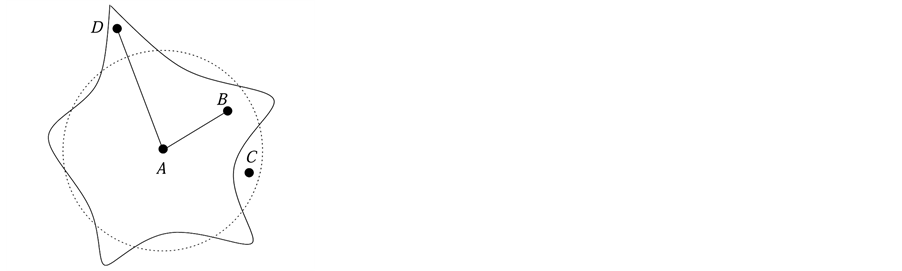
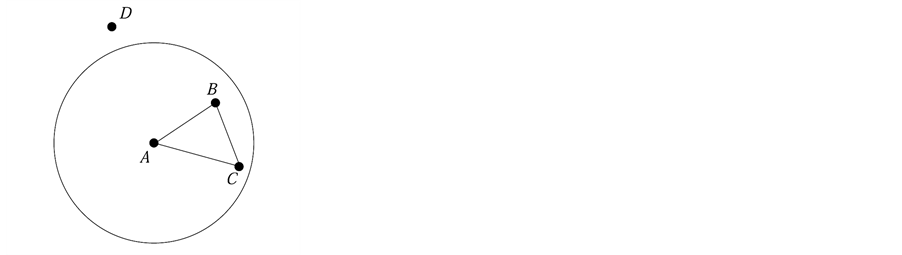
 . Under the path-loss model, the communication range of each node is a perfect circular disk (see Figure 1(a)). The node
  can directly communicate with all other nodes that are within its communication range.
But the path-loss model could be inaccurate because in reality the received power levels may show significant variations around the area mean power value. Due to these variations, short links could disappear while long links could merge. The log-normal shadowing model allows for random power variations around the area mean power. With the log-normal shadowing model, the received mean power taken over all possible locations that are at distance  to the transmitter is equal to the area mean power. However, it is further assumed that the time averaged received power varies from location to location in an apparently random manner [19] .
Assume that links are symmetric and the received power at node  from node
  is equal to the received power at node
  from node
  For any given Euclidean distance
  let
let  denote the received power strength between any two nodes separated by the distance
  under the log-normal shadowing model. The basic assumption in this realistic shadowing model is that the logarithm of
  is normally distributed around the logarithm of the area mean power
 . That is,
 (1)
(1)
where  is a zero-mean Gaussian (normal) distributed random variable (in dB) with standard deviation
  (also in dB). The standard deviation
  is a nonnegative value and, in case of severe signal fluctuations due to irregularities in the surroundings of the receiving and transmitting antennas, measurements indicates that it can be as high as 12 dB [20] .
For any two nodes separated by the Euclidean distance , there exists a link between them if and only if the received power
  under such a model is not less than some given threshold
  (also in dB milliwatts) that is assumed to be a constant in this paper, i.e.
 (2)
(2)
And we say that any two nodes are directly connected if and only if there exists a link between them.
Define  as the Euclidean distance where the area mean power
  is equal the given threshold power
  That is,
  Then
Then
 (3)
(3)
If both sides of Equation (1) minus  since
since 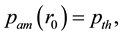 we have

Then Equation (2) is equivalent to
 (4)
(4)
Thus for any two nodes separatedy the Euclidean distance  let
let  denote the probability that there is a link between the two nodes. Then
 (5)
(5)
When  there is no shadowing (i.e.,
 ). Then

Thus, any two nodes are directly connected if and only if their Euclidean distance is at most . In such a case, the channel model is reduced to the simple unit-disk communication model and
  is the maximum transmission radius of each node.
When , the existence of a link is determined by both a deterministic function of the link length r and the shadowing effect represented by
 . The transmission area of each node is no longer a circular area under the log-normal shadowing model. Under the log-normal shadowing model, the communication range of each node is an irregular region other than a circular area (see Figure 1(b)). In this figure, the node
  is closer to node A than node D, the nodes A and D are directly connected, but the nodes A and C are not because of the shadowing effect between the nodes A and C. In real applications, σ is larger than zero, hence, the communication model with shadowing is more realistic than that without shadowing.
The following lemma demonstrates how the probability  changes when the link length
 , or the density
  or the transmission power
  changes.
Lemma 1. When  and
and  are fixed, the probability
  decreases as
  increases; when
  and
and  are fixed, the probability
  increases as
  increases.
Proof. According to Equation (5),  is fixed when
  and
and  are fixed, since
  increases as
  increases, it is easy to see that the probability
  is a decreasing function of the link length
 , which accords with intuition. When the density
  and the link length
  are fixed, as
  increases,
  increases and
  decreases. Therefore, the probability
  increases as
  increases, which also accords with intuition. Thus, the lemma is proved.
4. Preliminaries
In this section, we shall give some definitions that will be used to prove our main result of this paper. The results in this section are purely geometric, with no probabilistic content. Let  be the maximum transmission radius of the nodes. For any finite set of nodes
  in
in , we use
  to denote the
  -disk graph over
  in which there is an edge between two nodes if and only if their Euclidean distance is at most
 . For any positive integers
  and
and  with
with , let
, let  denote the set of
  satisfying that
  has exactly
  connected components.
For the given maximum transmission radius r, the unit-area disk  is partitioned into three regions,
  ,
,
 and
and  as shown in Figure 2:
  is the disk of radius
  centered at the origin;
  is the annulus of radii
  and
and  centered at the origin; and
  is the annulus of radii
  and
and  centered at the origin.
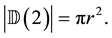
Then we have


 (a) (b)
Figure 1. (a) Unit-disk communication model; (b) Log-normal shadowing model.
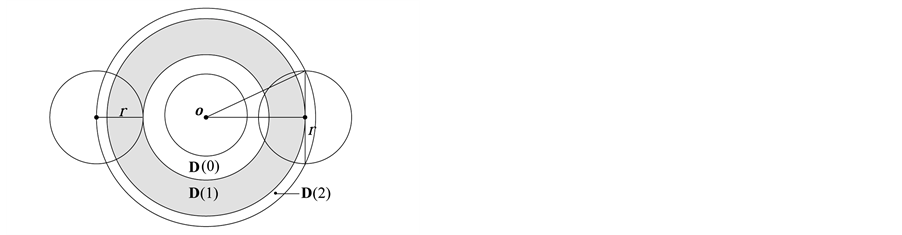
Figure 2. Partition of the unit-area disk .
.
5. Precise Asymptotic Distribution of the Number of Isolated Nodes
In this section, we assume that all the nodes transmit at a uniform power . We derive the precise asymptotic distribution of the number of isolated nodes in the network under the log-normal shadowing model with the complicated boundary effect taken into consideration.
We use the same notations as in Section 3. Recall that  denotes the probability that any two nodes separated by the distance
  are directly connected. Then by Equation (5), we have
 (6)
(6)
Let
 (7)
(7)
Refer to the discussions in [10] and [21] ,  is actually the expected node degree of the network. By Equations (6) and (7)
 (8)
(8)
Based on our assumptions,  is a function of
  and
and  (see Equation (3)). Therefore,
  depends only on
  and
and . When
  is fixed, it is easy to see that the value of
  increases as
  increases from Equation (8).
Let
 (9)
(9)
Then, when  is fixed,
  also increases as
  increases.
In this paper, we make the following two assumptions:
1)  has bounded support w.r.t.
  i.e., there is a positive parameter
  (depending only on
  and
and ) such that
 (10)
(10)
2) the transmission power  is properly chosen so that
  for some constant
  (including
 ).
).
The main theorem of this paper is stated below:
Theorem 2. Under the two assumptions given above, the total number of the isolated nodes in the network is asymptotically Poisson with mean 
Remarks. If the probability  (i.e., the shadowing model is reduced to the path-loss model), then Equation (9) is reduced to
 (11)
(11)
where  is the minimal transmission radius of each node (determined by the minimal transmission power) required for connectivity of multihop wireless networks under the path-loss model (see Gupta et al. [3] or Penrose [16] ).
If the probability  for some constant
  (i.e., the shadowing model is reduced to the unreliable link model used in [22] with all nodes active and
 ), then Equation (9) is reduced to

where  is the maximum transmission radius of each node used to derive the precise asymptotic distribution of the number of isolated nodes in the network with the unreliable link model defined in [22] . Therefore, our Theorem 2 above is the generalization of the main theorem in [22] to the more realistic lognormal shadowing model.
Theorem 2 will be proved by using the Brun’s sieve in the form described, for example, in [23] , Chapter 8, which is an implication of the Bonferroni inequalities.
Theorem 3. (Brun’s sieve) Let  be a positive integer parameter. Suppose that
  is a non- negative integer random variable depending on
 , and
, and  are
are 
 . Assume that for any subset
  we have

If there is a constant  such that for every fixed positive integer
 ,
,

then  is asymptotically Poisson with mean
  (with respect to
 ).
).
To apply Theorem 3, let  denote the event that the random point
  is isolated for
  and
and  be the number of
  that holds. Then
  is exactly the total number of isolated nodes. Clearly, for any subset

Therefore, in order to prove Theorem 2, it is sufficient to show that for any fixed positive integer  when the conditions of Theorem 2 hold, we have
 (12)
(12)
The proof of this asymptotic equation will use the following lemmas.
Lemma 4. Assume the conditions of Theorem 2 hold. Then there exist a sufficiently large constant  and a sufficiently small constant
  (both independent of
 ) satisfying that the probability
for all 
Proof. We prove the lemma by contradiction and assume the contrary is true. Then for any arbitrarily large  and any arbitrarily small
  such that
  as
as  there is an
  (with
(with 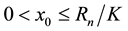 ) satisfies that
 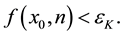 Since
Since  is a decreasing function of
  we have
  for all
  Note that
  Then by Equation (7), for any fixed
  we have
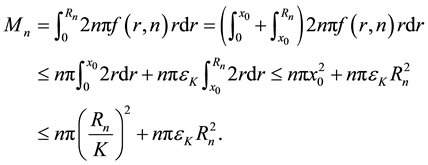
The above inequality holds for any arbitrarily large  when
when  is fixed. Fix
  and let
  we have
  Therefore,
  This contradicts with Equation (9). Therefore, the lemma is proved.
The following lemma shows that  has the order
  when the conditions of Theorem 2 hold.
Lemma 5. Assume the conditions of Theorem 2 hold. Then we have  and
and

where  and
and  are the two constants obtained in Lemma 4.
Proof. Note that  By Equation (9) and Equation (7),

By Lemma 4, there exist a sufficiently large constant  and a sufficiently small constant
(both independent of ) satisfying that
  for all
  Thus, we have

Thus, the lemma is proved.
Next we introduce a lemma that has only one event involved and has been proved in [18] (see Equation (10) and Equation (12) in [18] ).
Lemma 6. For any  we have

If  then
then
 (13)
(13)
Lemma 7. For any  and
and 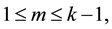 there is a constant
  such that for any
  we have

Proof. First we prove the lemma holds when  and
and  Let
Let 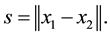 Then
Then  We consider two cases:
Case 1.  Let
Let  denote the event that
  does not have links to nodes in
  Then
Then

It remains to show that there is a constant  such that

For any  let
let  denote the angle of the arc of
  not contained in
  Since
Since  is increasing w.r.t.
  we have

Let

Apply the same approach in deriving the probability for  (see Equation (10) and Equation (12) in [18] ), we have

Case 2.  We only consider the nodes in
  Divide this disk by
  concentric circles with
center  and radii
  as we did in [18] . Since
  is a decreasing function of
  we have

Note that the inequality still holds for annuli not fully contained in  Therefore,
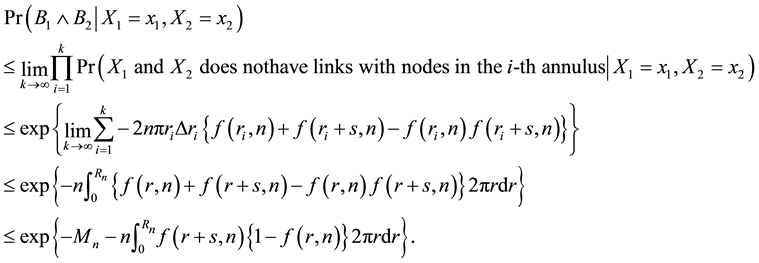
For any  we have
  Let
Let

Then

Thus,

The lemma holds for the constant 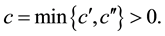 Thus, the lemma is proved when
  and
and .
.
When , for any
  since there always exist two overlapping disks (the distance between the two
centers is at most ) in the components
  the lemma can be proved by following similar steps
as the case for .
.
Next we assume 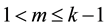 and
and  For any
  the set
  is parti- tioned into exactly
  subsets
 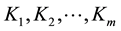 such that for each
  the subgraph of
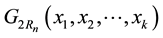 induced by only the nodes in
  forms a connected component. Let
  for each
 and let
 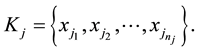 Then we have

Since at least one  for each
 , we have

Thus, the lemma is proved.
Now we are ready to prove the asymptotic Equation (12). The proof of this asymptotic equation is divided into three lemmas. The case for  is proved in Lemma 8. The case for any
  and
and 
 will be proved in Lemma 9. The case for any
  and
and  will be verified in Lemma 10. Thus, the asymptotic Equation (12) holds for any
  since
since 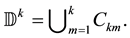
Lemma 8. 
Proof.
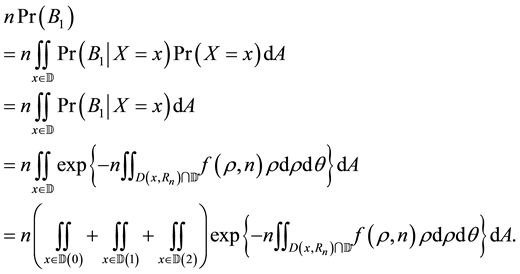
We will prove
 (14)
(14)
 (15)
(15)
 (16)
(16)
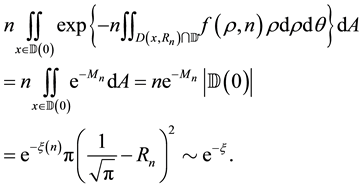
For the integral over  by Equation (13) we have
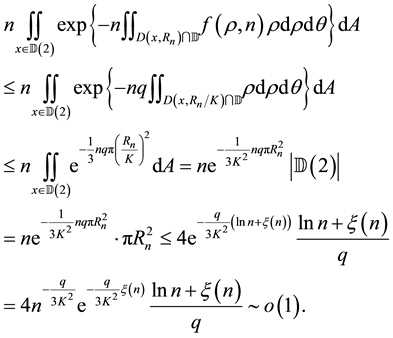
For the integral over  by Equation (13) we have
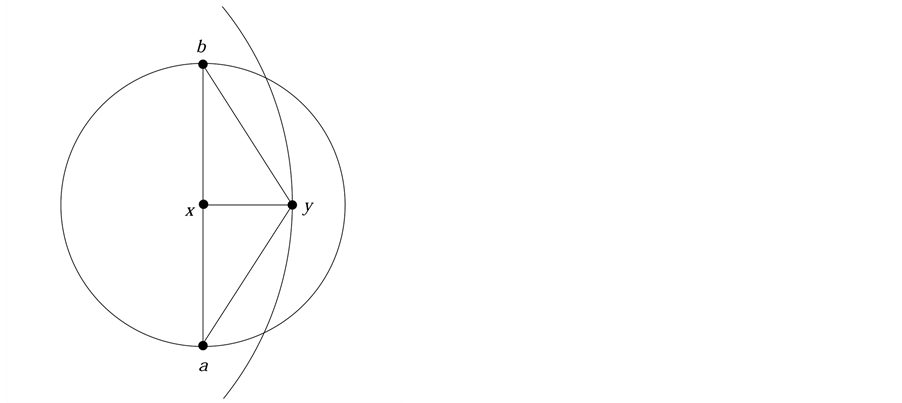
Next we calculate the integral over  For any
  let
let  be the point on
  such that
  and
and  the diameter perpendicular to
  (see Figure 3). Let
  denote the half disk contained in
 . Then
 (17)
(17)
Therefore, by Equation (7) and Equation (17)
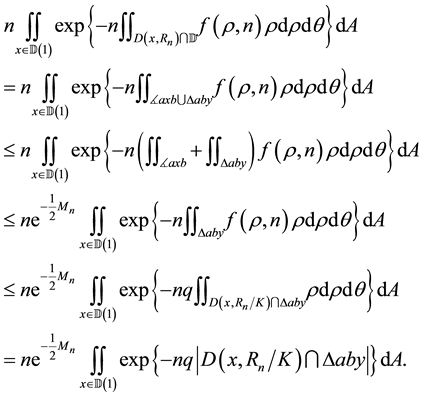
To complete the proof of the lemma, it is sufficient to prove that this integral over  is asymptotically vanishing as
 . We consider two cases.
Case 1.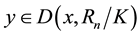 . Then

Thus,

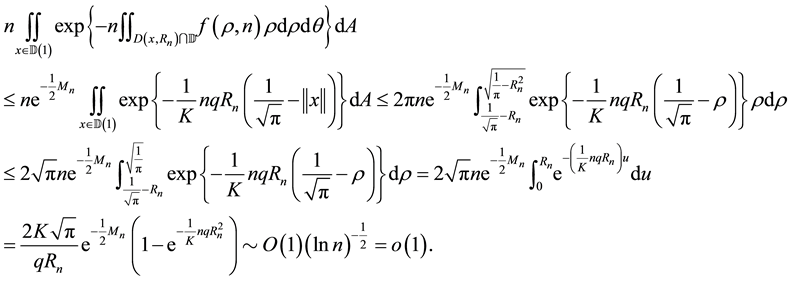
The last equation holds since  by Lemma 5.
Case 2. . Then

Thus,
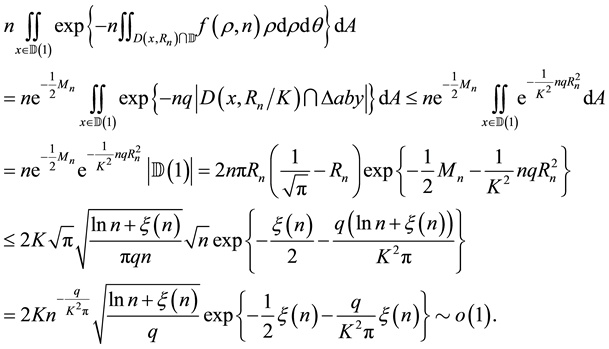
Therefore, the lemma is proved.
Lemma 9. For any  and
and 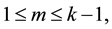 we have

Proof. By Equations (15) and (16), it is straightforward to verify that the lemma holds when
 for some
  Therefore, we only need to consider the case when
We first prove the case when  For any
 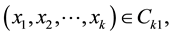 the
the  -disk graph
 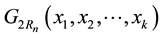 has exactly one connected component. That is, the graph
 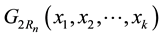 is connected. Assume that the points
 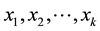 is listed in the increasing order of the graph distances from
  to
to 
 Then
Then
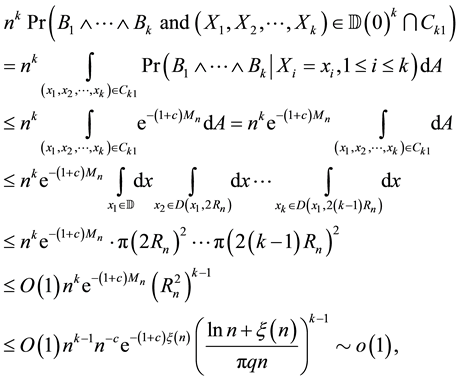
where the second last equation holds from Lemma 5.
Next we assume 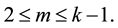 For any
  the set
  is partitioned into exactly
  subsets
 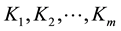 such that for each
  the subgraph of
 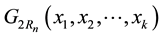 induced by only the nodes in
  forms a connected component. Let
  for each
  and let
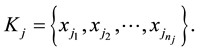 Then we have
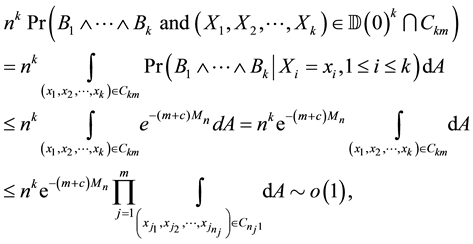
where the last equation holds by following the similar arguments as the case 
This completes the proof of the lemma.
Lemma 10. For any  we have

Proof. For any 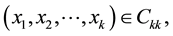 the
the  disks
disks  are disjoint. Thus,
 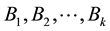 are independent. Therefore,
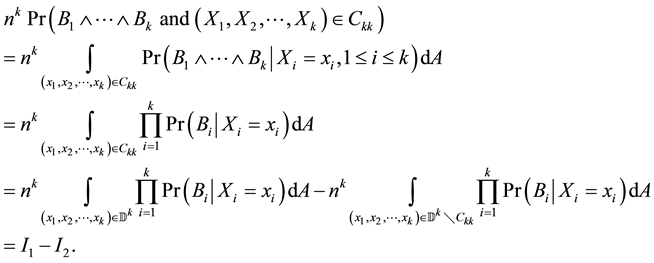
Next we calculate the two integrals  and
and  separately.
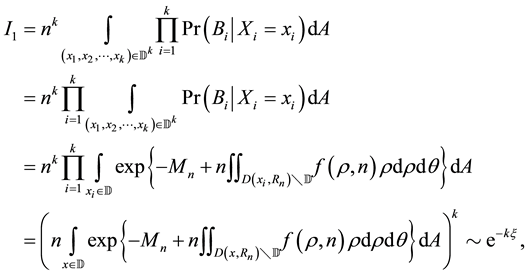
the last equation holds by following the same steps as we used in the proof of Lemma 8.
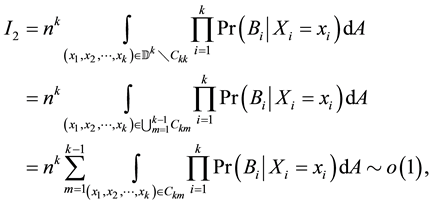
where the last equation holds from Lemma 9.
This completes the proof of the lemma.
6. Conclusion
In this paper, we assume that the wireless nodes are represented by a Poisson point process with density n over a unit-area disk, and that the transmission power is properly chosen so that the expected node degree of the network equals , where
  approaches to a constant
  as
as . We also assume that the probability that a pair of nodes separated by a Euclidean distance
  are directly connected has bounded support w.r.t
 . Under the log-normal shadowing model with the boundary effect taken into consideration, we proved that the total number of isolated nodes is asymptotically Poisson with mean
 .
.
Acknowledgements
The work of
Cite this paper
LixinWang,AlbertoArgumedo,WilliamWashington, (2014) Precise Asymptotic Distribution of the Number of Isolated Nodes in Wireless Networks with Lognormal Shadowing. Applied Mathematics,05,2249-2263. doi: 10.4236/am.2014.515219
References
- 1. Bettstetter, C. (2004) On the Connectivity of Ad Hoc Networks. The Computer Journal, 47, 432-447.
http://dx.doi.org/10.1093/comjnl/47.4.432 - 2. Bettstetter, C. (2002) On the Minimum Node Degree and Connectivity of a Wireless Multihop Network. 3rd ACM International Symposium on Mobile Ad Hoc Networking and Computing, Lausanne, 80-91.
http://dx.doi.org/10.1145/513800.513811 - 3. Gupta, P. and Kumar, P. (1998) Critical Power for Asymptotic Connectivity in Wireless Networks. Stochastic Analysis, Control, Optimization and Applications, 547-566.
- 4. Philips, T.K., Panwar, S.S. and Tantawi, A.N. (1989) Connectivity Properties of a Packet Radio Network Model. IEEE Transactions on Information Theory, 35, 1044-1047.
http://dx.doi.org/10.1109/18.42219 - 5. Wan, P.-J. and Yi, C.-W. (2004) Asymptotic Critical Transmission Radius and Critical Neighbor Number for k-Connectivity in Wireless Ad Hoc Networks. MobiHoc 2006, Roppongi, 1-8.
- 6. Xue, F. and Kumar, P. (2004) The Number of Neighbors Needed for Connectivity of Wireless Networks. Wireless Networks, 10, 169-181.
http://dx.doi.org/10.1023/B:WINE.0000013081.09837.c0 - 7. Yi, C.-W., Wan, P.-J., Li, X.-Y. and Frieder, O. (2006) Asymptotic Distribution of the Number of Isolated Nodes in Wireless Ad Hoc Networks with Bernoulli Nodes. IEEE Transactions on Communications, 54.
- 8. Takai, M., Martin, J. and Bagrodia, R. (2001) Effects of Wireless Physical Layer Modeling in Mobile Ad Hoc Networks. ACM International Symposium on Mobile Ad Hoc Networking and Computing (MobiHoc), Long Beach.
- 9. Zorzi, M. and Pupolin, S. (1995) Optimum Transmission Ranges in Multihop Packet Radio Networks in the Presence of Fading. IEEE Transactions on Communications, 43, 2201-2205.
http://dx.doi.org/10.1109/26.392962 - 10. Bettstetter, C. and Hartmann, C. (2005) Connectivity of Wireless Multihop Networks in a Shadow Fading Environment. Wireless Networks, 11, 571-579.
http://dx.doi.org/10.1007/s11276-005-3513-x - 11. Bernhardt, R.C. (1987) Macroscopic Diversity in Frequency Reuse Systems. IEEE Journal of Selected Areas in Communications SAC, 5, 862-878.
http://dx.doi.org/10.1109/JSAC.1987.1146594 - 12. Cox, D.C., Murray, R. and Norris, A. (1984) 800 MHz Attenuation Measured in and around Suburban Houses. AT & T Bell Laboratory Technical Journal, 63, 921-954.
http://dx.doi.org/10.1002/j.1538-7305.1984.tb00030.x - 13. Hekmat, R. and Mieghem, P.V. (2006) Connectivity in Wireless Ad-Hoc Networks with a Log-Normal Radio Model. Mobile Networks and Applications, 11, 351-360.
http://dx.doi.org/10.1007/s11036-006-5188-7 - 14. Mukherjee, S. and Avidor, D. (2005) On the Probability Distribution of the Minimal Number of Hops between Any Pair of Nodes in a Bounded Wireless Ad-Hoc Network Subject to Fading. International Workshop on Wireless Ad-Hoc Networks (IWWAN), London.
- 15. Stuedi, P., Chinellato, O. and Alonso, G. (2005) Connectivity in the Presence of Shadowing in 802.11 Ad Hoc Networks. IEEE Wireless Communications and Networking Conference, 2225-2230.
- 16. Penrose, M. (1997) The Longest Edge of the Random Minimal Spanning Tree. The Annals of Applied Probability, 7, 340-361. http://dx.doi.org/10.1214/aoap/1034625335
- 17. Penrose, M. (1999) A Strong Law for the Longest Edge of the Minimal Spanning Tree. The Annals of Applied Probability, 27, 246-260.
http://dx.doi.org/10.1214/aop/1022677261 - 18. Wang, L. and Baker, A.J. (2013) Critical Power for Vanishing of Isolated Nodes in Wireless Networks with Log-Normal Shadowing. IEEE MASS 2013, Hangzhou.
- 19. Bertoni, H. (2000) Radio Propagation for Modern Wireless Systems. Prentice Hall PTR, New Jersey.
- 20. Rappaport, T.S. (2001) Wireless Communications: Principles and Practice. 2nd Edition, Prentice Hall PTR, New Jersey.
- 21. Meester, R. and Roy, R. (1996) Continuum Percolation. Cambridge University Press, Cambridge.
http://dx.doi.org/10.1017/CBO9780511895357 - 22. Yi, C.-W., Wan, P.-J., Lin, K.-W. and Huang, C.-H. (2006) Asymptotic Distribution of the Number of Isolated Nodes in Wireless Ad Hoc Networks with Unreliable Nodes and Links. IEEE GLOBECOM.
- 23. Alon, N. and Spencer, J.H. (2000) The Probabilistic Method. 2nd Edition, Wiley, New York.
http://dx.doi.org/10.1002/0471722154