

Journal of Applied Mathematics and Physics
Vol.03 No.09(2015), Article ID:59717,12 pages
10.4236/jamp.2015.39141
Hall Effect on Peristaltic Flow of Third Order Fluid in a Porous Medium with Heat and Mass Transfer
Nabil T. M. Eldabe, Ahmed Y. Ghaly, Sallam N. Sallam, Khaled Elagamy, Yasmeen M. Younis
Department of Mathematics, Faculty of Education, Ain Shams University, Cairo, Egypt
Email: Mohamed.unis@yahoo.com
Copyright © 2015 by authors and Scientific Research Publishing Inc.
This work is licensed under the Creative Commons Attribution International License (CC BY).
http://creativecommons.org/licenses/by/4.0/



Received 1 July 2015; accepted 15 September 2015; published 18 September 2015
ABSTRACT
We investigated the influence of hall, heat and mass transfer on the peristaltic flow of MHD third order fluid under long-wavelength and low Reynolds number approximation. The governing equations are solved analytically with the appropriate boundary conditions by using perturbation technique. The formula of velocity with temperature and concentration is obtained analytically as a function of the physical parameters of the problem.
Keywords:
Peristaltic Flow, Third Order Fluid, Hall Effect, Heat, Mass Transfer

1. Introduction
Many fluids in biological system are transported by peristalsis. The word peristalsis stems from the Greek word peristaltikos, which means clasping and compressing. Physically, it means the mechanism for pumping fluid in a tube by means of a moving contractile ring around the tube, which pushes the material onward. The need for peristaltic pumping may arise in circumstances where it is desirable to avoid using any internal moving parts such as pistons to be one of the main mechanisms of fluid transport in a biological system. The application of peristaltic motion as a mean of transporting fluid has aroused interested in engineering fields. Latham [1] was probably the first to study the mechanism of peristaltic pumping in his M. S. Thesis. Several researches have analyzed the phenomenon of peristaltic transport under various assumptions. Haroun [2] studied the effect of a third-order fluid on the peristaltic transport in an asymmetric channel. In his study, the wavelength of the peristaltic waves is assumed to be large compared to the varying channel width, whereas the wave amplitudes need not be small compared to the varying channel width. Eldabe et al. [3] analyzed the incompressible flow of electrically conducting biviscosity fluid through an axisymmetric nonuniform tube with a sinusoidal wave under the considerations of long wavelength and low Reynolds number.
In the last years, several simple flow problems of classical hydrodynamics have received new attention in the more general context magnetohydrodynamics (MHD). The study of the motion of non-Newtonian fluids in the presense of the magnetic field has applications in many devices such as magneto hydrodynamic (MHD) power generator, MHD pumps, bioengineering devices and accelerators. Also it has been established that the biological systems are greatly affected by the application of the external magnetic field. Moreover, the MHD flow of a fluid in a channel with elastic, rhythmically contracting walls (peristaltic flow) is of interest in connection with certain problems of the movement of conductive physiological fluids. Some recent investigations made to discuss the mechanism of MHD include the works. Hayat et al. [4] studied the peristaltic transport of a third order fluid under the effect of a magnetic field. Srinivas and Kothandapani [5] have studied the influence of heat and mass transfer on MHD peristaltic flow through a porous space with compliant walls. Another important aspect in MHD is related to Hall effect. Such effect cannot be overlooked when flow subject to high magnetic field is considered. Siddiqui et al. [6] studied effects of Hall current and heat transfer on MHD flow of a Burgers fluid due to a pull of eccentric rotating disks. Hall effects on peristaltic flow of a Maxwell fluid in a porous medium have been studied by Hayat et al. [7] studied effects of Hall current and heat transfer on rotating flow of a second grade fluid through a porous medium. Khalid Nowar [8] studied Peristaltic Flow of a Nanofluid under the effect of Hall Current and Porous Medium.
The study of the influence of mass and heat transfer on non-Newtonian fluids has become important in the last few years. This importance is due to number of industrial processes. Examples are food processing, biochemical operations and transport in polymers, biomedical engineering; micro fabrication technologies etc., besides these biological tissues with heat transfer involve modes like heat conduction in tissues, heat convection by blood flow through the pores of tissue and radiation heat transfer between surface and its environment. Motivated by such facts, the peristaltic flow with heat transfer has been explored. El-Dabe et al. [9] studied magnetohydrodynamic flow and heat transfer for a peristaltic motion of carreau fluid through a porous medium. El-Dabe et al. [10] studied Peristaltic Motion of Non-Newtonian Fluid with Heat and Mass Transfer through a Porous Medium in Channel under Uniform Magnetic Field. El-Dabe et al. [11] analyzed the Magnetohydrodynamic Peristaltic motion with heat and mass transfer of a Jeffery fluid in a tube through porous medium.
With the above discussion in mind, we propose to study the peristaltic motion of non-Newtonian fluid through a porous medium in the channel under the effect of magnetic field. A third order non-Newtonian constitutive model is employed for the transport fluid. The effects of hall, body temperature and concentration are taken into consideration. The governing equations of motion, energy, and concentration have been reduced under the assumption of long wavelength. The reduced equations are then solved analytically via perturbation method. The physical behaviors of emerging parameters are discussed through graphs.
2. Mathematical Analysis
Consider a two-dimensional channel of uniform thickness , filled with incompressible homogeneous electrically conducting non-Newtonian third order fluid through a porous medium with heat and mass transfer. The channels walls are considered and flexible the vertical displacements for the upper and lower walls are
  and
and , see Figure 1, where
  is defined by
 (1)
(1)
where In the above equation  is the wave amplitude,
  is the wave length and
  is the time. A uniform magnetic field with magnetic flux density vector
  is applied, neglecting the induced magnetic field under the assumption that the magnetic Reynolds number is small, the expression for the current density
  including the Hall effect and neglecting ion-slip and thermoelectric effects is given by
 (2)
(2)
where  is the electric conductivity of the fluid is,
  is the velocity vector, It is also assumed that
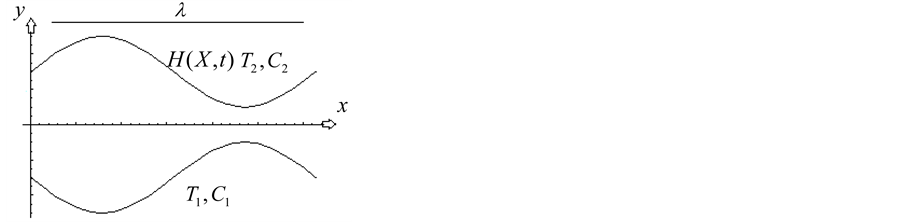
Figure 1. Sketch of the problem.
(since there is no applied polarization voltage),  is the Hall parameter,
  is the electric charge and
 is the number of density of electron. The constitutive equation for the non-Newtonian third order fluid can be written as in [4] .
Consider
 (3)
(3)
 (4)
(4)
Here  is the extra stress tensor,
  is the indeterminate part of the stress due to the constraint of incompressibility and
  are the Rivlin-Ericksen tensors, defined by
 (5)
(5)
where grad denotes the gradient operator,  the material time derivative,
  is the coefficient of shear vis-
cosity, the normal stress coefficients  and
and , and the coefficient
 ,
,
 (6)
(6)
The fundamental equations governing this model together with the generalized Ohm’s law taking the effects of Hall currents and Maxwell’s equations into account are
 (7)
(7)
 (8)
(8)
 (9)
(9)
 (10)
(10)
where  is the density of the fluid is,
  is the pressure,
  is the specific heat capacity at constant pressure,
  is the temperature,
  is the thermal conductivity,
  is the dissipation function,
  is the radiative heat flux,
  is the concentration of the fluid,
  is the coefficient of mass diffusivity,
  is the thermal diffusion ratio,
  is the mean fluid temperature and
  is the reaction rate constant.
By using Rosselant approximation we have
 (11)
(11)
where  is the Stefan Boltizman constant and
  is the mean absorption coefficient. We assume that the temperature differences within the flow are sufficiently small such that
  may be expressed as a linear function of temperature. This is accomplished by expanding
  in a Taylor series about
 , and neglecting higher order terms, we get

The equations governing the two-dimensional motion of this model (7)-(10)
 (12)
(12)
 (13)
(13)
 (14)
(14)
where
 (15)
(15)
 (16)
(16)
and
 (17)
(17)
where  is the velocity components in fixed frame of reference
The dissipation function  can be written as follows
 (18)
(18)
 (19)
(19)
 (20)
(20)
 (21)
(21)
The appropriate boundary conditions taken as follows:
 (22)
(22)
Consider a wave frame  which moving with speed
 . Coordinates and velocity components in wave frame are related by the following transformations
 (23)
(23)
In which  are components of the velocity in the moving coordinates system.
Then, the system of Equations (12)-(22) can be written as:
 (24)
(24)
 (25)
(25)
 (26)
(26)
where
 (27)
(27)
 (28)
(28)
And
 (29)
(29)
 (30)
(30)
 (31)
(31)
The boundary conditions become:
 (32)
(32)
We introduce the following non-dimensional quantities:
 (33)
(33)
where the non-dimensional wave number , the Reynolds number
 , the material coefficients are
 , Deborh number is
 , Darcy number is
 ,
,  is the Hartman number,
  is the Prandtl number,
  is the Eckert number,
  is the Radiation parameter,
  is the Schmidt number,
  is the Soret number and
  is the Chemical reaction parameter.
Substituting (33) into Equations (24)-(32) we obtain the following non-dimensional equations:
 (34)
(34)
 (35)
(35)
 (36)
(36)
where
 (37)
(37)
 (38)
(38)
and
 (39)
(39)
 (40)
(40)
 (41)
(41)
With conditions:
 (42)
(42)
We also note that  represents the dimensionless form of the surface of the peristaltic wall.
 (43)
(43)
where,  is the amplitude ratio or the occlusion
under the assumptions of long wavelength . The Equations (35)-(42) take the following form:
 (44)
(44)
 (45)
(45)
 (46)
(46)
 (47)
(47)
 (48)
(48)
 (49)
(49)
 . (50)
Eliminating  from Equations (44) and (45), we have the following equation
 (51)
(51)
 where
where  is a constant.
3. Series Solution
For perturbation solution we write
 (52)
(52)
Substituting (52) in the Equations (45)-(49), equating the coefficients of like powers of , we get the following
Zeroth order system:
 (53)
(53)
 (54)
(54)
 (55)
(55)
The subjected boundary conditions are:
 (56)
(56)
First order system
 (57)
(57)
 (58)
(58)
 (59)
(59)
 (60)
(60)
The solution of zero order system can be obtained analytically as
 (61)
(61)
 (62)
(62)
 (63)
(63)
Also, the solution of first order system can be obtained analytically as
 (64)
(64)
 (65)
(65)
 (66)
(66)
where




4. Results and Discussion
In order to obtain the physical insight of the problem, velocity, temperature and concentration are computed numerically for different values of the emerging parameters, viz., Darcy number is ,
,  is the Hartman number,
  is the Prandtl number,
  is the Eckert number and
 is the Radiation parameter using Mathematica and are presented in Figures 2-10.
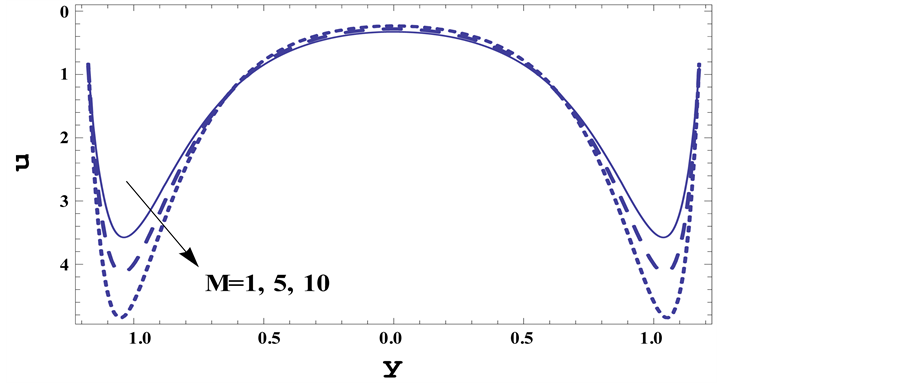
Figure 2. Velocity profiles  for varying values of
 .
.
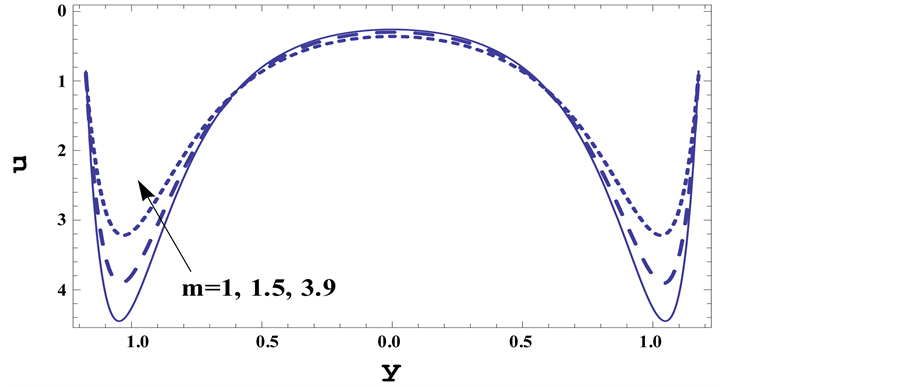
Figure 3. Velocity profiles  for varying values of
 .
.
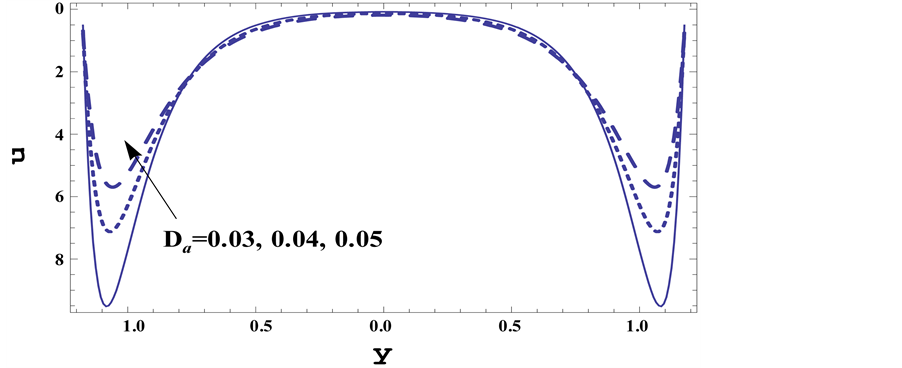
Figure 4. Velocity profiles  for varying values of
 .
.
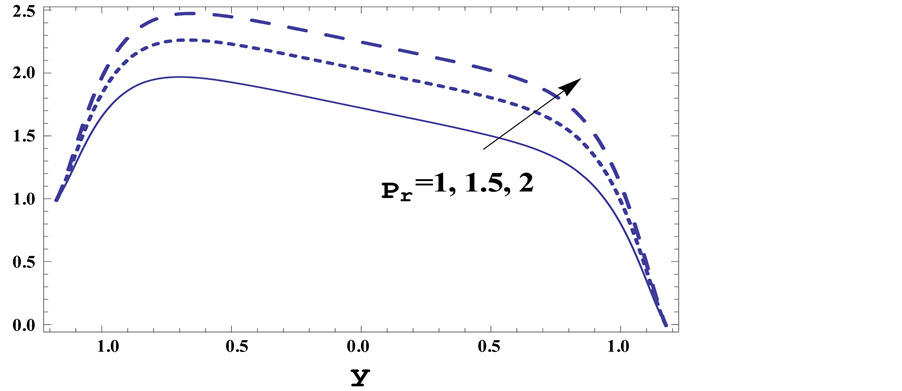
Figure 5. Temperature profiles  for varying values of
 .
.
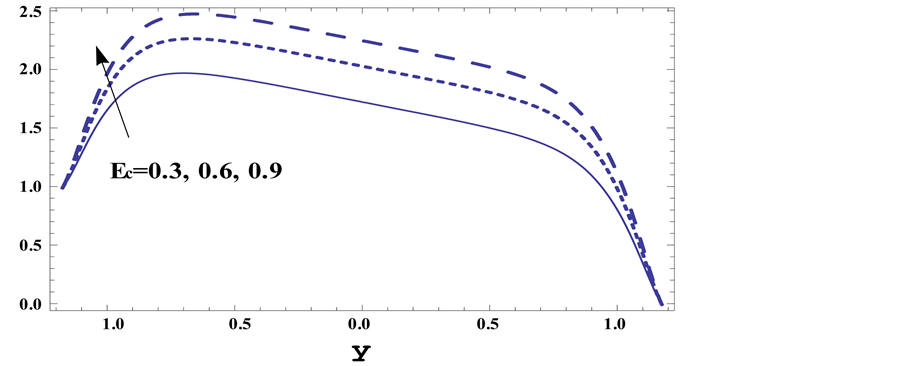
Figure 6. Temperature profiles  for varying values of
 .
.
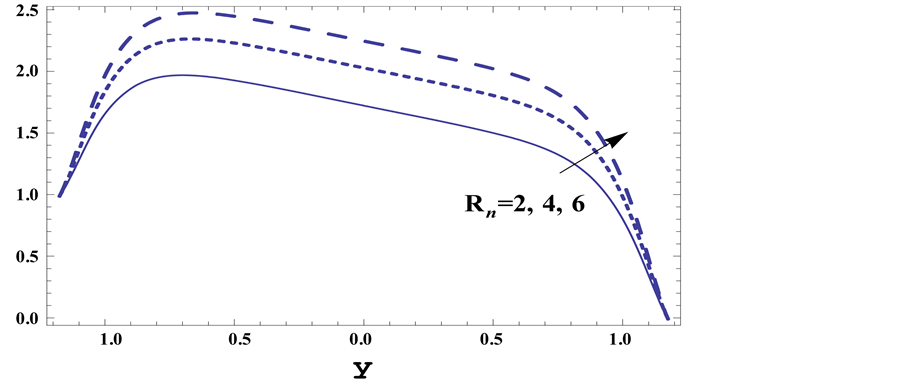
Figure 7. Temperature profiles  for varying values of
 .
.

Figure 8. Concentration profiles  for varying values of
 .
.
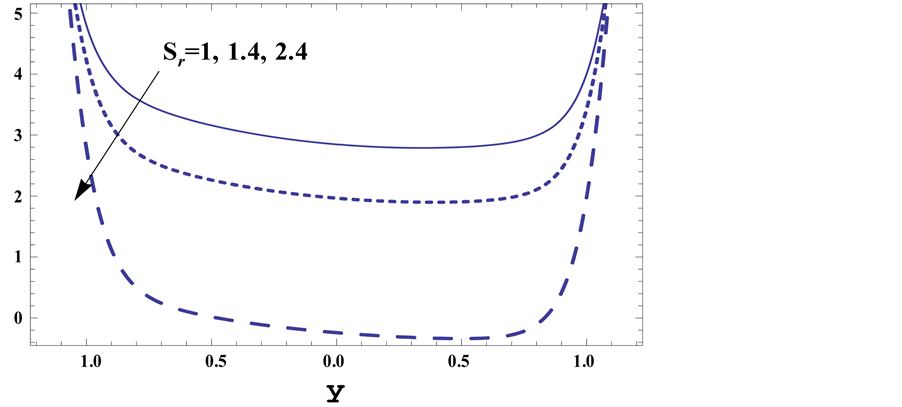
Figure 9. Concentration profiles  for varying values of
 .
.
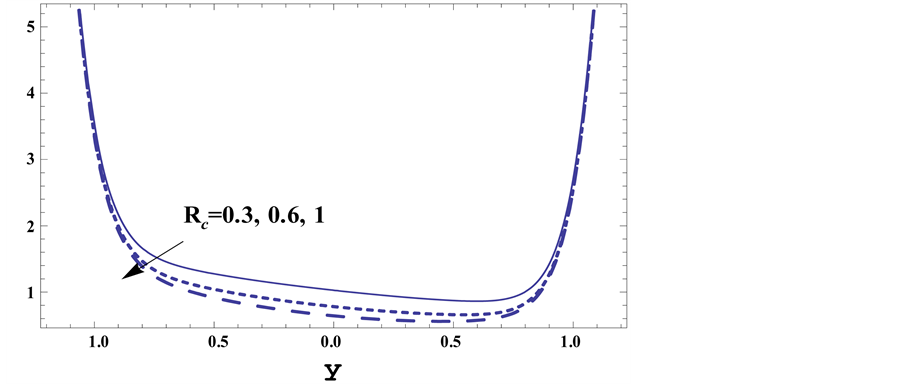
Figure 10. Concentration profiles  for varying values of
 .
.
Figure 2 presents the effect of Hartman number  on the velocity. It is noted that the velocity increases by increasing the Hartman number in the interval [−0.6, 0.6] and vice versa in the other intervals.
Figure 3 shows the effect of the Hall parameter m on the velocity. It is observed that as m increases the velocity decreases in the interval [−0.6, 0.6] and vice versa in the other intervals.
Figure 4 shows the effect of Darcy parameter  against the velocity. It is found that the velocity decreases by the increasing of
  in the interval [−0.6, 0.6] and vice versa in the other intervals.
Figures 5-7 describe the effect of different parameters on the temperature distribution . It is found that the temperature increases as the Prandtle number
  increases this is shown in Figure 5, also in Figure 6 it is observed that the temperature increases as the Eckert number
  increases. In Figure 7 the temperature increases as the Radiation parameter
  increases.
Figures 8-10 display results for the concentration  profiles. It is clear that the concentration decreases as the Schmidt number
  increases this is shown in Figure 8, also in Figure 9 and Figure 10 the concentration decreases as the Soret number
 , Chemical reaction parameter
  respectively.
5. Conclusions
In this paper, we studied the effects of the physical parameters of the considered problem on peristaltic transport in a tube, filled with an incompressible non-Newtonian (Third order) fluid, and considered the effects of hall current, body temperature and concentration. The system is solved analytically by perturbation technique. The effects of various emerging parameters on the flow, the temperature and the concentration distributions are shown and discussed with the help of graphs. The main findings can be summarized as follows.
1) The velocity decreases in the interval [−0.6, 0.6] and vice versa in the other intervals with the increase of each of  and
and , whereas it increases as
  increase.
2) The temperature  increases with the increase of each of as the Prandtle number
 , the Eckert number and the Radiation parameter
 .
.
3) The concentration decreases as the Schmidt number , the Soret number
  and Chemical reaction parameter
  increases.
Caption of Figures
Figure 2 the velocity profiles are plotted versus  for different values of
  for a system have the particu-
lars .
.
Figure 3 the velocity profiles are plotted versus  for different values of
  for a system have the particu-
lars .
.
Figure 4 the velocity profiles are plotted versus  for different values of
  for a system have the parti-
culars .
.
Figure 5 the temperature profiles are plotted versus  for different values of
  for a system have the par-
ticulars .
.
Figure 6 the temperature profiles are plotted versus  for different values of
  for a system have the
particulars .
.
Figure 7 the temperature profiles are plotted versus  for different values of
  for a system have the
particulars .
.
Figure 8 The concentration profiles are plotted versus  for different values of
  for a system have the
particulars .
.
Figure 9 the concentration profiles are plotted versus  for different values of
  for a system have the
particulars .
.
Figure 10 the concentration profiles are plotted versus  for different values of
  for a system have the
particulars .
.
Cite this paper
Nabil T. M.Eldabe,Ahmed Y.Ghaly,Sallam N.Sallam,KhaledElagamy,Yasmeen M.Younis, (2015) Hall Effect on Peristaltic Flow of Third Order Fluid in a Porous Medium with Heat and Mass Transfer. Journal of Applied Mathematics and Physics,03,1138-1150. doi: 10.4236/jamp.2015.39141
References
- 1. Latham, T.W. (1966) Fluid Motions in a Peristaltic Pump, M.S. Thesis, M.I.T., Cambridge.
- 2. Haroun, M.H. (2007) Effect of Deborah Number and Phase Difference on Peristaltic Transport of a Third-Order Fluid in an Asymmetric Channel. Communications in Nonlinear Science and Numerical Simulation, 12, 1464-1480.
http://dx.doi.org/10.1016/j.cnsns.2006.03.002 - 3. Eldabe, N.T.M., El-Sayed, M.F., Ghaly, A.Y. and Sayed, H.M. (2007) Peristaltically Induced Transport of a MHD Biviscosity Fluid in a Non-Uniform Tube. Physica A, 383, 253-266.
http://dx.doi.org/10.1016/j.physa.2007.05.027 - 4. Hayat, T., Afsar, A., Khan, M. and Asghar, S. (2007) Peristaltic Transport of a Third Order Fluid under the Effect of a Magnetic Field. Computers and Mathematics with Applications, 53, 1074-1087.
http://dx.doi.org/10.1016/j.camwa.2006.12.014 - 5. Srinivas, S. and Kothandapani, M. (2009) The Influence of Heat and Mass Transfer on MHD Peristaltic Flow through a Porous Space with Compliant Walls. Applied Mathematics and Computation, 213, 197-208.
http://dx.doi.org/10.1016/j.amc.2009.02.054 - 6. Siddiqui, A.M., Rana, M.A. and Ahmed, N. (2008) Effects of Hall Current and Heat Transfer on MHD Flow of a Burgers’ Fluid Due to a Pull of Eccentric Rotating Disks. Communications in Nonlinear Science and Numerical Simulation, 13, 1554-1570.
http://dx.doi.org/10.1016/j.cnsns.2006.10.005 - 7. Hayat, T., Abbas, Z. and Asghar, S. (2008) Effects of Hall Current and Heat Transfer on Rotating Flow of a Second Grade Fluid through a Porous Medium. Communications in Nonlinear Science and Numerical Simulation, 13, 2177-2192.
http://dx.doi.org/10.1016/j.cnsns.2007.03.033 - 8. Nowar, K. (2014) Peristaltic Flow of a Nanofluid under the Effect of Hall Current and Porous Medium. Mathematical Problems in Engineering, 2014, 1-15.
http://dx.doi.org/10.1155/2014/389581 - 9. Eldabe, N.T.M., Fouad, A. and Hussein, M.M. (2010) Magnetohydrodynamic Flow and Heat Transfer for a Peristaltic Motion of Carreau Fluid through a Porous Medium. Journal of Mathematics, 42, 1-16.
- 10. Eldabe, N.T.M., Agoor, M. and Alame, H. (2014) Peristaltic Motion of Non-Newtonian Fluid with Heat and Mass Transfer through a Porous Medium in Channel under Uniform Magnetic Field. Journal of Fluids, 2014, 1-12.
http://dx.doi.org/10.1155/2014/525769 - 11. Eldabe, N.T.M., Sallam, N.S., Mohamed, M.A.A, Abo Zaid, M.Y. and Abd-Elmonem, A. (2011) Magnetohydrodynamic Peristaltic Motion with Heat and Mass Transfer of a Jeffery Fluid in a Tube through Porous Medium. Innovative Systems Design and Engineering, 264-275.