

Advances in Pure Mathematics
Vol.06 No.12(2016), Article ID:72165,6 pages
10.4236/apm.2016.612069
The Riemann Hypothesis-Millennium Prize Problem
A. A. Durmagambetov
Karaganda State University, Karagandy, Kazakhstan

Copyright © 2016 by author and Scientific Research Publishing Inc.
This work is licensed under the Creative Commons Attribution International License (CC BY 4.0).
http://creativecommons.org/licenses/by/4.0/



Received: October 3, 2016; Accepted: November 19, 2016; Published: November 22, 2016
ABSTRACT
This work is dedicated to the promotion of the results C. Muntz obtained modifying zeta functions. The properties of zeta functions are studied; these properties lead to new regularities of zeta functions. The choice of a special type of modified zeta functions allows estimating the Riemann’s zeta function and solving Riemann Problem- Millennium Prize Problem.
Keywords:
Euler, Chebyshev, Dirichlet, Riemann, Hypothesis, Zeta Function, Muntz, Function, Complex Numbers, Regular Function, Integral Function Representation, Millennium Prize Problem

1. Introduction
In this work we are studying the properties of modified zeta functions. Riemann’s zeta function is defined by the Dirichlet’s distribution
 (1)
absolutely and uniformly converging in any finite region of the complex z-plane, for which  If
 the function is represented by the following Euler product formula
 (2)
where p is all prime numbers.  was firstly introduced by Euler [1] in 1737, who decomposed it to the Euler product formula (2). Chebyshev [2] , studying the law of prime numbers distribution, had considered this function. However, the most profound properties of the function
 had only been discovered later, when the function had been considered as a function of a complex variable. In 1876 Riemann [3] was the first who showed that:
 allows analytical continuation on the whole z-plane in the following form
 (3)
where ―gamma function.
 .
 is a regular function for all values of z, except z = 1, where it has a simple pole with a deduction equal to 1, and satisfies the following functional equation
 (4)
This equation is called the Riemann’s functional equation.
The Riemann’s zeta function is the most important subject of study and has a plenty of interesting generalizations. The role of zeta functions in the Number Theory is very significant, and is connected to various fundamental functions in the Number Theory as Mobius function, Liouville function, the function of quantity of number divisors, and the function of quantity of prime number divisors. The detailed theory of zeta functions is showed in [4] . The zeta function spreads to various disciplines and now the function is mostly applied in quantum statistical mechanics and quantum theory of pole [5] [6] [7] . Riemann’s zeta function is often introduced in the formulas of quantum statistics. A well-known example is the Stefan-Boltzman law of a black body’s radiation. The given aspects of the zeta function reveal global necessity of its further investigation.
The most significant contribution to the study of zeta functions is found in the results obtained by Muntz [8] .
Muntz generalized all the results from the studies of zeta functions’ analytical properties. He noticed that all the properties can be integrated in one theory, which is called the Muntz theorem for zeta functions.
Our goal is to use this theorem on the analogs of zeta functions. We are interested in the analytical properties of the following generalizations of zeta functions:
 (5)
 (6)
 (7)
 (8)
where p are prime numbers. The forms of the given function (5)-(8) allow assuming that they possess the same properties as the zeta function (1), but it is not quite obvious, considering
 (9)
we see the necessity of analyzing (5)-(8) functions for a deeper understanding of the properties of zeta functions.
2. Results
These are the well-known results obtained by Muntz for the zeta function.
Theorem 1. Let the function  be limited on every finite interval and have an order

 is continuous and limited on every finite interval and has an order
 then this equation holds
 (10)
Let N be the set of all natural numbers and ―the set of all prime numbers greater than m,
 ―the set of all natural numbers without the prime numbers greater than m.
Below we will always let m > 3, this limitation is introduced only to simplify the calculations. Considering all the information above let us rewrite

For the function , let us apply the results obtained by Muntz for the zeta function representation. With the help of the given definitions we formulate the analog of Muntz theorem.
Theorem 2. Let the function F(x) be limited on every finite interval and have an order 
 is continuous and limited on every finite interval and has an order
 ,
 , then the following equation holds for the function
 Muntz formula is true.
 (11)
 (12)
PROOF: According to the theorem conditions we have
 (13)
After the substitution of variables nx = y we can rewrite
 (14)
The last steps are true and result from the theorem conditions and Weierstrass theorem of uniform convergence of improper integrals. Let us introduce the functions
 (15)
 (16)
 (17)
According to the theorem conditions we have
 (18)
Applying the theorem conditions we have
 (19)
Substituting the variablles of the last part
 (20)
Calculating we obtain the following
 (21)
According to the result above we obtain
 (22)
Using the properties of defined integrals and subintegral function positivity, we have
 (23)
 (24)
From the result above it follows that
 (25)
According to the Muntz theorem, we have
 (26)
Finally, after the substitution of variables we have
 (27)
From the last equation we obtain the Muntz formula. From which we have the regularity of the function  as z satisfied

Theorem 3. The Riemann’s function has nontrivial zeros only on the line ;
PROOF: For , we have
 (28)
Applying the Muntz formula from the theorem 2
 (29)
estimating by the module
 (30)
Estimating the zeta function, potentiating, we obtain
 (31)
According to the theorem 1  limited for z from the following multitude
 (32)
similarly, applying the theorem 2 for  we obtain its limitation in the same multitude. For the function
 we have a limitation for all z, belonging to the half-plane
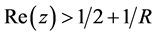 . Similarly, applying the theorem 2 for
 we obtain its limitation in the same multitude and finally we obtain:
 (33)
These estimations for  prove that zate function does not have zeros on the half-plane
 due to the integral representation (3) these results are projected on the half-plane
 for the case of nontrivial zeros. The Riemann’s hypothesis is proved.
3. Conclusion
In this work we obtained the estimation of the Riemann’s zeta function logarithm outside of the line  and outside of the pole z = 1. This work accomplishes all the works of the greatest mathematicians, applying their immense achievements in this field. Without their effort we could not even attempt to solve the problem.
Acknowledgements
The author thanks S.N. Baibekov for introducing the prime numbers to the proble- matics in the collective article [9] . Without this the work would be impossible.
Cite this paper
Durmagambetov, A.A. (2016) The Riemann Hypothesis-Mil- lennium Prize Problem. Advances in Pure Mathematics, 6, 915-920. http://dx.doi.org/10.4236/apm.2016.612069
References
- 1. Euler, L. (1988) Introduction to Analysis of the Infinite. Springer-Verlag, Berlin.
https:/doi.org/10.1007/978-1-4612-1021-4 - 2. Chebyshev, P.L. (1946) Selected Mathematical Works. Gostekhizdat, Moscow. [In Russian]
- 3. Riemann, G.F.B. (1972) On the Number of Prime Numbers Less than a Given Quantity. Chelsea, New York.
- 4. Titchmarsh, E.C. (1986) The Theory of the Riemann Zeta Function. 2nd Revised (Heath-Brown) Edition, Oxford University Press, Oxford.
- 5. Ray, D. and Singer, I.M. (1971) R-Torsion and the Laplacian on Riemannian Manifolds. Advances in Mathematics, 7, 145-210.
https:/doi.org/10.1016/0001-8708(71)90045-4 - 6. Bost, J.-B. (1987) Fibres determinants, determinants regularises et measures sur les espaces de modules des courbes complexes. Séminaire Bourbaki, 152-153, 113-149.
- 7. Kawagoe, K., Wakayama, M. and Yamasaki, Y. (2008) The q-Analogues of the Riemann zeta, Dirichlet L-Functions, and a Crystal Zeta-Function. Forum Mathematicum, 20, 126.
https:/doi.org/10.1515/FORUM.2008.001 - 8. Müntz, Ch.H. (1992) Beziehungen der Riemannschen ζ-Funktion zu willkurlichen reellen Funktionen. Matematisk Tidsskrift. B, 39-47.
- 9. Baibekov, S.N. and Durmagambetov. A.A. (2016) Infinitely Many Twin Primes.
arXiv:1609.04646 [math.GM]