

International Journal of Modern Nonlinear Theory and Application
Vol.05 No.01(2016), Article ID:64631,9 pages
10.4236/ijmnta.2016.51008
Global Attractors for a Class of Generalized Nonlinear Kirchhoff-Sine-Gordon Equation
Ruijin Lou, Penghui Lv, Guoguang Lin
Mathematical of Yunnan University, Kunming, China

Copyright © 2016 by authors and Scientific Research Publishing Inc.
This work is licensed under the Creative Commons Attribution International License (CC BY).
http://creativecommons.org/licenses/by/4.0/



Received 29 December 2015; accepted 14 March 2016; published 17 March 2016
ABSTRACT
In this paper, we consider a class of generalized nonlinear Kirchhoff-Sine-Gordon equation . By a priori estimation, we first prove the existence and uniqueness of solutions to the initial boundary value conditions, and then we study the global attractors of the equation.
Keywords:
Kirchhoff-Sine-Gordon Equation, The Existence and Uniqueness of Solutions, Priori Estimates, Global Attractors

1. Introduction
In 1883, Kirchhoff [1] proposed the following model in the study of elastic string free vibration:
 , where
  is associated with the initial tension, M is related to the material
properties of the rope, and  indicates the vertical displacement at the x point on the t. The equation is more accurate than the classical wave equation to describe the motion of an elastic rod.
Masamro [2] proposed the Kirchhoff equation with dissipation and damping term:
where  is a bounded domain of
  with a smooth boundary
 ; he uses the Galerkin method to prove the existence of the solution of the equation at the initial boundary conditions.
Sine-Gordon equation is a very useful model in physics. In 1962, Josephson [3] fist applied the Sine-Gordon equation to superconductors, where the equation: ,
,  is the two-order partial derivative of u with respect to the variable t;
  is the two-order partial derivative of the u about the independent variable x. Subsequently, Zhu [4] considered the following problem:
  (where
  is a bounded domain of
 ) and he proved the existence of the global solution of the equation. For more research on the global solutions and global attractors of Kirchhoff and sine-Gordon equations, we refer the reader to [5] -[11] .
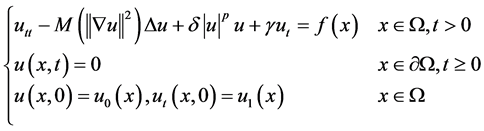
Based on Kirchhoff and Sine-Gordon model, we study the following initial boundary value problem:
 (1.1)
(1.1)
where  is a bounded domain of
  with a smooth boundary
 ;
;  is the dissipation coefficient;
  is a positive constant; and
  is the external interference. The assumptions on nonlinear terms
  and
and  will be specified later.
The rest of this paper is organized as follows. In Section 2, we first obtain the basic assumption. In Section 3, we obtain a priori estimate. In Section 4, we prove the existence of the global attractors.
2. Basic Assumption
For brevity, we define the Sobolev space as follows:


In addition, we define  and
and  are the inner product and norm of H.
Nonlinear function  satisfying condition (G):
(1) 
(2) 
(3) 
Function  satisfies the condition (F):
(4) 
(5) 
(6) 
(7) 
3. A Priori Estimates
Lemma 3.1. Assuming the nonlinear function  satisfies the condition (G)-(F),
  ,
,  , then the solution
  of the initial boundary value problem (1.1) satisfies
  and
and

where . Thus there exists a positive constant
  and
and , such that

Proof. Let , the equation
  can be transformed into
 (3.1)
(3.1)
Taking the inner product of the equations (3.1) with v in H, we find that
 (3.2)
(3.2)
By using Holder inequality, Young’s inequality and Poincare inequality, we deal with the terms in (3.2) one by as follows
 (3.3)
(3.3)
where  is the first eigenvalue of
  with Dirichlet boundary conditions on
 .
.
Since  and (F) (6), (7), we get
 (3.4)
(3.4)
and
 (3.5)
(3.5)
 (3.6)
(3.6)
where
 (3.7)
(3.7)
Combined (3.1)-(3.6) type, it follows from that
 (3.8)
(3.8)
According to condition (F) (5), this will imply , then,
 , and since
 (3.9)
(3.9)
that is
 (3.10)
With (3.10), (3.8) can be written as
 (3.11)
Set , and
, and , then (3.11) is equivalent to (3.12)
 (3.12)
where
 (3.13)
By using Gronwall inequality, we obtain
 (3.14)
Let .
.
So, we have
 (3.15)
then
 (3.16)
Hence, there exists  and
and , such that
 ■
■
Lemma 3.2. Assuming the nonlinear function  satisfies the condition (G)-(F),
  , then the solution
  of satisfies the initial boundary value problem (1.1) satisfies
  and
and

where . Thus there exists a positive constant
  and
and , such that

Proof. The equations (3.1) in the H and  have inner product, we find that
 (3.17)
By using Holder inequality, Young’s inequality and Poincare inequality, we get the following results
 (3.18)
 (3.19)
According to condition (F) (5), (6), we obtain
 (3.20)
 (3.21)
where
 (3.22)
By (3.18)-(3.22), (3.17) can be written
 (3.23)
Noticing , this will imply
 (3.24)
Substituting (3.24) into (3.23), we can get the following inequality
 (3.25)
Let , and
, and , then (3.25) type can be changed into
 (3.26)
then
 (3.27)
where .
.
By using Gronwall inequality, we obtain
 (3.28)
taking , we have
 (3.29)
then
 (3.30)
Hence, there exists  and
and , such that
 ■
■
Theorem 3.1. Assuming the nonlinear function  satisfies the condition (G)-(F),
  ,
,  , so the initial boundary value problem (1.1) exists a unique smooth solution
 .
.
Proof. By Lemma 3.1-Lemma 3.2 and Glerkin method, we can easily obtain the existence of solutions of equ-
ation , the proof procedure is omitted. Next, we prove the uniqueness of solutions in
detail.
Assume  are two solutions of equation, we denote
 , then, the two equations subtract and obtain
 (3.31)
We take the inner product of the above equations (3.31) with  in H, we have
 (3.32)
We deal with the terms in (3.32) one by as follows
 (3.33)
and
 (3.34)
By (3.32)-(3.34), we can get the following inequality
 (3.35)
Further, by mid-value theorem and Young’s inequality, we get
 (3.36)
Since ,
,
might as well set .
.

where .
.
Then, we obtain
 (3.37)
Substituting (3.36), (3.37) into (3.35), we can get
 (3.38)
Let , then (3.38) can be changed to
 (3.39)
By using Gronwall inequality, we obtain
 (3.40)
There has
 (3.41)
That show that .
.
So as to get , the uniqueness is proved. ■
4. Global Attractor
Theorem 4.1. [12] Set  be a Banach space, and
  are the semigroup operator on
 .
. ; here I is a unit operator. Set
  satisfy the follow conditions.
1)  is bounded, namely
 ; it exists a constant
 , so that

2) It exists a bounded absorbing set , namely,
 ; it exists a constant
 , so that

here  and B are bounded sets.
3) When ,
,  is a completely continuous operator.
Therefore, the semigroup operators S(t) exist a compact global attractor A.
Theorem 4.2. [12] Under the assume of Theorem 3.1, equations have global attractor

where ;
;  is the bounded absorbing set of
  and satisfies
(1) ;
;
(2) , here
  and it is a bounded set,
  .
.
Proof. Under the conditions of Theorem 3.1, it exists the solution semigroup S(t), here  .
.
(1) From Lemma 3.1-Lemma 3.2, we can get that  is a bounded set that includes in the ball
 ,
,

This shows that  is uniformly bounded in
 .
.
(2) Furthermore, for any , when
 , we have

So we get  is the bounded absorbing set.
(3) Since  is compact embedded, which means that the bounded set in
  is the compact set in
 , so the semigroup operator S(t) is completely continuous. ■
Hence, the semigroup operator S(t) exists a compact global attractor A. The proving is completed.
Acknowledgements
The authors express their sincere thanks to the anonymous reviewer for his/her careful reading of the paper, giving valuable comments and suggestions. These contributions greatly improved the paper.
Funding
This work is supported by the National Natural Sciences Foundation of People’s Republic of China under Grant 11161057.
Cite this paper
RuijinLou,PenghuiLv,GuoguangLin, (2016) Global Attractors for a Class of Generalized Nonlinear Kirchhoff-Sine-Gordon Equation. International Journal of Modern Nonlinear Theory and Application,05,73-81. doi: 10.4236/ijmnta.2016.51008
References
- 1. Kirchhof, G. (1883) Vorlesungen fiber Mechanik. Teubner, Stuttgarty.
- 2. Masamro, H. and Yoshio, Y. (1991) On Some Nonlinear Wave Equations 2: Global Existence and Energy Decay of Solutions. J. Fac. Sci. Univ. Tokyo. Sect. IA, Math., 38, 239-250.
- 3. Josephson, B.D. (1962) Possible New Effects in Superconductive Tunneling. Physics Letters, 1, 251-253.
http://dx.doi.org/10.1016/0031-9163(62)91369-0 - 4. Zhu, Z.W. and Lu, Y. (2000) The Existence and Uniqueness of Solution for Generalized Sine-Gordon Equation. Chinese Quarterly Journal of Mathematics, 15, 71-77.
- 5. Li, Q.X. and Zhong, T. (2002) Existence of Global Solutions for Kirchhoff Type Equations with Dissipation and Damping Terms. Journal of Xiamen University: Natural Science Edition, 41, 419-422.
- 6. Silva, M.A.J. and Ma, T.F. (2013) Long-Time Dynamics for a Class of Kirchhoff Models with Memory. Journal of Mathematical Physics, 54, Article ID: 021505.
- 7. Zhang, J.W., Wang, D.X. and Wu, R.H. (2008) Global Solutions for a Class of Generalized Strongly Damped Sine-Gordon Equation. Journal of Mathematical Physics, 57, 2021-2025.
- 8. Guo, L., Yuan, Z.Q. and Lin, G.G. (2014) The Global Attractors for a Nonlinear Viscoelastic Wave Equation with Strong Damping and Linear Damping and Source Terms. International Journal of Modern Nonlinear Theory and Application, 4, 142-152.
http://dx.doi.org/10.4236/ijmnta.2015.42010 - 9. Teman, R. (1988) Infiniter-Dimensional Dynamical Systems in Mechanics and Physics. Springer-Verlag, New York, 15-26.
http://dx.doi.org/10.1007/978-1-4684-0313-8_2 - 10. Ma, Q.F., Wang, S.H. and Zhong, C.K. (2002) Necessary and Sufficient Congitions for the Existence of Global Attractors for Semigroup and Applications. Indiana University Mathematics Journal, 51, 1541-1559.
http://dx.doi.org/10.1512/iumj.2002.51.2255 - 11. Ma, Q.Z., Sun, C.Y. and Zhong, C.K. (2007) The Existence of Strong Global Attractors for Nonlinear Beam Equations. Journal of Mathematical Physics, 27A, 941-948.
- 12. Lin, G.G. (2011) Nonlinear Evolution Equation. Yunnan University Press, 12.