

Journal of Applied Mathematics and Physics
Vol.04 No.03(2016), Article ID:65208,7 pages
10.4236/jamp.2016.43062
On Two Extension Formulas for Lauricella’s Function of the Second Kind of Several Variables
Ahmed Ali Atash1, Ahmed Ali Al-Gonah2
1Department of Mathematics, Faculty of Education-Shabwah, Aden University, Aden, Yemen
2Department of Mathematics, Faculty of Education-Aden, Aden University, Aden, Yemen

Copyright © 2016 by authors and Scientific Research Publishing Inc.
This work is licensed under the Creative Commons Attribution International License (CC BY).
http://creativecommons.org/licenses/by/4.0/



Received 1 February 2016; accepted 27 March 2016; published 30 March 2016
ABSTRACT
The aim of this research paper is to derive two extension formulas for Lauricella’s function of the second kind of several variables with the help of generalized Dixon’s theorem on the sum of the series  obtained by Lavoie et al. [1] . Some special cases of these formulas are also deduced.
Keywords:
Extension Formulas, Lauricella’s Function, Dixon’s Theorem, Hypergeometric Functions

1. Introduction
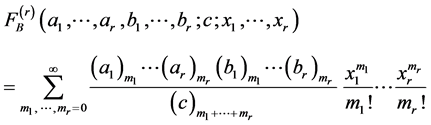
The Lauricella’s function  is defined and represented as follows [2]
 (1.1)
(1.1)
 ;
;
where  denotes the Pochhammer’s symbol defined by
 (1.2)
(1.2)
 (1.3)
(1.3)
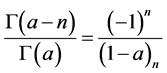
Also, we note that
 (1.4)
(1.4)
 (1.5)
(1.5)
 (1.6)
(1.6)
 (1.7)
(1.7)
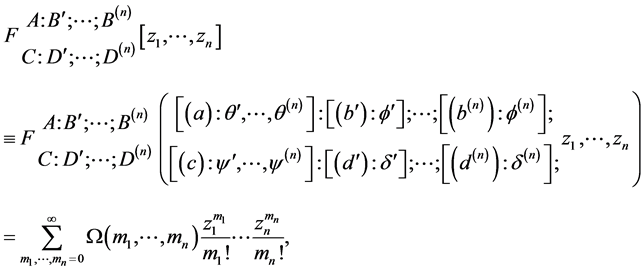
The generalized Lauricella’s function of several variables is defined as follows [2]
 (1.8)
(1.8)
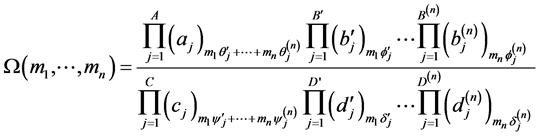
where
 (1.9)
(1.9)
the coefficients  for all
 are real and positive;
  abbreviates the array of A parameters;
  abbreviate
the array of  parameters
  for all
  with similar inter pretations for
  and
and 
 . Note that, when the coefficients in Equation (1.8) equal to 1, the generalized Lauricella function (1.8) reduces to the following multivariable extension of the Kamp’e de F’eriet function [2] :
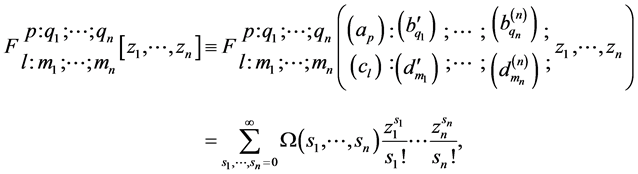 (1.10)
where
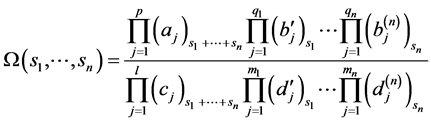 . (1.11)
In the theory of hypergeometric series, classical summation theorems such as Dixon, Watson and Whipple for the series , have many generalizations and wide applications; see for example [1] [3] - [6] . In the present investigation, we shall require the following generalization of the classical Dixon’s theorem for the series
  [1] :
[1] :
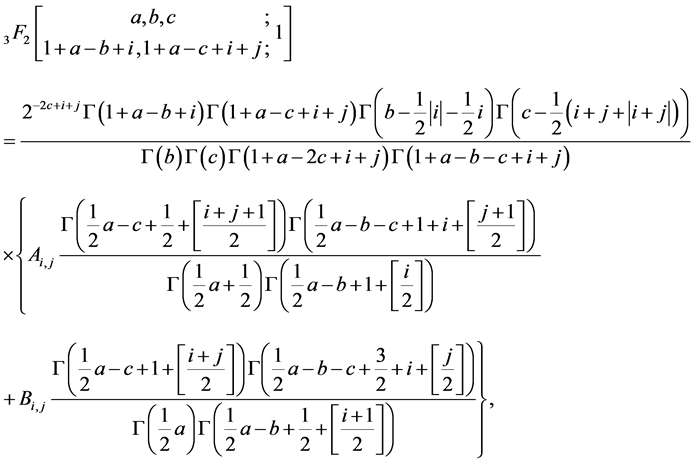 (1.12)
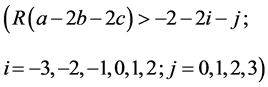 ,
,
where  denotes the greatest integer less than or equal to x and
  denotes the usual absolute value of x. The coefficients
  are given respectively in [1] . When
 , (1.12) reduces immediately to the classical Dixon's theorem [3] , (see also [6] )
 (1.13)

2. Extension Formulas
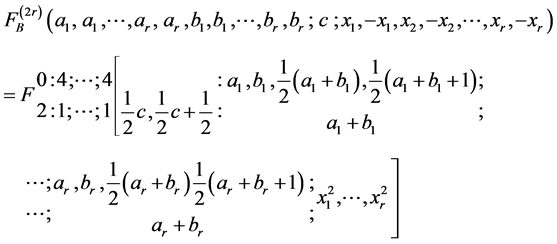
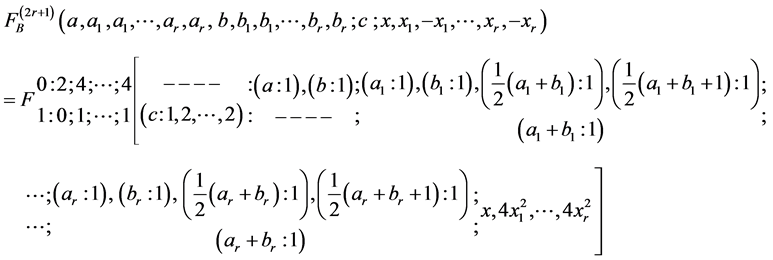
In this section, the following two extension formulas for Lauricella’s function of the second kind of several variables will be established:
 (2.1)
(2.1)
and
 (2.2)
(2.2)
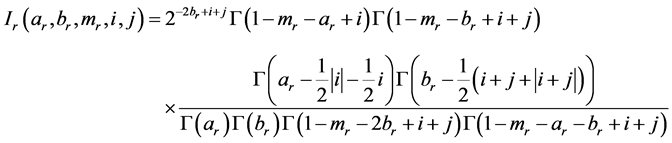
where
 (2.3)
(2.3)
 (2.4)
(2.4)
 (2.5)
(2.5)
for 
The coefficients  and
and  can be obtained from the tables of
  and
and  given in [1] by replacing a by
  and
and  respectively.
Proof of (2.1): Denoting the left hand side of (2.1) by S, expanding  in a power series and using the results [2] :
 (2.6)
(2.6)
 (2.7)
(2.7)
 and
and , (2.8)
we get
 (2.9)
(2.9)
where
 (2.10)
Separating (2.9) into its even and odd terms, we have
 (2.11)
Finally, in (2.11) if we use the result (1.12), then we obtain the right hand side of (2.1). This completes the proof of (2.1). The result (2.2) can be proved by the similar manner.
3. Special Cases
1) In (2.1), if we take  and use the results (1.3)-(1.7), then after some simplification we obtain the following transformation formula:
 (3.1)
(3.1)
which for , reduces immediately to a known result of Bailey [7]
 (3.2)
(3.2)
where  is Appell’s function [2] .
2) Similarly, in (2.2) if we take  and use the results (1.3)-(1.7), then we obtain the following transformation formula:
 (3.3)
(3.3)
3) In (2.2) if we take , then we get a known extension formulas [8] for Lauricella’s function of three va-
riables  for
for .
.
Cite this paper
Ahmed Ali Atash,Ahmed Ali Al-Gonah, (2016) On Two Extension Formulas for Lauricella’s Function of the Second Kind of Several Variables. Journal of Applied Mathematics and Physics,04,571-577. doi: 10.4236/jamp.2016.43062
References
- 1. Lavoie, J.L., Grondin, F., Rathie, A.K. and Arora, K. (1994) Generalizations of Dixon’s Theorem on the Sum of a . Mathematics of Computation, 62, 267-276.
- 2. Srivastava, H.M. and Manocha, H.L. (1984) A Treatise on Generating Functions. Hasted Press, New York.
- 3. Bailey, W.N. (1935) Generalized Hypergeometric Series. Cambridge University Press, Cambridge.
- 4. Lavoie, J.L., Grondin, F. and Rathie, A.K. (1992) Generalizations of Watson’s Theorem on the Sum of a . Indian Journal of Mathematics, 34, 23-32.
- 5. Lavoie, J.L., Grondin, F. and Rathie, A.K. (1996) Generalizations of Whipple’s Theorem on the Sum of a . Journal of Computational and Applied Mathematics, 72, 293-300.
http://dx.doi.org/10.1016/0377-0427(95)00279-0 - 6. Rainville, E.D. (1960) Special Functions. The Macmillan Company, New York.
- 7. Bailey, W.N. (1953) On the Sum of Terminating . Quarterly Journal of Mathematics Oxford, 2, 237-240.
http://dx.doi.org/10.1093/qmath/4.1.237 - 8. Atash, A.A. (2015) An Extension Formulas of Lauricella’s Functions by Applications of Dixon’s Summation Theorem. Applications and Applied Mathematics, 10, 1007-1018.