

World Journal of Engineering and Technology
Vol.02 No.04(2014), Article ID:51803,7 pages
10.4236/wjet.2014.24033
Vibration Control for Two air Compressor units Used in Tandem
Viorel-Mihai Nani1,2, Ioan Cireş2
1Faculty of Engineering, University ″Ioan Slavici″ Timisoara, Timisoara, Romania
2Research Department, SC PRO ATLAS ING SRL Timisoara, Timisoara, Romania
Email: viorelnani@yahoo.com, proatlasing@yahoo.com
academic Editor: Gwang-Hee Kim, Department of Plant & Architectural Engineering, College of Engineering, Kyonggi University, Republic of Korea
Copyright © 2014 by authors and Scientific Research Publishing Inc.
This work is licensed under the Creative Commons Attribution International License (CC BY).
http://creativecommons.org/licenses/by/4.0/



Received 23 September 2014; revised 18 October 2014; accepted 5 November 2014
ABSTRACT
The paper presents the vibration control for two air compressors used in tandem to an oxygen generating station. The compressors are identical in terms of constructive and functional proper- ties, and are both located on similar foundations. Each compressor is supported on a foundation made from one massive block of concrete, provided with some elastic and damping parts. This anti vibrating structure insulates the machines compared to other station equipment. During opera- tion, were observed dangerous levels of vibration at one of the machines, which forced some un- wanted stoppages for the station. Two hypotheses have been promoted. One of them referred to a pronounced wear of one compressor, although this was relatively new. The second hypothesis has taken in consideration the appearance of some cracks in the foundation massive concrete block. Experimental research conducted on the spot led to the identification of some errors done at foundation fabrication. The experimental results and some theoretical investigations are pre- sented in this paper.
Keywords:
foundation, harmonic disturbing Forces, Amortized forced Vibration, Vibration isolation, Coefficient of transmissibility

1. Introduction
In general, operating industrial equipments produce vibrations under the action of some disturbing forces. These are usually, periodic time dependent external forces. Common source for disturbing forces are the inertia forces. Virtually every moving body―(movements like: rotation, linear displacement, linear―alternative, oscillatory etc.)―is subject to inertial forces and therefore produces vibrations [1] and [2] .
Vibrations are transmitted to the foundation on which is installed the equipment. From dynamic stability con- siderations, these vibrations should be isolated. To isolate the vibrations it means to identify some technical measures, so that the foundation does not vibrate when the industrial equipment creates these forces. So, is re- quired that the disturbing forces transmitted to the foundation to be zero or as low as possible with the help of some damping measures [3] .
In the paper we studied a real case that occurred to an oxygen station. The replacement of two air compressors with a new model concurrently with restoration the foundation had generated unforeseen situation. During commissioning tests, there were identified dangerous levels of vibration which led the temporary shutdown of the compressors, and thus the oxygen station. In this context, our research team was asked to correct the non- compliance.
2. Theoretical Considerations on Forced Vibration
A particular important case in practical applications is the situation where the damping forces are negligible and over the mechanical system is acting only the disturbing force . Being independent of system characteris- tics, the differential equation of motion is [4] and [5] :
 (1)
(1)
where ―the mass of the mechanical system (industrial equipment);
 ―the elastic constant of the mechani- cal system;
 ―coordinate of motion.
In practice, is often encountered situations where the disturbing force is harmonic. If the pulsation of this force is , then equation (1) is:
 (2)
(2)
This equation has the particular solution
 (3)
(3)
where ―the amplitude for the forced vibration in the mechanical system;
 ―the amplitude of the vibra-
tion; Substituting (3) in (2) and putting condition , we obtain:
 (4)
(4)
With the notation , where
  is the static deformation of the vibrating system under the action of a
disturbing force equal with the maximum value , Equation (4) can be written in dimensionless [3] :
 (5)
(5)
We can observe that the amplitude of vibration  depends by the pulsation ratio
 . This dependence is
shown in Figure 1 [6] .
Note that for ,
,  is positive and represents the forced vibration amplitude, being higher than
 .
.
In this situation, the forced vibration  and disturbing force
  are in phase.
For ,
,  is negative. In this case the forced vibration and disturbing force are out of phase with
 ,
,
or they are in opposition. The vibration amplitude is , but for the vibration study we will suppress the nega-
tive sign and we will consider the dashed drawn curve (see Figure 1).
For , i.e. for low frequency of disturbing forces, the forced vibration amplitude is greater than
 .
.
For high frequencies , the amplitude is less than
  and tends to be zero when
  tends to be
 .
.

Figure 1. Diagram amplitudes depending pulses of the mecha- nical system.
In the point a, the disturbance force frequency is very low,  and the mechanical system vibrates in phase with the force with the amplitude equal to
 . In the point b,
  the amplitude of forced vibration
  is very small. The force varies so rapidly that mechanical system does not have time to follow it. Basically, the system remains in relative rest. The point c, where
 , corresponds to the phenomenon of resonance. The vibration amplitudes increase together with the forces of the mechanical system. If these forces exceed the limit values for the strength of the mechanical structure, the system can be destroyed irreversibly. For this reason, the design of industrial equipment and foundation, take into account the phenomenon of resonance.
Resonance is practically avoided either by changing frequency for disturbing force when it coincides with the resonance frequency, either by modifying the structure of the system, by modifying the parameters  and
and . The second situation includes also the computation for the foundation isolation [1] and [7] .
3. Theoretical Considerations on Vibration Isolation
To reduce or eliminate the forces transmitted to the foundation, it is inserted between the mechanical system and foundation different elastic materials: metal coil springs, cork, rubber, polystyrene, expanded sheets etc. If we note with  the elastic constant of the materials inserted between the mechanical system and the foundation, and with
  mass of the industrial equipments, then the mechanical model is presented in Figure 2 [3] .
Transmissibility coefficient , namely ratio between the maximum of force transmitted with foundation
  and disturbing force
 , is given by dimensionless relation (5). As seen from Figure 1, in order as force transmitted to foundation to be as small as possible, the ratio
  must be as high as possible. This is done
basically by adopting constructive solutions with their own pulsation  as small as possible, (i.e.
springs supple with elastic constant k small).
If industrial equipment is placed directly on the foundation without elastic elements,  ,
,  and
and , so the seating basis is rigid, the transmissibility coefficient
 , and disturbing forces are trans- mitted entirely to the foundation.
For , the transmissibility ratio is
 . In this situation, whether there are introduced elastic mate- rials, the results increase the forces transmitted to the foundation
 . The effect is more pronounced if the pul- sation
  is close to the resonant pulsation
 . Then transmissibility coefficient
  becomes very large, and the forces transmitted to the foundation, are very dangerous. Therefore, in the foundation structure, vibration isolation measures are introduced, in addition to elastic materials and viscous damping elements. The differen- tial equation of vibration movement in this case is [2] :
 (6)
(6)

Figure 2. The mechanical vibration isolation with elastic ele- ments.
where  is the damping coefficient.
If disturbing force is harmonic, namely , then forced vibrations
  as solution of Equation (6) is:
 (7)
(7)
where  is the initial phase at moment
  and is obtained from
 (8)
(8)
At resonance, the maximum forced amplitude is given [6]:
 (9)
(9)
where  is the critical damping coefficient, being equal to:
 (10)
(10)
Discussions:
・ In case , the movement is not vibratory, but atypical. Mechanical system slowly approach to the rest position
  due the very high forces created by the insulation structure.
・ Where , the mechanical system movement is also atypical and it slowly approach the rest position
 .
.
・ If , mechanical system approaches rest position
  in the time interval
  called the relaxa- tion period.
In the forced harmonic motion of industrial equipment, damping force lags by an angle  compared with elastic force. For this reason, the maximum force
  that is transmitted to the foundation will be [2] and [3] :
 (11)
(11)
4. Mathematical Modeling of the Air Compressor Unit
The mechanical model for vibration and isolation with elastic elements and damping viscous elements is pre- sented in Figure 3 [3] and [8] .
The curves from the diagram of transmissibility coefficient (see Figure 3(b)) show the effect of damping forces, which is a reduction for the amplitude of forced vibration.

Figure 3. Experimental test plan, a) simplified mechanical model of the air compressor located on the foundation; b) diagram the coefficient of trans- missibility in function ratio pulsation.
The vibration amplitude not becomes infinitely larger comparing with the case when  and when
 . The other curves present maximum of amplitudes with decreasing values, if
  increase, given by rela- tionship:
 (12)
(12)
The machines for compressing air and its mounting scheme on the foundation are presented in Figure 4. A multi-cylinder compressor, as a five stage air compressor 1, is composed from two parts, law pressure stage (cy- linders I, II and III) and high pressure stage (cylinders IV and V), both being driven by an electric machine 2 via an elastic coupling . All ensembles are fixed on a massive block of concrete 3 which is seating on the foun- dation 5. Between the block 3 and the foundation was interposed an elastic and damping structure 4.
The massive block foundation is used for two reasons: to machine axis line stiffening and to diminishing ma- chine-foundation vibration excited by residual inertial unbalanced forces , acting on machine [9] . The vibration levels depend on the dynamic characteristics of the elastic and damping structure 4 and on the in- ertial mass of the massive concrete block 3.
To determined the distribution of vibration was measured the vibration motions components,  ,
,  and
and , in a lot of points
  along the ensemble machine massive foundation. For the motion of a rigid body, the distribution of vibration occurs is [8] and [10] :
 (13)
(13)
where  is the column vector matrix for the resultants vibration, and is given by:
 (14)
(14)
・  is the column vector matrix of vibration point
  at radius
  -compared to the geometric centre 0
of the structure;
・  is the column vector matrix of “out of phase” at point
  compared to the reference system X0YZ-
chosen arbitrarily and is given by:
 (15)
(15)
・  is the matrix of position point
  compared to the reference system X0YZ and is:

Figure 4. Mounting scheme of a machine for air compression (with more cylinders).
 (16)
(16)
Distribution law for the rigid body vibration given by relationship (13), can be extended to the distribution of amplitudes:
 (17)
(17)
where with the letters  and
and  are meaning the terms
  and
and .
.
5. Experimental Researches
Experimental investigations have been focused on study of isolating vibration for two air compressor units from an oxygen station. Although the two aggregates were identical in terms of construction and were also placed on the identical foundations, one of them presented higher levels of vibration than the other.
Was emitted the hypothesis that one of aggregates had hidden defects at installation, which led to its prema- ture wear. But the two aggregates were new, and verification tests done before entering into service did not re- veal any hidden defect.
Has been also hypothesised that the concrete massive block interposed between aggregate and foundation, has “cracked” during the technological tests, and as result it was amplifying the disturbance forces generated by the mechanical (vibrating) system.
In the first phase was carried out a dimensional static verification of the two units, but no structural differ- ences were found between them. Tolerances of the active elements―pistons, cylinder shirts, rod-crank mechanism have been found to be into the prescribed limits. There were not found abnormal wear of these compo- nents and the mechanism rod-crank it is was working smoothly, evenly and without shocks at change of di- rection.
These results had supported the hypothesis that disruptive forces  are the same for both aggre- gates. To explain the large difference between the vibrations of the two units was placed the emphasis in the second phase of experimental research, it was performed integrity verification for the foundation. This was as- similated to a massive mass that must have the vibration motion of a rigid body. In the case of some hidden cracks, significant deviations from the rigid body anticipated movements will be present.
To determine the vibration distribution, we measured the components for the vibration movements ,
,  and
and ―see relationship (14)―for several points
  along the perimeter of aggregates placed on the solid concrete block of the foundation (see Figure 4).
The experimental measurements we made with a comprehensive installation type DELTA TRON®, have al- lowed the effective determination of vibration amplitudes, and out of phase according to the model shown in Figure 4. The vibration motion distribution for the two air compression machines is shown in Figure 5.
Were used 8 tri-axial transducers  for vibration monitoring, emplaced on the massive concrete block 3―in two parallel planes. It has been established one rectangular system X0YZ shown in the figure, as a reference basis for the reported measured vibration parameters.
The values for the vibration motion amplitude and out of phase for the first harmonic, corresponding to the two machines are given in the table below:
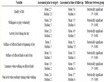
If we analyze these results, we cannot observe significant differences between the two aggregates. Therefore the hypotheses of premature wear, or the hypothesis of some cracks in the massive concrete block at one of the two units, were rejected.
Experimental researches performed in a longer time, showed however, random occurrence of some dangerous frequencies at different moments and speeds for the electric motor 2. Because the disturbance forces  are acting periodically on the foundation with the
  pulsation, and because the force
  transmitted to the foundation did not exceed the maximum allowable limit, it was advanced the hypothesis of a variable damping force acting randomly in time. The coefficient of transmissibility determined by relation (5) has, therefore, a va- riable character.
This hypothesis was accepted by the oxygen station management, which has assumed responsibility for the foundation work quality. Due to the difficulties encountered during the work for gravel compaction, it was not followed exactly the technological recipe at one of the two foundations.
6. Conclusions
The study on vibration isolation has highlighted the importance of a strict compliance with the technical re- quirements for the foundation execution technology. To explain the large difference between vibration of the two aggregates, we focused on the integrity of the concrete foundation verify which as a massive mass must to has vibration of rigid body motions. In case of a possible hidden crack the significant deviation from the rigid body motions may occurs.
The damping forces variation during operation of the equipment, leads to some variations for the transmissibility coefficient values (see Figure 3(b)):
・ For , coefficient of transmissibility is higher than one, regardless of the ratio
 ; which in-
cludes the case of resonance, viscous damping is advantageous because it reduces the transmissibility coeffi-

Figure 5. Scheme distribution of vibrational motion of the foundations for the two air com- pression aggregates.
cient and therefore the amplitude of vibration;
・ For , coefficient of transmissibility is less than one, and it is lower for foundations with elastic elements only, and increases with the ratio
 ; in this field, damping effect is unfavorable, so that for this situation―are preferred constructive solutions with materials with smaller elastic constant
 .
.
・ Whereas in the period starting and stopping, industrial equipments are passing through critical speeds, there is the possibility of the uncontrolled appearance of some dangerous vibrations; for this reason is recommended to use viscous damping with ratio  as small as possible or at most equal to 0.5.
References
- Achenbach, J.D. (1984) Wave Propagation in Elastic Solid. North Holland, New York.
- Beards, C.F. (1995) Engineering Vibration Analysis with Application to Control Systems. Edward Arnold, London.
- Blevins, R.D. (1979) Formulas for Natural Frequency and Mode Shape. Van Nostrand Reinhold, New York.
- Cioara, T.Gh., Nicolae, I., Cires, I., Cristea, D., Cires, D. and Caplanescu, C. (2010) Consideration on Structure Vibra- tion Isolation Asymmetry. Two Funny Cases. Proceedings of the IMAC-XXVIII, Jacksonville, 1-4 February 2010.
- Craig, R.R. and Kurdila, A. (2006) Fundamentals of Structural Dynamics. John Wiley and Sons, New York.
- Silas, Gh. (1968) Mechanics. Mechanical Vibration. Didactic and Pedagogical Publishing, Bucharest.
- Geradin, M. and Rixon, D. (1997) Theory and Application to Structural Dynamics. 2nd Edition, John Wiley and Sons, New York.
- Hussey, M. (1983) Fundamentals of Mechanical Vibrations. Mac Milan Press Ltd., London.
- Meirovitch, L. (2001) Fundamentals of Vibration. McGraw-Hill, New York.
- Rades, M. (2008) Mechanical Vibration. Publishing Printech Bucharest.