

Open Access Library Journal
Vol.03 No.11(2016), Article ID:71818,13 pages
10.4236/oalib.1103106
Oscillator with Distributed Nonlinear Structure on a Segment of Lossy Transmission Line
Vasil G. Angelov
Department of Mathematics, University of Mining and Geology “St. I. Rilski”, Sofia, Bulgaria

Copyright © 2016 by author and Open Access Library Inc.
This work is licensed under the Creative Commons Attribution International License (CC BY 4.0).
http://creativecommons.org/licenses/by/4.0/



Received: September 28, 2016; Accepted: November 3, 2016; Published: November 7, 2016
ABSTRACT
We consider a model of self-oscillator with distributed amplifying structure realized on a segment of lossy transmission line. The distributed structure of tunnel diode type generates nonlinearity of polynomial type in the hyperbolic transmission line system. The transmission line is terminated by nonlinear reactive elements at both ends. This means that using Kirchhoff’s law we obtain nonlinear boundary conditions. Then a mixed problem for lossy transmission line system is formulated. We give a new approach to present the mixed problem in a suitable operator form and using fixed point method we prove existence-uniqueness of a solution. To apply the theorem proved one has to check just several inequalities. We demonstrate conditions obtained on a numerical example.
Subject Areas:
Multimedia/Signal Processing
Keywords:
Oscillator Amplifier, Lossy Transmission Line, Nonlinear Distributed Structure, Fixed Point Method

1. Introduction
The present paper is devoted to investigation of self-oscillators with distributed amplifying structure of tunnel diode type realized on a segment of lossy transmission line. The transmission line is terminated by nonlinear reactive elements. Such problems and their applications (for instance to RF-circuits, PCB-s problems and so on) are usually considered by means of various methods (slowly varying in time and space amplitudes and phases, numerical methods and so on, cf. [1] - [14] ). We have developed (cf. [15] ) a general approach for investigation of lossy transmission lines terminated by nonlinear loads without Heaviside condition . From mathematical point of view in [15] , we consider just linear hyperbolic systems. In [16] and [17] , we have considered a Josephson superconductive transmission line system with sine type nonlinearities. Our main purpose here is to consider lossy transmission line with polynomial nonlinear distributed structure that leads to a nonlinear hyperbolic system. We extend Abolinya- Myshkis method (cf. reference of [16] ) to attack the nonlinear boundary value problem and propose a new general approach to reduce the mixed problem for such nonlinear systems to an operator form in suitable function spaces. The arising nonlinearity is of polynomial type in view of distributed tunnel diode element. The nonlinear characteristics of the reactive elements generate nonlinear boundary conditions. We prove the existence of an approximated solution of the mixed problem and show a way to reach this solution by successive approximations.
We proceed from the circuit shown on Figure 1, where  and
and  are nonlinear reactive elements. We consider that a particular case
  is a nonlinear capacitance, while
  is a nonlinear inductance. In a similar way, it can be treated more complicated circuits (cf. [15] ).
A lossy transmission line with distributed nonlinear resistive element can be prescribed by the following first order nonlinear hyperbolic system of partial differential equations (cf. [1] - [14] ):
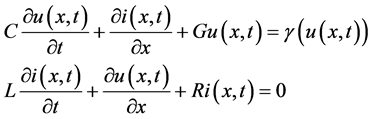 (1)
(1)

where  and
and  are the unknown voltage and current, while L, C, R and G are inductance, capacitance, resistance and conductance per unit length;
  is itslength; and
  is a prescribed polynomial of arbitrary order with intervalof negative resistance (in the applications most often of third order). For the above

Figure 1. Lossy transmission line with distributed nonlinear resistive element with an interval of negative differential resistance in the characteristic.
system (1), one can formulate the following initial-boundary (or briefly mixed) problem: to find the unknown functions  and
and  in
in  such that the following initial and boundary conditions are satisfied
 (2)
(2)
 (3)
(3)
where  and
and  are prescribed initial functions the current and voltage at the initial instant;
  are characteristics of the reactive elements
 .
.
Rewrite the system (1) in the form
 (4)
(4)
2. Transformation of the Partial Differential System
First we present the system (4) in matrix form:
 .
.
Introducing denotations


we have
 . (5)
. (5)
To transform the matrix  in diagonal form we solve the characteristic equation
  Its roots are
 ,
, . The eigen- vectors are
 ,
, . We form the matrix by eigen-vectors
 . Then
  and
and  .
.
Introduce new variables , where
 . Therefore
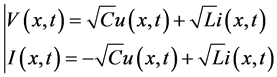 and
and  (6)
(6)
Substituting  in Equation (5) we obtain

or
 (7)
(7)
But
 ,
, 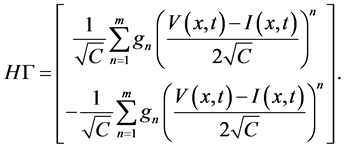
Then introducing denotations  we obtain from Equation (7)
 (8)
(8)
Introduce again new variables
 (9)
(9)
and then the system (8) reduces to

The new transformation formulas are
 (10)
(10)
The new initial conditions we obtain from Equations (2), (6) and (9) for :
:

The new boundary conditions we obtain from Equations (3):
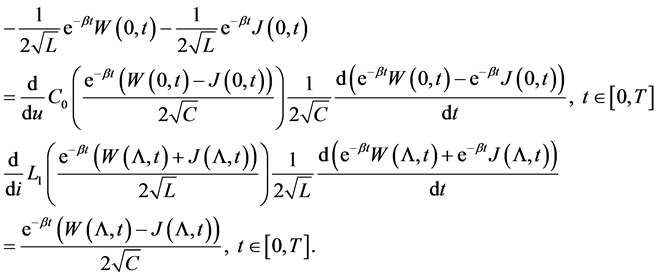 (11)
(11)
In order to solve the last equations with respect to the derivatives we consider the properties of nonlinear capacitive and inductive elements. For the capacitive element (cf. [15] ) we have , where
  are constants and
 . If
. If , then
  has strictly positive lower bound.
Indeed (cf. [15] ), .
.
To obtain  we make
Assumption (C) .
.
If we choose  it follows
  and
and  for
for  and therefore
 .
.
Besides
 .
.
The inductive element has I-L characteristic of polynomial type.
To solve the second equation (11) with respect to  we make
Assumptions (L) ,
, .
.
In view of  we obtain


We present the above relations in an integral form under
Assumptions (CC) ,
,
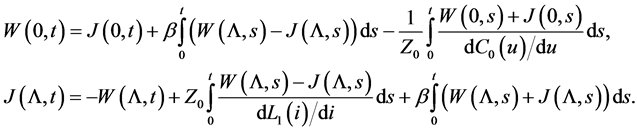
3. Operator Formulation of the Mixed Problem for the Transmission Line System
Now we are able to formulate the mixed problem with respect to the unknown functions : to find
  satisfying the system and initial and boundary conditions

(12)
In what follows we give an operator representation of the above mixed problem (12).
Recall that  and
and  and
and . The ordinary differential equations (Cauchy problem) for the characteristics of the hyperbolic system are
 for each
  (13)
(13)
 for each
  (14)
(14)
The functions  and
and  are continuous ones. This im- plies that for every
  there is a unique (to the left from
 ) solu- tion
  for
for ;
; , and respectively
  for
for ;
; . Denote by
  the smallest value of
  such that the solution
  of Equation (13) still belongs to
  and respective-
ly the solution  of Equation (14) by
 . If
. If  then
then  or
or  and respectively if
  then
then  or
or . In our case
 ;
; 
Remark 1. We notice that . It is easy to see that


Introduce the sets:





 .
.
Prior to present problem (12) in operator form we introduce

and

or
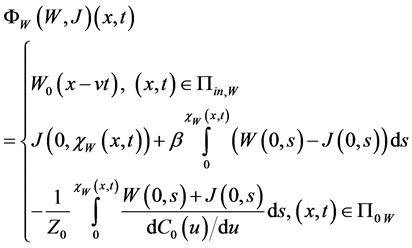

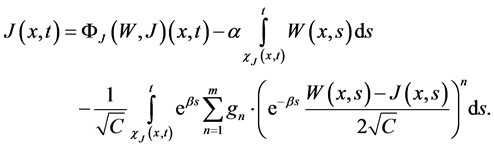
So we assign to the above mixed problem the following system of operator equations (cf. [16] , [17] ):

4. Existence Theorem
In order to obtain a contractive operator we consider the mixed problem (12) on the subset . We introduce the sets
 and
and 
where  and μ are positive constants chosen below. It is easy to verify that
  turns out into a complete metric space with respect to the metric
 ,
,
where
 ,
,
 .
.
Now we define an operator  by the formulas


Remark 2. Assumption (C) and Assumptions (L) in view of Equations (10) imply
 ;
; .
.
Theorem 1. Let the following conditions be fulfilled:
1) Assumption (C), Assumptions (L), Assumption (CC) and ,
,  for
for  as
as  are sufficiently small while
  is sufficiently large;
2) ;
;
3) ;
;
4) ;
;
5) .
.
Then there exists a unique solution of the problem (12).
Proof: We establish that the operator B maps the set  into itself.
First we notice that  and
and  are continuous functions. We show
 ,
, .
.
Indeed, for sufficiently small  and in view of
  and
and  we have
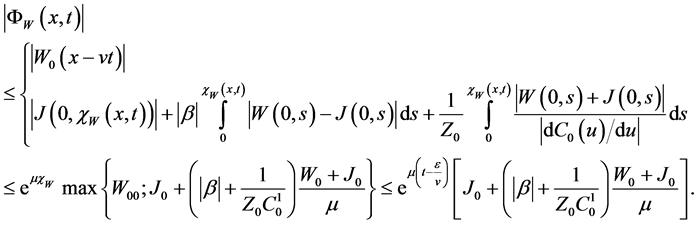
Then for the first component we have

In view of

and

for sufficiently small  for the second component we obtain:

Now we show that B is a contractive operator.
Indeed, for the first component we obtain:

Similarly for the second component we obtain

Therefore

and the operator B has a unique fixed point which is a solution of the mixed problem above formulated in the set .
.
Theorem 1 is thus proved.
Remark 3. We point out that for every  there is a unique solution
  in
in . The sequence
  is not necessary convergent when
 . To find a convergent subsequence we proceed as in [17] . Extending the solution on
  we can choose a convergent subsequence. The first approximation can be chosen, for instance, as a solution of the linearized system (12).
5. Conclusion Remarks
1) We note that the interval  is not sufficiently small.
2) We show a simple verification of all inequalities of the main theorem for soft nonlinearity  (cf. [1] ). Consider a lossy transmission line (cf. [1] - [15] ) satisfying the Heaviside condition with specific parameters:
 ;
;
 ;
; ;
;
 ;
;
 ;
;
 .
.
Let us choose a polynomial  with interval of negative differential resistance,
  and
and . Then
 ;
;  . The pn-junction capacity is
  , while the pn-junction potential
 . For
. For  and
and  the minimal value of
  is
is .
.
We choose  such that
 .
.
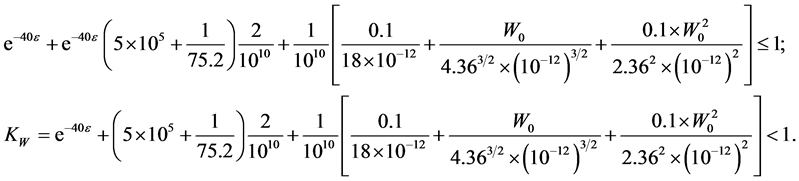
Then the inequalities from Remark 3 and two of inequalities from Theorem 1 become
 ;
;
Cite this paper
Angelov, V.G. (2016) Oscillator with Distributed Nonlinear Structure on a Segment of Lossy Transmis- sion Line. Open Access Library Journal, 3: e3106. http://dx.doi.org/10.4236/oalib.1103106
References
- 1. Utkin, G.M. (1978) Auto-Oscillating Systems and Wave Amplifiers. Sovetskoe Radio, Moscow.
- 2. Holt, C. (1967) Introduction in Elec-tromagnetic Fields and Waves. John Wiley & Sons, New York.
- 3. Jordan, E.C. and Balmain, K.G. (1968) Electromagnetic Waves and Radiating Systems. Prentice-Hall, Inc., Englewood Cliffs.
- 4. Ishimaru, A. (1991) Electromagnetic Wave Propagation Radiation and Scattering. Prentice- Hall, Inc., New Jersey.
- 5. Pozar, D. (1998) Microwave Engineering. John Wiley & Sons, New York.
- 6. Paul, C.R. (1994) Analysis of Multi-Conductor Transmission Lines. Wiley-Inter Science Publication, John Wiley & Sons, New York.
- 7. Ramo, S., Whinnery, J.R. and van Duzer, T. (1994) Fields and Waves in Communication Electronics. John Wiley & Sons, Inc., New York.
- 8. Vizmuller, P. (1995) RF Design Guide Systems, Circuits and Equations. Artech House, Inc., Boston, London.
- 9. Magnusson, P.C., Alexander, G.C. and Tripathi, V.K. (1992) Transmission Lines and Wave Propagation. 3rd Edition, CRC Press, Boca Ra-ton.
- 10. Dunlop, J. and Smith, D.G. (1994) Telecommunications Engineering. Chapman & Hall, London.
http://dx.doi.org/10.1007/978-1-4899-2929-7 - 11. Maas, S.A. (2003) Nonlinear Microwave and RF Circuits. 2nd Edition, Artech House, Boston, London.
- 12. Misra, D.K. (2004) Radio-Frequency and Microwave Communication Circuits. Analysis and Design. 2nd Edition, University of Wisconsin-Milwaukee, John Wiley & Sons, Inc., Publication.
http://dx.doi.org/10.1002/0471653764 - 13. Miano, G. and Maffucci, A. (2001) Transmission Lines and Lumped Circuits. Academic Press, New York.
- 14. Scott, A. (1970) Active and Nonlinear Wave Propagation in Electronics. John Wiley & Sons, New York.
- 15. Angelov, V.G. (2014) A Method for Analysis of Transmission Lines Terminated by Nonlinear Loads. Nova Science, New York.
- 16. Angelov, V.G. (2015) Josephson Lossless Transmission Lines with Nonlinear R-Element. International Research Journal of Natural Sciences, 3, 59-79.
- 17. Angelov, V.G. (2016) Lossy Transmission Lines with Josephson Junction—Continuous Generalized Solutions. Communication in Applied Analysis, 20, 91-106.