

Applied Mathematics
Vol.07 No.01(2016), Article ID:63004,23 pages
10.4236/am.2016.71007
Parabolic Partial Differential Equations as Inverse Moments Problem
Maria B. Pintarelli1,2
1Grupo de Aplicaciones Matematicas y Estadisticas de la Facultad de Ingenieria (GAMEFI), Universidad Nacional de La Plata (UNLP), La Plata, Argentina
2Departamento de Matematica, Facultad de Ciencias Exactas, Universidad Nacional de La Plata (UNLP), La Plata, Argentina

Copyright © 2016 by author and Scientific Research Publishing Inc.
This work is licensed under the Creative Commons Attribution International License (CC BY).
http://creativecommons.org/licenses/by/4.0/


Received 10 December 2015; accepted 22 January 2016; published 25 January 2016
ABSTRACT
We considerer parabolic partial differential equations

under the conditions


on a region . We will see that we can write the equation in partial derivatives as an Fredholm integral equation of first kind and will solve this latter with the techniques of inverse moments problem. We will find an approximated solution and bounds for the error of the estimated solution using the techniques on moments problem. Also we consider the one- dimensional one-phase inverse Stefan problem.
Keywords:
Parabolic PDEs, Freholm Integral Equations, Generalized Moment Problem

1. Introduction
We considerer parabolic partial differential equation of the form:
 (1)
where the unknown function  is defined in
 .
 is known function. We consider conditions


This problem was studied under conditions of Cauchy in [1] .
Parabolic differential equations are commonly used in the fields of engineering and science for simulating physical processes. These equations describe various processes in viscous fluid flow, filtration of liquids, gas dynamics, heat conduction, elasticity, biological species, chemical reactions, environmental pollution, etc. [2] [3] .
In a variety of cases, approximations are used to convert parabolic PDEs to ordinary differential equations or even to algebraic equations. The existence and uniqueness properties of this problem are presented in literature. Several numerical methods have been proposed for the solution of this problem [4] -[6] .
Next section is devoted to showing how the differential equation (1) is transformed into integral equation of first kind that can be seen as generalized moments problem. In Section 3 there we present a theorem that guarantees under certain conditions the stability and convergence of the finite generalized moment problem. In Section 4 we exemplify the general method by applying it to some parabolic PDEs of the form (1). Finally in Section 5 the method is applied to solve the one-dimensional one-phase inverse Stefan problem.
The Stefan problem consists of finding w y s such that

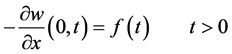

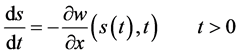


The classical Stefan problem is a nonlinear initial value problem with a moving boundary whose position is unknown a priori and it must be determined as part of the solution. The differential equations of parabolic type governing heat diffusion with phase change are an important class of Stefan problems.
The direct Stefan problem requires determining both the temperature and the moving boundary interface when the initial and boundary conditions, and the thermal properties of the heat conducting body are known. Conversely, inverse Stefan problems require determining the initial and/or boundary conditions, and/or thermal properties from additional information which may involve the partial knowledge or measurement of the moving boundary interface position, its velocity in a normal direction, or the temperature at selected interior thermo- couples of the domain.
In this paper we solve the inverse Stefan problem: find  with
 known such that the above con- ditions are met.
The d-dimensional generalized moment problem [7] -[10] can be posed as follows: find a function u on a domain  satisfying the sequence of equations
 (2)
where  is a given sequence of functions lying in
 linearly independent.
Many inverse problems can be formulated as an integral equation of the first kind, namely,

 and
 are given functions and
 is a solution to be determined;
 is a result of experimental measurements and hence is given only at finite set of points. It follows that the above integral equation is equivalent to the following moment problem

Also we considerer the multidimensional moment problems

Moment problems are usually ill-posed. There are various methods of constructing regularized solutions, that is, a approximate solution stable with respect to the given data. One of them is the method of truncated expan- sion.
The method of truncated expansion consists in approximating (2) by finite moment problems
 (3)
Solved in the subspace  generated by
 (3) is stable. Considering the case where the data
 are inexact, we apply some convergence theorems and error estimates for the regularized solutions [9] [11] .
2. Parabolic Partial Differential Equations as Integral Equations of First Kind
Let  be a partial differential equations such as (1). The solution
 is defined on the region
 and verifies conditiones on the boundary
 :


We apply the technique used in [1] . Let  be a vectorial field such that w verifies
 with
 a known function and, reciprocally, if w verifies
 then

Specifically in this case  and we take
 (4)
 (5)
Let  be the auxiliary function
 (6)
Since

we have

Moreover, as

and

we obtain
 (7)
where 
We consider the integral
 (8)
Integrating by parts:
 (9)
Note that in (9) if x is a natural number then
 (10)
and if  then
 (11)
Thus if  and
 :
 (12)
Also if we write  (see Figure 1) then


Figure 1. Domain E and contour .
We write


finally, if  y
 we get:
 (13)
If  then you can take
 (14)
and we must have  when

3. Solution of Generalized Moment Problems
Equation (13) is of the form:

We assign natural values to x and t:  and
 and we consider the corre- sponding generalized finite moment problem bi-dimensional [12] [13]

To obtain a numerical approximation of the solution  the truncated expansion method is applied [9] [11] .
We considerer the basis  obtained from the sequence
 with

 by Gram-Schmidt method and addition of the necessary functions in order to have an orthonormal basis.
To facilitate the calculations we write  and
 with

We then approximate the solution  with

and

where the coefficients  verifies
 (15)
 (16)
The proof of the following theorem is in [14] .
Theorem 1. Let  be a set of real numbers and let
 and E be two positive numbers such that
 (17)
 (18)
then
 (19)
where C is the triangular matriz with elements 
 .
And
 (20)
If , then (18) it is replaced by

and we must have

and

4. Numerical Examples
4.1. Example 1
Let considerer the equation

in the domain

and boundary condition on

given by


The exact solution is 
In Figure 2 the approximate numerical solution and the exact one are compared.Were taken  moments.

Figure 2.  and
 .
The accuracy is, in this case 
4.2. Example 2
Let considerer the equation

in the domain  and boundary condition on
 given by


The exact solution is 
In Figure 3 the approximate numerical solution and the exact one are compared.Were taken  moments.
To apply Gram Schmidt to  we consider the inner product

The accuracy is, with this inner product 
5. The One-Dimensional One-Phase Inverse Stefan Problem
5.1. The Inverse One-Phase Stefan Problem as Integral Equation
The Stefan problem consists of finding w y s such that
 (21)
 (22)
 (23)

Figure 3.  and
 .
 (24)
 (25)
 (26)
We want to solve the inverse Stefan problem: to find  with
 known such that the above con- ditions are met.
We write
 (27)
We take the auxiliary function

Therefore

We consider the vector field  with
 . In this manner
 . In consequence if w it is solution of the Equation (27), then
 . Reci-
procally, if w satisfies , then w it is solution of the Equation (27).
We write . We use that

if  it is the scalar product and
 is the gradient operator we get

By the divergence theorem

with , in consequence

We calculate :
First we write

and , (Figure 4) then we take
 .
If  then

As  by (23) and
 then
 (28)
Now we developed . Observe the Figure 5 and:

Figure 4. Domain ET.

Figure 5. Domain ET.
 (29)
 (30)
 (31)
 (32)
Then
 (33)
To solve the inverse problem, where  is known and
 is unknown we do

In this manner:
 (34)
We assign values to t: 
 (35)
We can interpret (35) as a one-dimensional generalized moments problem.
We solve the problem numerically considering the finite generalized moments problem
 (36)
and we apply the truncated expansion method.
5.2. Numerical Approximation to the Solution of the Inverse Stefan Problem
To obtain a numerical approximation of the solution the procedure is analogous to that presented in Section 3. To approximate  is taken a base
 of
 obtained from the sequence
 by Gram-Schmidt method and necessary functions are added in order to have an orthonormal basis. We then approximate the solution
 with:

where

and the coefficients  verifies
 (37)
 (38)
The following theorem is the one-dimensional version of Theorem 1. In [15] is the demonstration when the domain is bounded.
We present here the demonstration when the domain is the interval 
Theorem 2. Let  be a set of real numbers and let
 and M be two positive numbers such that
 (39)
 (40)
then if 
 (41)
and
 (42)
where C is the triangular matriz with elements 
 .
Proof. Since the problem is linear we can assume .
We applied Gram-Scmidt method on  in
 and we get
 then add the resulting set of necessary functions to obtain an orthonormal basis.
We write  as

where  it is the orthogonal projection of
 on the linear space generated by the set
 and
 it is the orthogonal projection of
 on the orthogonal complement. Here the underlying structure is the space
 . We can write
 (43)
where  are the Fourier coefficients in the expansion of
 .
To estimate  we consider the relationship between the Fourier coefficients
 and the moments
 :
 (44)
where  they are given in (37) y (38).
In matrix notation
 (45)
Then
 (46)
By (43) until ( 46) we can write
 (47)
To estimate  we see that each element of the orthonormal set
 can be expanded in terms of the
elements other orthonormal basis, in particular the base , where
 it represents the Laguerre polynomial of degree i.
These polynomials satisfy
 (48)
or also
 (49)
Then
 (50)
then using (50)
 (51)
After several calculations
 (52)
and
 (53)
where
 (54)
Now multiplying by  and integrating both sides of the differential Equation (49) and assuming that
 we get:
 (55)
then by (53) and (55):
 (56)
from (47) and (56):
 (57)
This inequality remains valid if we replace any integer i between 0 and n for n. Then the result (41) it demon- strated. An analogous demonstration proves inequality (42). □
6. Numerical Example
Find  such that


The exact solution is 
In Figure 6 the approximate numerical solution and the exact one are compared.Were taken  moments.
To apply Gram Schmidt to  en
 we considerer the inner product

The accuracy is, with this inner product 
7. Conclusions
The parabolic partial differential equations

on a region  can be written as an Fredholm integral equation

Figure 6.  and
 .

This equation is of the form:

with 
If , then this Fredholm integral equation of first kind can be transformed into a bi-dimen- sional generalized moment problem assigning integer values greater than or equal to zero to variables x and t
 (58)
As the functions  are linearly independent then the generalized moment problem defined by (58) can be solved numerically considering the correspondent finite problem.
The inverse Stefan problem which it is to find  being
 unknown and such that the follow- ing conditions are met


is equivalent to solve the integral equation

which is equivalent to the generalized moments problem

and can be solved numerically considering the correspondent finite problem.
Cite this paper
Maria B.Pintarelli,11, (2016) Parabolic Partial Differential Equations as Inverse Moments Problem. Applied Mathematics,07,77-99. doi: 10.4236/am.2016.71007
References
- 1. Pintarelli, M.B. and Vericat, F. (2014) Partial Differential Equations as Three-Dimensional Inverse Problem of Moments. Journal of Mathematics and System Science, 4, 657-666.
- 2. Cherniha, R.M. (2011) New Exact Solutions of One Nonlinear Equation in Mathematical Biology and Their Properties. Ukrainian Mathematical Journal, 53, 393-411.
- 3. Mittal, R.C. and Jiwari, R. (2011) A Higher Order Numerical Scheme for Some Nonlinear Differential Equations: Models in Biology. International Journal for Computational Methods in Engineering Science and Mechanics, 12, 134-140.
http://dx.doi.org/10.1080/15502287.2011.564265 - 4. Forsythe, G.E. and Wasow, W.R. (1960) Finite Difference Methods for Partial Differential Equations. John Wiley and Sons, New York.
- 5. Zafarullah, A. (1971) Some Stable Implicit Difference Methods for Heat Equation with Derivative Boundary Condition. The Computer Journal, 14, 309-311.
http://dx.doi.org/10.1093/comjnl/14.3.309 - 6. Keast, P. and Mitchell, A.R. (1966) On the Instability of the Crank Nicholson Formula under Derivative Boundary Conditions. The Computer Journal, 9, 110-114.
http://dx.doi.org/10.1093/comjnl/9.1.110 - 7. Akheizer, N.I. (1965) The Classical Moment Problem. Olivier and Boyd, Edinburgh.
- 8. Akheizer, N.I. and Krein, M.G. (1962) Some Questions in the Theory of Moment. American Mathematical Society, Providence.
- 9. Ang, D.D., Gorenflo, R., Le, V.K. and Trong, D.D. (2002) Moment Theory and Some Inverse Problems in Potential Theory and Heat Conduction. Lectures Notes in Mathematics, Springer-Verlag, Berlin.
http://dx.doi.org/10.1007/b84019 - 10. Shohat, J.A. and Tamarkin, J.D. (1943) The Problem of Moments. Mathematics Survey, American Mathematical Society, Providence.
http://dx.doi.org/10.1090/surv/001 - 11. Talenti, G. (1987) Recovering a Function from a Finite Number of Moments. Inverse Problems, 3, 501-517.
http://dx.doi.org/10.1088/0266-5611/3/3/016 - 12. Pintarelli, M.B. and Vericat, F. (2011) Bi-Dimensional Inverse Moment Problems. Far East Journal of Mathematical Sciences, 54, 1-23.
- 13. Pintarelli, M.B. and Vericat, F. (2012) Klein-Gordon Equation as a Bi-Dimensional Moment Problem. Far East Journal of Mathematical Sciences, 70, 201-225.
- 14. Pintarelli, M.B. (2015) Linear Partial Differential Equations of First Order as Bi-Dimensional Inverse Moment Problem. Applied Mathematics, 6, 979-989.
http://dx.doi.org/10.4236/am.2015.66090 - 15. Pintarelli, M.B. and Vericat, F. (2008) Stability Theorem and Inversion Algorithm for a Generalized Moment Problem. Far East Journal of Mathematical Sciences, 30, 253-274.