

Open Journal of Optimization
Vol.04 No.03(2015), Article ID:60043,30 pages
10.4236/ojop.2015.43012
A Maximum Principle for Smooth Infinite Horizon Optimal Control Problems with State Constraints and with Terminal Constraints at Infinity
Atle Seierstad
University of Oslo, Oslo, Norway
Email: atle.seierstad@econ.uio.no
Copyright © 2015 by author and Scientific Research Publishing Inc.
This work is licensed under the Creative Commons Attribution International License (CC BY).
http://creativecommons.org/licenses/by/4.0/



Received 14 May 2015; accepted 26 September 2015; published 29 September 2015
ABSTRACT
Necessary conditions for optimality are proved for smooth infinite horizon optimal control problems with unilateral state constraints (pathwise constraints) and with terminal conditions on the states at the infinite horizon. The aim of the paper is to obtain strong necessary conditions including transversality conditions at infinity, which in many cases lead to a set of candidates for optimality containing only a few elements, similar to what is the case in finite horizon problems. However, strong growth conditions are needed for the results to hold.
Keywords:
Infinite Horizon, Optimal Control, State Constraints

1. Introduction
The aim of this paper is, in a control problem with unilateral state constraints and terminal conditions at infinity, to obtain necessary conditions, with a full set of transversality conditions at infinity, which frequently make it possible to narrow down the set of candidates for optimality to only a few, or sometimes a single one. In infinite horizon problems without unilateral state constraints (pathwise constraints), with or without terminal conditions on the states at the infinite horizon, there exist various types of necessary conditions for optimality, and examples are [1] (without a transversality condition), and a number of results with certain limited types of transversality conditions, for example [2] , slightly generalized in [3] . See the latter paper and [4] for several further references (see also [5] ). The limited types of transversality conditions mentioned are in problems with several states-often insufficient if one wishes to avoid getting an infinite number of candidates. With strong growth conditions there exist necessary conditions, with a full set of transversality conditions at infinity, which in many cases make it possible to narrow down the set of candidates to only a few, or sometimes a single one, see Theorem 16, p. 2441 in [5] . For nonsmooth problems with a full set of transversality conditions in the infinite horizon case, see [6] . For such problems, see also [7] .
The novelty of the results in this paper is hence the establishment of necessary conditions that include a full set of transversality conditions at infinity in an infinite horizon problem with both terminal constraints at the infinite horizon and unilateral state constraints (constraints of the form
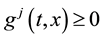 for all t). Strong growth conditions are needed for the results to hold.
For Michel-type necessary condition in the case of unilateral state constraints, sees [8] .
The growth conditions used below, ((11), (12), (13)) are more demanding than the conditions applied in [9] for the case of no unilateral state constraints and no terminal constraints (problems with a dominant discount). In later work the authors use even more general conditions, see [10] (see also [11] , and [12] for problems with a special structure).
The results below are of especial interest in the case where not all states are completely constrained at infinity. In the opposite case, generalizations of Halkin’s infinite horizon theorem in [1] to problems with unilateral state constraints where no transversality conditions appear, like Theorem 9, p. 381 in [6] , frequently yield enough information for determining one or a few candidates for optimality. When not all states are completely constrained at infinity, transversality conditions related to the terminal conditions are needed, unless one can accept the possibility of an infinite number of candidates for optimality.
In certain cases there is a danger of degeneracy of multipliers. See the early review in [13] and [14] . We have added conditions that secure nondegeneracy of multipliers in some such cases, in particular in the case where unilateral constraints are satisfied as equalities by the initial state (the state at time zero). See [15] -[17] for a presentation of similar conditions in the finite horizon case, as well as for a number of references for this case (see for example [18] -[22] ).
2. The Control Problem, Necessary Conditions, and Examples
Consider the problem
 (1)
(1)
where
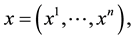 subject to
 (2)
(2)
 (3)
(3)
 (4)
(4)
where we require that
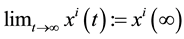 exists for
 and where
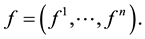 Here,
Here,

 and n are given natural numbers, and we allow for the case where there are no equality constraints or no inequality constraints in (4) (in which cases
 and
and
 so
so
 and/or
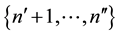 are empty sets). Furthermore,
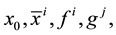
 are fixed entities, u the control. It is possible that
 in which case
 is replaced by
 We want to maximize the objective in (1) over the set
 of all measurable functions
 taking values in U and being bounded on bounded time intervals, subject
to (2)-(4). When the solution
 corresponding to such a
 satisfies (2)-(4), we call
 admissible. Below
 will be a given optimal admissible pair, assumed to exist.
We assume that
 is continuous in
 that
that
 is measurable in
 continuous in
 with derivatives
 and
and , where
 is continuous in x and
 is continuous in
 We also assume, for any bounded sets
 and
and
 that
that

and that for any x,
 These assumptions are called the basic smoothness
assumptions. At various points some strengthening of these assumptions are added.
The following definitions are needed: let


 let
let
 be the resolvent of the equation
 (
( I the identity map),
 if
if


In Theorem 1, in addition to the basic assumptions, assumptions (5)-(15) below are needed. It is assumed that for all

 (5)
(5)
We shall make use of some constraint qualifications, (6) and (8) below, related to
 Define

 ,
,


 ,
,

 (6)
(6)
((6) holds vacuously if ).
).
 (7)
(7)
 (8)
(8)


 (9)
(9)
Either2


 (10)
(10)
The following growth conditions are also needed: For some

 (11)
(11)
and there exist some positive constants
 such that
 (12)
(12)
 (13)
(13)
where . In (10) (g), we also need that for some

 for all


Assume finally that, for all j
 (14)
(14)
 (15)
(15)
Define
 The following necessary conditions for optimality holds.
Theorem 1. (Necessary condition, infinite horizon) Assume (5)-(8), (11)-(15) and the basic smoothness as
sumptions. There exist a number
 vectors
 ,
,
 bounded vector functions
 and
and

 nondecreasing and right continuous on
 , such that if
 3 satisfies, for
 , the equation
 (16)
(16)
then
 (the limit does exist),

 is left continuous on
 and satisfies (16) for
 (the integrals exist), and
 (17)
(17)
Moreover,
 (18)
(18)
 (19)
(19)

 (20)
(20)
Finally,
 for some
 and if (6) fails, then (18) must be replaced by
 ,
,
Remark 1. For
 the growth condition in (13) can be weakened to : For some
 for all

 (where still
 satisfies
 ). ,
). ,
In the sequel three trivial examples with rather obvious optimal controls will be presented, but to illustrate the use of the necessary conditions, we derive the form of the optimal controls from these conditions.
Example 1.
 ,
,

 free,
free,


 free.
free.
Solution:
Evidently
 and, because
 by necessity,
 for all t. For
 from (16) we get

 Then
Then
 The maxi- mum condition is that
 (21)
(21)
Consider first the case that we might have


 Let
Let
 satisfy
 Now, for


 means that
 for t close to T,

see the expression for
 so
so
 for t close to T. But this surely continues back to
 (see
(see
the expression for
 again). So even
 for
for
 (for such t, in fact,

when ). Let
 be the smallest
 such that
 for
for
 Consider first the subcase
 Then
Then
 and by the expression for
 ,
,
 and
and

 By the maximum condition
 for
for

 for
for
 We must have
 in order to obtain
 we get


 for
for

 for
for
 so
so
 For
For

 (
( an arbitrary constant). Using
 we get
 hence
hence
 Thus,
Thus,
 ,
,
 with k satisfying
 i.e.
i.e.
 so
so
 (By the way, note here that as
 satisfies the equation for
 we would know that
 for some constant C, but
 would not determine the constant. This shows the usefulness of the formula
 ) The subcase
 is impossible, then
 and
and
 The case

 is impossible, then
 for t close to T, so
 for such t and then for all t (see the expression for
 ). In fact,
 when
when
 so
so
 for all t, implying
 and
and
 a contradiction. Consider finally
 Then, by (18),
 so
so
 and then
 for t close to T, so
 for such t, in fact for all t (see the expression for
 ), and
 Hence,
 for all t, which gives
 and
and
 contradicting
 ,
,
Remark 2. (Further non-triviality properties)
a) Replace (6) by the assumption that either
 is empty, or (if not), for some
 some
some
 for any
 there exists a
 such that
 for all
 where
where
 is assumed to exist. Assume also that
 and
and

 are bounded4. Then

b) Assume in addition that, for any
 either
 is empty, or (if not), there exists a
 such that
 for all
 and, in case
 that for each u,
 is continuous, that

 is left continuous at each
 and has a limit when
 Then
Then
 ,
,
For finite horizon normality conditions, see [23] and [24] .
The main reason for including the next theorem is that it forms a basis for obtaining Theorem 1, but it has some interest of its own.
It contains necessary conditions for the case where (14) and/or (15) fail, in particular where
 also depends on

 We then need three conditions, see (25)-(27) below, that automatically hold if (14) and (15) are satisfied.
Theorem 2. In the situation of Theorem 1, with (5), (6), (8), (14), and (15) deleted, assume that the three conditions (25), (26), (27) below are satisfied. Then the following necessary conditions hold: for some
 for some vector
 and some bounded nonnegative finitely additive set functions
 vanishing on sets of Lebesgue measure zero, for a.e. s, for all

 (22)
(22)
where


 (
( and the integrals exist). Moreover,

 satisfying (20). Finally, defining
 we have
 (23)
(23)
 (24)
(24)
If (7) and (8) hold,
 Moreover,
 if, for some
 and some positive

 when
when
 for all

 Finally, if both the last condition and (7) and (8) hold, then
 ,
,
As before when

 is replaced by

Assume, for some arbitrarily large
 that the conditions (25)-(27) hold
 (25)
(25)
Let
 be a solution on
 of
of
 for
for
 given. For some positive second order term
 (i.e.
(i.e. ), if
), if
 then, for all j, for all

 (26)
(26)
Moreover, for any given number
 and any given positive second order term
 a positive second order term
 exists such that the following property holds. Let
 be a solution on
 of
of
 for
for
 given,
 . Then, if

 (27)
(27)
As an example in which (25)-(27) hold, consider a case where
 (11) and (12) hold for
 where f
is concave in x, and where, for some positive


 is
is
 and convex,
 and
and

 all j,
 (For
(For
 in a short
hand notation

where
 which means that, a.e.,
 so
so

 If
If
 then
then
 and then

Remark 3. For Theorem 2 to hold, we can weaken (7) and the basic assumptions on
 and
and
 as follows: the derivatives
 and
and
 exist at
 for all t and the three conditions on
 below are satisfied: For all

 (28)
(28)
 (29)
(29)
 (30)
(30)
Moreover in the growth conditions (12) and (13), roughly speaking, the inequalities need not hold for states x that cannot possibly occur, more precisely, the conditions can be modified as follows. Define for each t,


 the solution of (2) corresponding to
 . Then (12), (13) need only hold for some
 for
for
 such that
 In (10)(g) we must add the assumptions that, for some

 is differentiable in
 at
at
 uniformly in
 with a derivative at this point bounded uniformly in

Finally, U can be replaced by a time dependent subset
 where
where

 ,
,
 continuous, we then require all control functions to satisfy
 We assume
 and in case
 in (9), we require
 Then the maximum conditions (17) and (22) hold only for
 (The set U can even be replaced by
 with (17) and (22) holding for
 We must then still require
 and, in (9),
 In the proof below, the perturbations
 of the optimal control have to belong to
 . ,
. ,
Example 2.


 for all t,


 free. It is convenient to replace
 by
by
 (Then (25)-(27) will be satisfied). Choose
 as the largest possible
 such that
 for
for
 If
If
 and even, for some

 for all t, then

 so
so
 by the maximum condition
 (31)
(31)
and , contradicting the last inequality. Consider now the case where

Let
 be the set of time points s for which (31) holds. Now,
 implies the existence of some
 for which
 5, (
5, ( see the state equation). If

 can be chosen arbitrarily large, if

 can be chosen arbitrarily close to
 . Now,
 so
so
 If
If
 then
then
 (use (31) for
 ), implying
 contradicting
 Hence,
 (Note that this
argument would not work if we had replaced
 by, say,
 ). For
 by (31),
 and because
 is strictly decreasing on
 (
( is con-
stant on ), in fact
 on
on
 in fact on all
 by (31). Hence, on

 so
so
 is finite and
 and
and
 It is easily seen by a similar argument that on

 : to see this, having
 on an interval
 , assuming that
 is as large as
possible, is impossible: Let
 and define
 Now,
Now,
 leads to

 on
on
 which is impossible, and both for
 and
and
 and for
 and
and
 certain time points in
 close to
 (i.e. arbitrarily large if
 ) exist at which
 but then
 in
in
 by (31), as
 is strictly decreasing in
 . But
. But
 in
in
 contradicts

 in
in . Hence, on
 ,
,
 by (31), so
 or
or
 on
on
 (
( can be represented by an integrable function
 here). If we put
 , we have a valid proposal for the multipliers (It can be seen that
 is even necessary, compare (89(ii)) on p. 333 in [6] ).
Example 3.


 ,
,

 free. It is convenient to replace
 by
by
 The maximum condition is
 (32)
(32)
Again, assuming, for some
 that
that
 for all t, and (in the opposite case)
 both yield contradictions. So
 Now,
Now,
 in (32) is impossible, so
 all the time. But, due to the constraint
 then
then
 all the time (see the state equation). Let
 The maximum condition (32) yields

 , for
, for

 Now,
Now, . The general solution is
 To have the initial condition and

 satisfied we need

 and hence

Remark 4. Assume in the problem (1)-(7), (11)-(15), that
 is convex and that there are given additional constraints in the problem of the form

 (Perhaps
 In this case, here and below, replace
 by
by .) Assume that
 is optimal in this problem. We assume for
 that
that
 is continuous and depends only on

 , that
 and
and
 exist, that

 that
that
 is continuous in
 uniformly in t and that
 is
is
 in
in
 and measurable in t. We assume, for some positive constants
 for all
 that for

 and
and
 for
for
 and
and
 for
for
 and, for
 that
that
 and
and
 for
for
 and
and
 for
for

 Define
 {
{ : For all
 such that

 }. Assume that
 and that (8) holds, for
 for
for
 in (9). Write


 Then, in addition to

 and
and
 satisfying (20), (23), and (24),
 there exist bounded non-
negative finitely additive set functions

 also vanishing on Lebesgue null sets, such that (22) holds
for , summing now over
 Moreover, for
 for all

 (33)
(33)
 (34)
(34)
( and the integrals exist). Furthermore, for
 we have
 on
on
 and on
 for all
 Finally,
 where
where
 (If (6) fails, then the last property must be replaced by
 ).
).
When for some vectors ,
,

 the following properties hold: the maxi-
mum condition (17) holds for , together with
 (35)
(35)
for all
 where now

 (36)
(36)
and where, for some nonnegative


 ,
,
 ,
,
 for
for
 and
and
 for
for
 if
if
 or if
or if
 for
for
 Moreover,
 and in (36), for

 can be
represented by a bounded nondecreasing right-continuous function
 and, finally,
 (If (6) fails, then this property must be replaced by
 ).
).
When, in addition, for some
 some
some

 for all
 the inequality
 holds for all t, then
 for
for
 and, for
 in both (36) and (35),
 can be represented by a nonnegative function
 in
in
 (replace
 by
by ) and, moreover,
 (If (6) fails, then this property must be replaced by
 ). Finally, in this case, for a.e. t, for all

 ,
,
3. Proofs of the Results
Proof of Theorem 2. To simplify the notation, instead of the criterion (1), we can and shall assume that
 is the criterion to be maximized,
 that
that
 is free, hence is not required to be equal to
 The proof will be carried out under the assumptions of Theorem 2, allowing for the weakening of these assumptions in Remark 3.
Overview of the proof. A rough outline of the proof is as follows. We are going to make a number of strong (needleshaped) perturbations of
 This gives rise to first order variations of the optimal trajectory (the
 - functions below). We introduce a convex subset of these variations (
 below) consisting of variations satisfying a first order version of the unilateral constraint. We then introduce the convex set of endpoints (at infinity) of these variations as is standard in traditional proofs of the maximum principle, and show that it has to be separated from the set of “better, first order admissible” points, the set {
 for
for
 if
if
 } (The endpoints we consider consist actually only of the first
 components of the state). The separation argument (carried out in
 ) consists of a standard use of the Brouwer fixed point theorem combined with the fact the endpoints are “good” first order approximations of the endpoints of the exact solutions following from the perturbations. We need the fact that these exact solutions satisfy the unilateral state constraint, and this is shown first. The separating functional (
 -vector) is denoted
 . Another separation argument, carried out in
 -space’ gives the multipliers
 related to the unilateral state constraints.
Detailed proof. To avoid certain problems connected with coinciding perturbation time points, the following construction is helpful (we then avoid coinciding perturbation time points). Let
 be a countable dense set in
 and let
 be the set of right Lebesgue points of
 and all

 in
in
 Then choose some set
 of full measure (i.e. meas
 ),
),
such that for each
 a subset
 of
of
 exists with the property that if
 and
and
 then
then
 and with the property that for each
 each
each
 there exists a sequence
 such
such
that
 and
and

 For any given

 let
let
 be the collection of
 -tuples of the type


 and for all
 such that

 belongs
to
 and
and
 belongs to
 (This means that for any

 if
if
 then
then
 which implies
 ). The separate treatment of the case
 where we can have several perturbations at the same time, is useful for obtaining nondegeneracy results (i.e. informative necessary conditions). Below
 is varying

Let
 and for

 define
 (37)
(37)
and


where a sum over an empty set is put equal to zero. For


Let
 and note that
 is convex6. Define
 to be the convex subset of
 consisting of functions
 that satisfy: For some


 (38)
(38)
where

The linear variations
 are the ones that will appear in the necessary conditions that will be obtained (see (53), (54) below). These variations are jumping at each perturbation time points, so, near these points, they do not approximate (to the first order) the corresponding (continuous) exact solutions. Yet, we are able to show that the latter solutions satisfy the unilateral constraints when
 belongs to
 . To show this, the “better”, continuous, approximations
 are used.
3.1. Satisfaction of the Unilateral Constraints by Perturbed Solutions
Fix a pair
 such that
 satisfies (38) for certain numbers


 . Let
. Let
 be some number for which (25), (26) and (27) hold. There exists a
 so small that
 (39)
(39)
To see this, choose
 such that (39) is satisfied in this manner both for
 and (by using (25)) for
 Then, for


 satisfies
 (40)
(40)
For some positive
 for
for
 for all
 , when
 then
then
 and
and
 are disjoint for all
 and, moreover,
 if
if

( is closed). Let
 be the set of points
 in
in
 for which
 (41)
(41)
Now,
 (42)
(42)
by (40) because
 in
in
 Let
Let
 and define
 inductively by the for
mula
 (
( ). Let
 and, for
 let
let

 (see (37) for
 ). Then, assuming right continuity at
 , (see (9)7), it is easily seen that
 (43)
(43)
is small when
 is small,
 uniformly in
 See the arguments connected with (74) below. For
 let
let
 for
for
 let
let
 for
for

 (recall that these intervals are disjoint when the left ends differ and that
 ), and
 elsewhere. Let
 be the corresponding solution. Define

Now, for
 small,
 for
for
 hence by (43) and the Lebesgue point property of
 and
and
 at
at

 is of the second order in
 uniformly in
 and
and
 Let
Let
 We want to prove that for some

 (44)
(44)
Because
 is bounded by assumption (25), and
 is of the second order,
 is of the second order, uniformly in
 Moreover,
 is of the second order, uniformly in
 by the boundedness of
 Hence, by (41), for some positive
 for
for

 (45)
(45)
Next, it is well-known that
 (46)
(46)
uniformly in

 (see Lemma D in Appendix). Moreover, by the differentiability assumption on
 at
at
 ((28)), for some positive second order term
 , we have
 (47)
(47)
for all
 (because
 is of the first order in
 ). Hence, for some positive second order term
 for
for

 (48)
(48)
both for all
 by boundedness of
 on
on
 (combine (46) and (47)) and for all
 (com-
(com-
bine (27) and (26)). Then, by (45), for some positive

 for
for


 Moreover,
for some positive
 for
for
 for all t, by (48),
 and (by (25)),
 uniformly in

 so uniformly for


 (49)
(49)
Hence, (44) has been shown, and in particular, (see (42))
 (50)
(50)
So far, we have only used the basic assumptions and the first of the three conditions on
 in Remark 3, namely (28). The other two properties, (30) and (29), will be used in what follows.
We want to show that
 when
when


 Now,
Now,
 implies
 for
for

 close to
 (recall
 ). Thus, by (40),
 for
for
 and
and

 For
For
 small (
 ),
), when
when

 (by continuity,

 is small, when
 is small). Note that if
 for some
 ,
,
 is a convex combination of
 and
and
 (the former one has weight
 ). Hence, for any

 belongs to the segment between
 and
and
 hence
hence
 for
for


So far, we have proved (44) for
 recall that if
 then for
 ,
,
 (in particular this holds for
 so for
 (44) holds for all
 ).
).
Finally, let us prove (44) for

 We can assume that
 is so small that
 if
if

 So consider the case where
 ,
,

Then the right derivative

 First
First
consider the subcase where
 and
and
 (only one
 ). By (39),

 Combining the two last weak inequalities we get
 Then
Then
 so
so
 for
for

 for
for
 small (
 ).
).
Consider next the subcase where
 contains several pairs


 ,
,
 Using (43), it is easily seen that
 When
When
 and
and
 we have that
 Now,
Now,
 by (39), so
 Hence we again get
 for
for

 for
for
 small (
 ).
).
Thus, when
 satisfies (38), then
 (51)
(51)
3.2. Local Controllability at Infinity
Observation 1. Define
 and
and
 {
{ for
for
 for all
 with
with
 if
if
 }. Note that by Lemma B in Appendix, for all
 and
and ,
,
 and
and
 exist. Let
 be the convex set
 (for
(for
 see (38)). If
 , then for some positive
 , some


 where each
 equals


 linearly independent. Let
 Then
Then

 for some vector
 In fact, for each
 there is a unique
 such that

 evidently depends linearly on z, note that
 extends linearly to all
 . Let
. Let
 and let
 consist of all


 for
for
the moment we allow the pairs in
 to be doubly indexed, (and the time points not to be ordered). Then
 where
where
 (as we have double
indices on , we have double indices on the components of
 ). Note that

 Of course, we can re-index the pairs in
 (and so also the entities
 ) by using a
single index, with the time points in the pairs in increasing order. Let
 be the number of pairs
 We use
 also as the name of the vector of reindexed pairs, and
 for the vector consisting of all entities
 reindexed in the same manner as the pairs in
 . Then for


 linear.
The following result should surprise nobody, a proof however is given in Appendix.
Lemma 1. Assume that for


 linear,
 . Then there exist some first order term
 (i.e.
(i.e. ) and some
 such that for each
 for some
 some
some

 ,
,

 ,
,
3.3. Separation Arguments That Yield the Multipliers
By optimality, for all

 To see this, assume, by contradiction the opposite,
that for some

 Then by Observation 1 and Lemma 1, for
 and small,
for some


 and
and
 satisfies the unilateral time constraint (3), see (51) (because
 and
and ). The last equality gives that
 satisfies the terminal constraint (4) for
 small, and that
 This contradicts the optimality of
 . Thus the sets
 and
and
 are disjoint (this is trivial if
 ). Thus these sets can be separated8: there exists a nonzero vector
 such that
 As
As
 this inequality gives that
 (52)
(52)
Define
 {
{ : for all j, for some positive
 ,
,
 ,
,
 when
when
 }. Recall that
 for all
 see (25), and write
 . Note that
 (for
(for , see (38)) has to be disjoint from the convex body
 in
in
 otherwise the inequality
 is contradicted. By separation, for some continuous linear functional
 on
on
 and some number


 (53)
(53)
for all
 all
all
 Evidently, by this inequality,
 and
and
 are nonnegative on
 , with
 for all
 Each
Each
 can be represented by a bounded
finitely additive nonnegative set function
 vanishing on sets of Lebesgue measure zero. Evidently,
 va-
va-
nishes on
 for all
 in particular
 vanishes on
 The inequality (53) gives that, for
 ), for all pairs


 (
( still fixed in
 ) and for all pairs


 and
and

 (54)
(54)
where
 (To obtain (54), in (53) let
 ). Moreover, (54) also holds for
 , for
, for
 for any given

Let us now choose a sequence
 converging to zero when
 such that (54) holds in the manner
described for
 for certain multipliers

 In particular (54) holds for
 for any given
 Let us fix such a sequence
 assuming it to be bounded. We can assume that
 (we extend
 to
to
 by letting
 ). Using the weak* topology on
 there exists a cluster point
 of the sequence
 satisfying
 (55)
(55)
(for some subsequence

 ). (by the cluster point property, so the last
equality holds). The cluster point
 is a bounded nonnegative finitely additive set function that vanishes on Lebesgue null sets. It is furthermore easily seen that (54) holds for
 and
and , for
, for ,
,
 and for
 , both for
 equal to the cluster point
 9 as well as for
 provided this limit exists, for any
 for any given


Now
 is nondecreasing and bounded. Let
 be the continuity points in
 of
of

 For any
 and for any
 a sequence
 exists, such that
 and
and
 (see the very beginning of this proof), and because (54) holds for
 it is easily seen by taking limits that (54) holds for
 and
and
 10.
10.
Finally, let us extract an additional property. If
 for all t in some interval
 and
and
 then, for some

 for
for
 when
when
 which by (55) implies
 and hence
 . Thus
 (56)
(56)
for (say)
 11.
11.
3.4. Further Information on the Multipliers in Special Cases
Let us prove the results concerning the multipliers in the three last sentences in Theorem 2 in the case where
 is maximized.
Define
 (57)
(57)
Now, assume (9) and (10) (a), with
 We may assume of the sequence
 used above that
 for the single
 (there exists a sequence
 such that
 ). Here (29) was used. Let
 satisfy the inequality in (9), define
 and assume that
 Then, by (30), for some
 for
for
 close to 0,
 which combined with the previous inequality gives
 So
So

 any given cluster point of
 . We can assume that (54)
holds for this cluster point , for
, for

Evidently,
 for all t close to 0. Now, if
 and
and
 for all
 then for any

 From
From
 we get, for all
 close to zero, that
 which gives
 for
for
 close to zero, and so
 a contradiction. Hence,

When
 and 0 is a right Lebesgue point of
 (i.e. (10) (b) holds), we can choose the sequence
 Evidently, by (29),
 when
when
 so again

 and we get the same conclusion regarding
 (with
(with
 again) and in this case, (as well as in the case that
 is differentiable,
i.e. (10) (g), see Appendix), we don’t need the assumption that
 contains a single element12. In fact,
when (8) holds, in Theorem 2, we can assume

Define
 Note that, by (23),
 for
for
 large enough if
 Assume that a
 and positive numbers
 and
and
 exist such that
 (58)
(58)
(see the end of Theorem 2). For


Assume for the moment that
 Choose a sequence
 such that
 Letting
 in the preceding inequality, and using
 (see Appendix, Lemma A), we get
 so
so

Can ? No, we have shown that then
 , and then
 so
so
 a contradiction. So when (58) holds
 (59)
(59)
Finally, assume that both (58) and (8) are satisfied. By contradiction assume now that
 Then
Then
 (Þ
(Þ and
and , so
, so
 a contradiction. So (58) and (8) imply
 (60)
(60)
Proof of Theorem 1.
We still keep the assumption that
 is maximized. Using lemmas in Appendix, note that (25)-(28) are implied by the basic smoothness assumptions, the growth conditions (11)-(13), (7), (14) (i.e.
 depends only
on ,
, ), and (15) implying that
 is differentiable at 0, uniformly in t ((27) follows from Lemma E in Appendix). Moreover, also (29), (30) evidently follow. So all the above results also hold in the situation of Theorem 1. Using the definition (57) the maximum condition (54) can be written
 (61)
(61)
Now,
 Using
Using
 (5) and (14),
 when
when
 Then, by (57), also
 exists, and
 Hence,
 when
when

Let
 Let
Let
 be the continuity points of all
 Write for the moment

and
 Then13, for

 and then

 With
With
 (
( occurring in the definition of
 ) it is well-known that
 satisfies (16)14. Evidently, (61) yields
 (62)
(62)
In Theorem 1, we have written
 and
and
 instead of
 and
and .
.
Note that (6) implies that (58) holds, as ,
, . Thus, (60) holds, which means that
 in the situation of Theorem 1, because then
 exists and equals
 .
.
Proof of Remark 2. We give a proof for the case where
 is maximized. Note that
 for
for
 for
for
 where
where
 is a set of Lebesgue points of
 of full measure. The inequality holds for all
 in case of left continuity of
 .
.
Proof of a)
Let

 and recall
 Assume
 Assume by contradiction that
 Then, for all
 large enough


(the last term is
 all square brackets
 when
when ). Then
 which is a contradiction because
 for
for
 So
So
 cannot be
 when
when . Hence
 implies

Proof of b) Assume by contradiction that

If
 then for some arbitrary large
 we must have
 For
For
 for all j, for large
 the left hand side is
 i.e. it does not change much if
 is replaced by
 . Hence, for
 (whether
 or =1), for large
 , for
, for
 as in a),

Using the vectors
 in a), for
 large we then have
 Because
 when
when
 s large, we finally get
 when
when
 is large. When s is large
 means
means

 Using
Using
 and (22) (which even holds for

 ), for
 large, we get
 Hence, both for
 and for

 for some (large) s.
Next, let
 By contradiction, assume
 Let
Let
 where
where
 has the property that
 for
for
 see b). By continuity, for any
 and close to

 (63)
(63)
There exist

 and arbitrarily close to
 such that for

 . If
. If
 for all j, the left hand side is
 so for
 close to

 for all
 whether
 or
or
 Combining this inequality with (63), we get for
 s close to
 that
that
 for
for
 15. From this, we finally get, by Lipschitz continuity of
 on
on , uniformly in s, that there exists a

 and close to
 such that
 when
when
 and
and
 can be chosen so close to
 that
that
 when
when

 The last inequality and (22) then yields
 which gives
 both for
 and for
 and so
 for all j. Evidently we cannot have
 so
so
 Thus
Thus
 contradicting
 Hence
Hence

Proof of Remark 4. We construct an auxiliary problem: assume for given functions
 that we want to maximize
 subject to
 (64)
(64)


 measurable. Here

 are auxiliary states, governed by


 where
where
 are auxiliary controls. Write
 For
For
 define
 {
{

 if
if

 },
},
 , and let
 Below,
 is so small that
 Given any measurable control functions


 let
let

 be the solutions of (64) and
 corresponding to

 . For any
 there exists a
 such that if
 and
and
 then
then
 for all t, by Lemmas B and C in Appendix, hence, by continuity of
 at
at
 uniformly in t, for some


 for
for
 when
when
 and
and
 (
( and
and
 perhaps dependent on
 ). In the auxiliary problem the constraints are the terminal constraints (4),


 for all
 for
for

 for all
 for
for

 Hence, if
 is admissible in the auxiliary problem, we have seen that
 is admissible in the original problem when

 We assume that
 is
is
 (for
(for
 see the beginning of Remark 4, then
 and then, for
 the property related to
 in Remark 3 is satisfied in the auxiliary problem for
 ). So, in the auxiliary problem,

 are optimal in the set of controls {


 }. The arguments in the proof of Theorem 2 apply also in the present situation, with one modification: For
 the inequality
 in
in
 for
for

 automatically holds for
 Hence the arguments in the section between (50) and (51) are not needed16 (and do not work) for

The necessary conditions in Theorem 2 are now applied to this auxiliary system (they apply even when admissible controls are restricted as above, see the inequalities involving
 and even for
 replaced by
 see the end of Remark 317. In the auxiliary system, the linearized system is

 where
where
 is the transposed of
 The resolvent of the linearized system becomes
 (65)
(65)
where

 From Lemma A in Appendix, we get that
 (66)
(66)
for some constant Q, independent of t and , where
 is the i’th row of B and
 (to apply Lemma A, note that for

 in an obvious notation,

 where
where


 ). Note that (22), or actually (54), applied to the auxiliary system, holds for
 for the limit point

 given,
 any given element in
 (see remarks subsequent to (55)). From this we get, for
 and
and

 and
and
 that
that
 (67)
(67)
From now on assume
 in (67). Moreover, for

 from (54) applied to the auxiliary system, we get that (54) holds as written. Finally,

 defined below.
Let
 consist of all pairs
 such that
 satisfies (52) and
 satisfies

 for all
 and (56) for
 with
with
 Let
Let


 consist of all pairs
 such that (67) holds for the given
 and (54) are satisfied for all
 for a.e. s, in particular for

 and
and

 any given
cluster point of any given sequence , each
 corresponding to some collection
 from
from .
.
Let
 consist of all finite set


 We have just proved that for each
 ,
,
 is nonempty, so by compactness
 is nonempty (the weak* topology is applied on the m’s ). Let
 be any given element in the latter intersection. Then, for
 , both
(67) holds for all
 and (54) is satisfied for
 for a.e. s. (To obtain this last property, preferably the set
 of point s for which (54) holds should be independent of the
 ’s in each
 , one can use that (54) now holds for
 , for
, for
 for
for ,
,
 and hence by earlier limit arguments (54) holds for
 , for all
 , for a.e. s). We also have that (54) is satisfied by
 for
for
 for any given cluster point
 for any given sequence
 , each
 corresponding to some
 for some
 .
.
The proof of
 is the same as the proof for the analogous condition in the case
 noting that
 for some
 means for some

 for t near 0 (so

 again leads to a contradiction in the same way as before)18. Similarly,
 has essentially the same proof as before. To show
 in case
 holds, we now assume
 and we replace
 by
by
 in the definition of
 where
where

 Then from (66), we get
 (68)
(68)
Using the inequality
 (69)
(69)
(i.e. (67)), we get
 (70)
(70)
Note that
 So, from (68), (70) and
 ,
,
 it follows that
 Then
Then

 (note the
 -norm on
 ). But then
 ,
,
 can be
represented by nonnegative functions
 in
in
 in fact in
 because
 is bounded.
Let us finally show that
 when
when
 exists. By (66), for


 independent of
 and
and

 So, for

 ,
,
 By this inequality, there exists a
 such that, for

 for
for

 Next, for some
 , for
, for


 for
for . To see this, for k chosen such that

 for
for
 note that
 when
when
 By (67) and the two inequalities involving
 for
for , and for
 for any


But then

 because
 was arbitrary. A contradiction of
 has arisen, so

4. Conclusion
The paper establishes necessary conditions for optimality in a smooth infinite horizon optimal control problem with unilateral state constraints and terminal constraints at the infinite horizon. The necessary conditions include a complete set of transversality conditions at infinity. The specific growth conditions placed upon the system in this paper can easily be modified, but strong growth conditions are in any case needed for the full set of necessary conditions to hold.
Acknowledgements
I was deeply grateful to the referees. Their detailed comments made it possible to correct omissions and improve the exposition.
Cite this paper
AtleSeierstad, (2015) A Maximum Principle for Smooth Infinite Horizon Optimal Control Problems with State Constraints and with Terminal Constraints at Infinity. Open Journal of Optimization,04,100-130. doi: 10.4236/ojop.2015.43012
References
- 1. Halkin, H. (1974) Necessary Conditions for Optimal Control Problems with Infinite Horizons. Econometrica, 42, 267-272.
http://dx.doi.org/10.2307/1911976 - 2. Michel, P. (1982) On the Transversality Condition in Infinite Horizon Problems. Econometrica, 50, 975-985.
http://dx.doi.org/10.2307/1912772 - 3. Seierstad, A. and Sydsaeter, K. (2009) Conditions Implying the Vanishing of the Hamiltonian at Infinity in Optimal Control Problems. Optimization Letters, 3, 507-512.
http://dx.doi.org/10.1007/s11590-009-0128-7 - 4. Aseev, S.M. and Veliov, V.M. (2011) Maximum Principles for Infinite-Horizon Optimal Control Problems with Dominating Discount. Research Report 2011-06 June, Operations Research and Control Systems, Institute of Mathematical Methods in Economics, Vienna University of Technology, Vienna.
- 5. Benveneniste, L. and Scheinkman, J. (1982) Duality Theory for Dynamic Optimization Models in Economics. Journal of Economic Theory, 27, 1-19.
http://dx.doi.org/10.1016/0022-0531(82)90012-6 - 6. Seierstad, A. and K. Sydsaeter (1987) Optimal Control Theory with Economic Applications. Amsterdam, The Netherland.
- 7. Seierstad, A. (1999) Necessary Conditions for Non-Smooth Infinite Horizon Control Problems. Journal of Optimization Theory and Applications, 103, 201-229.
http://dx.doi.org/10.1023/A:1021733719020 - 8. Pereira, F.L. and Silva, G.N. (2011) A Maximum Principle for Constrained Infinite Horizon Dynamic Control Systems. Preprints of the 18th IFAC World-Congress, Milano, 28 August-2 September 2011, 10207-10212.
- 9. de Oliveira, V.A. and Silva, G.N. (2009) Optimality Conditions for Infinite Horizon Control problems with State Constraints. Nonlinear Analysis, 71, e1788-e1795.
- 10. Aseev, S.M. and Veliov, V.M. (2012) Needle Variations in Infinite-Horizon Optimal Control. Research Report 2012-4, September, Operations Research and Control Systems, Institute of Mathematical Methods in Economics, Vienna University of Technology, Vienna.
- 11. Aseev, S.M. and Kryazhimskii, A.V. (2004) The Pontryagin Maximum Principle and Transversality Conditions for a Class of Optimal Control Problems with Infinite Time Horizons. SIAM Journal on Control and Optimization, 43, 1094-1119.
- 12. Weber, T.A. (2006) An Infinite-Horizon Maximum Principle with Bounds on the Adjoint Variable. Journal of Economic Dynamics and Control, 30, 229-241.
http://dx.doi.org/10.1016/j.jedc.2004.11.006 - 13. Arutyunov, A.V. and Aseev, S.M. (1977) Investigation of the Degeneracy Phenomenon of the Maximum Principle for Optimal Control with State Constraints. SIAM Journal on Control and Optimization, 35, 930-952.
http://dx.doi.org/10.1137/S036301299426996X - 14. Vinter, R.B. and Ferreira, M.M.A. (1994) When Is the Maximum Principle for State Constrained Problems Nondegenerate? Journal of Mathematical Analysis and Applications, 187, 438-467.
http://dx.doi.org/10.1006/jmaa.1994.1366 - 15. Ferreira, M.M.A. and Fontes, F.A.C.C. (2004) Nondegeneracy and Normality in Necessary Conditions for Optimality: An Overview. Proceedings of the 6th Portuguese Conference on Automatic Control, CONTROLO, Faro, Portugal, 1-9 June 2004.
- 16. Vinter, R.B. (2000) Optimal Control. Birkhäuser, Boston.
- 17. Arutyunov, A.V., Karamzin, D.Y. and Pereira, F.L. (2011) The Maximum Principle for Optimal Control Problems with State Constraints by R.V. Gamkrelidze: Revisited. Journal of Optimization Theory and Applications, 149, 474-493.
http://dx.doi.org/10.1007/s10957-011-9807-5 - 18. Arutyunov, A.V., Aseev, S.M. and Blagodatskikh, V.I. (1994) First Order Necessary Conditions in the Problem of Optimal Control of a Differential Inclusion with Phase Constraints. Russian Academy of Sciences Sbornik Mathematics, 79, 117-139.
http://dx.doi.org/10.1070/sm1994v079n01abeh003493 - 19. Arutyunov, A.V. (2000) Optimality Conditions: Abnormal and Degenerate Problems. Kluwer Academic, Dortdrecht.
http://dx.doi.org/10.1007/978-94-015-9438-7 - 20. Arutyunov, A.V. and Aseev, S.M. (1995) State Constraints in Optimal Control: The Degeneracy Phenomenon. Systems & Control Letters, 26, 267-273.
http://dx.doi.org/10.1016/0167-6911(95)00021-Z - 21. Rampazzo, F. and Vinter, R.B. (1999) A Theorem on the Existence of a Neighbouring Feasible Trajectory Satisfying a State Constraint, with Application to Optimal Control. IMA Journal of Mathematical Control and Information, 16, 335-351.
http://dx.doi.org/10.1093/imamci/16.4.335 - 22. Rampazzo, F. and Vinter, R.B. (2000) Degenerate Optimal Control Problems with State Constraints. SIAM Journal on Control and Optimization, 39, 989-1007.
http://dx.doi.org/10.1137/S0363012998340223 - 23. Bettiol, P. and Frankowska, H. (2007) Normality of the Maximum princIple for Nonconvex Constrained Bolza Problems. Journal of Differential Equations, 243, 2565-2569.
http://dx.doi.org/10.1016/j.jde.2007.05.005 - 24. Fontes, F.A.C.C. (2000) Normality in the Necessary Conditions of Optimality for Control Problems with State Constraints. Proceedings of the IASTED Conference on Control and Applications, Cancun, Mexico.
Appendix
Below, for any matrix

 .
.
Lemma A. Let


 let
let

where, in , the matrices in the first row are respectively
 and
and
 and in the second row
 and
and , and, in
 ,
,
 is
is
 and
and
 is
is
 all entries being measurable functions of

 and
and
 locally integrable. Assume that for some positive numbers


 Write
Write
 for the solution
 on
on ,
,
 , of
, of
 for
for
 given. Define
 Then for some positive number Q, only dependent on


 Hence
Hence

Lemma B. Let
 and
and
 be measurable in t, and with
 ,
,

 and
and
 Lipschitz continuous with Lipschitz constants
 ,
,
 ,
,
 and
and , respectively,
 Write
Write

 There exists a positive number
 such that the following properties hold: let
 and
and
 be two solution on
 of
of
 for
for , respectively
 given, assumed to exist. Then for all t,
 and
and , so
, so
 which implies that
 exists if
 exists. ,
Note that
 and
and
 do exist whenever
 and
and
 are integrable.
The proofs of the lemmas A and B are of a standard type and omitted in order to save space.
Let
 be given and let
 Let
Let

Lemma C. Let
 be a family of functions
 such that all
 are Lipschitz
continuous in
 with a common Lipschitz rank

 integrable, and with
 measurable. Let
 be a solution of

 and
and
 given (assumed to exist). Assume that all

 are bounded by a common constant
 . Then a constant
 exists such
that for any
 for any given
 , a solution of

 exists, and
 for all
 .
.
Proof of Lemma C. Note that
 so by Gronwall’s inequality,

Lemma D. Let
 be a family of functions
 all Lipschitz continuous in x with a
common Lipschitz rank ,
,
 integrable, and with
 measurable. Let
 be a given function in
 and let
 be a solution of
 ,
,
 given (assumed to exist). We assume that all

 are bounded by a common constant
 . We also assume that
 is differentiable at
 for a.e. t. For
 let
let
 be a solution of


 given. Then, for some
 for all t,
 when
when

 Moreover, for some
 and some second order term
 for all t, all
 all
all
 all f such that

 where
where
 is the solution of

 given (it does exist).
Proof of Lemma D. The proof of
 follows from Lemma C. Let
 and let
 on
on

 We have that
 and, by differentiability of
 at
at
 we have that
 for some second order increasing term
 , so for


for a.e. t. Dividing by d, we get

By Lebesgue’s dominated convergence theorem,
 when
when . As
. As

then

and then by Gronwall’s inequality,

where
 a second order term in d, equals

Lemma E. In the situation of Lemma B, let
 be differentiable at
 where
where
 is a given solution on
 of
of

 given, assumed to exist. For each
 let
let
 be a solution on

 of
of

 given (it does exist), and let
 be a solution of

 given. Assume that, for some K,
 for all

 a second order term in d. Then for some second order term
 ,
,

Proof of Lemma E. By Lemma D, for some term
 being of the second order in d,
 when
when
 is of the second order. For some

 for
for
 Hence, by Lemma B, for some constants

 we have that


 so
so

By Lebesgue’s dominated convergence theorem the conclusion in the lemma follows if we can prove that for
each t,
 when
when
 To obtain the latter fact, let
 and note that

where the second order term

Proof of Lemma 1.
Consider the map
 for
for
 d any number in
 . Let
. Let
 and note that, by Lemma C,
 and
and
 are continuous in
 Then, by Lemma B,
 and
and
 are continuous in
 Let
Let
 be a Lipschitz rank of
 and
and . For
. For
 let the second order term
 satisfy
 when
when


for the existence of
 see Lemmas D and E. Recall that
 and that
 when
when
 for some second order term
 , see an argument preceding (44) and Lemma A. Hence, for
 ,
,
 when
when


Note that for
 we have
 as
as , and for d small (
 for some
 ),
),
 Fix such a
 . Now,
 is continuous in
 and has a fixed point
 here, by Brouwer’s fixed point theorem. As
 and
and


 Then let

 to obtain Lemma 1.
Observation A. On the space of continuous real-valued functions on
 with compact support, furnished with the sup-norm,
 can be represented by a nondecreasing bounded function
 such that
 for all bounded continuous
 with compact support. In fact, we can let

 , (
, ( right continuous for
 ). Let
 be the continuity points in
 of
of
 Then
Then
 for any
 hence for

 and
and
 so
so
 is also left continuous at s. For piecewise constant functions
 with bounded support, jumping only at points in
 evidently
 By approximating continuous function (or even piecewise continuous functions jumping only at points in
 ) by such piecewise constant functions, one see that the same equality holds for continuous functions (or such piecewise continuous functions)
 with bounded support.
Note that if
 uniformly (
 continuous, with a common bounded support), and
 then
then : Assuming for simplicity (say)
 , this follows from

Let

 arbitrary. For

 large,
 hence, for any

 Thus for


 Hence,
 when
when
 If
If
 is bounded and continuous, but with unbounded support, evidently, by the last inequality,
 so
so
 exists. As also
 (
(
 ), exactly the same argument works for
 the latter limit written

Proof of (10) (g) Þ

Assume again that
 is maximized and postulate the conditions in Theorem 2 (allow even for the conditions in Remark 3), in particular postulate (10) (g). For simplicity, assume
 for
for

 for
for

 We want to replace each condition

 by two conditions,
 for
for

 for
for
 It can be done by requiring that

 holds for
 and, by adding new constraints
 required to hold on
 , where
 for
for . We now first assume both that
 ,
,
 is independent of t, and that
 is independent of t for
 . Assume that there exist
 ,
,


 (see (9)) such that
 (71)
(71)
Then, for some
 both
both
 (72)
(72)
and, for

 (73)
(73)
Let
 have the property that
 and
and
 for
for
 Let
Let
 be a first order term (i.e.
 when
when ), such that
 when
when
 for all
 , i. As we did in connection with (43), let
 and define inductively

 . Let
. Let . Choose a partition

 of
of
 such that
 . Define
 It is easily seen that for

 (74)
(74)
for any
 To see this, note that for
 the left hand side vanishes, while for

 the left hand side is smaller that
 Let
Let
 Define


 Let
Let
 be any given number,

 such that
 and
and
 when
when .
.
Let

 Moreover, let

 Then
Then
 when
when

 as
as . So
. So
 when
when

Consider the following auxiliary control problem on . Define

 Let
Let
 and introduce the two state equations


 ,
,

 free, and let
 and
and
 be the controls. We require
 on
on
 for
for
 and
and
 on
on
 for
for
 and
and

 described below. The end conditions on
 are as before. Then
 and
and
 (on
(on ) are optimal in this problem, see below. Applying Theorem 2 to this problem, with
 and
and
 as costates corresponding to
 and
and , gives


 for all

 for
for


 and the maximum condition (22), i.e. (a.e.)


 ,
,
where

 ,
,
 In particular, because
 when
when

 see (72), then
 (75)
(75)
Assume by contradiction both that
 and that
 where
where
 which by necessity means that
 Then, fo r

 ,
,
 for
for

 for
for

 for
for
 which gives
 and
and
 for
for
 and
and
 for
for . Also,
 by (73). As
 , using (74), we have, for
 ,
,

contradicting
 for
for
 (as
(as
 is optimal).
The optimality of
 follows from the following argument: Let
 be an arbitrary admissible quadruple in the auxiliary problem. Let
 If
If
 let
let


 for
for
 let
let

 for
for
 and let
 ,
,
 for
for
 Next, let


 Then
Then

and hence
 Moreover,

So

 is a solution in the original system evidently satisfying the end restrictions, and
 for
for

 Because

 for
for


 and then
 for
for

 Finally, on


 as we shall see in a moment, so
 for
for
 hence
hence
 for all

 For
For
 let
let
 in which case
 is automatically an original solution.
From (74) and
 for
for
 we get
 (76)
(76)
Using
 when
when
 for
for


Then, by (72), (73), (76), for all
 all
all
 all
all


19In case we have constraints ,
,
 , (in which case
 ,
,
 is required), then for
 and
and
 small, for
 ,
,
 , as
, as .
.
As
 then
then
 for
for

 Moreover, for
 for some positive
 small enough,
 when
when

 (For
(For
 there is nothing to prove.)
Now,
 for
for
 so
so
 belongs to the set of admissible pairs in the original problem. We have
 hence
hence

 are optimal in the auxiliary problem19.
Let now

 where
where
 and let
 and
and
 be corresponding multipliers, satisfying the normalization
 We put
 Now,
Now,
 has a cluster point
 satisfying (22), (55), and (56). Assume now that
 . Then there exist some
 such that

 and hence
 Hence,
 which leads to a contradiction, as was shown above. Thus,
 .
.
We can extend this result to problems that are nonautonomous on , by using t as a new state variable, say z, governed by
 with x governed by
 provided that
 is jointly differentiable in
 at
at
 for all t, and that
 is differentiable in
 at
at
 uniformly in
 with a derivative at this point bounded uniformly in

NOTES

1In that theorem, correct the inequality
 by replacing it by
 .
.

2A right Lebesgue point s of any integrable function
 means a point s such that
 . If
. If
 in (9) even belongs to
 and (10) (b) holds, then the right continuity in (9) can be weakened to 0 being a right Lebesgue point of
 for all
 .
.

3 always exists, and is left continuous on
 .
.

4For
 it suffices that
 when
when ,
,
 , note that for
 ,
,
 for some C.

5Or even ,
an observation needed in the next example.
,
an observation needed in the next example.

6One may consult Observation 1 below at this point.

7Only when there are more than one perturbation
 at
at
 right continuity is needed to obtain (43). If there is a single perturbation at
 , (i.e. for all
 ,
,
 = some
 ) it suffices that
 is a right Lebesgue point of
 . Finally, if
 , then we shall throughout assume a single perturbation
 at
at .
.

8If
 and
and , then K and
 can be separated. If
 , then for some nonzero
 ,
,
 , and
, and
 can be chosen such that
 .
.

9For simplicity, assume that . Then, for any
 , for all n large enough,
 for all for
 , so, by (25); for
 ,
,
 , for any
 ; for all n large enough,
 for all
 . As
. As ,
,
 , so
, so , which converges to zero at least for a subsequence of
 .
.

10If U is replaced by
 as in Remark 3, we asume that
 . The perturbations
 will belong to
 , because in the proof we now require the
 ’s to belong to
 and then
 for t in
 , for d small. Then (54) holds for a.e. s for
 (Þ
(Þ for n) and also for
 , for any given cluster point
 of any given bounded sequence
 where
where ,
,
 ,
,
 In addition, (54) holds for
 for all limits
 of all such sequences
 that are convergent. In particular, (54) holds for a given cluster point
 of a given sequence
 , where
 ,
,
 given points in
 ,
, .
.
11In case , it can be assumed that
 , for all j, and, as said before, we then assume that for all P,
 ,
,
 some arbitrarily given element in
 (in
(in
 in case U is replaced by
 ,
,
 for n large).

12If (8) holds only for a subset
 of
of
 then it is easily seen that the collection
 ,
,
 ,
,
 ,
,
 is nonzero (at least one entity is nonzero).

13Observation A in Appendix may be consulted at this point.
14Compare e.g. Section 9.5 in [16] .

15As an alternative to the left continuity assumption on
 in Remark 2 (for
 ), we may assume that, if
 in the necessary conditions, then these conditions imply left continuity of
 on
on .
.

16Thus we don’t need (and often don’t have!) differentiability of
 for
for .
.
17The growth conditions related to
 are of the same type as those related to
 in problem (1)-(4). Note that the perturbations
 now belong to
 .
.

18We can again let ,
,
 also in the present case, (67) does not change for this change of
 .
.