

Journal of Applied Mathematics and Physics
Vol.04 No.05(2016), Article ID:66666,11 pages
10.4236/jamp.2016.45099
Properties of Solutions of Kolmogorov-Fisher Type Biological Population Task with Variable Density
Muhamediyeva Dildora
CDSPHSC under TUIT, Tashkent, Uzbekistan

Copyright © 2016 by author and Scientific Research Publishing Inc.
This work is licensed under the Creative Commons Attribution International License (CC BY).
http://creativecommons.org/licenses/by/4.0/



Received 5 April 2016; accepted 20 May 2016; published 23 May 2016
ABSTRACT
In this paper, we discussed population model of two competing populations with non-linear double diffusion and variable density which described by nonlinear system of competing individuals. We identify new properties, such as finite speed of propagation, and localization of the outbreaks in a specific area.
Keywords:
Model of Biological Population, Reaction-Diffusion, Double Nonlinearity, Self-Similar Solution, Variable Density, Fast Diffusion, Low Diffusion

1. Introduction
Population models are studied for a long time. The first such work was done by Gause G.F. and Fisher R.D., and mathematical studies were performed by Kolmogorov, Petrovskii (KPP) and Piskunov (1937) in the famous paper [1] - [4] . They were interested in the behavior of the speed of the wave solutions and the resulting estimate of the speed of wave propagation.
Then there were other models of the population [5] - [8] . In recent years, intensive study of nonlinear models was based on diffusion and revealed new properties of finite speed of propagation of diffusion waves (see [3] and the literature given there). We have proposed a population model of two competing populations with non-linear double diffusion and variable density that are described by nonlinear system of competing individuals. We identify new properties, such as finite speed of propagaton, and localization of the outbreaks in a specific area. In particular, in the critical case, the rate type CPT generalizes their result.
Statement of the Task
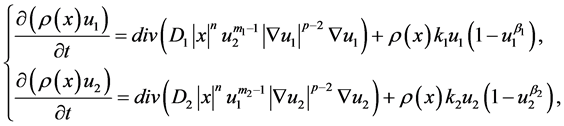
In this paper, we investigate the properties of solutions of biological population task of Fisher-Kolmogorov type in the case of variable density. The main research method is a self-similar approach. Considering in the field , there is a parabolic system of two quasilinear equations of reaction-diffusion
 (1)
(1)
 ,
,  , (2)
, (2)
which describes the process of biological population of Kolmogorov-Fisher in a nonlinear two-component environment, and mutual diffusion coefficients which are respectively equal to ,
,  . Numeric parameters
 ,
,  ,
,  are positive real numbers, and
 ,
,  ,
,  ,
,
 ;
; ,
,  is desired solutions.
We study properties of solutions to problem (1), (2) based on the self-similar analysis of solutions of a system of equations constructed by the method of nonlinear splitting and a reference equations and bringing the system (1) for radially symmetric mind. Note that replacing in (1)
 ,
, 
leads to the form
 (3)
(3)
 ,
, . (4)
. (4)
If , choosing
 ,
,  ,
,  ,
,
we get the following system of equations:
 (5)
(5)
where ,
, 
 ,
, 
If , and
, and ,
,  , system has the form:
 (6)
(6)
A significant role in the study of the Cauchy problem and boundary problems for Equations (1) has self- similar solutions. Under self-similar solution we will understand as particular solutions of Equation (1), depending on the combination of t and x. Knowledge of them plays a sometimes crucial role in the study of various properties of solutions of the original equations.
Below we describe one way of obtaining self-similar system for the system of Equations (5). It consists in the following. We find first the solution of a system of ordinary differential equations

in the form
 ,
,  ,
,
for the case of , and
, and ,
, . And in the case of
 , and
, and ,
,  we solve a system of ordinary differential equations

in the form
 ,
,  ,
,
then the solution of system (5) is sought in the form
 (7)
(7)
and  is selected so

if .
.
Then for  we get the system of equations:
 (8)
(8)
where
 (9)
(9)

If , self-similar solution of system (9) has the form
 , (10)
Then substituting (10) into (8) with respect to  gets a self-similar system of equations
 (11)
(11)
where  и
и .
.
System (11) has an approximate solution of the form
 ,
,  ,
,
where А and В are constants and
 ,
, .
.
In this paper, on the basis of the aforesaid methods, we studied qualitative properties of solutions of the system (1), solved the problem of choosing the initial approximation for iterative, leading to fast convergence to the solution of the Cauchy problem (1), (2), depending on the values of numerical parameters and initial data. For this purpose, as the initial approximation was used, we found the asymptotic representation of the solution. This has allowed to perform numerical experiments and visualization of the process described by system (1), depending on the values included in the system of numeric parameters.
2. Construction of Upper Solutions
Let us build an upper solution for system (11).
Note that the functions  have properties

and

We choose A and B from the system of nonlinear algebraic equations

Then functions  were the solution of the Zel’dovich-Kompanees for the system (1) and in the field
  they satisfy the system of equations

in the classical sense.
Due to the fact that

function  and the flows have the following smoothness properties

 .
.
We choose A and B such that the inequality of inequality
 (12)
(12)
Since then

It is due to the fact that

from (12) we have

Then in the field Q according to the comparison principle of solutions have
Theorem 1. Let  Then for the solution of problem (1) Q is the evaluation


where ―above-defined functions.
Note that the solution of system (1) when  has the following representation at

where B(a, b)-Euler Beta function.
It is proved that this view is the self-similar asymptotics of solutions of systems (1).


Here

3. Slow Diffusion
Case  (slow diffusion). Applying the method of [1] to solve Equation (11) will receive the following features

where ,
,  ,
, . It is known [1] [2] that for the global existence of solutions of problem (1) function
  must satisfy the following inequality:

and
 .
.
Let’s take the function , and show that they are asymptotic finite solutions of the system (11).
Theorem 2. The finite solution of system (11) when  has asymptotic
 .
.
Proof. We seek a solution of Equation (8) in the following form
 , (13)
where , and
, and  at
at , to explore the asymptotic stability of the solution of problem (11) when
 . Substituting (13) into (11) for
  gets the following equation
 (14)
(14)
where  above-defined function.
Note that the study of the solution of the last equation is equivalent to examining the solution of Equation (11), each of which in a certain period  satisfies the inequality:
 ,
, .
.
Let us show first of all that decision  Equations (14) have a finite limit
  at
at . We introduce the notation
 .
.
Then for the Equation (14) has the form
 .
.
To analyze the last expression we introduce a new helper function
 ,
,
where ―real numbers. Hence it is easy to see that each value
  function
  stores the sign on a certain interval
  and for all
  either of the inequalities
 ,
, .
.
And so for the function  there is a limit when
 . From the expression for
  it follows that

Hence, given that
 ,
,  ,
,  ,
, 
get the following algebraic equation


The latter system gives  and because (14)
 .
.
Theorem 2 is proved.
4. Fast Diffusion
Case  (fast diffusion case). For (11), we have

where .
.
Theorem 3. At  vanishing at infinity solution of problem (11) has the asymptotics
  .
.
Proof. In the proof of theorem used the transform
 , (15)
where , which leads (11) to the following form.
Substituting (15) into (11) for  gets the following equation
 (16)
(16)
where  is above-defined function.
Note that the study of the solution of the last equation is equivalent to examining the solution of Equation (11), each of which in a certain period  satisfies the inequality:
 ,
, .
.
Let us show first of all that solution  of the Equation (16) has a finite limit
  at
at . We in-
troduce the notation . Then Equation (15) has the form
 .
.
To analyze the last expression we introduce a new helper function
 ,
,
where  -real number. Hence it is easy to see that each value
  function
  stores the sign on a certain interval
  and at all
  satisfied either of the inequalities
 ,
, .
.
Therefore for the function  there is a limit when
 . From the expression for
  follows that
 .
.
Hence, when ,
,  we get the following algebraic equation

The calculation of the last equation gives  and because (15)
 .
.
Theorem 3 is proved.
5. Computational Experiment
Investigation of qualitative properties of system (1) has allowed to perform numerical experiment depending on the values included in the system of numeric parameters. For this purpose, the initial approximation was used to construct asymptotic solutions. The numerical solution of the problem for the linearization of system (2) was used linearization methods of Newton and Picard. To build self-similar system of equations of biological population used the method of nonlinear splitting [1] [6] .
For the numerical solution of the problem (1) we will construct a uniform grid

and temporal grid
 .
.
Replace the problem (1) implicit difference scheme and receive differential task with the error .
.
It is known that the main problem for the numerical solution of nonlinear problems is the appropriate choice of the initial approximation and the method of linearization of system (1).
Consider the function:


where  и
и above-defined functions,
Record  means
means . These functions have the property of finite speed of propagation of perturbations [1] [6] . Therefore, for the numerical solution of problem (1) when
  as an initial approximation of the proposed function
 ,
, .
.
Created on input language Matlab the program allows you to visually trace the evolution process for different values of the parameters and data.
Numerical calculations show that in the case of arbitrary values  qualitative properties of solutions do not change. Below are the results of numerical experiments for various values of the parameters (Figures 1-4).

Figure 1. Results of numerical simulations at ,
,  ,
, .
.

Figure 2. The results of numerical simulations at ,
, ,
, .
.

Figure 3. The results of numerical simulations at ,
,  ,
, .
.

Figure 4. The results of numerical simulations at ,
,  ,
, .
.
6. Conclusions
Thus, the proposed nonlinear mathematical model of biological populations with double nonlinearity and variable density properly describes the studied process. Numerical study of nonlinear processes described by equations with a double nonlinearity and analysis results on the basis of evaluation solutions provides a comprehensive picture of the process in two-component systems competing biological population with the preservation of localization properties in the target area and the size of the flash.
Results in future will provide an opportunity to evaluate the speed of propagation of diffusive waves.
Cite this paper
Muhamediyeva Dildora, (2016) Properties of Solutions of Kolmogorov-Fisher Type Biological Population Task with Variable Density. Journal of Applied Mathematics and Physics,04,903-913. doi: 10.4236/jamp.2016.45099
References
- 1. Aripov, M. (1988) The Method of Standard Equations for the Solution of Nonlinear Boundary Value Problems. Tashkent: Fan Publishing, Uzbekstan, 137.
- 2. Belotelov, N.V. and Lobanov, A.I. (1997) The Population Model with Nonlinear Diffusion. Mathematical Modeling, No. 12, 43-56.
- 3. Volterra, V. (1976) Mathematical Theory of Struggle for Existence. Nauka, Moscow, 288 p.
- 4. Gause, G.F. (1934) Processes of Destruction of One Species by another in Populations of Ciliates. Zoology Journal, 13, No. 1.
- 5. Aripov, M. and Muhammadiev, J. (1999) Asymptotic Behaviour of Automodel Solutions for One System of Quasilinear Equations of Parabolic Type. Buletin Stiintific-Universitatea din Pitesti, Seria Matematica si Informatica, No. 3, 19-40.
- 6. Aripov, M.M. and Muhamediyeva, D.K. (2013) To the Numerical Modeling of Self-Similar Solutions of Reaction-Diffusion System of the One Task of Biological Population of Kolmogorov-Fisher Type. International Journal of Engineering and Technology, 2, No. 11.
- 7. Aripov, M.M. and Muhamedieva, D.K. (2013) Approaches to the Solution of One Task of Biological Popu-lation. Issues of Computational and Applied Mathematics, 129, 22-31.
- 8. Murray James, D. (1983) Diffusion of Nonlinear Equations in Biology. Clarendon Press, Oxford, 397 p.