

Journal of Mathematical Finance
Vol.06 No.02(2016), Article ID:66555,21 pages
10.4236/jmf.2016.62026
A Linear Regression Approach for Determining Explicit Expressions for Option Prices for Equity Option Pricing Models with Dependent Volatility and Return Processes
Raj Jagannathan
Department of Management Sciences, Tippie College of Business, The University of Iowa, Iowa City, IA, USA

Copyright © 2016 by author and Scientific Research Publishing Inc.
This work is licensed under the Creative Commons Attribution International License (CC BY).
http://creativecommons.org/licenses/by/4.0/



Received 28 June 2015; accepted 16 May 2016; published 19 May 2016
ABSTRACT
We consider a risk-neutral stock-price model where the volatility and the return processes are assumed to be dependent. The market is complete and arbitrage-free. Using a linear regression approach, explicit functions of risk-neutral density functions of stock return functions are obtained and closed form solutions of the corresponding Black-Scholes-type option pricing results are derived. Implied volatility skewness properties are illustrated.
Keywords:
Option Pricing, Black-Scholes Model, Heston’s Model, Risk-Neutral Density Functions, Linear Regression Approach, Implied Volatility Functions, Ito Formula

1. Introduction
Stochastic volatility (SV) modeling is the subject of several papers in the option price literature. By assuming that the volatility and the return processes of a stock price model are correlated, one can explain better the skewness of the implied volatility curve. Apart from the single-factor CEV model [1] , the models proposed are mostly variations of 2-factor affine-jump diffusion models, [2] - [4] , with one of the factors being stock volatility. The 2-factor affine model [2] assumes correlated volatility and asset return processes. In [2] , however, one has to numerically integrate conditional characteristic functions obtained as solutions of nonlinear pdf to derive the call option prices. The case of the two factors, namely the asset price and volatility being uncorrelated, is considered in the paper [5] , which obtains Call Option Price Conditional on the variance rate  and derives the uncondi-
tional call price by integrating using an approximate probability density function . The paper [6] consi-
ders stochastic forward rate processes which are lognormally distributed conditional on the volatility state variables. See also [7] pp 182-183, for other numerical approximation methods.
Some of the well-known numerical procedures for deriving option pricing that are tree-based binomial or tree- based trinomial are available in [8] and [9] . GARCH based heteroscedacity models are discussed in [10] - [13] where empirical versions of SV models in discrete time are approached.
In the next section, the proposed two-factor stock price model that allows the volatility factor and the Brownian motion return processes to be dependent and a linear regression approach that derives explicit expressions for the distribution functions of log return of a stock or stock index are used.
In the subsequent section, we obtain a closed form formula for the call option price that has an algebraic expression that is similar to that of a Black-Scholes model, making it much easier to compute its value.
In the following section, we define an implied volatility function and derive its skewness property.
Finally, we provide concluding remarks and suggestions for future direction.
2. Heston’s Stochastic Volatility Model
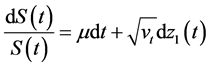
It is known that under a Black-Scholes model formulation the implied volatility function must remain constant for different values of the strike price when the other parameters of the option pricing model are kept constant. However, skewness in implied volatility curves is observed in actual market data for European options. To explain the skewness property of implied volatility functions, [2] considers the following model (1)-(3) with the condition that the (2) asset price and volatility are correlated:
 (1)
(1)
 (2)
(2)
 (3)
(3)
where  are Brownian processes.
Note that it can be shown, applying the Ito formula, that the variance rate  has a square root process model (see [2] ).
Computation of option price in the case of the above correlated model as described in using a pdf is fairly complicated. To obtain a closed form solution for the option price one has to invert two conditional characteristic functions to compute the difference between two probability functions as the required solution of the pdf.
3. A Two-Factor Stochastic Volatility Model
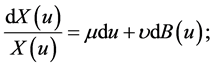
Here, we will explicitly specify the sde of the asset price and volatility processes. In this paper, we consider a risk-adjusted diffusion process (4) for spot asset price  defined with respect to a probability space
 , with the data-gathering measure P
 (4)
(4)
 (5)
(5)
In (4),  is called the instantaneous diffusion rate and
  is called the instantaneous drift rate of the diffusion process.
In (5), we have a log normal model for the asset price 
At this point, we introduce a second factor , which is a mean-reverting process, in Equation (7), and corresponds to the volatility
  in Equation (1) of Heston’s model.
 (6)
(6)
 (7)
(7)
(6) can be transformed to
 (6a)
(6a)
4. Formulation of a Risk-Neutral Model
The dynamic processes (8)-(9) below are defined with respect to the martingale probability measure Q, where  and
and  are Brownian motions under Q, where we assume the corresponding Novikov’s condition is satisfied.
5. Two Factor Risk-Neutral Model
 (8)
(8)
An equivalent Two-factor Black-Derman-Toy model [14] can be formulated.
The  (6) and (8) can be transformed using Ito formula to (6a) and (9), a two-factor Black-Derman?Toy (1990)-type model [14] obtained by introducing a second factor
  in Equation (5).
As mentioned previously, in (4),  is the instantaneous diffusion rate and
  is called the instantaneous drift rate of the diffusion process.
As stated previously, in Equation (7), we define the volatility  as a mean reverting Gaussian process with
  as its long-term mean1.
We assume  to be correlated with
  as in the Equation (8) and that
  is a standard Brownian motion process.
Then it follows (see [2] ).that the distribution of  is:
is:
 ,
,
Alternatively,  may be expressed as

where

Assumption 1: The Brownian motion processes  and
and  are related as follows:
 (10)
(10)
where .
.
Also, the Brownian motion processes  and
and  under Q are independent.
See [15] for a similar assumption. See also [3] and [4] .
From (6) and (10), it is clear that
 (11)
(11)

Equation (11) follows because from [16] we know that the Gaussian random variable  may be expressed as

where


Note that  has a normal distribution with mean 0 and variance s, so
  can be written as
 , where
  is a standard normal variable. Then
  can be written as a quadratic function of
  plus a residual term
 . (See Proposition 1 below).
For , we define a volatility process
 .
.

Define  as the average standard deviation in the case of uncorrelated Brownian motion process
 (see [7] , p. 182).
Then the average variance is:

 (12)
(12)
and where


 where
where

 approximately, where
 because (13)
 (14)
(14)
 (15)
(15)
 (16)
(16)
 (17)
(17)
Proof: See Appendix A
(a)  and
and  are independent random variables.
(b)  approximately where
 because
Remark 2:
Some of the limitations of the model can be described as follows:
a) Since we can verify that , we have only the necessary condition for independence between
  and
and  is satisfied.
b) We have assumed that the error terms  and
and  of the linear regressions are normally distributed and that
  is also normally distributed.
 (18)
(18)
where the expectation is obtained using the risk neutral distribution of  as defined in (6).
Remark 3:
Proposition 2 restates the result that the risk neutral property of  holds; the normalized process
  is a martingale with respect to Q and the market
  is arbitrage free.
We can evaluate any security that is a derivative of  using the risk neutral probability distribution of
 . In particular, consider a non-dividend paying European call option with strike price K and maturity dates2.
Then the price  at time 0 of the call option is the present value of the expected terminal value,
  , where the expectation is obtained using the risk neutral distribution of
 .Similarly the put option is defined as
 . Then, using Put Call- parity formula and the Equation (18) we have


In the next sections, we will derive a simple Black-Sholes type expression for the call option price  and derive its properties.
For easier reference we present below the explicit expressions for the vector

 (19)
(19)
where the conditional risk-neutral distribution function of  is derived below.
Next we determine an explicit expression for the conditional distribution function

So given 
 (20)
(20)
Then the roots of the equation

are
 (21)
(21)
Assumption 3:
 (22)
(22)
Assumption (3) ensures that the roots are real and are well defined.
Let 
Then

where


Define

and also suppose Assumption (2) holds. Note that the functions  and
and  are independent of h.
Remark 4:
If  then
then is a convex function of
  and a minimum of
  as a function of
  exists.
Similarly if  then
then  is a concave function of
  and a maximum of
  as a function of
  exists.
Proposition 3:
Suppose , which implies that
 .
.
If Assumption (3) holds then the conditional risk-neutral distribution of  is:
is:

If , then the roots of the equation defined in (18) are equal so that
 , then there exists a value
  such that
 .
.
In other words,  is the lowest value the conditional random variable
  can assume in this case.
Next we consider the case of 
Conditional Risk-neutral Distribution function of ,
, .
.
Suppose , which implies
If Assumption (3) holds then the conditional risk-neutral distribution of  is derived as follows:

Example 1:
Let . Then in Figure 1 depicts the conditional risk-neutral distribution of

In the next section we consider the evaluation of price of a security that is derivative of stock price . We need the following Assumption (4) to ensure that the call option price is well defined.
Example 2:
Let .
.
Figure 2 shows the conditional risk-neutral distribution of  is depicted.

Figure 1. 1 
 , h = 0.
CDF of lnX(s), m(s) > 0

Figure 2. Conditional risk-neutral distribution
Assumption 4:
We will utilize the Assumption (4) later for deriving the price of any derivative security.
Conditional Call Option Price
Assumption 4
 (23)
(23)
We will utilize the Assumption (4) later for deriving the price of any derivative security.
Conditional Call Option Price
Next we obtain an explicit closed form expression for the conditional call option price that is similar to the corresponding B-S expression and hence is easier to compute.
Proposition 4:
Given  and
and


where  and
and  ,
,  is the cdf of the standard normal variable Z.
Remark 5:
To simplify the presentation of the results, we have suppressed usually the dependence of  on
on .
.
Proof:

We prove Proposition 4 below using the risk-neutral distribution results (Proposition 3) of lnX(s) for . Again using the risk-neutral distribution results of lnX(s) (Proposition3) for
 , the Proposition 5 issimilarly proved.
Case 1:
Here, we make use of risk-neutral distribution of lnX(s) results for .
.

where  and
and  are as defined in (19)

Case 2:

Since  it follows that if
  then
then

Then,  which follows as in Case 1.
This completes the proof.
Proposition 5:
Suppose  which
which  and which easily satisfies the Assumption (4):
 . Then,

Case 1: 
Then given that  and
and  we have:

So in this case

Case 2: 

Remark 6:
We define
(i) Hedge ratio = 
Then, given that  and
and  we have:

Figure 3 shows the unconditional hedge ratio as derived using (28).

Figure 3. Unconditional hedge ratio, k from 3 to 31.5.
(ii) Since  we have, if
  the option is said to be in-the-money; if
 , the option is at- the-money and if
  then the option is out-of-the money.
(iii) Subject to the condition (22), it can be verified that the call option price function increases (i) as time to maturity s increases and (ii) as  increases.
Delta-Neutral Portfolio
Consider the following portfolio that includes a short position of one European call with a long position delta units of the stock.
(i) The portfolio of delta-neutral positions is defined as

(ii) The hedge ratio expressions are similarly derived for the case of  using results in Proposition 4.
Conditional Put-Call Parity
Consider a non-dividend paying European put option with strike price K and exercise date s. Then the price  at time 0 of the put option is the present value of the expected terminal value,
  where the expectation is obtained using the risk neutral distribution of
 . Here the investor can exercise the option at time s if
 . However we have the relationship in terms of conditional distribution of
  given
given :
:
 (24)
(24)
Unconditional Call Option Price
 (25)
(25)
where , where we have assumed the marginal distribution of
  to be normal with mean 0 and variance
 .
.
One could evaluate the option price (26) numerically as follows:
 (26)
(26)
Put-Call Parity
The Put option price is obtained using Put-Call parity:
 (27)
(27)
Again, we can apply the discrete approximation numerical method as in (26) in evaluating (27).
Figures 4-6 represent respectively, conditional call option price given h = −0.5146, 0, 0.5146.
Call option price functional values for the Equation (26) for m = 1, as the time to maturity  and the strike price Kvaries.
For m = 1, (26) reduces to (28):
 (28)
(28)


Figure 4. Conditional call price where h = −0.5146.

Figure 5. Conditional call price where h = 0.

Figure 6. Conditional call price where h = 0.5146.
The unconditional cost of call option as a weighted average of the cost of call option, as approximated for m = 1, can be represented by Figure 7.
Implied Volatility Functions
By definition, an implied volatility function is the function  such that the following equation, connecting the call option price
  of the new model with the corresponding Black- Sholes model’s call option price
 , is satisfied, where

 (29)
(29)
In other words, we find a suitable value for implied volatility  so that call option price values both under the new model with parameter values
  and under the Black-Sholes model with parameters
 are equal. Implied volatility is a popular estimate of future stock price volatility, obtained from
option price data. It is known that under a Black-Scholes model formulation the implied volatility function must remain constant for different values of the strike price when the other parameters of the option pricing model are kept constant. However, skewness in implied volatility curves is observed in actual market data for European options.
With a view to explaining this anomaly, several different models have been proposed in the option-price literature. These models are mostly variations of 2-factor affine-jump diffusion models, one of the factors being stock volatility3
Let 
In this section, we show that the implied volatility skewness property of negative correlation- model. The “implied volatility smile curves are rotated clock wise into smirks”, which is known as “Volatility asymmetry”. See [4] , p. 350. The implied volatility can be easily computed and is an increasing function of the time to maturity s-(see Figure 8).
6. Conclusion
In this paper, we formulate a two-factor model of a stock index, where we assume the volatility process and the Brownian motion process of the model are dependent and use a novel linear regression approach to obtain call option price expressions for the proposed model. We have obtained closed form Black-Scholes type expressions

Figure 7. Unconditional call option, k from 3 to 35.

Figure 8. Implied volatility.
for option prices under the assumption of constant interest rate. We can also show stochastic interest rate and random economic shocks can also be incorporated in the model (see [21] - [23] ). Analyzing the proposed model is computationally simpler than it is for the other affine jump process models. The results of this paper can also be applied to bond option, foreign currency option and futures option models and to more complex derivative securities including various types of mortgage-backed securities.
Cite this paper
Raj Jagannathan, (2016) A Linear Regression Approach for Determining Explicit Expressions for Option Prices for Equity Option Pricing Models with Dependent Volatility and Return Processes. Journal of Mathematical Finance,06,303-323. doi: 10.4236/jmf.2016.62026
References
- 1. Cox, J.C. and Ross, S.A. (1976) The Valuation of Options for Alternative Stochastic Processes. Journal of Financial Economics, 3, 145-166.
http://dx.doi.org/10.1016/0304-405X(76)90023-4 - 2. Heston, S. (1993) A Closed-Form Solution for Options with Stochastic Volatility with Applications to Bond and Currency Options. Review of Financial Studies, 6, 327-344.
http://dx.doi.org/10.1093/rfs/6.2.327 - 3. Pan, J. (2002) The Jump-Risk Premia Implicit in Options Evidence from an Integrated Time Series. Journal of Financial Economics, 63, 3-50.
http://dx.doi.org/10.1016/S0304-405X(01)00088-5 - 4. Duffie, D. and Singleton, K. (2003) Credit Risk: Pricing, Measurement, and Management. Princeton University Press, Princeton, 350.
- 5. Hull, J.C. and White, A. (1987) The Pricing of Options on Assets with Stochastic Volatilities. The Journal of Finance, 42, 281-300.
http://dx.doi.org/10.1111/j.1540-6261.1987.tb02568.x - 6. Jarrow, R., Li, H. and Zhao, F. (2007) Interest Rate Caps “Smile” Too! But Can the “LIBOR” Market Models Capture the Smile? The Journal of Finance, 62, 345-382.
http://dx.doi.org/10.1111/j.1540-6261.2007.01209.x - 7. Duffie, D. (1996) Dynamic Asset Pricing Theory. 2nd Edition, Princeton University Press, Princeton.
- 8. Cox, J.C., Ross, S.A. and Rubinstein, M. (1979) Option Pricing: A Simplified Approach. Journal of Financial Economics, 7, 229-263.
- 9. Figlewski, S. and Gao, B. (1999) The Adaptive Mesh Model, a New Approach to Efficient Option Pricing. Journal of Financial Economics, 53, 313-351.
http://dx.doi.org/10.1016/S0304-405X(99)00024-0 - 10. Cumby, R., Figlewski, S. and Hashbrook, J. (1993) Forecasting Volatilities and Correlations with EGARCH Models. The Journal of Derivatives, 1, 51-63.
http://dx.doi.org/10.3905/jod.1993.407877 - 11. Campbell, J.Y., Lo, A.W. and MacKinlay, A.C. (1997) The Econometrics of Financial Markets. Princeton University Press, Princeton.
- 12. Oksendal, B. (2003) Stochastic Differential Equations: An Introduction with Applications. Springer-Verlag, Berlin.
- 13. Nelson, D.B. (1991) Conditional Heteroskedasticity in Asset Returns: A New Approach. Econometrica, 50, 347-370.
http://dx.doi.org/10.2307/2938260 - 14. Black, F., Derman, E. and Toy, W. (1990) A One-Factor Model of Interest Rates and Its Application to Treasury-Bond Options. Financial Analysts Journal, 46, 33-39.
http://dx.doi.org/10.2469/faj.v46.n1.33 - 15. Trolle, A.B. and Schwarz, E.S. (2009) A General Stochastic Volatility Model for the Pricing of the Interest Rate Derivatives. The Review of Financial Studies, 22, 2007-2057.
- 16. Vasicek, O. (1977) An Equilibrium Characterization of the Term Structure. Journal of Financial Economics, 5, 177- 188.
- 17. Ait-Sahalia, Y. and Lo, A. (1998) Non-Parametric Estimation of State-Price Densities Implicit in Financial Asset Prices. The Journal of Finance, 53, 499-547.
http://dx.doi.org/10.1111/0022-1082.215228 - 18. Bakshi, G., Cao, C. and Chen, Z. (1997) Empirical Performance of Alternative Option Pricing Models. The Journal of Finance, 52, 2003-2049.
http://dx.doi.org/10.1111/j.1540-6261.1997.tb02749.x - 19. Bakshi, G., Kapadia, N. and Madan, D. (2003) Stock Return Characteristics, Skew Laws, and the Differential Pricing of Individual Equity Options. The Review of Financial Studies, 16, 101-143.
http://dx.doi.org/10.1093/rfs/16.1.0101 - 20. Buraschi, A. and Jackwerth, J.C. (2001) The Price of a Smile: Hedging and Spanning in Option Markets. The Review of Financial Studies, 14, 495-527.
http://dx.doi.org/10.1093/rfs/14.2.495 - 21. Merton, R.C. (1976) Option Pricing when the Underlying Stock Returns Are Discontinuous. Journal of Financial Economics, 3, 125-144.
http://dx.doi.org/10.1016/0304-405x(76)90022-2 - 22. Jagannathan, R. (2008) A Class of Asset Pricing Models Governed by Subordinated Processes that Signal Economic Shocks. Journal of Economic Dynamics and Control, 32, 3820-3846.
- 23. Scott, L.O. (1997) Pricing Stock Options in a Jump-Diffusion Model with Stochastic Volatility and Interest Rates: Applications of Fourier Inversion Methods. Mathematical Finance, 7, 413-426.
http://dx.doi.org/10.1111/1467-9965.00039 - 24. Wilks, S.S. (1962) Mathematical Statistics. John Wiley & Sons, Inc., Hoboken.
Appendix
Appendix A
Some preliminary results are stated below prior to the proof of Proposition 1.
Application of Least Squares Linear Regression (see [24] , p. 87).
 on
on 
where 
The regression equation obtained is:
 (1A1)
(1A1)
and where
 (1A2)
(1A2)
is the regression coefficient
 (1A3)
(1A3)

2) Regress the function
 on
on 
Note that (see [12])

We can show that (see [12])

Proof:
Using Ito’s Lemma, we have

This completes the proof.

is the regression coefficient

 (2A1)
(2A1)

Then the regression equation is
 (2A2)
(2A2)
Assumption:
 (approximately) (2A3)
Note that  and
and .
.

Assumption:
 (approximately) (2A4)
Proof of Proposition 1:
1)

2)

where


where

Appendix B
Proof of Proposition 3:

Now we assume  and
and  Then
Then
 (1B1)
(1B1)
If , then the roots of the equation defined in (18) are equal so that
  , then there exists a value
  such that

In other words,  is the lowest value the conditional random variable
  can assume.
The equations defined in (12) hold under the Assumption (2) so that the roots of the quadratic Equation (13) are well defined.
Substituting for  in the condition:
 , we have
 where
where


In other words  is the highest value the conditional random variable
  can assume.
An explicit expression for 

Then, .
.
 (1B2)
(1B2)
NOTES

1This process is known as “O-U” process, the Ornstein-Uhlenbeck process.

2This condition can be relaxed by replacing r by r − d, where d is the dividend payout rate and r is the annual risk-free interest rate.

3But there are several empirical papers that use S & P 500 options data-set on a given date directly to estimate risk-neutral return densities and a measure of risk-neutral skewness, [17] - [20] .