

Journal of Applied Mathematics and Physics
Vol.03 No.07(2015), Article ID:57638,10 pages
10.4236/jamp.2015.37094
Hopf Bifurcation Analysis for a Modified Time-Delay Predator-Prey System with Harvesting
Yang Ni, Yan Meng, Yiming Ding
School of Mathematics and physics, University of Science and Technology Beijing, Beijing, China
Email: ny123ling@126.com


Received 28 April 2015; accepted 23 June 2015; published 30 June 2015

ABSTRACT
In this paper, we consider the direction and stability of time-delay induced Hopf bifurcation in a delayed predator-prey system with harvesting. We show that the positive equilibrium point is asymptotically stable in the absence of time delay, but loses its stability via the Hopf bifurcation when the time delay increases beyond a threshold. Furthermore, using the norm form and the center manifold theory, we investigate the stability and direction of the Hopf bifurcation.
Keywords:
Hopf Bifurcation, Time-Delay, Predator-Prey Model

1. Introduction
Due to its universal existence and importance, the study on the dynamics of predator-prey systems is one of the dominant subjects in ecology and mathematical ecology since Lotka [1] and Volterra [2] proposed the well- known predator-prey model [3]-[6]. Recently, a new method of central manifold has been developed to study the stability of delay induced bifurcation. In this paper, we study the following system:
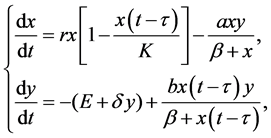 (1)
(1)
with
 (2)
(2)
where dot means differentiation with respect to time ,
,  and
and  are the prey and predator population densities, respectively. Parameter
  is the specific growth rate of prey in the absence of predation and without environment limitation.
  is environmental carrying capacity. The functional response of the predator is of Holling’s type with
 . And all parameters involved with the model are positive.
The purpose of this paper is to investigate the effect of time-delay on a modified predator-prey model with harvesting. We discussed the existence of Hopf bifurcation of system (1) and the direction of Hopf bifurcation and the stability of bifurcated periodic solutions are given.
2. Positive Equilibrium and Locally Asymptotically Stabiliy
After some calculations, we note system (1) has no boundary equilibria. However, it is more interesting to study the dynamical behaviors of the interior equilibrium points  and
and , where


The two distinct interior equilibrium points  exist whenever

holds.
We transform the interior equilibrium  to the origin by the transformation
 ,
, . Respectively, we still denote
  and
and  by
by  and
and . Thus, system (1) is transformed into
 (3)
(3)
First, we give the condition such that  is locally stable. For simplicity, we denote
 (4)
(4)
The characteristic polynomial of  is
is
 (5)
(5)
where


Now we consider the locally asymptotically stabiliy of the system without time-delay. Then we have
 (6)
(6)
If

holds, then it follows from the Routh-Hurwitz criterion that two roots of (6) have negative real parts.
Theorem 1. If  and
and  hold, the interior equilibrium point
  of system (1) is locally asymptotically stable.
3. Hopf Bifurcaion
In the section, we study whether there exists periodic solutions of system (1) about the interior equilibrium point . Now we have the following results.
Theorem 2. If the system (1) satisfies the hypothesis 
 and
and  holds, then there exists a critical point
  such that the positive equilibrium point
  is locally asymptotically stable for
  and unstable for
 , where
  is defined in Equation (14).
By the use of the instability result for the delayed differential Equations, in order to prove the instability of the equilibrium point, it is sufficient to show that there exists a purely imaginary  and a positive real
  such that
 (7)
(7)
where  is defined in Equation (5).
If  is a root of Equation (7), then we have
 (8)
(8)
which leads to
 (9)
(9)
Let , then Equation (9) takes the form
 (10)
(10)
Since  holds, we have
 , which leads to
 . Thus Equation (10) has at least one positive root, which leads to
 (11)
(11)
Set  as the root of Equation (8) with
 , we have
 (12)
(12)
where
 (13)
(13)
Then  are a pair of simple purely imaginary roots of Equation (8) with
 , and we have
 (14)
(14)
Then by the Butler’s Lemma,  is unstable for
 . On the other hand, if
 , then Equation (7) have no roots on the imaginary axis. Then Equation (7) for
 , only has negative real part roots, which implies that
  is locally asymptotically stable for
 .
.
Theorem 3. If the system (1) satisfies the hypothesis 
 and
and , then the system (1) undergoes Hopf bifurcation at
  when
when .
.
Proof. The Hopf bifurcation will be proved if we can show that
 (15)
(15)
From Equation (7), we have
 (16)
(16)
Substituting Equation (8) into Equation (16), we have
 (17)
(17)
Substituting Equation (14) into the above equation, we have

Therefore, the transversality condition is satisfied. Therefore Hopf bifurcation occurs at .
.
4. The Direction and Stability of the Hopf Bifurcation
In this section, we analyze the direction and stability of the Hopf bifurcation of (3) obtained in Theorem 3 by taking  as the bifurcation parameter.
Let , then
  is the Hopf bifurcation value of system (3). Rescale the time by
  to normalize the delay. The periodic solution of system (3) is equivalent to the solution of the following system
 (18)
(18)
We define  as nonnegative integer, define
  as follows

Rewrite system (18) to
 (19)
(19)
where
 (20)
(20)
We use the method which is based on the center manifold and normal form theory, and define . Then the system (19) is transformed into a functional differential equation as
 (21)
(21)
where  and
and  are respectively represented by
 (22)
(22)
and
 (23)
(23)
where . By the Riesz representation theorem, there exist a
  matrix
 , whose elements are of bounded variation functions such that
 (24)
(24)
In fact, we can choose
 (25)
(25)
where  is the Dirac delta function. For
 , we define
 (26)
(26)
and
 (27)
(27)
Thus system (21) is equivalent to
 (28)
(28)
where  for
for .
.
For , define
 (29)
(29)
and a bilinear inner product
 (30)
(30)
where . Then
  and
and  are adjoint operators. From the discussion in Theorem 2, we know that
  are eigenvalues of
  and therefore they are also eigenvalues of
 .
.
Suppose  is the eigenvector of
  corresponding to
 . Thus,
 . From the definition of
  we have

Then we have
 (31)
(31)
Similarly, let  be the eigenvector of
  corresponding to
 . Then by
  and the definition of
 , we obtain

Therefore
 (32)
(32)
In order to ensure, we need to determine the value of , from Equation (29) we have
 (33)
(33)
Then we can choose  such as
 (34)
(34)
where  is the conjugate complex number of
 .
.
Next we will compute the coordinate to describe the center manifold  at
at . Let
. Let  be the solution of Equation (27) when
 . Define
 (35)
(35)
On the center manifold , we have
 , where
 (36)
(36)
 and
and  are local coordinates for the center manifold
  in the direction of
  and
and . Note that
  is real if
  is real. We only concern with the real solutions. For solution
  of Equation (27), since
  and Equation (35), we have
 (37)
(37)
We rewrite above equation as
 (38)
(38)
where
 (39)
(39)
From Equation (35) and Equation (36), we obtain that
 (40)
(40)
Substituting Equation (23) and Equation (40) into Equation (39), we have
 (41)
(41)
where  stands for higher order terms, and


Comparing Equation (39) and Equation (41), we get
 (42)
(42)
Since  depends on
  and
and , we need to find the values of
  and
and . From Equation (21) and Equation (35), we have
 (43)
(43)
where
 (44)
(44)
From Equation (36), we have
 (45)
(45)
It follows from Equation (39) that
 (46)
(46)
Comparing the coefficients of  and
and  from Equation (45) and Equation (46), we get
 (47)
(47)
Then for , we have
 (48)
(48)
Comparing the coefficients of  and
and  between Equation (44) and Equation (48), we get
 (49)
(49)
From the definition of  and Equation (49), we have
 (50)
(50)
Since , we obtain
 (51)
(51)
where  is a constant vector. Similarly, we have
 (52)
(52)
where  is a constant vector. Now, we shall find the values of
  and
and . From the definition of
  and Equation (50), we have
 (53)
(53)
and
 (54)
(54)
where . In view of Equation (43), we induce that when
 .
.
 (55)
(55)
Then we have
 (56)
(56)
Comparing both sides of Equation (56), we obtain
 (57)
(57)
where  and
and  are respectively the coefficients of
  and
and  of
of . Thus we have
 (58)
(58)
where .
.
Since  is the eigenvalue of
  and
and  is the corresponding eigenvector, we get
 (59)
(59)
 (60)
(60)
Therefore, substituting Equation (53) and Equation (59) into Equation (60), we have
 (61)
(61)
that is
 (62)
(62)
where
 (63)
(63)
Thus ,
,  , and
, and  is the value of the determinant
 , where
  is formed by replacing the
  th column vector of
  by another column vector
  for
for . In a similar way, we have
 (64)
(64)
where
 (65)
(65)
Thus , where
  and
and  is the value of the determinant
  that is formed by replacing the
  th column vector of
  by another column vector
  for
for . Therefore, we can determine
  and
and  from Equation (51) and Equation (52). Furthermore, we can easily compute
 .
.
Then the Hopf bifurcating periodic solutions of system (1) at  on the center manifold are determined by the following formulas
 (66)
(66)
Here  determines the direction of Hopf bifurcation. If
 , then the Hopf-bifurcation is forward(backward) and the bifurcating periodic solutions exist for
 . Again
  determines the stability of the bifurcating periodic solutions. The bifurcating periodic solutions are stable (unstable) if
 .
.  determines the period of periodic solutions: the period increases (decreases) if
 . Therefore, we have the following results.
Theorem 4. The Hopf bifurcation of the system (1) occurring at  when
when  is forward (backward) if
  and the bifurcating periodic solutions on the center manifold are stable (unstable) if
  .
.
5. Conclusion
This paper introduces modified time-delay predator- prey model. Then we study the Hopf bifurcation and the stability of the system. Our results reveal the conditions on the parameters so that the periodic solutions exist surrounding the interior equilibrium point. It shows that  is a critical value for the time delay
 . Furthermore, the direction of Hopf bifurcation and the stability of bifurcated periodic solutions are investigated.
Acknowledgements
This project is jointly supported by the National Natural Science Foundations of China (Grant No. 61074192). We also would like to thank the anonymous referees which have improved the quality of our study.
Cite this paper
Yang Ni,Yan Meng,Yiming Ding, (2015) Hopf Bifurcation Analysis for a Modified Time-Delay Predator-Prey System with Harvesting. Journal of Applied Mathematics and Physics,03,771-780. doi: 10.4236/jamp.2015.37094
References
- 1. Lotka, A.J. (1925) Elements of Physical Biology. Nature, 116, 461. http://dx.doi.org/10.1038/116461b0
- 2. Volterra, V. (1926) Fluctuations in The Abundance of A Species Considered Mathematically. Nature, 118, 558-560. http://dx.doi.org/10.1038/118558a0
- 3. Yan, X. and Li, W. (2007) Bifurcation and Global Periodic Solutions in A Delayed Facultative Mutualism System. Physica D: Nonlinear Phenomena, 227, 51-69. http://dx.doi.org/10.1016/j.physd.2006.12.007
- 4. Tian, C. and Zhang, L. (2013) Hopf Bifurcation Analysis in a Diffusive Food-Chain Model with Time Delay. Computers & Mathematics with Applications, 66, 2139-2153. http://dx.doi.org/10.1016/j.camwa.2013.09.002
- 5. Kar, T.K. and Jana, S. (2012) Stability and Bifurcation Analysis of a Stage Structured Predator Prey Model with Time Delay. Applied Mathematics & Computation, 219, 3779-3792. http://dx.doi.org/10.1016/j.amc.2012.10.007
- 6. Zhang, J., Li, W. and Yan, X. (2011) Hopf Bifurcation and Turing Instability in Spatial Homogeneous and Inhomogeneous Predator-Prey Models. Applied Mathematics & Computation, 218, 1883-1893. http://dx.doi.org/10.1016/j.amc.2011.06.071