

Journal of Modern Physics
Vol.07 No.11(2016), Article ID:68422,11 pages
10.4236/jmp.2016.711118
As Regards the Speed in a Medium of the Electromagnetic Radiation Field
Robert M. Yamaleev1, A. R. Rodríguez-Domínguez2
1Joint Institute for Nuclear Research, Dubna, Russia
2Instituto de Física, Universidad Autónoma de San Luis Potosí, San Luis Potosí, México

Copyright © 2016 by authors and Scientific Research Publishing Inc.
This work is licensed under the Creative Commons Attribution International License (CC BY).
http://creativecommons.org/licenses/by/4.0/



Received 11 June 2016; accepted 12 July 2016; published 15 July 2016
ABSTRACT
The velocity of the electromagnetic radiation in a perfect dielectric, containing no charges and no conduction currents, is explored and determined on making use of the Lorentz transformations. Besides the idealised blackbody radiation, whose vacuum propagation velocity is the universal constant c, being this value independent of the observer, there is another behaviour of electromagnetic radiation, we call inertial radiation, which is characterized by an electromagnetic inertial density , and therefore, it happens to be described by a time-like Poynting four-vector field
  which propagates with velocity
 .
.  is found to be a relativistic invariant expressible in terms of the relativistic invariants of the electromagnetic field. It is shown that there is a rest frame, where the Poynting vector is equal to zero. Both phase and group velocities of the electromagnetic radiation are evaluated. The wave and eikonal equations for the dynamics of the radiation field are formulated.
Keywords:
Inertial Radiation Field, Mass Field Density, Rest State, Poynting Vector, Wave and Eikonal Equations of the Radiation Field Dynamics

1. Introduction
In his famous lecture delivered for almost 93 years now to the Nordic Assembly of Naturalists at Gothenburg [1] , A. Einstein expressed his lively interest concerning the problem of identifying gravitational and electromagnetic fields not as quite independent manifestations of nature, but just as two manifestations of same nature, or of a same entity. Although some previous efforts have been already conducted looking for generalized and dual expressions of the electromagnetic field, where the gravitational field should already appear lodging there [2] - [6] , the idea of present work is to develop a contribution to see through as directly as possible, not where the concept of unification is now playing a deep role; but where the concept of inertiality appears clearly as an intrinsic hidden property of the electromagnetic field.
So, the problem is to derive a formula for velocity of the electromagnetic radiation as a certain function of the field strengths [7] . In this context, let us recall that in the case of the dynamics of massive point particles, it can conventionally be presented by two expressions, where the first one contains evolution equations for the energy and momentum, and the second part contains a connection among energy, momentum and the velocity of the particle. The relationship of the energy with the velocity is the main part of the particle dynamics which is indispensable in order to define a trajectory of motion of the point particle.
The aim of the present paper is to elaborate a method for finding the velocity of the e-m radiation, corresponding to the transport of the energy, momentum and angular momentum, as a function of the field strengths.
Z. Oziewicz [8] (1998) proposed that the transportation of the energy by e-m radiation field is possible if only if the density of the momentum does not vanish with respect to all inertial observers. He has argued that this may happen only in the system of reference moving with light-velocity equal to c, because for other systems of reference moving with velocities less than light-velocity, one may find such a system where the Poynting vector vanishes. Furthermore, he elaborated a method of calculation of the velocity of the system of reference where the Poynting vector vanished [9] .
In this paper, we explore the dynamics of energy and momentum of the electromagnetic field by introducing the concepts of velocity of the radiation and the field mass density. Our method is based on the same idea of Z. Oziewicz proposed to identify the velocity of the radiation with the velocity of the system of reference, where the Poynting vector vanished. However, oppositely to our result, he concluded that there was no physical rest frame, with , where the Poynting vector might vanish, but the frame of light.
In order to define a velocity for the electromagnetic radiation, a simple logic scheme has to be used: there exists a certain inertial reference system where the density of the momentum of the inertial e-m radiation field is equal to zero. The velocity of this inertial system is identified with the velocity of the radiation. So, according to this concept, in order to define the velocity of the field, it is sufficient to know the transformation laws of the field under the Lorentz-group.
The Concept of the Inertial Electromagnetic Field
In the solution of any electromagnetic problem the fundamental relations that must be satisfied are the four field equations―Maxwell equations [10] . Consider the particular case of electromagnetic phenomena in a perfect dielectric containing no charges and no conduction currents. For this case the Maxwell equations become
 (1.1a)
 (1.1b)
 (1.2a)
 (1.2b)
According to Maxwell theory the velocity of the electromagnetic (e-m) waves is defined via permittivity  and permeability
  of the medium. In the same way, in the vacuum the velocity is defined by the universal constant
 (1.3)
(1.3)
The physical sense of the speed of the electromagnetic radiation is attached to the velocity of the flux of radiation transporting energy, momentum and angular momentum. Since the speed of the light in the medium is defined by formula , the velocity of electromagnetic radiation depends of the index of refraction n,
  , i.e, the velocity of the e-m radiation in the medium depends on the refractive index n of the medium. The refractive index n is related with the phase velocity and the wavelength according to formulae
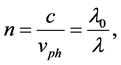 (1.4)
(1.4)
where
 (1.5)
(1.5)
is the vacuum wavelength. We are addressing both cases occuring  and
and . The transversal fields in the medium are related as follows
 (1.6)
(1.6)
 (1.7)
(1.7)
and
 (1.8)
(1.8)
It is seen, that in the medium the value of the e-m field characteristics change in such a way that the property of transversality keeps conserved, but the relationship
 (1.9)
(1.9)
which is valid for the radiation field in the vacuum, in the medium holds no more true.
This argument is taken as a pivoting idea to introducing the concept of inertial e-m radiation field, as a transversal e-m field, which is principally characterized by the main condition
 (1.10)
Once the concept of inercial electromagnetic field is defined, the rest of the paper is organized as follows. First we present an alternative covariant double-scalar potential formalism for the representation of transversal electromagnetic fields (Section 2). Thereafter we derive the formula for the phase velocity of the electromagnetic radiation field (Section 3). As an application of this formula, we write the eikonal equation of the geometrical optics, and the wave equation for electromagnetic radiation field for a definite energy density, Poynting vector and mass field density (Section 4). Finally, in Section 5 the main conclusions of the work are thrown.
2. Double Potential Representation of the Transversal Electromagnetic Field
In Ref. [11] we have suggested another look on the nature of the transversal e-m fields. According to this viewpoint, for the transverse e-m fields, instead of using four potential functions, it is better to use a pair of Lorentz scalar functions. This representation automatically provides transversality of the strength vectors. Furthermore, the pair of scalar potentials are solutions of the Klein-Gordon equations, whereas the four- potentials play the role of a current density, and the Lorentz gauge condition for the four potentials takes the form of a continuity equation for the current density.
The Maxwell’s equations in the vacuum are equations for the electric field strength  and the magnetic flux density
 . The four-potentials
  were introduced into the Maxwell’s electrodynamics in order to simplify the system of wave equations. However, thanks principally to the quantum mechanics, the essential conceptual and theoretical role of the potentials has been manifested. Indeed, in the Schrödinger, Dirac and Klein-Gordon equations the field strengths do not any longer appear, but the four potentials actually do instead. External e-m fields were introduced into quantum mechanics via four-potentials already at the level of Hamilton-Jacobi equations. It is to be acknowleged, that the principle of gauge invariance was born thanks to the four-potential representation of the e-m fields. However, the form of the potential representation has a great significance in the quantum field theory, in the theory of superconductivity, in the theory of the magnetic charge. The puzzling role playing by the vector potential representation in the quantum mechanical motion of particles was strikingly illustrated by the Aharonov-Bohm effect [12] .
As we very well know, the equation
 (2.1)
(2.1)
is automatically satisfied, if the magnetic-flux density is represented as
 (2.2)
(2.2)
because of the identity
 (2.3)
(2.3)
The expression for the electric field strength is in turn expressed by
 (2.4)
(2.4)
These formulae are such that the second group of Maxwell equations representing Faraday’s law and the absence of magnetic charges are automatically satisfied. The first group of Maxwell equations are reduced to the following two equations for the potentials
 (2.5a)
 (2.6b)
Equations (2.6a, 2.6b) can be separated by choosing the so called Lorentz gauge condition
 (2.7)
(2.7)
Substitution of Equation (2.7) into (2.6a, 2.6b) yields wave equations for the four-potentials
 (2.8)
(2.8)
Now, let us rewrite these formulae in their tensorial form. From the potentials  and
and  we pass into the four-vector representation by

Further, let us introduce four-coordinates

In this notation, the vectors of electric field strength and magnetic flux density may be cast into the form of a screw-symmetric tensor
 (2.9)
(2.9)
Then, formulae (2.4) and (2.5) are joined into one expression
 (2.10)
The first group of Maxwell equations takes the form
 (2.11a)
whereas the second part of Maxwell equations admits the following form
 (2.11b)
In order to obtain the wave equation for the four-potential vector, usually, the Lorentz-gauge condition is used
 (2.12)
With this condition, the Maxwell equations are reduced to the wave equation for the four-potential vector
 (2.13)
With respect to Lorentz transformations the electromagnetic fields are characterized to possess two invariants  and
and . Among them, the field defined as a pure radiation field, or null field, for which the two invariants are identically zero, has a peculiar status. This field is a propagating field with the well- known properties
 , where
  is the direction of propagation. Under these conditions, we refer to the transversal character of the e.m. radiation field [10] . However, the potential representation of this field meets difficulties concerning with its Lorentz covariant description. The radiation fields are described by two degrees of freedom, whereas the theory describes them by a four potential vector. Therefore, it is necessary for the theory to introduce subsidiary conditions, like the radiation gauge, or the Coulomb gauge. These Lorentz noncovariant conditions are used besides the Lorentz-covariant Lorentz gauge equation. These are the main difficulties which appear in the common accepted formulation. Alternatively we can handle the formalism as follows
First of all let us notice that the equation
 (2.14)
is satisfied by defining the magnetic-flux density as
 (2.15)
For the electric field strength one obtains
 (2.16)
In a tensorial form these formulas are given by
 (2.17)
Obviously, the functions  (two-potentials) are invariant with respect to Lorentz-transformations. Within these formulae, the field Lorentz-transformations directly follow from the coordinate Lorentz-transformations. The four-potential vector is expressed from two-potentials as follows
 (2.18)
or in tensorial notation
 (2.19)
The advantage of using this two-potential representation resides in the fact that we automatically introduce the two desired degrees of freedom. The first main consequence of this approach is the property of transversality of the electromagnetic field. In fact, in this representation, the field strength vectors satisfy the equation
 (2.20)
Notice, however, that the dealing of the second invariant  is not trivial.
It is to be noticed, that by reducing the degrees of freedom from four to two, additional algebraic relations between the fields and the four potential vector arise, they are namely
 (2.21)
What kind of interpretation can be given to these equations? Looking for an answer, we refer the reader to Ref. [13] and references therein. Stating it briefly, the authors have found the following topological invariant
 (2.22)
Furthermore, it is shown that for the static magnetic field , S characterizes to what extent the magnetic lines are coupled to each other. For a single magnetic line this value estimates the screwness of the line. The relativistic generalization of this invariant was done in Ref. [14] , as
 (2.23)
Or in the components

The four-vector  satisfies the equation
 (2.24)
From this last equation it follows that  is conserved only for transversal fields.
Lorentz Gauge Equation as a Continuity Equation
The Lorentz gauge Equation (2.12) appears written in our two-potential representation as

which can be evaluated to
 (2.25)
This equation separates into two Klein-Gordon type equations
 (2.26)
where the parameter  is the Compton’s length of the wave. Furthermore, two real Klein-Gordon equations (2.26) may be united into one Klein-Gordon type equation for the complex-valued function
 .
.
We may also define in our formalism the current density as
 (2.27)
Furthermore, this current density satisfies the continuity equation
 (2.28)
which arose above as the Lorentz-gauge condition (2.12) for the potential .
.
3. The Concept of Velocity for the Inertial Radiation Field
Consider two observers  and
and  with relative velocity v. Then the e-m fields are transformed according to the Lorentz formulae
 (3.1)
(3.1)
where
 (3.2)
(3.2)
Suppose that the velocity of  -observer is perpendicular to electric and magnetic fields detected by
  - observer:
 (3.3)
(3.3)
Then formulae (3.1) are reduced to Heaviside formulae
 (3.4)
(3.4)
These transformation formulae keep unchanged both invariants:
 (3.5)
(3.5)
The Poynting’s vector is transformed as follows
 (3.6)
(3.6)
(Hereafter we omit the  -observer designation.)
Now suppose that in the  -system of references moving with velocity v with respect to the
  -system the Poynting vector is equal to zero

Then,
 (3.7)
(3.7)
From this equation it follows that the velocity vector  is parallel (or, anti-parallel) to the Poynting vector
 . This proposition is compatible with the condition (3.3). Thus, we may take
 (3.8)
(3.8)
In order to construct an equation for the unknown constant ,
,  from (3.8) is substituted into (3.7). In this way we obtain
 (3.9)
(3.9)
Suppose that . Then Equation (3.9) is reduced into the following quadratic equation for
 :
:
 (3.10)
Let us introduce the following quantities
 (3.11)
and
 (3.12)
Evidently,  is a function of the two invariants
 :
:
 (3.13)
Consequently,  is itself also an invariant. This value we interpret as the inertial field density. In this notation, the quadratic equation for
  appears as
 (3.14)
which has two different roots

By using this quantities in (3.8) we obtain two kinds of velocities
 (3.15a)
and
 (3.15b)
The first velocity  is less than the speed of light
 , and other one is greater than the speed light
 . Notice also that
 (3.16)
These velocities are explicitly expressed via field strengths as follows
 (3.17a)
 (3.17b)
Thus, if , then there always exists a system of reference where the Poynting’s vector is equal to zero. In other words, the rest state is achievable. The situation is quite analogous to the case of massive particle where the state with
  can be achieved. Now, we are in position to specify the concept of inertial field density. Define this quantity as follows
 (3.18)
In this notation, the formula for the velocity is written as
 (3.19)
From this formula it follows the expression for the density of the energy
 (3.20)
and for the Poynting’s vector
 (3.21)
Let  be the rapidity, so that,
 (3.22)
Then,
 (3.23)
Comparing these formulae with the analogous formulae for the relativistic point-particle, it is seen, that in the case of e-m field, for theenergy and the momentum, the rapidity appears multiplied by the factor “2”.
We have derived two kinds of velocities  and
and . In order to interpret these velocities we have to refer to formulae (1.6)-(1.8) for transverse fields in the medium with refractive index n. Within our notations of the densities of the energy and the mass we write
 (3.24)
Consequently, we have
 (3.25)
for , and
, and
 (3.26)
for .
.
From these formulae it follows that the velocities  admit an interpretation as the phase velocities related in ordinary way with the refractive index n.
By analogy we may also define the group velocity V
 (3.27)
satisfying always .
.
The group velocity is related to the phase velocity by the formula
 (3.28)
where v can be either .
.
4. Wave Mechanical Dynamics
In the previous section we have obtained formulae for phase velocities as functions of the densities of the energy, momentum and the mass. Consider classical electromagnetic waves travelling according to a scalar wave equation of the simple form
 (4.1)
(4.1)
where  represents any component of the electric or magnetic field and
  is the (time independent ) refractive index of the medium.
By assuming
 (4.2)
(4.2)
with , we get from (4.1) the Helmholtz equation
 (4.3)
(4.3)
The solutions of the wave equation are looked of the form [15]
 (4.4)
(4.4)
with real R and  functions, which represent respectively, the amplitude and phase of the monochromatic waves. The wave vector is defined as
 (4.5)
(4.5)
In the limit of geometrical optics, according to the eikonal equation
 (4.6)
(4.6)
The Eikonal equation in a geometrical wave theory has the form

For the rays inside the medium with refractive index n defined via  by formulae (3.25)-(3.26) we write the eikonal equation of the form

and

5. Conclusions
The concept of velocity for the radiation fields is a long stated problem. This problem of the velocity of the electromagnetic waves has been always considered as a definitely solved problem: these waves have a velocity equal to  in the vacuum. From this formula, it follows that in the medium the velocity of the electromagnetic wave obeys actually the same formula

which is used also to be written as , where n is the refractive index of the medium. To the present,
this expression has been considered phenomenological in nature, it is however relativistic. Here, it is clear that we are refering to the phase velocity of the waves, which can be both smaller as well as larger than the speed of light. However, we have been able to relate this velocity to the true physical group velocity of the radiation which is always present. We have developed this study in a relativistic formalism, considering the velocity of the electromagnetic radiation field as proposed by Zbigniew Oziewicz. This formalism is constructed out of first principles, because it is based on the transformations of Lorentz group, in order to derive the formula for the velocity of the reference system where the Poynting vector is equal to zero. In this way we arrived to the formula connecting the phase velocity with the densities of the energy and momentum.
From the viewpoint of the theory, we have been able to describe the inertiality of the electromagnetic Field, we are able to assure that with the exception of the propagation in vacuum, where the Poynting vector is a null four-vector, in a dielectric medium, the Poynting vector migrates into a time-like four-vector, whose norm is the inertial field density, formula (3.12), that is why the rest frame of the propagation is reachable. To the present, it has been known to us only the massless quantum mechanical behavior of photons. We don’t dare, for the moment, to describe them, inside matter, as mutants in a classical, massive state, but we just point out to the inertiality as an intrinsic hidden property of the electromagnetic field. How to quantify the inertial field density may surely be the subject of future works.
As we have introduced the notion of inertial field density as a measure of the inertia of the electromagnetic radiation, in return, we have formulated a new wave equation envolving the density of energy and the inertial field density.
Cite this paper
Robert M. Yamaleev,A. R. Rodríguez-Domínguez, (2016) As Regards the Speed in a Medium of the Electromagnetic Radiation Field. Journal of Modern Physics,07,1320-1330. doi: 10.4236/jmp.2016.711118
References
- 1. Einstein, A. (1923) Fundamental Ideas and Problems of the Theory of Relativity. Lecture Delivered to the Nordic Assembly of Naturalists at Gothenburg, 11 July 1923.
- 2. Kalb, M. and Ramond, P. (1974) Physical Review D, 9, 2273-2284.
http://dx.doi.org/10.1103/PhysRevD.9.2273 - 3. Dvoeglazov, V. (2000) Annales de la Fondation Louis de Broglie, 25, 81.
- 4. Malik, R.P. (2011) Physics of Particles and Nuclei Letters, 8, 244-250.
http://dx.doi.org/10.1134/S1547477111030149 - 5. Rodríguez-Domínguez, A.R. and Martínez-González, A. (2012) Journal of Nonlinear Mathematical Physics, 19, No. 4.
- 6. Keller, J. (1986) International Journal of Theoretical Physics, 25, 779-806.
http://dx.doi.org/10.1007/BF00669917 - 7. Kholmetskii, A.L. (2004) Annales de la Fondation Louis de Broglie, 29, 549-557.
- 8. Oziewicz, Z. (2006) Electric Field and Magnetic Field in a Moving Reference System (Abridged Abstract). In: Adhikari, M.R., Ed., Physical Interpretations of Relativity Theory Session, an International Symposium on Recent Advances, Kolkata, 47-53.
- 9. Oziewicz, Z. (2008) Review Bulletin of Calcutta Mathematical Society, 16, 49-66.
- 10. Barut, A.O. (1980) Electrodynamics and Classical Theory of Fields and Particles. Dover Publications, Inc., New York.
- 11. Yamaleev, R.M. (2005) Annales de la Fondation Louis de Broglie, 30, 449-461.
- 12. Ryder, L.H. (1985) Quantum Field Theory. Cambridge University Press.
- 13. Keller, J. (1993, 1999) The Geometric Content of the Electron Theory, Parts I and II. Advances in Applied Clifford Algebras, 3, 5-25 and 9, 309-395.
- 14. Rañada, A.F. (1992) European Journal of Physics, 13, 70-76.
http://dx.doi.org/10.1088/0143-0807/13/2/003 - 15. Orefice, A., Giovanell, R. and Ditto, D. (2015) Annales de la Fondation Louis de Broglie, 40, 95-112.