
Applied Mathematics
Vol.06 No.14(2015), Article ID:62450,9 pages
10.4236/am.2015.614198
Four Nontrivial Solutions for Kirchhoff Problems with Critical Potential, Critical Exponent and a Concave Term
Mohammed El Mokhtar Ould El Mokhtar
Departement of Mathematics, College of Science, Qassim University, Buraidah, Kingdom of Saudi Arabia

Copyright © 2015 by author and Scientific Research Publishing Inc.
This work is licensed under the Creative Commons Attribution International License (CC BY).
http://creativecommons.org/licenses/by/4.0/



Received 13 November 2015; accepted 27 December 2015; published 30 December 2015
ABSTRACT
In this paper, we consider the existence of multiple solutions to the Kirchhoff problems with critical potential, critical exponent and a concave term. Our main tools are the Nehari manifold and mountain pass theorem.
Keywords:
Kirchhoff Problems, Critical Potential, Concave term, Nehari Manifold, Mountain Pass Theorem

1. Introduction
In this paper, we consider the multiplicity results of nontrivial solutions of the following Kirchhoff problem
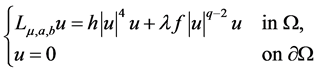 (1.1)
(1.1)
where , Ω is a smooth bounded domain of
 ,
,  ,
,
 ,
,  ,
,  ,
,  ,
,  is a real parameter,
  with
with  is the topological dual of
  satisfying suitable conditions, h is a bounded positive function on Ω.
The original one-dimensional Kirchhoff equation was introduced by Kirchhoff [1] in 1883. His model takes into account the changes in length of the strings produced by transverse vibrations.
In recent years, the existence and multiplicity of solutions to the nonlocal problem
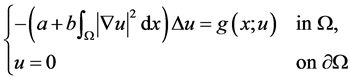 (1.2)
(1.2)
has been studied by various researchers and many interesting and important results can be found. For instance, positive solutions could be obtained in [2] -[4] . Especially, Chen et al. [5] discussed a Kirchhoff type problem when , where
  if
if ,
,  if
if 
 and
and  with some proper conditions are sign-changing weight functions. And they have obtained the existence of two positive solutions if
 ,
, .
.
Researchers, such as Mao and Zhang [6] , Mao and Luan [7] , found sign-changing solutions. As for in nitely many solutions, we refer readers to [8] [9] . He and Zou [10] considered the class of Kirchhoff type problem when  with some conditions and proved a sequence of a.e. positive weak solutions tending to zero in
 .
.
In the case of a bounded domain of  with
with , Tarantello [8] proved, under a suitable condition on f,
the existence of at least two solutions to (1.2) for ,
,  and
and .
.
Before formulating our results, we give some definitions and notation.
The space  is equiped with the norm

wich equivalent to the norm

with . More explicitly, we have

for all , with
  and
and .
.
Let  be the best Sobolev constant, then
 (2.1)
(2.1)
Since our approach is variational, we define the functional  on
on  by
by
 (2.2)
(2.2)
A point  is a weak solution of the Equation (1.1) if it is the critical point of the functional
 . Generally speaking, a function u is called a solution of (1.1) if
  and for all
  it holds

Throughout this work, we consider the following assumptions:
(F) There exist  and
and  such that
 , for all x in
 .
.
(H) 
Here,  denotes the ball centered at a with radius r.
In our work, we research the critical points as the minimizers of the energy functional associated to the problem (1.1) on the constraint defined by the Nehari manifold, which are solutions of our system.
Let  be positive number such that

where


Now we can state our main results.
Theorem 1. Assume that ,
,  and (F) satisfied and
  verifying
  then the problem (1.1) has at least one positive solution.
Theorem 2. In addition to the assumptions of the Theorem 1, if (H) hold and  then there exists
  such that for all
  verifying
  the problem (1.1) has at least two positive solutions.
Theorem 3. In addition to the assumptions of the Theorem 2, assuming  then the problem (1.1) has at least two positive solutions and two opposite solutions.
This paper is organized as follows. In Section 2, we give some preliminaries. Section 3 and 4 are devoted to the proofs of Theorems 1 and 2. In the last Section, we prove the Theorem 3.
2. Preliminaries
Definition 1. Let  E a Banach space and
 .
.
i)  is a Palais-Smale sequence at level c (in short
 ) in E for I if

where  tends to 0 as n goes at infinity.
ii) We say that I satisfies the  condition if any
  sequence in E for I has a convergent subsequence.
Lemma 1. Let X Banach space, and  verifying the Palais-Smale condition. Suppose that
  and that:
i) there exist ,
,  such that if
  then
then 
ii) there exist  such that
  and
and 
let  where
where

then c is critical value of J such that .
.
Nehari Manifold
It is well known that the functional  is of class
  in
in  and the solutions of (1.1) are the critical points of
  which is not bounded below on
 . Consider the lowing Nehari manifold

Thus,  if and only if
 (2.3)
(2.3)
Define

Then, for 
 (2.4)
(2.4)
Now, we split  in three parts:


Note that  contains every nontrivial solution of the problem (1.1). Moreover, we have the following results.
Lemma 2.  is coercive and bounded from below on
 .
.
Proof. If , then by (2.3) and the Hölder inequality, we deduce that

Thus,  is coercive and bounded from below on
 .
.
We have the following results.
Lemma 3. Suppose that  is a local minimizer for
  on
on . Then, if
 ,
,  is a critical point of
 .
.
Proof. If  is a local minimizer for
  on
on , then
  is a solution of the optimization problem

Hence, there exists a Lagrange multipliers  such that

Thus,

But , since
 . Hence
 . This completes the proof.
Lemma 4. There exists a positive number  such that, for all
  we have
 .
.
Proof. Let us reason by contradiction.
Suppose  such that
 . Moreover, by the Hölder inequality and the Sobolev embedding theorem, we obtain

and

with

From (2.5) and (2.6), we obtain , which contradicts an hypothesis.
Thus . Define

For the sequel, we need the following Lemma.
Lemma 5. i) For all  such that
 , one has
 .
.
ii) There exists  such that for all
 , one has

Proof. i) Let . By (2.4), we have

and so

We conclude that .
.
ii) Let . By (2.4) and the Hölder inequality we get

Thus, for all  such that
 , we have
 .
.
For each  with
with , we write

Lemma 6. Let  real parameters such that
 . For each
  with
with , there exist unique
  and
and  such that
 ,
,  ,
,  ,
,

Proof. With minor modifications, we refer to [11] .
Proposition 1. (see [11] )
i) For all  such that
 , there exists a
  sequence in
 .
.
ii) For all  such that
 , there exists a a
  sequence in
 .
.
3. Proof of Theorem 1
Now, taking as a starting point the work of Tarantello [8] , we establish the existence of a local minimum for  on
on .
.
Proposition 2. For all  such that
 , the functional
  has a minimizer
  and it satisfies:
i) 
ii)  is a nontrivial solution of (1.1).
Proof. If , then by Proposition 1. i) there exists a
 sequence in
 , thus it bounded by Lemma 2. Then, there exists
  and we can extract a subsequence which will denoted by
  such that
 (3.1)
(3.1)
Thus, by (3.1),  is a weak nontrivial solution of (1.1). Now, we show that
  converges to
  strongly
in . Suppose otherwise. By the lower semi-continuity of the norm, then either
  and we obtain

We get a contradiction. Therefore,  converge to
  strongly in
 . Moreover, we have
 . If not, then by Lemma 6, there are two numbers
  and
and , uniquely defined so that
  and
and . In particular, we have
 . Since

there exists  such that
 . By Lemma 6, we get

which contradicts the fact that . Since
  and
and , then by Lemma 3, we may assume that
  is a nontrivial nonnegative solution of (1.1). By the Harnack inequality, we conclude that
  and
and , see for exanmple [12] .
4. Proof of Theorem 2
Next, we establish the existence of a local minimum for  on
on . For this, we require the following Lemma.
Lemma 7. Assume that  then for all
  such that
 , the functional
  has a minimizer
  in
in  and it satisfies:
i) 
ii)  is a nontrivial solution of (1.1) in
 .
.
Proof. If , then by Proposition 1. ii) there exists a
 ,
,  sequence in
 , thus it bounded by Lemma 2. Then, there exists
  and we can extract a subsequence which will denoted by
  such that

This implies that

Moreover, by (H) and (2.4) we obtain

if  we get
 (4.1)
(4.1)
This implies that

Now, we prove that  converges to
  strongly in
 . Suppose otherwise. Then, either
 . By Lemma 6 there is a unique
  such that
 . Since

we have

and this is a contradiction. Hence,

Thus,

Since  and
and , then by (4.1) and Lemma 3, we may assume that
  is a nontrivial nonnegative solution of (1.1). By the maximum principle, we conclude that
 .
.
Now, we complete the proof of Theorem 2. By Propositions 2 and Lemma 7, we obtain that (1.1) has two positive solutions  and
and . Since
 , this implies that
  and
and  are distinct.
5. Proof of Theorem 3
In this section, we consider the following Nehari submanifold of 

Thus,  if and only if

Firsly, we need the following Lemmas.
Lemma 8. Under the hypothesis of theorem 3, there exist  such that
  is nonempty for any
  and
and .
.
Proof. Fix  and let

Clearly  and
and  as
as . Moreover, we have

If  for
for , then there exists
  such that
 . Thus,
 and
and  is nonempty for any
 .
.
Lemma 9. There exist M positive real such that

for  and any
Proof. Let  then by (2.3), (2.4) and the Holder inequality, allows us to write

Thus, if  then we obtain that
 (5.1)
(5.1)
Lemma 10. There exist r and  positive constants such that
i) we have

ii) there exists  when
when , with
 , such that
 .
.
Proof. We can suppose that the minima of  are realized by
  and
and . The geometric conditions of the mountain pass theorem are satisfied. Indeed, we have
i) By (2.4), (5.1), the Holder inequality and the fact that , we get

Thus, for  there exist
  such that

ii) Let , then we have for all

Letting  for t large enough, we obtain
  For t large enough we can ensure
 .
.
Let  and c defined by

and

Proof of Theorem 3.
If  then, by the Lemmas 2 and Proposition 1. ii),
  verifying the Palais-Smale condition in
 . Moreover, from the Lemmas 3, 9 and 10, there exists
  such that

Thus  is the third solution of our system such that
  and
and . Since (1.1) is odd with respect u, we obtain that
  is also a solution of (1.1).
Cite this paper
Mohammed El Mokhtar Ould ElMokhtar, (2015) Four Nontrivial Solutions for Kirchhoff Problems with Critical Potential, Critical Exponent and a Concave Term. Applied Mathematics,06,2248-2256. doi: 10.4236/am.2015.614198
References
- 1. Kirchhoff, G.R. (1883) Vorlesungen über mathematische Physik—Mechanik. 3 Edition. Teubner, Leipzig.
- 2. Alves, C.O., Correa, F.J.S.A. and Ma, T.F. (2005) Positive Solutions for a Quasilinear Elliptic Equation of Kirchhoff type. Computers & Mathematics with Applications, 49, 85-93.
http://dx.doi.org/10.1016/j.camwa.2005.01.008 - 3. Cheng, C.T. and Wu, X. (2009) Existence Results of Positive Solutions of Kirchhoff Type Problems. Nonlinear Analysis, 71, 4883-4892.
http://dx.doi.org/10.1016/j.na.2009.03.065 - 4. Ma, T.F. and Rivera, J.E.M. (2003) Positive Solutions for a Nonlinear Nonlocal Elliptic Transmission Problem. Applied Mathematics Letters, 16, 243-248.
http://dx.doi.org/10.1016/S0893-9659(03)80038-1 - 5. Chen, C., Kuo, Y. and Wu, T. (2011) The Nehari Manifold for a Kirchhoff Type Problem Involving Sign Changing Weight Functions. Journal of Differential Equations, 250, 1876-1908.
- 6. Mao, A.M. and Zhang, Z.T. (2009) Sign-Changing and Multiple Solutions of Kirchhoff Type Problems without the P.S. Condition. Nonlinear Analysis, 70, 1275-1287.
http://dx.doi.org/10.1016/j.na.2008.02.011 - 7. Mao, A.M. and Luan, S.X. (2011) Sign-Changing Solutions of a Class of Nonlocal Quasilinear Elliptic Boundary Value Problems. Journal of Mathematical Analysis and Applications, 383, 239-243.
http://dx.doi.org/10.1016/j.jmaa.2011.05.021 - 8. Jin, J.H. and Wu, X. (2010) Infinitely Many Radial Solutions for Kirchhoff-Type Problems in RN. Journal of Mathematical Analysis and Applications, 369, 564-574.
http://dx.doi.org/10.1016/j.jmaa.2010.03.059 - 9. Wei, L. and He, X.M. (2012) Multiplicity of High Energy Solutions for Superlinear Kirchho Equations. Journal of Applied Mathematics and Computing, 39, 473-487.
http://dx.doi.org/10.1007/s12190-012-0536-1 - 10. He, X.M. and Zou, W.M. (2009) Infinitely Many Positive Solutions for Kirchhoff-Type Problems. Nonlinear Analysis, 70, 1407-1414.
http://dx.doi.org/10.1016/j.na.2008.02.021 - 11. Brown, K.J. and Zhang, Y. (2003) The Nehari Manifold for a Semilinear Elliptic Equation with a Sign Changing Weight Function. Journal of Differential Equations, 2, 481-499.
http://dx.doi.org/10.1016/S0022-0396(03)00121-9 - 12. Drabek, P., Kufner, A. and Nicolosi, F. (1997) Quasilinear Elliptic Equations with Degenerations and Singularities, Walter de Gruyter Series in Nonlinear Analysis and Applications Vol. 5. New York.
http://dx.doi.org/10.1515/9783110804775