
Applied Mathematics
Vol.06 No.06(2015), Article ID:56854,6 pages
10.4236/am.2015.66085
Study of the Convergence of the Increments of Gaussian Process
Abdelkader Bahram1, Shaban A. El-Shehawy2
1Department of Mathematics, Djillali Liabes University, Sidi Bel Abbès, Algeria
2Department of Mathematics, Faculty of Science, Menoufia University, Shebin El-Kom, Egypt
Email: menaouar_1926@yahoo.fr, shshehawy64@yahoo.com
Copyright © 2015 by authors and Scientific Research Publishing Inc.
This work is licensed under the Creative Commons Attribution International License (CC BY).
http://creativecommons.org/licenses/by/4.0/



Received 29 April 2015; accepted 30 May 2015; published 2 June 2015
ABSTRACT
Let 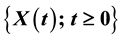 be a Gaussian process with stationary increments
 . Let
. Let  be a nondecreasing function of t with
 . This paper aims to study the almost sure behaviour of
  where
where

with  and
and  is an increasing sequence diverging to
 .
.
Keywords:
Wiener Process, Gaussian Process, Law of the Iterated Logarithm, Regularly Varying Function

1. Introduction
Let 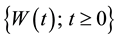 be a standard Wiener process. Suppose that
  is a nondecreasing function of t such that
  with
with  is nonincreasing and
  is an increasing sequence diverging to
 . In [1] the following results are established.
i) If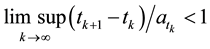 , then
 (1)
(1)
and
 (2)
(2)
where  and
and
 .
.
ii) If , then
 ,
,
where ,
,  and
and .
.
In this paper the limit theorems on increments of a Wiener process due to [1] are developed to the case of a Gaussian process. This can be considered also as an extension of the results to Gaussian processes obtained in [2] . Throughout this paper, we shall always assume the following statements: Let  be an almost
surely continuous Gaussian process with ,
,  and
and , where
 is a function of
 . Further we assume that
 ,
,  , is a nondecreasing continuous concave, regularly varying function at exponent
  at
at  (e.g., if
  is a standard Wiener pro- cess, then
 ).
).
Let  be a nondecreasing function of t with
 . For large t, let us denote

where  and
and  is an increasing function of
 .
.
We define two continuous parameter processes  and
and  by
by

and
 .
.
2. Main Results
In this section we provide the following two theorems which are the main results. We concern here with the development of the limit theorems of a Wiener process to the case of a Gaussian process under consideration the above given assumptions.
Theorem 1. Let  be a nondecreasing function of t where
  with the nonincreasing function
  and let
  be any increasing sequence diverging to
  such that
 , (3)
, (3)
then
 (4)
(4)
and
 (5)
(5)
where .
.
We note that  for large k in case of the Wiener process. It is interesting to compare (1) and (2) with (4) and (5) respectively.
Theorem 2. Let  be a nondecreasing function of
  where
where  with the nonincreasing function
  and let
  be an increasing sequence diverging to
  such that
 , (6)
, (6)
then
 (7)
(7)
and
 (8)
(8)
where  and
and .
.
3. Proofs
In order to prove Theorems 1 and 2, we need to give the following lemmas.
Lemma 1. (See [3] ). For any small  there exists a positive
  depending on
  such that for all
 ,
,
where m is any large number and  is defined above.
Lemma 2. (See [4] ) Let  and
and  be centered Gaussian processes such that
 for all
  and
and  for all
 . Then for any real number u
 .
.
Proof of Theorem 1. Firstly, we prove that
 (9)
(9)
For any  with the condition (3), we define an increasing sequence
  by
by
 .
.
For instance, let  for some
 ,
,
 .
.
The condition (3) is satisfied, and for large k,  and
and . By Lemma 1, we have, for any small
 ,
,
 (10)
(10)
where k is large enough and  is a constant. By the definition of
 ,
, .
.
We shall follow the similar proof process as in [5] . Set
 .
.
Since  is an increasing sequence, the fact that
  implies
 . Consider the odd subse-
quence  of
of  and define the sequence of events
  in the following form
 .
.
By (10), for large k we have

where  is a constant. From the fact
 , it is clear that
 .
.
Since , we get
 . Also,
 . (11)
Setting

and
 ,
,
we have
 .
.
Let
 ,
,
and
 .
.
Then, by (11) and the concavity of  we find that

This implies that . Using Lemma 2, we obtain

where . It follows from the Borel-Cantelli lemma that

Also, the same result for the even subsequence  of
of  is easily obtained. Therefore we have (9).
To finish the proof of Theorem 1, we need to prove
 (12)
(12)
The proof of (12) is similar to the provided proof in [1] . Thus the proof of Theorem 1 is complete.
Proof of Theorem 2. Firstly, we prove that
 (13)
(13)
According to Lemma 1, we have

provided k is large enough, where  and
and .
.
From the definition of , it follows that
 .
.
Thus, (13) is immediate by using Borel Cantelli lemma.
To finish the proof of Theorem 2 we need to prove
 (14)
(14)
Let
 .
.
Using the well known probability inequality

(see [6] ), one can find positive constants C and K such that, for all ,
,

where  and
and . By the definition of
 , we have
 .
.
The condition (6) implies that there exists  such that
  for all
 . So, using Lemma 2 and the concavity of
 , we obtain
 ,
,
where  and Borel-Cantelli lemma implies (14). If
 , then Theorem 2 is immediate. Thus the proof of Theorem 2 is complete.
4. Some Results for Partial Sums of Stationary Gaussian Sequence
In this section we obtain similar results as Theorems 1 and 2 for the case of partial sums of a stationary Gaussian sequence. Let  be a stationary Gaussian sequence with
 ,
,  ,
,  and
and
 for all
  We define
  with
with  and set
 .
.
Assume that  can be extended to a continuous function
  with
with  which is nondecreasing and regularly varying with exponent
  at
at . Suppose that
  is a nondecreasing sequence of positive integers such that
 . For large n, we define
 ,
,
where  and
and  is an increasing function of n and also we define discrete time parameter processes by

and
 ,
,
respectively, where  is an increasing sequence of positive integers diverging to
 . By the same way as in the proofs of Theorems 1 and 2, we obtain the following results.
Theorem 3. Under the above statements of ,
,  and
and , for
, for  we have the following:
i) If , then

ii) If , then

where
 .
.
Example. Let  be a fractional Brownian motion with the covariance function
 . Then
 .
.
Define random variables
 ,
,

 and.
and.
Then

and  is a stationary Gaussian sequence with
 ,
,  and
and  for all
 . So we have Theorem 3.
In particular if , then
  is an i.i.d. Gaussian sequence with
  and
and .
.
5. Conclusion
In this paper, we developed some limit theorems on increments of a Wiener process to the case of a Gaussian process. Moreover, we obtained similar results of these limit theorems for the case of partial sums of a stationary Gaussian sequence. Some obtained results can be considered as extensions of some previous given results to Gaussian processes.
References
- Bahram, A. (2014) Convergence of the Increments of a Wiener Process. Acta Mathematica Universitatis Comenianae, 83, 113-118.
- Hwang, K.S., Choi, Y.K. and Jung, J.S. (1997) On Superior Limits for the Increments of Gaussian Processes. Statistics and Probability Letters, 35, 289-296. http://dx.doi.org/10.1016/S0167-7152(97)00025-4
- Choi, Y.K. (1991) Erdös-Réyi Type Laws Applied to Gaussian Process. Journal of Mathematics of Kyoto University, 31, 191-217.
- Slepian, D. (1962) The One-Sided Barrier Problem for Gaussian Noise. Bell System Technical Journal, 41, 463-501. http://dx.doi.org/10.1002/j.1538-7305.1962.tb02419.x
- Vasudeva, R. and Savitha, S. (1993) On the Increments of Weiner Process―A Look through Subsequences. Stochastic Processes and Their Applications, 47, 153-158. http://dx.doi.org/10.1016/0304-4149(93)90101-9
- Fernique, X. (1975) Evaluations of Processus Gaussian Composes. Probability in Banach Spaces. Lecture Notes in Mathematics, 526, 67-83.