

Advances in Pure Mathematics
Vol.06 No.12(2016), Article ID:72060,10 pages
10.4236/apm.2016.612065
Local Solutions to a Class of Parabolic System Related to the P-Laplacian
Qitong Ou, Huashui Zhan
School of Applied Mathematics, Xiamen University of Technology, Xiamen, China

Copyright © 2016 by authors and Scientific Research Publishing Inc.
This work is licensed under the Creative Commons Attribution International License (CC BY 4.0).
http://creativecommons.org/licenses/by/4.0/



Received: September 27, 2016; Accepted: November 14, 2016; Published: November 17, 2016
ABSTRACT
In this paper, the existence and uniqueness of local solutions to the initial and boundary value problem of a class of parabolic system related to the p-Laplacian are studied. The regularization method is used to construct a sequence of approximation solutions, with the help of monotone iteration technique, then we get the existence of solution of a regularized system. By the use of a standard limiting process, the existence of the local solutions of the system is obtained. Finally, the uniqueness of the solution is also proven.
Keywords:
Existence, Uniqueness, Evolution, P-Laplacian, Parabolic System

1. Introduction
The objective of this paper is to study the existence and uniqueness of local solutions to the initial and boundary value problem of the parabolic system
 (1.1)
(1.1)
 (1.2)
(1.2)
 (1.3)
(1.3)
where 
 is a bounded domain with smooth boundary
 . The conditions of
  and
and  will be given later.
System (1.1) is popular applied in non-Newtonian fluids [1] [2] and nonlinear filtration [3] , etc. In the non-Newtonian fluids theory,  are all characteristic quantity of the medium. Media with
  are called dilatant fluids and those with
  are called pseudoplastics. If
 , they are Newtonian fluids.
Some authors have studied the global finiteness of the solutions (see [4] [5] ) and blow-up properties of the solutions (see [6] ) with various boundary conditions to the systems of evolutionary Laplacian equations. Zhao [7] and Wei-Gao [8] studied the existence and blow-up property of the solutions to a single equation and the systems of two equations. We found that the method of [8] can be extended to the general systems of n equations. For the sake of simplicity, this paper only makes a detailed discussion on n = 3. Since the system is coupled with nonlinear terms, it is in general difficult to study the system. In this paper, we consider some special cases by stating some methods of regularization to construct a sequence of approximation solutions with the help of monotone iteration technique and obtain the existence of solutions to a regularized system of equations. Then we obtain the existence of solutions to the system (1.1)-(1.3) by a standard limiting process. Systems (1.1) degenerates when  or
or . In general, there would be no classical solutions and hence we have to study the generalized solutions to the problem (1.1)-(1.3).
The definition of generalized solutions in this work is the following.
Definition 1.1. Function  is called a generalized solution of the system (1.1)-(1.3) if
 ,
,  and satisfies
 (1.4)
(1.4)
for any  for
for 
Equations (4) implies that
 (1.5)
(1.5)
The followings are the constrains to the nonlinear functions  involved in this paper.
Definition 1.2. A function  is said to be quasimonotone nondecreasing (resp., nonincreasing) if for fixed
 ,
,  is nondecreasing (resp., non- increasing) in
Our main existence result is following:
Theorem 1.3. If there exist nonnegative functions  which are quasimonotonically nondecreasing for
 ,
,  ,
,  , and a non- negative function
  such that
 (1.6)
(1.6)
Then there exists a constant  such that the system (1.1)-(1.3) has a solution
  in the sence of Definition 1.1 with
  replaced by
 .
.
In Theorem 1.3, we just obtain the existence of local solution. As known to all, when the system degenerates into an equation, as long as some order of growth conditions is added on , we can find the global solution, which is the main result of [7] . The existence of the global solution of (1.1)-(1.3) remains to be further studied.
On the other hand, similar to [8] , we made the assumption of monotonicity to . From the current point of view, the condition is relatively strong. It is well worth studying how to reduce
  monotonicity requirements of the system (1.1)-(1.3).
2. Proof of Theorem 1.3
To prove the theorem, we consider the following regularized problem
 (2.1)
(2.1)
 (2.2)
(2.2)
 (2.3)
(2.3)
where ,
,  are quasimonotone nondecreasing and
  uniformly on bounded subsets of
  also
also
 (2.4)
(2.4)
 strongly in
 .
.
Lemma 2.1. The regularized problem (2.1)-(2.3) has a generalized solution.
Proof. Starting from a suitable initial iteration , we construct a se- quence
  from the iteration process
 (2.5)
(2.5)
 (2.6)
(2.6)
 (2.7)
(2.7)
where . It is clear that for each
  the above system consists of three nondegenerated and uncoupled initial boundary-value problems.
By classical results (see [9] ) for fixed  and
and  the problem (2.5)-(2.7) has a classical solution
  if
if  is smooth.
To ensure that this sequence converges to a solution of (2.1)-(2.3), it is necessary to choose a suitable initial iteration. The choice of this function depends on the type of quasimonotone property of . In the following, we establish the monotone property of the sequence.
Set . Let
. Let  be a classical solution of the following problem.
 (2.8)
(2.8)
 (2.9)
(2.9)
 (2.10)
By  and the comparison theorem (see [10] ), we have that
 (2.11)
Hence by the quasimonotone nondecreasing property of , we have
 (2.12)
for .
.
Using the same argument as above, we can obtain a classical solution  of the problem
 (2.13)
 (2.14)
 (2.15)
for .
.
By the comparison theorem, we have
 (2.16)
By induction method, we obtain a nonincreasing sequence of smooth functions
 (2.17)
In a similar way, by setting  we can get a solution
  of
of
 (2.18)
 (2.19)
 (2.20)
with
 (2.21)
In the same way as above, we obtain a nondecreasing sequence of smooth functions
 (2.22)
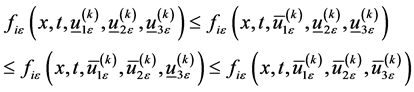
It is obvious that . By induction method, we may assume that
 . Since
  is quasimonotone nondecreasing, we have
 (2.23)
for .
.
 (2.24)
 (2.25)
 (2.26)
 (2.27)
By the comparison principle, we have . Therefore
 (2.28)
Taking , we get a nondecreasing bounded sequence
 . Hence there exist functions
  such that
 (2.29)
By the continuity of  we have
 (2.30)
We now prove that there exist  and a constant M (independent of k and
 ) such that for all k, we have
 (2.31)
Let  be the solutions of the ordinary differential equations
 (2.32)
By standard results in [11] , there exist , such that
  exists on
  with
with  depends only on
 . By the comparison theorem
 (2.33)
Setting , we obtain (2.31).
We now claim that  as
as , in
, in , where
  stands for weak convergence,
 .
.
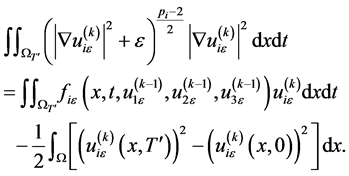
Multiplying (2.5) by  and integrating over
 , we obtain that
 (2.34)
Furthermore
 (2.35)
 (2.36)
By (2.12) and the property of 
 (2.37)
where C is a constant independent of  and k.
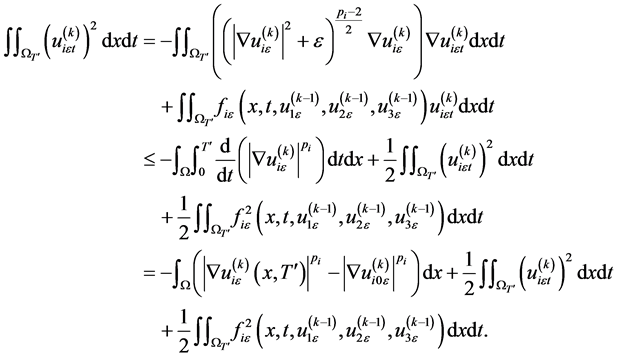
Multiplying (2.5) by  and integrating over
 , we have
 (2.38)
By Cauchy inequality and integrating by parts, we obtain
 (2.39)
Hence
 (2.40)
By (2.37) and (2.40), we obtain that there exists a subsequence of  converging weakly in the following sense as
 .
.
 (2.41)
 (2.42)
 (2.43)
where  stands for weak convergence,
 .
.
From (2.29), (2.30), (2.37), (2.40) and the uniqueness of the weak limits, we have that, as ,
,
 (2.44)
 (2.45)
 (2.46)
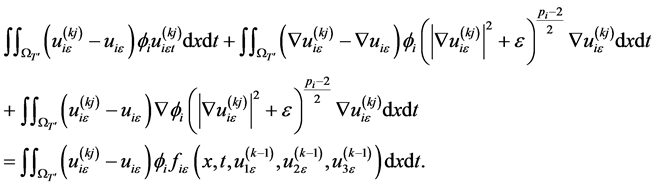
We now claim that 
Multiplying (2.5) by  and integrating over
  with
with  we get
 (2.47)
Hence
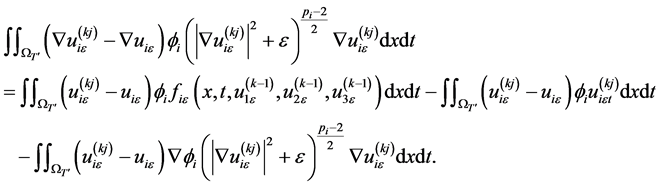 (2.48)
Since the three terms on the right hand side of the above equality converge to 0 as . This yields that
 (2.49)
On the other hand, since , we have that
 (2.50)
Note that
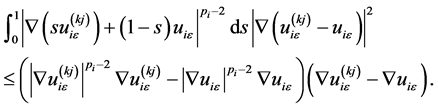 (2.51)
Following (2.50) and (2.51), we have
 (2.52)
Since
 (2.53)
and
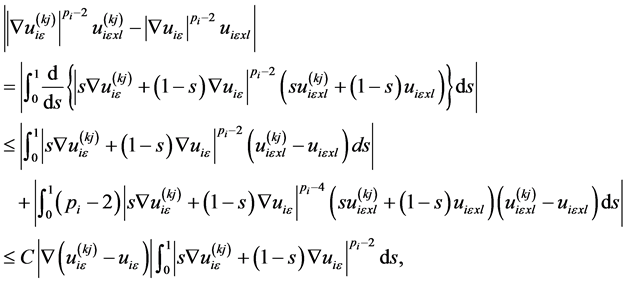 (2.54)
by Hölder inequality, we have
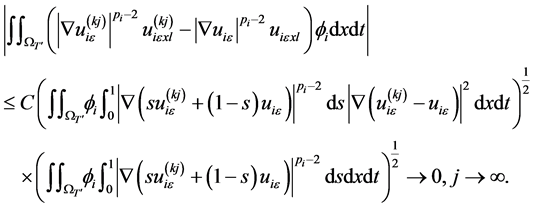 (2.55)
i.e.,
 (2.56)
Hence
 (2.57)
This proves that any weak convergence subsequence of  will have
  as its weak limit and hence by a standard argument, we have that as
 ,
,
 (2.58)
Combining the above results, we have proved that  is a generalized solution of (2.1)-(2.3).
Proof of theorem 1.3.
Since  satisfy similar estimates as (2.31), (2.37) and (2.40), combining the property of
 , we know that there are functions
  (as
(as ) such that for some subsequence of
  denoted again by
 ,
,
 (2.59)
 (2.60)
 (2.61)
 (2.62)
In a similar way as above, we prove that 
By a standard limiting process, we obtain that  satisfies the initial and boundary value conditions and the integrating expression. Thus
  is a generalized solution of (1.1)-(1.3).
3. Uniqueness Result to the Solution of the System
We now prove the uniqueness result to the solution of the system.
Theorem 3.1. Assume  is Lipschitz continuous in
 , then the solution of (1.1)-(1.3) is unique.
Proof. Assume that  and
and  are two solutions of (1.1)- (1.3). Let
  then following (1.5),
 (3.1)
(3.1)
 (3.2)
(3.2)
By (3.1) subtracting (3.2), we get
 (3.3)
(3.3)
By the inequality (3.3) and the Lipschitz condition, a simple calculation shows that
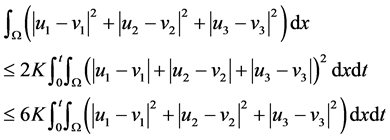 (3.4)
(3.4)
Setting , then (3.4) can be written as
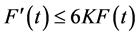 . Since
 , by a standard argument, we have
 , and hence
 .
.
Cite this paper
Ou, Q.T. and Zhan, H.S. (2016) Local Solutions to a Class of Parabolic System Related to the P-Lapla- cian. Advances in Pure Mathematics, 6, 868- 877. http://dx.doi.org/10.4236/apm.2016.612065
References
- 1. Astrita, G. and Marrucci, G. (1974) Principles of Non-Newtonian Fluid Mechanics. McGraw-Hill, New York.
- 2. Martinson, L.K. and Pavlov, K.B. (1971) Unsteady Shear Flows of a Conducting Fluid with a Rheological Power Law. Magnitnaya Gidrodinamika, 2, 50-58.
- 3. Esteban, J.R. and Vazquez, J.L. (1982) On the Equation of Turbulent Filteration in One-Dimensional Porous Media. Nonlinear Analysis, 10, 1303-1325.
http://dx.doi.org/10.1016/0362-546X(86)90068-4 - 4. Constantin, A., Escher, J. and Yin, Z. (2004) Global Solutions for Quasilinear Parabolic System. Journal of Differential Equations, 197, 73-84.
http://dx.doi.org/10.1016/S0022-0396(03)00165-7 - 5. Dichstein, F. and Escobedo, M. (2001) A Maximum Principle for Semilinear Parabolic Systems and Application. Nonlinear Analysis, 45, 825-837.
http://dx.doi.org/10.1016/S0362-546X(99)00419-8 - 6. Pierre, M. and Schmidt, D. (1997) Blowup in Reaction-Diffusion Systems with Dissipation of Mass. SIAM Journal on Mathematical Analysis, 28, 259-269.
http://dx.doi.org/10.1137/S0036141095295437 - 7. Zhao, J. (1993) Existence and Nonexistence of Solutions for . Journal of Mathematical Analysis and Applications, 172, 130-146.
http://dx.doi.org/10.1006/jmaa.1993.1012 - 8. Wei, Y. and Gao, W. (2007) Existence and Uniqueness of Local Solutions to a Class of Quasilinear Degenerate Parabolic Systems. Applied Mathematics and Computation, 190, 1250-1257.
http://dx.doi.org/10.1016/j.amc.2007.02.007 - 9. Ladyzenskaja, O.A., Solonnikov, V.A. and Ural’ceva, N.N. (1968) Linear and Quasilinear Equations of Parabolic Type. American Mathematical Society, Providence, RI.
- 10. Friedman, A. (1964) Partial Differential Equations of Parabilic Type. Prentice-Hall Inc., Englewood Cliffs, NJ.
- 11. Coddingtin, E. and Levinson, N. (1955) Theory of Ordinary Differential Equations. McGraw-Hill, New York.