

Advances in Pure Mathematics
Vol.06 No.01(2016), Article ID:62842,20 pages
10.4236/apm.2016.61004
The Space of Bounded p(×)-Variation in the Sense Wiener-Korenblum with Variable Exponent
O. Mejía, N. Merentes, J. L. Sánchez, M. Valera-López
Departamento de Matemática, Universidad Central de Venezuela, Caracas, Venezuela

Copyright © 2016 by authors and Scientific Research Publishing Inc.
This work is licensed under the Creative Commons Attribution International License (CC BY).
http://creativecommons.org/licenses/by/4.0/



Received 28 October 2015; accepted 16 January 2016; published 19 January 2016
ABSTRACT
In this paper we present the notion of the space of bounded p(×)-variation in the sense of Wiener-Korenblum with variable exponent. We prove some properties of this space and we show that the composition operator H, associated with , maps the
  into itself, if and only if h is locally Lipschitz. Also, we prove that if the composition operator generated by
  maps this space into itself and is uniformly bounded, then the regularization of h is affine in the second variable, i.e. satisfies the Matkowski’s weak condition.
Keywords:
Generalized Variation, p(×)-Variation in the Sense of Wiener-Korenblum, Exponent Variable, Composition Operator, Matkowski’s Condition

1. Introduction
A number of generalizations and extensions of variation of a function have been given in many directions since Camile Jordan in 1881 gave a first notion of bounded variation in the paper [1] devoted to the convergence of Fourier series. Consequently, the study of notions of generalized bounded variation forms an important direction in the field of mathematical analysis. Two well-known generalizations are the functions of bounded p-variation and the functions of bounded j-variation, due to N. Wiener [2] and L. C. Young [3] respectively. In 1924 N. Wiener [2] generalized the Jordan notion and introduced the notion of p-variation (variation in the sense of Wiener). Later, in 1937, L. Young [3] introduced the notion of j-variation of a function. The p-variation of a function f is the supremum of the sums of the pth powers of absolute increments of f over no overlapping intervals. Wiener mainly focused on the case , the 2-variation. For p-variations with
 , the first major work was done by Young [3] , partly with Love [4] . After a long hiatus following Young’s work, pth-variations were reconsidered in a probabilistic context by R. Dudley [5] [6] , in 1994 and 1997, respectively. Many basic properties of the variation in the sense of Wiener and a number of important applications of the concept can be found in [7] [8] . Also, the paper by V. V. Chistyakov and O. E. Galkin [9] , in 1998, is very important in the context of p-variation. They study properties of maps of bounded p-variation
  in the sense of Wiener, which are defined on a subset of the real line and take values in metric or normed spaces.
In 1997 while studying Poisson integral representations of certain class of harmonic functions in the unit disc of the complex plan B. Korenblum [10] introduced the notion of bounded k-variation and proved that a function f is of bounded k-variation if ot can be written as the difference of two k-decreasing functions. This concept differs from others due to the fact that it introduces a distortion function k that measures intervals in the domain of the function and not in the range. In 1986, S. Ki Kim and J. Kim [11] , gave the notion of the space of functions of kf-bounded variation on , which is a combination of the notion of bounded f-variation in the sense of Schramm and bounded k-variation in the sense of Korenblum, and J. Park et al. [12] [13] proved some properties in this space. Considering
  for
for  and
and , then it follows that this space generalized the space of functions of kp-bounded variation in the sense of Wiener-Korenblum. In 1990 S. Ki Kim and J. Yoon [14] showed the existence of the Riemann-Stieltjes integral of functions of bounded k-variation and in 2011 W. Aziz, J. Guerrero, J. L. Sánchez and M. Sanoja, in [15] , showed that the space of bounded k-variation satisfies the Matkowski’s weak condition. Also, in 2012, M. Castillo, M. Sanoja and I. Zea [16] presented the space of functions of bounded k-variation in the sense of Riez-Korenblum, denoted by
 , which is a combination of the notions of bounded p-variation in the sense of Riesz
  and bounded k-variation in the sense of Korenblum.
Recently, there has been an increasing interest in the study of various mathematical problems with variable exponents. With the emergency of nonlinear problems in applied sciences, standard Lebesgue and Sobolev spaces demonstrated their limitations in applications. The class of nonlinear problems with exponent growth is a new research field and it reflects a new kind of physical phenomena. In 2000 the field began to expand even further. Motivated by problems in the study of electrorheological fluids, L. Diening [17] raised the question of when the Hardy-Littlewood maximal operator and other classical operators in harmonic analysis are bounded on the variable Lebesgue spaces. These and related problems are the subject of active research nowadays. These problems are interesting in applications (see [18] -[21] ) and give rise to a revival of the interest in Lebesgue and Sobolev spaces with variable exponent, the origins of which can be traced back to the work of W. Orlicz in the 1930’s [22] . In the 1950’s, this study was carried on by H. Nakano [23] [24] who made the first systematic study of spaces with variable exponent. Later, Polish and Czechoslovak mathematicians investigated the modular function spaces (see for example J. Musielak [25] [26] , O. Kovacik and J. Rakosnik [27] ). We refer to books [21] for the detailed information on the theoretical approach to the Lebesgue and Sobolev spaces with variable exponents. In 2015, R. Castillo, N. Merentes and H. Rafeiro [28] studied a new space of functions of generalized bounded variation. There the authors introduced the notion of bounded variation in the Wiener sense with the exponent p(×)-variable. In the same year, O. Mejia, N. Merentes and J. L. Sánchez in [29] , proved some properties in this space, for the composition operator and showed a structural theorem for mappings of bounded variation in the sense of Wiener with the exponent p(×)-variable.
The main purpose of this paper is threefold: First, we provide extension of the space of generalized bounded variation present in [28] and [29] in the sense Wiener-Korenblum and we give a detailed description of the new class formed by the functions of bounded variation in the sense of Wiener-Korenblum with the exponent p(×)- variable. Second, we prove a necessary and sufficient condition for the acting of composition operator
(Nemystskij) on the space  and, third we show that any uniformly bounded composition operator that maps the space
  into itself necessarily satisfies the so called Matkowski’s weak condition.
2. Preliminaries
We use throughout this paper the following notation: we will denote by

the diameter of the image  (or the oscillation of f on
 ) and by
  a number between
 .
.
The class of bounded variation functions exhibit many interesting properties that it makes them a suitable class of functions in a variety of contexts with wide applications in pure and applied mathematics (see [8] and [30] ). Since C. Jordan in 1881 (see [1] ) gave the complete characterization of functions of bounded variation as a difference of two increasing functions, the notion of bounded variation functions has been generalized in different ways.
Definition 2.1. Let  be a function. For each partition
  of
of , we define
 (1)
(1)
where the supremum is taken over all partitions  of the interval
 . If
. If , we say that f has bounded variation. The collection of all functions of bounded variation on
  is denoted by
 .
.
A generalization of this notion was presented by N. Wiener (see [2] ) who introduced the notion of p-variation as follows.
Definition 2.2. Given a real number , a partition
  of
of , and a function
 . The nonnegative real number
 (2)
(2)
is called the Wiener variation (or p-variation in Wiener’s sense) of f on  where the supremum is taken over all partitions
 .
.
In case that , we say that f has bounded Wiener variation (or bounded p-variation in Wiener’s sense) on
 . The symbol
  will denote the space of functions of bounded p-variation in
Wiener’s sense on .
.
Other generalized version was given by B. Korenblum in 1975 [10] . He considered a new kind of variation, called k-variation, and introduced a function k for distorting the expression  in the partition if self, rather than the expression
  in the range. On advantage of this alternative approach is that a function of bounded k-variation may be decomposed into the difference of two simpler functions called k-decreasing functions.
Definition 2.3. A function  is called a distortion function (k-function) if k satisfies the following properties:
1) k is continuous with  and
and ;
;
2) k is concave and increasing;
3) .
.
B. Korenblum (see [10] ), introduced the definition of bounded k-variation as follows.
Definition 2.4. Let k be a distortion function, f a real function , and
, and  a partition of the interval
 . Let one consider
 (3)
(3)
where the supremum is taken over all partitions  of the interval
 . In the case
  one says that f has bounded k-variation on
  and one will denote by
  the space of functions of bounded k-variation on
 .
.
Some properties of k-function cab be found in [12] [14] [16] .
In 2013 R. Castillo, N. Merentes and H. Rafeiro [28] introduce the notation of bounded variation space in the Wiener sense with variable exponent on  and study some of its basic properties.
Definition 2.5. Given a function , a partition
  of the interval
 , and a function
 . The nonnegative real number
 (4)
(4)
is called Wiener variation with variable exponent (or p(×)-variation in Wiener’s sense) of f on  where
where  is a tagged partition of the interval
 , i.e., a partition of the interval
  together with a finite sequence of numbers
  subject to the conditions that for each i,
 .
.
In case that , we say that f has bounded Wiener variation with variable exponent (or bounded p(×)-variation in Wiener’s sense) on
 . The symbol
  will denote the space of functions of bounded p(×)-variation in Wiener’s sense with variable exponent on
 .
.
Remark 2.6. Given a function 
1) If  for all x in
 , then
 .
.
2) If  for all x in
  and
and , then
 .
.
In [29] , O. Mejia, N. Merentes and J. L. Sánchez proved some properties in this space, for the composition operator and show a structural theorem for mappings of bounded variation in the sense of Wiener with the exponent p(×)-variable.
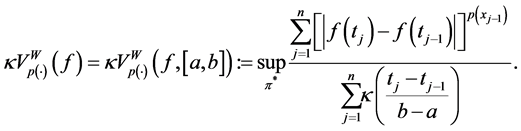
Now, we generalized the notion of bounded variation space in the sense of Wiener-Korenblum with variable exponent on . For this, we defined bellow the bounded p(×)-variation in the sense of Wiener-Korenblum with exponent variable.
Definition 2.7. Given a function , a partition
  of the interval
 ,
,  be a distortion function and a function
 . The nonnegative real number
 (5)
(5)
is called Wiener-Korenblum variation with variable exponent (or p(×)-variation in the sense of Wiener-Korenblum) of f on  where
where  is a tagged partition of the interval
 , i.e., a partition of the interval
  together with a finite sequence of numbers
  subject to the conditions that for each i,
 .
.
In case that , we say that f has bounded Wiener-Korenblum variation with variable exponent (or bounded p(×)-variation in the sense of Wiener-Korenblum) on
 . The symbol
will denote the space of functions of bounded p(×)-variation in the sense Wiener-Korenblum with variable exponent on .
.
Remark 2.8. Given a function
1) If  for all
  in
in , then
 .
.
2) If  for all
  in
in  and
and , then
 .
.
Example 2.9. Let  be a function such that
  and
and  for
for . Then, from mean value theorem, we have

Therefore, .
.
3. Properties of the Space
Theorem 3.1. Let  and
and  be a distortion function then
 .
.
Proof. Let ,
,  and
and  be a partition of the interval
 . Then, by the
  subadditivity, we have:

Thus,
 (6)
(6)
Then considering the supremum of the left side we get
 (7)
(7)
therefore,  and
and . W
. W
Remark 3.2. From this result we deduce that every function of bounded p(×)-variation in of Wiener’s sense with variable exponent on the interval  is a bounded p(×)-variation in the Wiener-Korenblum sense on the interval
 .
.
Now we will see that the class of function of bounded p(×)-variation in the sense of Wiener-Korenblum has a structure of vector space.
Theorem 3.3. Let , then the set
  is a vector space.
Proof. Let , then for each partition
  of
of , and
, and  is a tagged partition of the interval
 , we obtain:
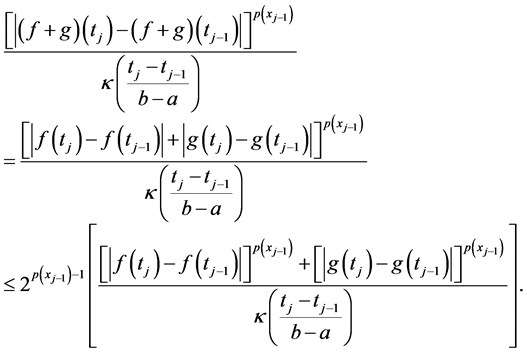
Now adding from  to
to  we get
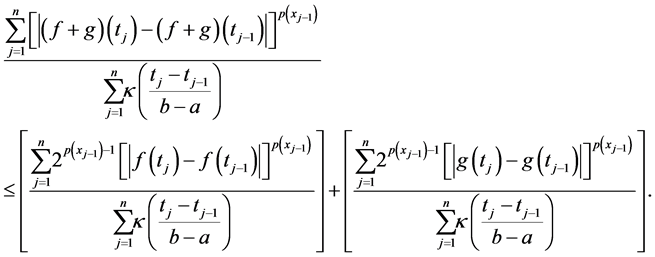
Since p(×) is bounded, then there is a  such that
  for all
 , and we obtain
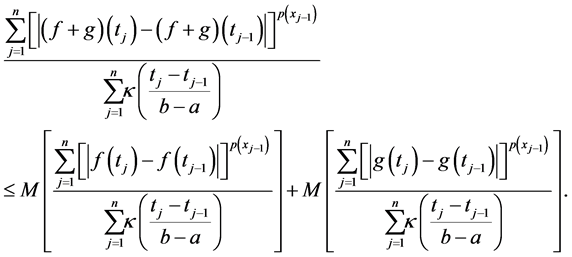
In other word, if , then the function
  is of bounded p(×)-variation in the sense of Wiener-Korenblum with variable exponent on
  and
and

On the other hand, since p(×) is bounded, there exists  such that
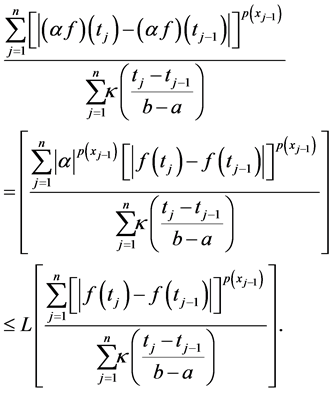
therefore, . So,
. So,  is a vector space. W
Proposition 3.4. Given a function , the variation
  is convex.
Proof. Let  and
and . By Theorem 3.3
 . Since for
  the function
  is convex, then we get
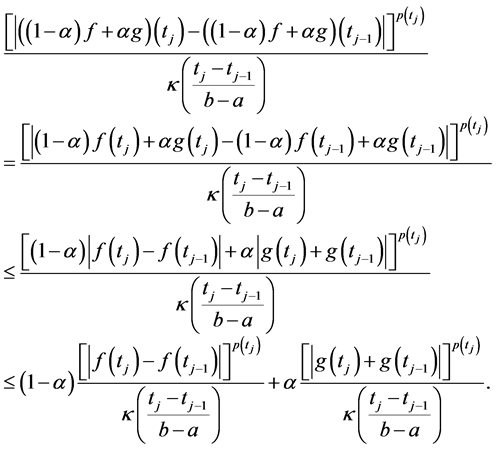
Then,

W
Definition 3.5. (Norm in )
)
Let  be a function that belongs to
 . Then
 (8)
(8)
where .
.
Theorem 3.6.  is a normed space.
Proof. Let ,
, . Then, we have that:
a)  since
since  and
and .
.
b)
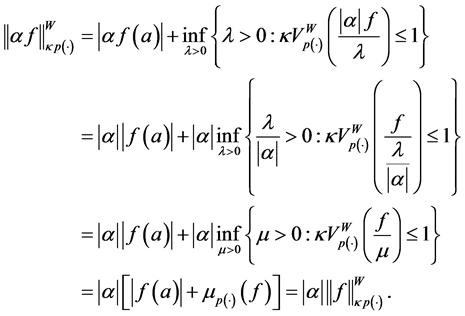
Therefore, .
.
c) Fix  and
and ; then
  and
and . Now let
 . Then by convexity of

Hence

Thus, 
d) Let us now prove that  if and only if
 . If
. If , then
  for all
 , and so
 . Conversely, suppose that
 , i.e.,

then  and
and , we get

i.e.,
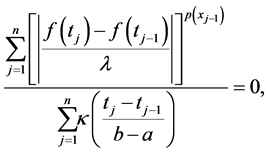
without loss of generality, considering the partition  we get

then
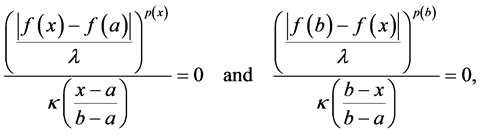
we get

Hence,  for all
  and
and , therefore
 . W
. W
In the following, we show that  endowed with the norm
  is a Banach space.
Theorem 3.7. Let  be a function, then
  is a Banach space.
Proof. Let  be a Cauchy sequence in
 , then given
 , there is
  such that for
  we have

i.e.

Then

Thus, for all  and
and , we have that

then

therefore

by properties of function , we get
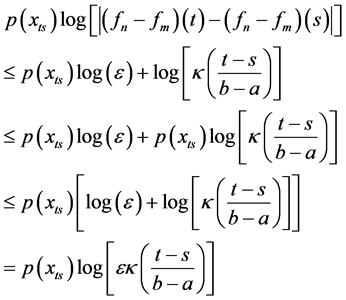
then

hence

In consequence, the sequence , is a uniformly sequence of Cauchy, on the interval
 . Since
  is complete, there exists a function f defined on
  such that

We will show that  converge on the norm
 .
.
Since the  is a Cauchy sequence there is a
  such that

From the fact that  converge uniformly to the function f on the interval
 , we get

Therefore, the sequence  converge to the function f on the norm
 .
.
Thus  is a Banach space. W
The following properties of elements of  allow us to get characterizations of them.
Lemma 3.8. (General properties of the p(×)-variation) Let  be a arbitrary map and
  be a distortion function. We have
(P1) Minimality: if , then

(P2) Change of variable: if  and
and  is a (not necessarily strictly) monotone function, then
(P3) Regularity: 
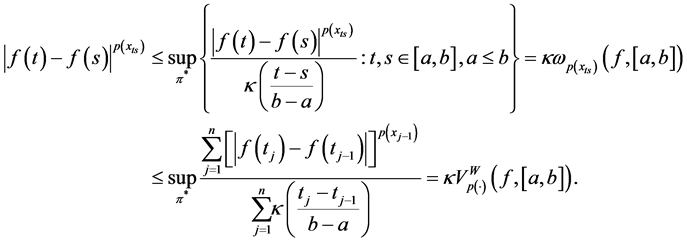
Proof. (P1) Let ,
, .
.
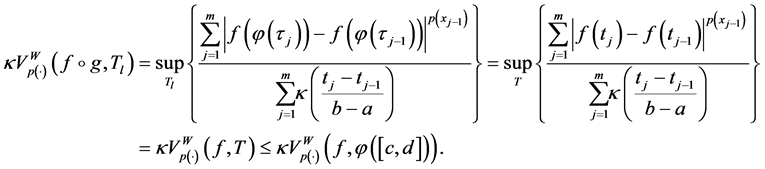
(P2) Let ,
,  a (not necessary strictly) monotone function,
  a tagged partition of the interval
 ,
,  and
and  with
with , then
On the other hand, if a partition  of
of  is such that
  for
for , then there exist
  such that
  and again by the monotonicity of
 :
:

(P3) By monotonocity of  we get

On the other hand, for any number  there is a partition
 ,
,  with
with . We define
  a partition of the interval
 , then
  and
and  . W
. W
In the next section we will be dealing with the composition operator (Nemitskij).
4. Composition Operator between the Space 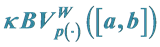
In any field of nonlinear analysis composition operators (Nemytskij), the superposition operators generated by appropriate functions, play a crucial role in the theory of differential, integral and functional equations. Their analytic properties depend on the postulated properties of the defining function and on the function space in which they are considered. A rich source of related questions is the monograph by J. Appell and P. P. Zabrejko [31] and J. Appell, J. Banas, N. Merentes [8] .
The composition operator problem refers to determining the conditions on a function , such that the composition operator, associated with the function h, maps a space
  of functions
  into itself [32] [33] . There are several spaces where the composition operator problem has been resolved. In 1961, A. A. Babaev [34] showed that the composition H, associated with the function
 , maps the space
  of the Lipschitz functions into itself if and only if h is locally Lipschitz; in 1967, K. S. Mukhtarov [35] obtained the same result for the space
  of the Hölder functions of order
 .
.
The first work on the composition operator problem in the space of functions of bounded variation  was made by M. Josephy in 1981, [36] . Other work of this type have been preformed over
 ,
,
 ,
,  ,
,  ,
,  ,
,  ,
,  ,
,  and
and  (see [8] ).
Now, we define the composition operator. Given a function , the composition operator H, associated to a function f (autonomous case) maps each function
  into the composition function
 , given by
 (9)
(9)
More generally, given , we consider the operator H, defined by
 (10)
(10)
This operator is also called superposition operator or susbtitution operator or Nemytskij operator. In what follows, will refer (9) as the autonomus case and to (10) as the non-autonomus case.
In order to obtain the main result of this section, we will use a function of the zig-zag type such as the employed by J. Appell et al. [8] [37] that the locally Lipschitz condition of the function h is a necessary and suffi-
cient condition such that  and that in this situation H is bounded.
One of our main goals is to prove a result in the case when h is locally Lipschitz if and only if the composition operator maps the space of functions of bounded p(×)-variation into itself.
The following lemma, established in [38] , will be useful in the proof of our main Theorem (Theorem 4.2).
Lemma 4.1. Let ,
,  , then

Theorem 4.2. Let H be a composition operator associated to . H maps the space
  into itself if and only if h is locally Lipschitz.
Proof. We may suppose without loss generality that . First, let
  be locally Lipschitz on
 , and let
 . Then
  for some
 . Considering the local Lipschitz condition
 (11)
(11)
for , for any partition
  we obtain the estimate
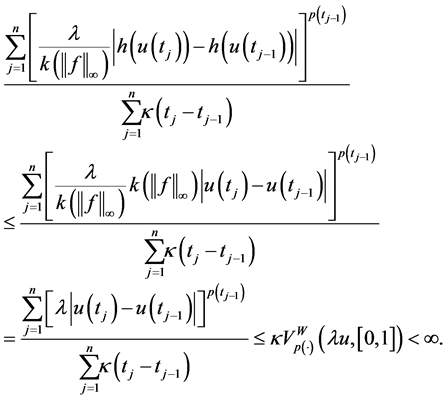
This shows that for ,
,  , and hence
  as claimed.
The proof of the only if direction will be by contradiction, that is we assume  and h is not locally Lipschitz. Since the identity function
  belong to
 , then
  and therefore h is bounded in the interval
 . Without loss of generality we may assume that
 (12)
(12)
Since h is not locally Lipschitz in  there is a closed interval I such that h does not satisfy any Lipschitz condition. In order to simplify the proof we can assume that
  In this way for any increasing sequence of positive real numbers
  that converge to infinite, that we will define later, we can choose sequences
 ,
,  , such that
 (13)
(13)
In addition choose  such that

Considering subsequence if it necessary, we can assume without loss of generality that the sequence  is monotone increasing.
Since  is compact, from inequality (13) we have that exist subsequences of
  and
and  that we will denote in the same way, and that converge to
 .
.
Since the sequence  is a Cauchy sequence we can assume (taking subsequence if it is necessary) that
 (14)
(14)
Again considering subsequences if needed and using the properties of the function  we can assume that
 (15)
(15)
Consider the new sequence  defined by

From of inequalities (12) and (13) it follows that , therefore

Consider the sequence defined recursively  by
by

This sequence is strictly increasing and from the relations (14) and (15), we get

Then to ensure that , is sufficient to suppose that
 .
.
We define the continuous zig-zag function , as shown below

Put

We can write each interval , as the union of the family of non-overlapping intervals

And function u is defined on  as follows
 (16)
(16)
 (17)
(17)
and
 (18)
(18)
In all these situations the slopes of these segments of lines is 1.
Hence, we have for , the absolute value of the slope of the line segments in these ranges are bounded by 1, as shown below


We will show that .
.
Let , then there are the following possibilities for the location of s and t on
 .
.
Case 1: If  are in the same interval
From relations (16), (17) and (18) follows .
.
Case 2: If  are in two different intervals
There are several possibilities:
a) ,
,
 .
.
 )
) . By Lemma 4.1 and relations (16) and (17) we have

 )
) . Then

b) .
.
If  proceed as
 ).
).
If , again using the Lemma 4.1 and relations (16), (17) and (18) we obtain

Case 3: If .
.
From Lemma 4.1 and the second case, we conclude

Case 4: If .
.
Then from Lemma 4.1

Case 5: If .
.
From Lemma 4.1 and Case 4

Case 6: If 
In this circumstance  and the situation is trivial. Therefore we have that

So u is Lipschitz in . Moreover, for each partition of interval
  of the form

and , using the inequality (13), convexity of the function
  and definition of
 , we have
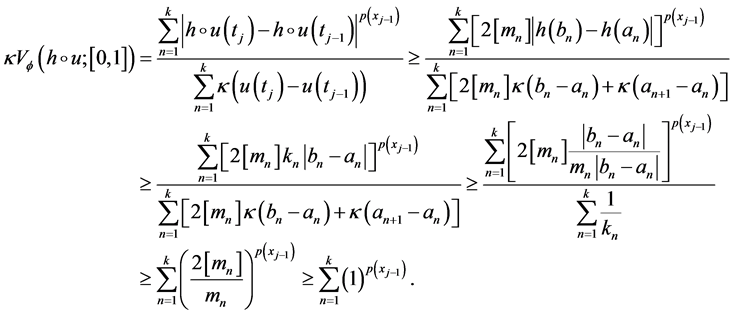
As the serie  diverge,
  , which is a contradiction. W
5. Uniformly Continuous Composition Operator
In a seminal article of 1982, J. Matkowski [39] showed that if the composition operator H, associated with the function , maps the space
  of the Lipschitzian functions into itself and is a globally Lipschitzian map, then the function h has the form
 (19)
(19)
for some .
.
There are a variety of spaces besides  that verify this result [37] . The spaces of Banach
  that fulfill this property are said to satisfy the Matkowski property [32] .
In 1984, J. Matkowski and J. Miś [40] considered the same hypotheses on the operator H for the space  of the function of bounded variation and concluded that (19) is true for the regularization
  of the function h with respect of the first variable; that is,

where . The spaces that satisfy this condition are said to verify weak Matkowski property, [32] .
In this section, we give the other main result of this paper, namely, we show that any uniformly bounded composition operator that maps the space  into itself necessarily satisfies the so called Matkowski’s weak condition.
First of all we will give the definition of left regularization of a function.
Definition 5.1. Let , its left regularization
  of mapping f is the function given as

We will denote by  the subset in
  which consists of those functions that are left continuous on
 .
.
Lemma 5.2. If , then
 .
.
Thus, if a function , then its left regularization is a left continuous function, i.e.,
 .
.
Also, we will denote by  the subset in
  which consists of those functions that are left continuous on
 .
.
Lemma 5.3. If , then
 .
.
Proof. By Lemma 5.2, we have . Then, by Theorem 3.1,
 .
.
Thus, if a function , then its left regularization is a left continuous function, i.e.,
 . In consequence,
 .
.
Another lemma useful for the follow theorem is developed below:
Lemma 5.4. Let , be a distortion function,
  and
and . Then
  if and only if
 .
.
Proof. Let . Suppose that
 ; then by definition of
  there exists
  such that
  and
and . Since, for
  the function
  is convex, we have:

Conversely, assume , then
 ; hence
 .
.
Theorem 5.5. Suppose that the composition operator H generated by  maps
maps  into itself and satisfies the following inequality
 (20)
(20)
for some function . Then, there exist functions
  such that
 (21)
(21)
where  is the left regularization of
  for all
 .
.
Proof. By hypothesis, for  fixed, the constant function
  belongs to
 . Since H maps
  into itself, we have
 . By Lemma 5.2 the left regularization
  for every
 .
.
From the inequality (20) and definition of the norm  we obtain for
 ,
,
 (22)
(22)
From the inequality (22) and Lemma 5.2, if  then
then
 (23)
(23)
Let , and let
  be the equidistant partition defined by

Given  with
with , define
  by
by
 (24)
(24)
and
 (25)
(25)
Then the difference  satisfies

Consequently, by the inequality (20)

From the inequality (23) and the definition of p(×)-variation in the sense of Wiener-Korenblum we have
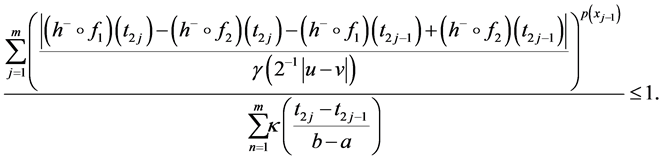
However, by definition of the functions  and
and ,
,
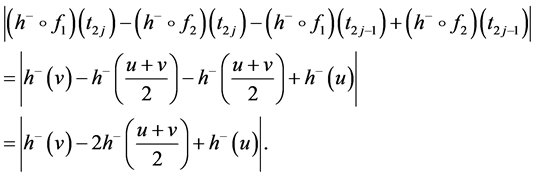
Then
 (26)
(26)
Since  for all
 ,
,  , and passing to the limit as
 , then

hence,

So, we conclude that  satisfies the Jensen equation in
  (see [41] , page 315). The continuity of
  with respect of the second variable implies that for every
  there exist
  such that

Because ,
,  and
and , for each
 , we obtain that
 . W
. W
J. Matkowski [42] introduced the notion of a uniformly bounded operator and proved that any uniformly bounded composition operator acting between general Lipschitz function normed spaces must be of the form (21).
Definition 5.6. ([42] , Def. 1) Let  and
and  be two metric (or normed) spaces. We say that a mapping
  is uniformly bounded if, for any
  there exists a nonnegative real number
  such that for any nonempty set
  we have

Remark 5.7. Every uniformly continuous operator or Lipschitzian operator is uniformly bounded.
Theorem 5.8. Let  and H be the composition operator associated with h. Suppose that H maps
  into itself and is uniformly continuous, then, there exist functions
  such that

where  is the left regularization of
  for all
 .
.
Proof. Take any  and
and  such that

Since  by the uniform boundedness of H, we have

that is,

and therefore, by the Theorem 5.5 we get

Acknowledgements
This research has been partially supported by the Central Bank of Venezuela. We want to give thanks to the library staff of B.C.V for compiling the references.
Cite this paper
O.Mejía,N.Merentes,J. L.Sánchez,M.Valera-López, (2016) The Space of Bounded p(·)-Variation in the Sense Wiener-Korenblum with Variable Exponent. Advances in Pure Mathematics,06,21-40. doi: 10.4236/apm.2016.61004
References
- 1. Jordan, C. (1881) Sur la série de Fourier. Comptes Rendus de l’Académie des Sciences, 228-230.
- 2. Wiener, N. (1924) The Quadratic Variation of a Function and Its Fourier Coefficients. Journal of Mathematical Physics, 3, 73-94.
http://dx.doi.org/10.1002/sapm19243272 - 3. Young, L.C. (1937) Sur une généralisation de la notion de variation de pussance piéme bornée au sens de M. Wiener, et sur la convergence des séries de Fourier. Comptes Rendus de l’Académie des Sciences, 204, 470-472.
- 4. Love, E.R. and Young, L.C. (1937) Sur une classe de fonctionelles linéaires. Fundamenta Mathematicae, 28, 243-257.
- 5. Dudley, R.M. (1994) The Order of the Remainder in Derivatives of Composition and Inverse Operators for p-Variation Norms. Annals of Statistics, 22, 1-20.
http://dx.doi.org/10.1214/aos/1176325354 - 6. Dudley, R.M. (1997) Empirical Processes and p-Variation. In: Pollard, D., Torgersen, E. and Yang, G.L., Eds., Festschrift for Lucien Le Cam, Springer, New York, 219-233.
http://dx.doi.org/10.1007/978-1-4612-1880-7_13 - 7. Dudley, R.M. and Norvaisa, R. (1999) Differentiability of Six Operators on Nonsmooth Functions and p-Variation. Springer, Berlin.
- 8. Appell, J., Banas, J. and Merentes, N. (2014) Bounded Variation and Around. De Gruyter, Boston.
- 9. Chistyakov, V.V. and Galkin, O.E. (1998) On Maps of Bounded p-Variation with p>1. Positivity, 2, 19-45.
http://dx.doi.org/10.1023/A:1009700119505 - 10. Korenblum, B. (1975) An Extension of the Nevalinna Theory. Acta Mathematica, 135, 187-219.
http://dx.doi.org/10.1007/BF02392019 - 11. Kim, S.K. and Kim, J. (1986) Functions of kø-Bounded Variation. Bulletin of the Korean Mathematical Society, 23, 171-175.
- 12. Park, J. (2010) On the Functional of Bounded kø-Variations (I). Journal of Applied Mathematics & Informatics, 28, 171-175.
- 13. Sok, Y.-U. and Park, J.-K. (1989) A Study on the Functions of kø-Bounded Variation. Journal of the Chungcheong Mathematical Society, 2, 55-64.
- 14. Kim, S.K. and Yoon, J. (1990) Riemman-Stieltjes Integral of Functions of k-Bounded Variation. Communications of the Korean Mathematical Society, 5, 65-73.
- 15. Aziz, W., Guerrero, J., Sánchez, J. and Sanoja, M. (2011) Lipschitzian Composition Operator in the Space . Journal of Mathematical Control Science and Applications (JMCSA), 4, 67-73.
- 16. Castillo, M., Sanoja, M. and Zea, I. (2012) The Space Functions of Bounded k-Variation in the Sense of Riesz-Korenblum. Journal of Mathematical Control Science and Applications (JMCSA), 2012, 1-16.
- 17. Diening, L. (2004) Maximal Function on Generalize Lebesgue Spaces . Mathematical Inequalities & Applications, 7, 245-253.
- 18. Azroul, E., Barbara, A. and Redwane, H. (2014) Existence and Nonexistence of a Solution for a Nonlinear p(x)-Elliptic Problem with Right-Hand Side Measure. International Journal of Analysis, 2014, 1-15.
- 19. Fan, X., Zhao, Y. and Zhao, D. (2001) Compact Imbedding Theorems with Symmetry of Strauss-Lions Type for the Space . Journal of Mathematical Analysis and Applications, 255, 333-348.
http://dx.doi.org/10.1006/jmaa.2000.7266 - 20. Yin, L., Liang, Y., Zhang, Q. and Zhao, C. (2015) Existence of Solutions for a Variable Exponent System without PS Conditions. Journal of Differential Equations, 2015, 1-23.
- 21. Radulescu, V.D. and Repovs, D.D. (2015) Partial Differential Equations with Variable Exponent: Variational Methods and Qualitative Analysis. CRC Press, Taylor & Francis Group, Boca Raton.
- 22. Orlicz, W. (1931) über konjugierte exponentenfolgen. Studia Mathematica, 3, 200-211.
- 23. Nakano, H. (1950) Modulared Semi-Ordered Linear Spaces. Maruzen Co., Ltd., Tokyo.
- 24. Nakano, H. (1951) Topology and Topological Linear Spaces. Maruzen Co., Ltd., Tokyo.
- 25. Musielak, J. (1983) Orlicz Spaces and Modular Spaces. Springer-Verlag, Berlin.
- 26. Musielak, J. and Orlicz, W. (1959) On Modular Spaces. Studia Mathematica, 18, 49-65.
- 27. Kovácik, O. and Rákosník, J. (1991) On Spaces and . Czechoslovak Mathematical Journal, 41, 592-618.
- 28. Castillo, R., Merentes, N. and Rafeiro, H. (2014) Bounded Variation Spaces with p-Variable. Mediterranean Journal of Mathematics, 11, 1069-1079.
http://dx.doi.org/10.1007/s00009-013-0342-5 - 29. Mejia, O., Merentes, N. and Sánchez, J. (2015) The Space of Bounded p(·)-Variation in Wiener’s Sense with Variable Exponent. Advances in Pure Mathematics, 5, 703-716.
http://dx.doi.org/10.4236/apm.2015.511064 - 30. Merentes, N. and Rivas, S. (1996) El Operador de Composición en Espacios de Funciones con Algún Tipo de Variación Acotada, IX Escuela Venezolana de Matemáticas, Facultad de Ciencias-ULA, Mérida-Venezuela.
- 31. Appell, J. and Zabreiko, P.P. (1990) Nonlinear Superposition Operators. Cambridge University Press, Cambridge.
http://dx.doi.org/10.1017/CBO9780511897450 - 32. Appell, J., Guanda, N. and Väth, M. (2011) Function Spaces with the Matkowski Property and Degeneracy Phenomena for Composition Operators. Fixed Point Theory, 12, 265-284.
- 33. Appell, J., Jesús, Z. and Mejía, O. (2011) Some Remarks on Nonlinear Composition Operators in Spaces of Differentiable Functions. Bolletino Della Unione Matematica Italiana, 4, 321-336.
- 34. Babaev, A.A. (1961) On the Structure of a Certain Nonlinear Operator and Its Application. Uchenye Zapiski Azerbajdzh Gos. Univ., 4, 13-16.
- 35. Mukhtarov, K.S. (1967) On the Properties of the Operator in the Space . Sbornik Nauchm. Rabot Mat. Kaf. Dagestan Univ, 83, 145-150.
- 36. Josephy, M. (1981) Composing Functions of Bounded Variation. Proceedings of the American Mathematical Society, 83, 354-356.
http://dx.doi.org/10.1090/S0002-9939-1981-0624930-9 - 37. Appell, J., Guanda, N., Merentes, N. and Sanchez, J.L. (2011) Some Boundedness and Continuity Properties of Nonlinear Composition Operators: A Survey. Communications in Applied Analysis, 15, 153-182.
- 38. Jesús, Z., Mejia, O., Merentes, N. and Rivas, S. (2013) The Composition Operator and the Space of the Functions of Bounded Variation in Schramm-Korenblum’s Sense. Journal of Functional Spaces and Applications, 2013, 1-13.
http://dx.doi.org/10.1155/2013/284389 - 39. Matkowski, J. (1982) Functional Equation and Nemytskiǐ Operators. Fako de l’Funkcialaj Ekvacioj Japana Matematika Societo, 25, 127-132.
- 40. Matkowski, J. and Miǐ, J. (1984) On a Characterization of Lipschitzian Operators of Substitution in the Space . Mathematische Nachrichten, 117, 155-159.
http://dx.doi.org/10.1002/mana.3211170111 - 41. Kuczma, M. (1885) An Introduction to the Theory of Functional Equations and Inequalities. Polish Scientific Editors and Silesian University, Warszawa.
- 42. Matkowski, J. (2011) Uniformly Bounded Composition Operators between General Lipschitz Function Normed Spaces. Topological Methods in Nonlinear Analysis, 38, 395-405.