
Advances in Pure Mathematics
Vol.05 No.06(2015), Article ID:56591,13 pages
10.4236/apm.2015.56034
Super Characteristic Classes and Riemann-Roch Type Formula
Tadashi Taniguchi
Gunma National College of Technology, Maebashi-Shi, Japan
Email: tani@nat.gunma-ct.ac.jp
Copyright © 2015 by author and Scientific Research Publishing Inc.
This work is licensed under the Creative Commons Attribution International License (CC BY).
http://creativecommons.org/licenses/by/4.0/



Received 26 March 2015; accepted 22 May 2015; published 25 May 2015
ABSTRACT
The main purpose of this article is to define the super characteristic classes on a super vector bundle over a superspace. As an application, we propose the examples of Riemann-Roch type formula. We also introduce the helicity group and cohomology with respect to coefficient of the helicity group. As an application, we propose the examples of Gauss-Bonnet type formula.
Keywords:
Superspace, Super Characteristic Class, Complex Supercurve with Genus g, SUSY Structure, Cohomology of Helicity Group

1. Introduction
In this paper, we define various characteristic classes on a super vector bundle over a superspace, so called super characteristic classes. We also propose the super Riemann-Roch formulas and the super Gauss-Bonnet formulas as its application. In contrast, it is justified the definition of the super characteristic classes by establishing those formulas. In [1] , we defined the super Chern classes with values in the super number ,
,  and we succeeded in applying the super ADHM construction of the super Yang-Mills instantons. But essentially the super Chern classes ought to take with values in an integer
 . Meaning like it, we introduce the new definition of the super Chern classes with values in integer. In general, the characteristic classes consider that given the vector bundles it corresponds to some cohomology class of the base manifolds. Hence, we need the cohomology reflecting the properties of superspaces. Therefore, we will define the cohomology with respect to coefficient of the some finitely generated group, which is called the helicity group.
This article is organized as follows. After a brief sketch on the definition and examples of superspaces and its cohomology in Section 2 ([1] -[6] ), main result in this paper is that we define the Chern class, Chern character, Todd class, Pontrjagin class, Eular class,  -genus and L-genus as in the case of super category in Section 3. In Section 4, as an application, we have the Riemann-Roch type formula of super structure sheaf on the complex supercurves of dimension
  with genus g. Moreover, it generalizes the structure sheaf to any super line sheaves. In particular, in the case of dimension
 , with
  supersymmetric structure, we obtain the Atiyah-Singer index type formula for any super line bundles. In Section 5, we attempt to define the helicity group and cohomology with respect to coefficient of the helicity group. In Section 6, we give the Gauss-Bonnet type formula on the complex supercurves of dimension
  with genus g and the complex super projectve space of dimension
 .
.
2. Supermanifolds
We will summarize the definitions here in order to establish terminology and notation ([1] -[6] ).
Definition 2.1 A superspace is defined to be a local ringed space 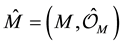 consisting a topological
space M and a sheaf of  -graded supercommutative rings
 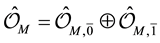 on it such that the stalk
  at any point
  is a local ring.
In particular case of a superspace, a supermanifold is defined by the following.
Definition 2.2 A supermanifold of dimension  is a ringed space
 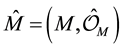 with the following properties:
1) the structure sheaf  is a sheaf of
  -graded supercommutative rings,
2) Let  be the ideal sheaf of nilpotents in
 . Then
  is a classical manifold M of dimension n, so also called body.
3) Let  be the locally free
  -module of rank
 . Then
  is locally isomorphic to the exterior algebra
 .
.
A supermanifold is said to be split if the isomorphism 3) holds globally.
A local section  can be expressed as follows:
 (1)
(1)
where ,
,  is a local coordinate function on
  and
and  a local
generator of . We refer to
  as a local coordinate of a supermanifold
 .
.
Example 2.1 1) The typical example is the real (or complex) linear superspace  (or
(or ) which can be defined by


where  (or
(or ) is the sheaf of the ring of differential functions on
  (or
(or ). It is easy to see that
the  is isomorphic to
 .
.
2) A real super sphere of dimension  is defined by

where  is the sheaf of the ring of differential functions on
 .
.
3) A complex super projective space of dimensin  is defined by

We denote by  the structure sheaf
  of
of . A super holomorphic function 1) on
  should be a function of total homogeneity 0 in
  even variables
  and N odd variables
 , that is
  has homogeneity
 . Let
. Let  be the even line sheaf of degree d on
  and
and  be the odd line sheaf of degree d on
 .
.
4) A quaternionic super projective space of dimension  is defined by

The above are examples of the supermanifolds in Definition 2.2.
5) We have a new example of superspace in Definition 2.1 as follows. The complex supercurves of dimension  with genus g is defined by

where  is the canonical line bundle on the classical Riemann surfaces
  and
and . In the case of
 , it becomes the super Riemann surfaces with
  SUSY structure (c.f. [7] , p.162). In the case of
 , we do not kown whether or not there exists a SUSY structure.
We can construct the super Euler sequence as follows ([1] ).

Tensoring this with , we have

Considering the super determinant ( so called Berezin bundle ) of the super Euler sequence, we obtain

Dualizing this, we can write

where  calls the canonical super line bundle of
  and
and  is the parity change functor. The fol- lowing is given by Manin ([5] ).
Lemma 2.1


where  and
and .
.
The following is given by Penkov ([8] ).
Theorem 2.1 (Super Serre Duality) Let E be a complex super vector bundle over . Suppose that
  is the canonical super line bundle of
 . Then we have the following.

3. Super Characteristic Class
In this section, we will give a main result in this paper. Let  denote the structure sheaf on
 . Then we have an exact sequence (cf. [2] , p.166 Lemma 2.1)

where  is the natural injection and exp is defined by

The  implies
 ,
, . Hence
 . This induces the exact sequence of cohomology groups:

We can identify  with the equivalence classes of
  or
or  -super line bundles over
 . Then we can define the super first Chern class of
  -super line bundle L and
  -super line bundle
  by
by

Remark 3.1 Note that we can define . We consider the line sheaf
  over the complex super projective space
 . This line sheaf is decomposed into

The super first Chern calss and the classical first Chern class denote by  and
and , respectively. Then we have


Hence, we see that for the superline bundle L

We will propose the axiomatic definition of super Chern classes (cf. [1] [2] [9] -[15] ). We consider the category of complex  -super vector bundles over an
  -superspace
 .
.
Axiom 1 For each complex super vector bundle E over  and for each positive integer i, the i-th super Chern class
  is given, and
 .
.
We set  and call
  the total super Chern class of E.
Axiom 2 (Naturality)
Let E be a complex super vector bundle over a superspace  and
and  a morphism of superspaces. Then

where  is the pull-back bundle over
 .
.
Axiom 3 (Whitney sum formula)
Let  be complex line bundles of rank
  or
or  and
and  be their Whitney sum. Then

Axiom 4 (Normalization)
We put  and
and . Then it can be axiomatically as follows:


In order to explicitly define the super characteristic classes we need the splitting principle ([2] Proposition 3.7) as follows.
Proposition 3.1 (Bartocci, Bruzzo, Hernandez-Ruiperez) Let E be a complex  -super vector bundle over an
  -supermanifold
 . Then there exists a supermanifold
  and a proper fibration
  such that
1) The homomorphism  is injective.
2) The pull-back bundle  splits into a direct sum of even complex line bundles
  of rank
  and odd complex line bundles
  of rank
 :
:


We will explicitly give the super characteristic classes.
Definition 3.1 1) The total super Chern class  is defined by

2) The total super Chern character  is defined by

3) The super Todd class  is defined by

4) The super Eular class  is defined by

5) Let  be a real vector bundle of rank
 . The i-th super Pontrjagin class
  and the total super Pontrjagin class are defined by


6) The super  -genus
  is defined by

7) The super L-genus  is defined by

We can consider that it is justified these definitions by the following (cf. [13] [14] ).
Lemma 3.1 The first few terms of  and
and  are given by the following.


Proof. Let E be a complex rank- super vector bundle over a complex
  -dimensional supermanifold
 . Then, total super Chern class is written by

Hence, we have


The total super Chern character is written by

Hence we have
 ,
,
 ,
,
 ,
,
 .
.
It is well-known thtat


Hence the total super Todd class is written by

Therefore we have
 ,
,
 ,
,
 ,
,
 .
.
Then, they satisfy that


W
Lemma 3.2 The first few terms of ,
,  and
and  are given by the following.


Proof. ,
,  and
and  similarly form in the classical case. Therefore
  and
and  are of same argument (cf. [13] ).
Let E be a complex rank- super vector bundle over a complex
  -dimensional supermanifold
 . The total super Chern class is written by

Hence, we have
 ,
,
 ,
,
 ,
,
 .
.
The total super Pontrjagin class is written by

Hence, we have
 ,
,
 .
.
Then, they satisfy that

W
4. Riemann-Roch Type Formula
Let  be the complex supercurves with genus g, where
 ,
,  ,
,
in Example 2.1 (5). Then the canonical super line bundle on  is explicitly written by

Hence we have .
.
Note that for any object E and F the parity change functor  satisfies

In general, if  is a supermanifold, then its tangent bundle can be written by
  (cf. [16] ). Hence we have

Using this decomposition, Euler number of  get
get

Note that .
.
Theorem 4.1 Let  be the complex
  -dimensional supercurves with genus g. Then, we have a Noether type formula as follows.

Proof. Let  be the genus on the classical Riemann surfaces and
  be
be
the number of linear independent Dirac zero modes or harmonic spinors which is not topologically invariant.
The structure sheaf of the complex supercurves have decomposition
 .
.
In the case of genus , we have (cf. ([17] ))

In the case of genus , it always satisfies
  for any p. In the case of genus
 , it satisfies

In the case of genus , we have the following.


Note that equal of second make use of the classical Serre duality. Hence we obtain

In the case of genus  and
and , we can prove similarly. W
Corollary 4.1 Let  be the complex
  -dimensional supercurves with genus g. Then we have a Riemann- Roch type formula as follows.

where  is the fundamental homology class.
Proof.

From Theorem 4.1, this completes the proof of Corollary 4.1. W
The following Corollary essentially has been obtained by [18] . It needs the  supersymmetric structure on the
  super Riemann surfaces (cf. [7] [19] [20] ). The following rewrite the result of [21] to the super characteristic classes.
Corollary 4.2 Let  be the complex
  -dimensional super Riemann surfaces and
  be any super line bundles of rank
  on
on . Then we have a Atiyah-Singer index type formula as follows.

where  is the fundamental homology class.
Proof. The canonical super line bundle  of a super Riemann surface
  can be defined by splitting the Berezin bundle
  using the super complex structure
 . We get an exact sequence ([21] [22] )

We can define the operator ,
,  ,
,  ,
, . Note that the
operator  is
is  supersymmetric anti-holomorphic vector fields. Tensoring this exact sequence with any super line bundles
 , we have

We can define the operator ,
,  ,
, . We can describe
as the space of sections s of  satisfying the condition
 . The group
  can be described as
the space of sections  modulo the image of the operator
 . Hence
and . W
. W
Let  be
be  distinct points and
 ,
, . Then the super meromorphic functions

is coresponding to the super Weil divisor (cf. [18] [20] )

where  is a super holomorphic function. We put
 ,
,  ,
,  and
and
 . Then the inverse element of
 , which is unique, is given by the formula
  (cf. [23] ). As an application, we have a main theorem as follows.
Theorem 4.2 Let  be the complex
  -dimensional supercurves with genus g and
  be
be
any super line bundles of rank  on
on . Then we have a Riemann-Roch type formula as follows.

where  is the fundamental homology class.
Proof. Let us consider the super divisor  on
on . The local equation on D is defined by
  on a open set
  of
of . If
. If , then
 . The super Weil divisor can be considered as the super Cartier divisor. Then there is the exact sequence

The line sheaf  corresponding to
  is defined by the transition functions

on . The sheaf
  which is defined by

is the coherent ideal sheaf. The fiber  of
of  is of zero in
  and
and  in
in . The sheaf
  is called the super skyscraper sheaf. Tensoring this with
 , we have

The map  is defined by
  on an open set
  of
of . Taking co-
homology, this gives a long exact sequence

Taking the alternative sum, we have

Noting that  and
and , we have

From  and
and , we have

We also take the exact sequence

This gives rise to a long exact sequence

Taking also the alternative sum, we have

Hence, we havet

Note that . So adding
  in both side, we see that

Therefore,  is independent of
 , so that we can put
 .
.
From Theorem 6.1, . This completes the proof of
Theorem 4.2. W
5. Helicity Group
Definition 5.1 The helicity rank of finitely generated group G is defined by the positive generator of linearly independent itself. The helicity rank is denoted by . The helicity rank of
  is defined by the negative generator of linearly independent itself. The helicity rank of
  also is defined by twice the positive generator of linearly independent itself of G.
We define the finitely generated group of two type as follows.


Note that ,
,  and
and  are isomorphic to
 ,
,  and
and  as abelian groups, respectively.
But its helicity rank is differently as follows.
Example 5.1 ,
,  ,
,  ,
,
 , , , ,
 , ,.
, ,.
Definition 5.2 Let  be a
be a  -dimensional complex supermanifold. Then the helicity group
  is defined by the following.

The helicity rank of  can be represented by

The super cohomology with coefficient in  of an
of an  -dimensional supermanifold
  is isomorphic to the
  -valued cohomology with coefficient in
  of the classical manifold M using the universal coefficient theorem. That is to say, we have the following.

This isomrphism is applied in section 6.
6. Gauss-Bonnet Type Formula
In this section, we will apply the super cohomology with coefficient in helicity group .
.
Theorem 6.1 Let  be the complex
  -dimensional supercurves with genus g. Then we have a Gauss- Bonnet type formula as follows.

Proof. Euler number of  get
get

Note that . On the other hand, the right hand side is
 .
.
Both sides coincide. W
Theorem 6.2 Let  be the complex
  -dimensional super projective space. Then, we have

Proof.
From the super Euler sequence, we can compute the total Chern class of holomorphic tangent bundle . Setting
  for simplicity’s sake and
 , we have

The sum of coefficient of x is the first super Chern number .
.
 W.
W.
References
- Taniguchi, T. (2009) ADHM Construction of Super Yang-Mills Instantons. Journal of Geometry and Physics, 59, 1199- 1209. http://dx.doi.org/10.1016/j.geomphys.2009.06.003
- Bartocci, C., Bruzzo, U. and Ruipérez, D.H. (1991) The Geometry of Supermanifolds. Mathematics and Its Applications, Volume 71, Kluwer Academic Publishers, Norwell.
- LeBrun, C., Poon, Y.S. and Wells Jr., R.O. (1990) Projective Embedding of Complex Supermanifolds. Communica- tions in Mathematical Physics, 126, 433-452. http://dx.doi.org/10.1007/BF02125694
- Leites, D.A. (1980) Introduction to the Theory of Supermanifolds. Russian Mathematical Surveys, 35, 1-64.
- Manin, Yu.I. (1997) Gauge Field Theory and Complex Geometry. 2nd Edition, Springer, Berlin. http://dx.doi.org/10.1007/978-3-662-07386-5
- Rogers, A. (2007) Supermanifolds Theory and Applications. World Scientific, Singapore City. http://dx.doi.org/10.1142/9789812708854
- LeBrun, C. and Rothstein, M. (1988) Moduli of Super Riemann Surfaces. Communications in Mathematical Physics, 117, 159-176. http://dx.doi.org/10.1007/BF01228415
- Penkov, I.B. (1983) D-Modules on Supermanifolds. Inventiones Mathematicae, 71, 501-512. http://dx.doi.org/10.1007/BF02095989
- Bartocci, C. and Bruzzo, U. (1988) Cohomology of the Structure Sheaf of Real and Complex Supermanifolds. Journal of Mathematical Physics, 29, 1789-1794. http://dx.doi.org/10.1007/BF02095989
- Bott, R. and Tu, L.W. (1982) Differential Forms in Algebraic Topology. Springer, Berlin. http://dx.doi.org/10.1007/978-1-4757-3951-0
- Bruzzo, U. and Ruipérez, D.H. (1989) Characteristic Classes of Super Vector Bundles. Journal of Mathematical Physics, 30, 1233-1237. http://dx.doi.org/10.1063/1.528606
- Hartshorne, R. (1977) Algebraic Geometry. Springer, Berlin. http://dx.doi.org/10.1007/978-1-4757-3849-0
- Hirzebruch, F. (1966) Topological Methods in Algebraic Geometry. Springer-Verlag, Berlin.
- Lawson Jr., H.B. and Michelsohn, M. (1989) Spin Geometry. Princeton University Press, Princeton.
- Voronov, A.A. and Manin, Y.I. (1990) Elements of Supergeometry. Journal of Mathematical Sciences, 51, 2069-2083.
- Bruzzo, U. and Fucito, F. (2004) Superlocalization Formulas and Supersymmetric Yang-Mills Theories. Nuclear Phy- sics B, 678, 638-655. http://dx.doi.org/10.1016/j.nuclphysb.2003.11.033
- Ninnemann, H. (1992) Deformations of Super Riemann Surfaces. Communications in Mathematical Physics, 150, 267- 288. http://dx.doi.org/10.1007/BF02096661
- Rosly, A.A., Schwarz, A.S. and Voronov, A.A. (1988) Geometry of Superconformal Manifolds. Communications in Mathematical Physics, 119, 129-152. http://dx.doi.org/10.1007/BF01218264
- Crane, L. and Rabin, J.M. (1988) Super Riemann Surfaces: Uniformization and Teichmüller Theory. Communications in Mathematical Physics, 113, 601-623. http://dx.doi.org/10.1007/BF01223239
- Manin, Y.I. (1991) Topics in Non-Commutative Geometry. M. B. Porter Lectures at Rice University, Houston. http://dx.doi.org/10.1515/9781400862511
- Giddings, S.B. and Nelson, P. (1988) The Geometry of Super Riemann Surfaces. Communications in Mathematical Physics, 116, 607-634. http://dx.doi.org/10.1007/BF01224903
- Giddings, S.B. and Nelson, P. (1988) Line Bundles on Super Riemann Surfaces. Communications in Mathematical Physics, 118, 289-302. http://dx.doi.org/10.1007/BF01218581
- De Witt, B. (1992) Supermanifolds. 2nd Edition, Cambridge University Press, Cambridge. http://dx.doi.org/10.1017/CBO9780511564000