

Applied Mathematics
Vol.05 No.17(2014), Article ID:50347,6 pages
10.4236/am.2014.517254
N-Fold Darboux Transformation of the Jaulent-Miodek Equation
Guohua Xu
College of Science, University of Shanghai for Science and Technology, Shanghai, China
Email: ghxumath@163.com
Copyright © 2014 by author and Scientific Research Publishing Inc.
This work is licensed under the Creative Commons Attribution International License (CC BY).
http://creativecommons.org/licenses/by/4.0/



Received 20 July 2014; revised 19 August 2014; accepted 6 September 2014
ABSTRACT
In this paper, based on the Lax pair of the Jaulent-Miodek spectral problem, we construct the Darboux transformation of the Jaulent-Miodek Equation. Then from a trivial solution, we get the exact solutions of the Jaulent-Miodek Equation. We obtain a kink-type soliton and a bell-kink-type soliton. Particularly, we obtain the exact solutions which describe the elastic-inelastic-interaction coexistence phenomenon.
Keywords:
Darboux Transformation, Exact Solution, Jaulent-Miodek Equation

1. Introduction
In this paper, we consider the Jaulent-Miodek (JM) Equation [1]
 (1.1)
(1.1)
We study the exact solutions of the JM Equation (1.1) by using Darboux transformation (DT), which is an effective method to get exact solutions from the trivial solutions of the nonlinear partial differential equations based on the Lax pairs [2] -[11] . As to the higher JM Equation, authors used several methods considering the travellling wave solutions [12] -[14] . For the solutions of the JM Equation (1.1), in [1] , the solitary wave solutions have been obtained by Darboux transformation. In this paper, we start from a different Lax pair to get some new exact solutions.
This paper is arranged as follows. Based on the Lax pair of the JM Equation (1.1), in Section 2, we deduce a basic DT of the JM Equation (1.1). In Section 3, from a trivial solution, we get solitary wave solutions of the JM Equation (1.1). Particularly, we obtain the bell-kink-type solitary wave solutions. We also get the elastic-inelastic- interaction coexistence phenomenon for the JM Equation (1.1). To the author’s best knowledge, this is a new phenomenon for the JM Equation (1.1).
2. Darboux Transformation
We consisder the isospectral problem introduced in [15]
 (2.1)
(2.1)
and the auxiliary spectral problem
 (2.2)
(2.2)
From the zero curvature equation , we get the JM Equation (1.1).
We introduce a transformation
 (2.3)
(2.3)
with
 , (2.4)
 . (2.5)
The Lax pair (2.1) and (2.2) is transformed into a new Lax pair
 (2.6)
(2.6)
and
 (2.7)
(2.7)
We suppose that
 , (2.8)
where ,
,  ,
,  ,
,  ,
,  ,
,  are functions of
  and
and .
.
Let  and
and  be two basic solutions of the Lax pair (2.1)
and (2.2). From (2.3), there exist constants  such that
 (2.9)
(2.9)
with
 (2.10)
There are  Equations and
  unknowns
 ,
,  ,
,  ,
,  ,
,  in (2.9). In order to determine these unknowns uniquely, we add another three Equations
 (2.11)
The unknown  in
in  will be determined later.
From (2.8) and (2.9), we have
 , (2.12)
which means  are roots of
  (note that
  is independent of
 ).
).
Proposition 1. Let  satisfy the Equation
 (2.13)
Through the transformation (2.3) with (2.4), the isospectral problem (2.1) is transformed into (2.6) with
 (2.14)
where  are determined by (2.9) and (2.11).
Proof. Let  and
and
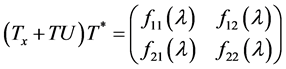 , (2.15)
It is easy to see that  are (2N) th-order polynomials in
 ,
,  is a (2N-1)th-or- der polynomial in
 . By (2.1) and (2.10), we have Riccati Equation
 . (2.16)
Then all  are roots of
 . Therefore we have
 , (2.17)
where

and  are independent of
 . We can rewrite (2.17) as
 (2.18)
By comparing the coefficients of ,
,  ,
,  with (2.11) and (2.13), we get
 : (2.19)
 : (2.20)
 (2.21)
 (2.22)
 : (2.23)
 (2.24)
 (2.25)
From (2.21), (2.23) and (2.25), together with (2.11), (2.13), (2.14), (2.19), (2.20) and (2.24), we respectively get
 (2.26)
Comparing with (2.4) and (2.18), we find that , and then
  and
and  have the same form. □
Remark. When , supposing
 , DT is
 (2.27)
Proposition 2. Let  satisfy the Equation
 (2.28)
where ,
,  ,
,  are defined by (2.9) and (2.11),
  and
and  are defined by (2.14). Through the transformation (2.3) with (2.5), the auxiliary spectral problem (2.2) is transformed into (2.7) with (2.14).
To prove Proposition 2, we need to use Proposition 1 and the JM Equation (1.1), together with the help of the mathematical software (such as Mathematica). Although the idea of the proof for Proposition 2 is the same as Proposition 1, it is much more tedious and is omitted for brevity.
Since the transformation (2.3) with (2.14) transforms the Lax pair (2.1) and (2.2) into the same Lax pair (2.6) and (2.7), the transformation  determined by (2.3) and (2.14) is called the DT of the Lax pair (2.1) and (2.2). Both the Lax pairs (2.1), (2.2) and (2.6), (2.7) obtain the JM Equation (1.1). Then, the transformation
  determined by (2.3) and (2.14) is also called the DT of the JM Equation (1.1).
3. Exact Solutions
In this section, by using of the above obtained DT, we get new solutions of the JM Equation (1.1).
For simplicity, taking , we get two basic solutions of the Lax pair (2.1) and (2.2)
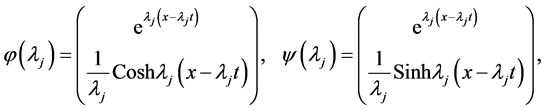 (3.1)
(3.1)
with .
.
According to (2.10), we get
 . (3.2)
In the following, we discuss the two cases  and
and .
.
1) For , from (2.9) and (2.11 ), we have
 (3.3)
(3.3)
with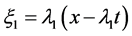 . Then the exact solution of the JM Equation (1.1) is
 (3.4)
(3.4)
with . This solution is similar with the solution in [11] .
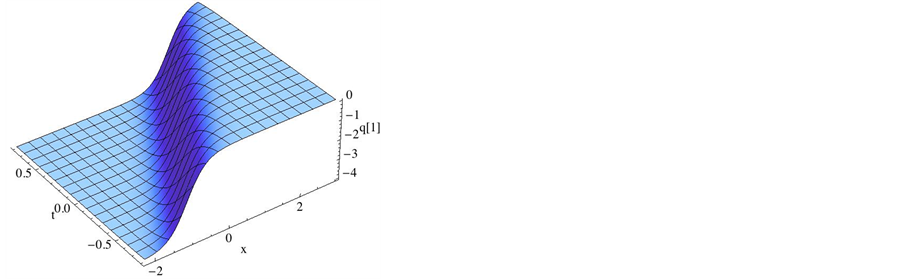
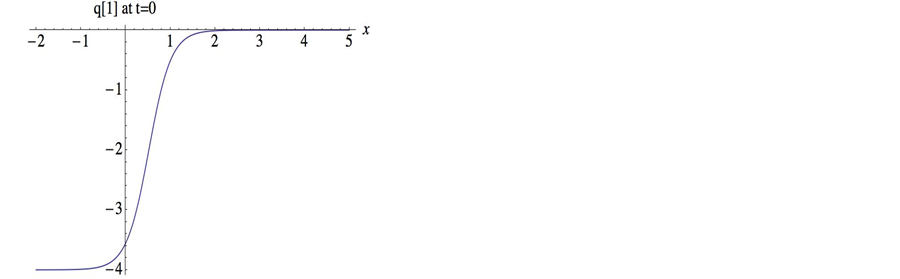
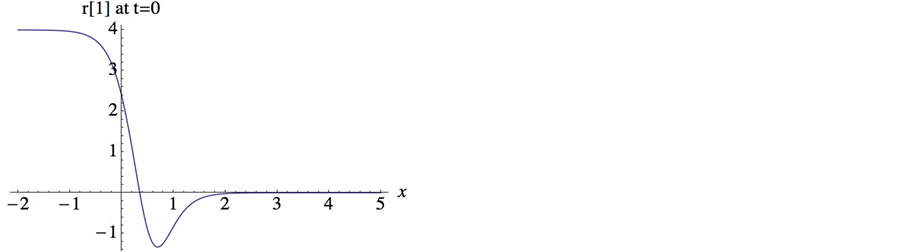
As , this is a solitary wave solution where
  is a kink-type soliton and
  is a bell-kink-type soliton, i.e. this soliton is composed of a bell-type wave and a kink-type wave (see Figure 1).
2) For , from (2.9) and (2.11), we have
 (3.5)
(3.5)
where
 (3.6)
(3.6)
 (a) (b)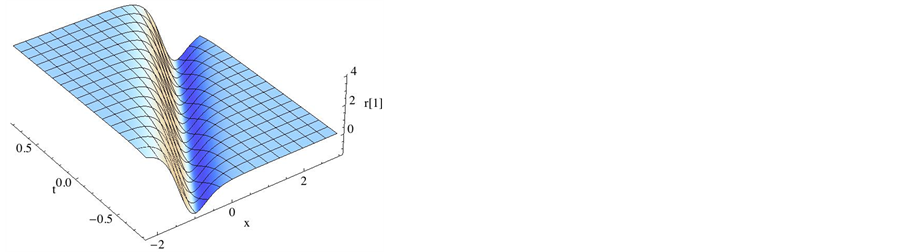
 (c) (d)
Figure 1. Plots of solitary wave solution of (3.4) with 
with
 . (3.7)
The exact solution of the JM Equation (1.1) is
 (3.8)
(3.8)
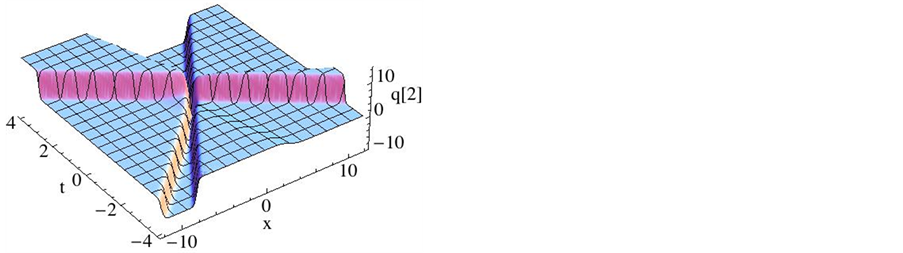
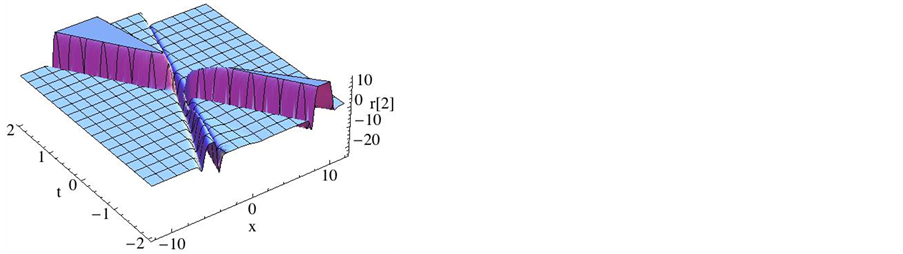
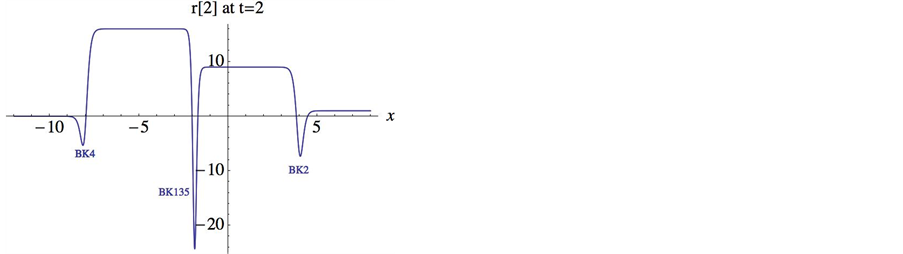
When the parameters are suitably chosen, the solution (3.8) describes the elastic-inelastic-interaction coexistence phenomenon, i.e. the elastic and fission interactions coexist at the same time (see Figure 2).
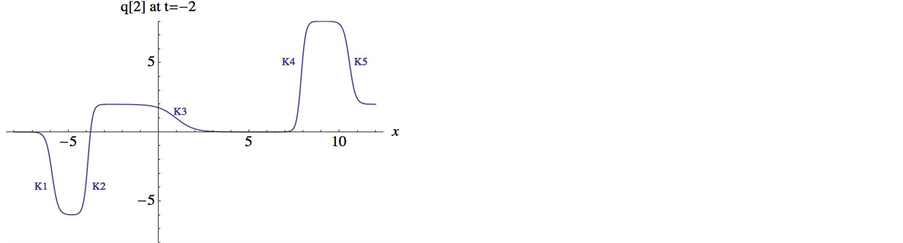
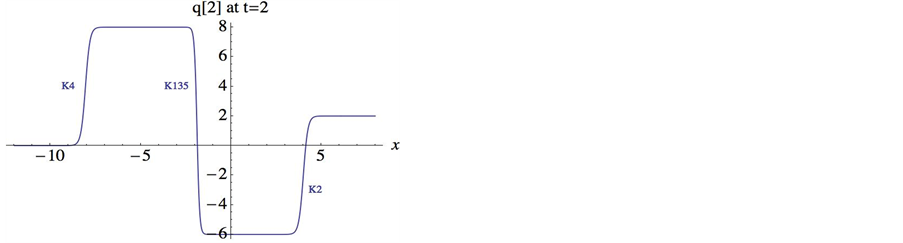
In Figure 3, we can clearly find the interactions of the solitons. The solution  is a solitary wave solution, where five kink-type solitons fuse into three kink-type solitons, i.e. K2 kink-type soliton and K4 kink-type
 (a) (b)
Figure 2. Plots of the solitary wave solution of (3.8) with 
 (a) (b)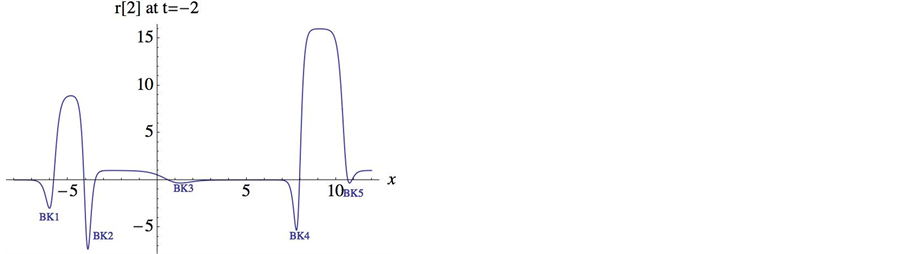
 (c) (d)
Figure 3. Plots of the interactions of the solitary wave solution of (3.8) with 



soliton are head-on interactions (this is an elastic interaction), K1 kink-type soliton, K3 kink-type soliton and K5 kink-type soliton fuse into K135 kink-type soliton (this is a inelastic interaction). The solution  is a solitary wave solution, which is the same as
 , but the solitons are the bell-kink-type (see also Figure 3). This phenomenon has been described in the Whitham-Broer-Kaup shallow-water-wave model [16] . It seems to be new for the JM Equation.
References
- Xue, Y.S., Tian, B., Ai, W.B. and Jiang, Y. (2012) Darboux Transformation and Hamiltonian Structure for the Jaulent- Miodek Hierarchy. Applied Mathematics and Computation, 218, 11738-11750. http://dx.doi.org/10.1016/j.amc.2012.04.072
- Neugebauer, G. and Meinel, R. (1984) General N-Soliton Solution of the AKNS Class on Arbitrary Background. Physics Letters A, 100, 467-470. http://dx.doi.org/10.1016/0375-9601(84)90827-2
- Matveev, V.B. and Salle, M.A. (1991) Darboux Transformations and Solitons. Springer-Verlag, Belin-Heidelberg.
- Mañas, M. (1996) Darboux Transformations for the Nonlinear Schrödinger Equations. Journal of Physics A: Mathematical and General, 29, 7721-7737. http://dx.doi.org/10.1088/0305-4470/29/23/029
- Li, Y.S. (1996) The Reductions of the Darboux Transformation and Some Solutions of the Soliton Equations. Journal of Physics A: Mathematical and General, 29, 4187-4195. http://dx.doi.org/10.1088/0305-4470/29/14/036
- Geng, X.G. and Tam, H.W. (1999) Darboux Transformation and Soliton Solutions for Generalized Nonlinear Sch- rödinger Equations. Journal of Physical Society of Japan, 68, 1508-1512. http://dx.doi.org/10.1143/JPSJ.68.1508
- Li, Y.S., Ma, W.X. and Zhang, J.E. (2000) Darboux Transformations of Classical Boussinesq System and Its New Solutions. Physics Letters A, 275, 60-66. http://dx.doi.org/10.1016/S0375-9601(00)00583-1
- Chen, A.H. and Li, X.M. (2006) Darboux Transformation and Soliton Solutions for Boussinesq-Burgers Equation. Chaos, Solitons & Fractals, 27, 43-49. http://dx.doi.org/10.1016/j.chaos.2004.09.116
- Hassan, M. (2009) Darboux Transformation of the Generalized Coupled Dispersionless Integrable System. Journal of Physics A: Mathematical and General, 42, 065203. http://dx.doi.org/10.1088/1751-8113/42/6/065203
- Geng, X.G. and He, G.L. (2010) Darboux Transformation and Explicit Solutions for the Satuma-Hirota Coupled Equation. Applied Mathematics and Computation, 216, 2628-2634. http://dx.doi.org/10.1016/j.amc.2010.03.107
- Zha, Q.L. (2011) Darboux Transformation and N-Soliton Solutions for a More General Set of Coupled Integrable Dispersionless System. Communications in Nonlinear Science and Numerical Simulation, 16, 3949-3955. http://dx.doi.org/10.1016/j.cnsns.2011.02.006
- Fan, E.G. (2003) Uniformly Constructing a Series of Explicit Exact Solutions to Nonlinear Equations in Mathematical Physics. Chaos, Chaos, Solitons & Fractals, 16, 819-839. http://dx.doi.org/10.1016/S0960-0779(02)00472-1
- Biswas, A. and Kara, A.H. (2010) 1-Soliton Solution and Conservation Laws for the Jaulent-Miodekequation with Power Law Nonlinearity. Applied Mathematics and Computation, 217, 944-948. http://dx.doi.org/10.1016/j.amc.2010.06.021
- Biswas, A. (2009) Solitary Wave Solution for the Generalized KdV Equation with Time-Dependent Damping and Dispersion. Communications in Nonlinear Science and Numerical Simulation, 14, 3503-3506. http://dx.doi.org/10.1016/j.cnsns.2008.09.026
- Zhang, Y.J. and Gu, X.S. (1988) A Correspondence between the AKNS Hierarchy and the JM Hierarchy. Acta Mathematicae Applicatae Sinica, 4, 307-315. http://dx.doi.org/10.1007/BF02007234
- Lin, G.D., Gao, Y.T., Wang, L., Meng, D.X. and Yu, X. (2011) Elastic-Inelastic-Interaction Coexistence and Double Wronskian Solutions for the Whitham-Broer-Kaup Shallow-Water-Wave Model. Communications in Nonlinear Scien- ce and Numerical Simulation, 16, 3090-3096.