
Advances in Pure Mathematics
Vol.06 No.04(2016), Article ID:65095,85 pages
10.4236/apm.2016.64018
Representations by Certain Sextenary Quadratic Forms Whose Coefficients Are 1, 2, 3 and 6
Barış Kendirli
Istanbul Aydın University, Istanbul, Turkey

Copyright © 2016 by author and Scientific Research Publishing Inc.
This work is licensed under the Creative Commons Attribution International License (CC BY).
http://creativecommons.org/licenses/by/4.0/



Received 9 December 2015; accepted 26 March 2016; published 29 March 2016
ABSTRACT
Here, we determine formulae, for the numbers of representations of a positive integer by certain sextenary quadratic forms whose coefficients are 1, 2, 3 and 6.
Keywords:
Sextenary Quadratic Forms, Representations, Theta Functions, Dedekind Eta Function, Eisenstein Series, Eisenstein Forms, Modular Forms, Cusp Forms

1. Introduction
The divisor function  is defined for a positive integer i by

The Dedekind eta function and the theta function are defined by

where

and an eta quotient of level N is defined by
 (1)
(1)
It is important and interesting to determine explicit formulas of the representation number of positive definite quadratic forms.
Here we give the following Lemma, see ( [1] , Theorem 1.64), about the modularity of an eta quotient.
Lemma 1. An eta quotient of level N is a meromorphic modular form of weight  on
on  having rational coefficients with respect to q if
a) 
b) 
c) 
For  and a nonnegative integer n, we define

Clearly  and without loss of generality we can assume that
Now, let’s consider sextenary quadratic forms of the form

where ,
,
We write  to denote the number of representations of n by a sextenary quadratic form
 . Its theta function is obviously

Formulae for  for the nine octonary quadratic forms (2i, 2j, 2k, 2l) = (8, 0, 0, 0), (2, 6, 0, 0), (4, 4, 0, 0), (6, 2, 0, 0), (2, 0, 6, 0), (4, 0, 4, 0), (6, 0, 2, 0), (4, 0, 0, 4), and (0, 4, 4, 0) appear in the literature, (cf. [2] - [12] ). Alaca and Williams have obtained some results on sextenary quadratic forms in terms of the functions
  and
and , see [13] [14] . There are more works on representation number of sextenary quadratic forms in [15] - [17] . Other methods for representation number have been used in (cf. [7] [10] [12] [18] [19] ). Here, we will classify all fourtuples
  for which
  is a modular form of weight 8 with level 24. Then we will obtain their representation numbers in terms of the coefficients of Eisenstein series and some eta quotients.
First, by the following Theorem, we characterize the facts that

are in 
Theorem 1. Let

where,  ,
, be a sextenary quadratic form. Then its theta series is of the form

Moreover, it is in  if and only if
  is given in the Table 1. Here we also see that
  are either both even or both odd.
Proof. It follows from the Lemma 1, holomorphicity criterion in ( [20] Corollary 2.3, p. 37) and the fact
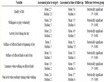
Table 1. Sextenary quadratic forms
that

The condition  is a square of a rational number implies that either
  are both even or both odd integers.
Now let,


 the unique newform in


Theorem 2. The set

is a basis of . Moreover, the unique newform in
  is
is , the unique newform in
  is
is , the two unique newforms in
  are
are


the two unique newforms in  are
are


and the three unique newforms in  are
are


Proof.  is 32 dimensional,
  is 24 dimensional, see ( [21] Chapter 3, p. 87 and Chapter 5, p. 197), and generated by


where  is the unique newform in
 ;
;  is the unique newform in
 ;
;  is the unique newform in
 ,
,  are the unique newforms in
 ;
;  are the unique newforms in
  and
and  are the unique newforms in
 .
.
As a consequence of this Theorem, we have obtained the following Corollary.We have used Magma for the calculations.
2. Corollary
The following representation numbers formulae are valid.


Cite this paper
Barış Kendirli, (2016) Representations by Certain Sextenary Quadratic Forms Whose Coefficients Are 1, 2, 3 and 6. Advances in Pure Mathematics,06,212-296. doi: 10.4236/apm.2016.64018
References
- 1. Ono, K. (2004) The Web of Modularity: Arithmetic of the Coefficients of Modular Forms and Q-Series. CBMS Regional Conf. Series in Math. 102, Amer. Math. Soc., Providence.
- 2. Alaca, A., Alaca, S. and Williams, K.S. (2010) Fourteen Octonary Quadratic Forms. International Journal of Number Theory, 6, 37-50. http://dx.doi.org/10.1142/S179304211000279X
- 3. Alaca, S. and Williams, K.S. (2010) The Number of Representations of a Positive Integer by Certain Octonary Quadratic Forms. Functiones et Approximatio Commentarii Mathematici, 43, 45-54.
http://dx.doi.org/10.7169/facm/1285679145 - 4. Alaca, S. and Kesicioglu, Y. (2014) Representations by Certain Octonary Quadratic Forms Whose Coefficients Are 1, 2, 3 and 6. International Journal of Number Theory, 10, 133-150. http://dx.doi.org/10.1142/S1793042113500851
- 5. Alaca, S. and Kesicioglu, Y. (2015) Representations by Certain Octonary Quadratic Forms with Coefficients 1, 2, 3, and 6. Integers, 15, 1-9.
- 6. Jacobi, C.G.J. (1969) Fundamenta Nova Theoriae Functionum Ellipticarum. In: Gesammelte Werke, Erster Band Chelsea Publishing Co., New York, 49-239, 285-290.
- 7. Kendirli, B. (2012) Cusp Forms in and the Number of Representations of Positive Integers by Some Direct Sum of Binary Quadratic Forms with Discriminant -47. International Journal of Mathematics and Mathematical Sciences, 2012, Article ID: 303492, 10 p.
- 8. Kendirli, B. (2015) Evaluation of Some Convolution Sums by Quasimodular Forms. European Journal of Pure and Applied Mathematics, 8, 81-110.
- 9. Kendirli, B. (2014) Evaluation of Some Convolution Sums andthe Representation Numbers. Ars Combinatoria, CXVI, 65-91.
- 10. Kendirli, B. (2015) Evaluation of Some Convolution Sums and Representation Numbers of Quadratic Forms of Discriminant 135. British Journal of Mathematics and Computer Science, 6, 494-531.
http://dx.doi.org/10.9734/BJMCS/2015/13973 - 11. Kokluce, B. (2013) The Representation Numbers of Three Octonary Quadratic Forms. International Journal of Number Theory, 9, 505-516.
http://dx.doi.org/10.1142/S1793042112501461 - 12. Ramakrishnan B. and Sahu, B. (2013) Evaluation of the Convolution Sums ∑l+15m=nσ(l)σ(m) and ∑3l+5m=n&σ (l) σ(m) and an Application. International Journal of Number Theory, 9, 799-809.
http://dx.doi.org/10.1142/S179304211250162X - 13. Alaca, A., Alaca, S. and Williams, K.S. (2010) Sextenary Quadratic Forms and an Identity of Klein and Fricke. International Journal of Number Theory, 6, 169-183.
http://dx.doi.org/10.1142/S1793042110002880 - 14. Alaca, A., Alaca, S. and Williams, K.S. (2008) Liouville’s Sextenary Quadratic Forms, x2+y2+z2+t2+2u2+2v2, x2+y2+2z2+2t2+2u2+2v2 and x2+2y2+2z2+2t2+2u2+4v2. Far East Journal of Mathematical Sciences, 30, 547-556.
- 15. Alaca, A., Alaca, S. and Williams, K.S. (2009) Some New Theta Function Identities with Applications to Sextenary Quadratic Forms. Journal of Combinatorics and Number Theory, 1, 89-98.
- 16. Berkovich, A. and Yeiilyurt, H. (2009) On the Representations of Integers by the Sextenary Quadratic Form x2+y2+z2+7s2+7t2+7u2 and 7-Cores. Journal of Number Theory, 129, 1366-1378.
http://dx.doi.org/10.1016/j.jnt.2008.09.001 - 17. Xia, E.X.W., Yao, O.X.M. and Zhao, A.F.Y. (2015) Representation Numbers of Five Sextenary Quadratic Forms. Colloquium Mathematicum, 138, 247-254.
http://dx.doi.org/10.4064/cm138-2-9 - 18. Kendirli, B. (2012) Cusp Forms in S4 (Γ0 (79)) and the Number of Representations of Positive Integers by Some Direct Sum of Binary Quadratic forms With Discriminant -79. Bulletin of the Korean Mathematical Society, 49, 529-572.
http://dx.doi.org/10.4134/BKMS.2012.49.3.529 - 19. Kendirli, B. (2015) The Number of Representations of Positive Integers by Some Direct Sum Of Binary Quadratic Forms With Discriminant -103. IJEMME International Journal of Electronics, Mechanical, and Mecathronics Engineering, 5, 979-1007.
- 20. Kohler, G. (2011) Eta Products and Theta Series Identities. Springer-Verlag, Berlin.
- 21. Diamond, F. and Shurman, J. (2005) A First Course in Modular Forms (Graduate Texts in Mathematics, Vol. 228). Springer, Berlin.