

Advances in Pure Mathematics
Vol.06 No.02(2016), Article ID:63261,39 pages
10.4236/apm.2016.62008
Artin Transfer Patterns on Descendant Trees of Finite p-Groups
Daniel C. Mayer*
Naglergasse 53, 8010 Graz, Austria

Copyright © 2016 by author and Scientific Research Publishing Inc.
This work is licensed under the Creative Commons Attribution International License (CC BY).
http://creativecommons.org/licenses/by/4.0/



Received 25 November 2015; accepted 25 January 2016; published 29 January 2016
ABSTRACT
Based on a thorough theory of the Artin transfer homomorphism  from a group G to the abelianization
  of a subgroup
  of finite index
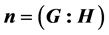 , and its connection with the permutation representation
  and the monomial representation
  of G, the Artin pattern
 , which consists of families
 , resp.
 , of transfer targets, resp. transfer kernels, is defined for the vertices
  of any descendant tree
  of finite p-groups. It is endowed with partial order relations
  and
and , which are compatible with the parent-descendant relation
  of the edges
  of the tree T. The partial order enables termination criteria for the p-group generation algorithm which can be used for searching and identifying a finite p-group G, whose Artin pattern
  is known completely or at least partially, by constructing the descendant tree with the abelianization
  of G as its root. An appendix summarizes details concerning induced homomorphisms between quotient groups, which play a crucial role in establishing the natural partial order on Artin patterns
  and explaining the stabilization, resp. polarization, of their components in descendant trees
  of finite p- groups.
Keywords:
Artin Transfer, Kernel Type, Target Type, Descendant Tree, Coclass Tree, Coclass Graph

1. Introduction
P 1.1. In the mathematical field of group theory, an Artin transfer is a certain homomorphism from an arbitrary finite or infinite group to the commutator quotient group of a subgroup of finite index.
Originally, such transfer mappings arose as group theoretic counterparts of class extension homomorphisms of abelian extensions of algebraic number fields by applying Artin’s reciprocity isomorphism ([1] , §4, Allgemeines Reziprozitätsgesetz, p. 361) to ideal class groups and analyzing the resulting homomorphisms between quotients of Galois groups ([2] , §2, p. 50).
However, independently of number theoretic applications, a natural partial order on the kernels and targets of Artin transfers, has recently been found to be compatible with parent-child relations between finite p-groups, where p denotes a prime number. Such ancestor-descendant relations can be visualized conveniently in des- cendant trees ([3] , §4, pp. 163-164).
Consequently, Artin transfers provide valuable information for classifying finite p-groups by kernel-target patterns and for searching and identifying particular groups in descendant trees by looking for patterns defined by kernels and targets of Artin transfers. These strategies of pattern recognition are useful not only in purely group theoretic context, but also, most importantly, for applications in algebraic number theory concerning Galois groups of higher p-class fields and Hilbert p-class field towers. The reason is that the unramified extensions of a base field contain information in the shape of capitulation patterns and class group structures, and these arithmetic invariants can be translated into group theoretic data on transfer kernels and targets by means of Artin’s reciprocity law of class field theory. The natural partial order on Artin patterns admits termination criteria for a search through a descendant tree with the aid of recursive executions of the p-group generation algorithm by Newman [4] and O’Brien [5] .
P 1.2. The organization of this article is as follows. The detailed theory of the transfer will be developed in §§ 2 and 3, followed by computational implementations in § 4. It is our intention to present more than the least common multiple of the original papers by Schur [6] and Artin [2] and the relevant sections of the text books by Hall [7] , Huppert [8] , Gorenstein [9] , Aschbacher [10] , Doerk and Hawkes [11] , Smith and Tabachnikova [12] , and Isaacs [13] .
However, we shall not touch upon fusion and focal subgroups, which form the primary goal of the mentioned authors, except Artin. Our focus will rather be on a sound foundation of Artin patterns, consisting of families of transfer kernels and targets, and their stabilization, resp. polarization, in descendant trees of finite p-groups. These phenomena arise from a natural partial order on Artin patterns which is compatible with ancestor- descendant relations in trees, and is established in its most general form in §§5 and 6.
Since our endeavour is to give the most general view of each partial result, we came to the conviction that categories, functors and natural transformations are the adequate tools for expressing the appropriate range of validity for the facts connected with the partial order relation on Artin patterns. Inspired by Bourbaki’s method of exposition [14] , Appendix on induced homomorphisms, which is separated to avoid a disruption of the flow of exposition, goes down to the origins exploiting set theoretic facts concerning direct images and inverse pre-images of mappings which are crucial for explaining the natural partial order of Artin patterns.
2. Transversals and Their Permutations
2.1. Transversals of a Subgroup
Let G be a group and  be a subgroup of finite index
 .
.
Definition 2.1. See also ([6] , p. 1013); ([7] , (1.5.1), p. 11); ([8] , Satz 2.5, p. 5).
1). A left transversal of H in G is an ordered system  of representatives for the left cosets of H in
G such that  is a disjoint union.
2). Similarly, a right transversal of H in G is an ordered system  of representatives for the right
cosets of H in G such that  is a disjoint union.
Remark 2.1. For any transversal of H in G, there exists a unique subscript  such that
 , resp.
 . The element
 , resp.
 , which represents the principal coset (i.e., the subgroup H itself) may be replaced by the neutral element 1.
Lemma 2.1. See also ([6] , p. 1015); ([7] , (1.5.2), p. 11); ([8] , Satz 2.6, p. 6).
1). If G is non-abelian and H is not a normal subgroup of G, then we can only say that the inverse elements  of a left transversal
  form a right transversal of H in G.
2). However, if  is a normal subgroup of G, then any left transversal is also a right transversal of H in G.
Proof. 1). Since the mapping ,
,  is an involution, that is a bijection which is its own inverse, we see that
 implies
 .
.
2). For a normal subgroup , we have
  for each
 .
.

Let  be a group homomorphism and
  be a left transversal of a subgroup H in G with finite index
 . We must check whether the image of this transversal under the homomorphism is a transversal again.
Proposition 2.1. The following two conditions are equivalent.
1).  is a left transversal of the subgroup
  in the image
  with finite
index .
.
2). .
.
We emphasize this important equivalence in a formula:
 (2.1)
(2.1)
Proof. By assumption, we have the disjoint left coset decomposition  which comprises two
statements simultaneously.
Firstly, the group  is a union of cosets,
and secondly, any two distinct cosets have an empty intersection , for
, for .
.
Due to the properties of the set mapping associated with , the homomorphism
  maps the union to another union

but weakens the equality for the intersection to a trivial inclusion

To show that the images of the cosets remain disjoint we need the property  of the homo- morphism
 .
.
Suppose that  for some
 ,
,
then we have  for certain elements
 .
.
Multiplying by  from the left and by
  from the right, we obtain

Since , this implies
 , resp.
 , and thus
 . (This part of the proof is also covered by ([13] , Thm. X. 21, p. 340) and, in the context of normal subgroups instead of homomorphisms, by ([7] , Thm. 2.3.4, p. 29) and ([8] , Satz 3.10, p. 16))
Conversely, we use contraposition.
If the kernel  of
of  is not contained in the subgroup H, then there exists an element
  such that
 .
.
But then the homomorphism  maps the disjoint cosets
to equal cosets .
.
□
2.2. Permutation Representation
P 2.1. Suppose  is a left transversal of a subgroup
  of finite index
  in a group G. A fixed element
  gives rise to a unique permutation
  of the left cosets of H in G by left multiplication such that
 (2.2)
(2.2)
for each .
.
Similarly, if  is a right transversal of H in G, then a fixed element
  gives rise to a unique permutation
  of the right cosets of H in G by right multiplication such that
 (2.3)
(2.3)
for each .
.
The elements , resp.
 ,
,  , of the subgroup H are called the monomials associated with x with respect to
 , resp.
 .
.
Definition 2.2 See also ([8] , Hauptsatz 6.2, p. 28).
The mapping , resp.
 , is called the permutation representation of G in
  with respect to
 , resp.
 .
.
Lemma 2.2. For the special right transversal  associated to the left transversal
 , we have the following relations between the monomials and permutations corresponding to an element
 :
:
 (2.4)
(2.4)
Proof. For the right transversal , we have
 , for each
 .
.
On the other hand, for the left transversal , we have
 , for each
 .
.
This relation simultaneously shows that, for any , the permutation representations and the associated monomials are connected by

for each . □
. □
3. Artin Transfer
Let G be a group and  be a subgroup of finite index
 . Assume that
 , resp.
 , is a left, resp. right, transversal of H in G with associated permutation representation
 ,
,  , resp.
 , such that
 , resp.
 , for
, for .
.
Definition 3.3. See also ([6] , p. 1014); ([2] , §2, p. 50); ([7] , (14.2.2-4), p. 202); ([8] , p. 413); ([9] , p. 248); ([10] , p. 197); ([11] , Dfn.(17.1), p. 60); ([12] , p. 154); ([13] , p. 149); ([15] , p. 2).
The Artin transfer  from G to the abelianization
  of H with respect to
 , resp.
 , is defined by
 (3.1)
(3.1)
resp.
 (3.2)
(3.2)
for .
.
Remark 3.1. I.M. Isaacs [13] , p. 149 calls the mapping ,
,  , resp.
 ,
,
the pre-transfer from G to H. The pre-transfer can be composed with a homomorphism  from H into
an abelian group A to define a more general version of the transfer ,
,  , resp.
 , from G to A via
 , which occurs in the book by D. Gorenstein ([9] , p. 248). Taking the
natural epimorphism ,
,  , yields the Definition 3.3 of the Artin transfer
  in its original form by I. Schur ([6] , p. 1014) and by E. Artin ([2] , §2, p. 50), which has also been dubbed Verlagerung by H. Hasse ([16] , §27.4, pp. 170-171). Note that, in general, the pre-transfer is neither independent of the transversal nor a group homomorphism.
3.1. Independence of the Transversal
Assume that  is another left transversal of H in G such that
 .
.
Proposition 3.1. See also ([6] , p. 1014); ([7] , Thm. 14.2.1, p. 202); ([8] , Hilfssatz 1.5, p. 414); ([9] , Thm. 3.2, p. 246); ([10] , (37.1), p.198); ([11] , Thm.(17.2), p.61); ([12] , p.154); ([13] , Thm.5.1, p.149); ([15] , Prop.2, p. 2).
The Artin transfers with respect to (g) and  coincide,
 .
.
Proof. There exists a unique permutation  such that
 , for all
 . Consequently,
  , resp.
  with
with , for all
 . For a fixed element
 , there exists a unique permutation
  such that we have
 ,
,
for all . Therefore, the permutation representation of G with respect to
  is given by
 , resp.
 , for
, for . Furthermore, for the connection between the elements
 and
and , we obtain

for all . Finally, due to the commutativity of the quotient group
  and the fact that
  and
and  are permutations, the Artin transfer turns out to be independent of the left transversal:

as prescribed in Definition 3.1, Equation (3.1). □
It is clear that a similar proof shows that the Artin transfer is independent of the choice between two different right transversals. It remains to show that the Artin transfer with respect to a right transversal coincides with the Artin transfer with respect to a left transversal.
For this purpose, we select the special right transversal  associated to the left transversal
 , as explained in Lemma 2.1 and Lemma 2.2.
Proposition 3.2. The Artin transfers with respect to  and
and  coincide,
 .
.
Proof. Using (2.4) in Lemma 2.2 and the commutativity of , we consider the expression

The last step is justified by the fact that the Artin transfer is a homomorphism. This will be shown in the following subsection 3.2. □
3.2. Artin Transfers as Homomorphisms
Let  be a left transversal of H in G.
Theorem 3.1. See also ([6] , p. 1014); ([7] , Thm. 14.2.1, p. 202); ([8] , Hauptsatz 1.4, p. 413); ([9] , Thm. 3.2, p. 246); ([10] , (37.2), p.198); ([11] , Thm.(17.2), p.61); ([12] , p. 155); ([13] , Thm.5.2, p. 150); ([15] , Prop.1, p. 2).
The Artin transfer ,
,  and the permutation representation
 are group homomorphisms:
 (3.3)
(3.3)
Proof. Let  be two elements with transfer images
  and
and
 . Since
  is abelian and
  is a permutation, we can change the order of the factors in the following product:

This relation simultaneously shows that the Artin transfer  and the permutation representation
  are homomorphisms, since
  and
and , in a covariant way. □
3.3. Monomial Representation
Let , resp.
 , be a left, resp. right, transversal of a subgroup H in a group G. Using the monomials
 , resp.
 , associated with an element
  according to Equation (2.2), resp. (2.3), we define the following maps.
Definition 3.2. The mapping , respectively
  , is called the monomial representation of G in
  with respect to
 , resp.
 .
.
P 3.1. It is illuminating to restate the homomorphism property of the Artin transfer in terms of the monomial
representation. The images of the factors  are given by
  and
and
 . In the proof of Theorem 3.1, the image of the product
  turned out to be
 , which is a very peculiar law of com- position discussed in more detail in the sequel.
The law reminds of the crossed homomorphisms  in the first cohomology group
  of a G-module M, which have the property
 , for
, for .
.
These peculiar structures can also be interpreted by endowing the cartesian product  with a special law of composition known as the wreath product
  of the groups H and
  with respect to the set
 .
.
Definition 3.3. For , the wreath product of the associated monomials and permutations is given by
 (3.4)
(3.4)
Theorem 3.2. See also ([7] , Thm.14.1, p. 200); ([8] , Hauptsatz 1.4, p. 413).
This law of composition on  causes the monomial representation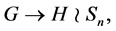
 also to be a homomorphism. In fact, it is a faithful representation, that is an injective homomorphism, also called a monomorphism or embedding, in contrast to the permutation representation.
Proof. The homomorphism property has been shown above already. For a homomorphism to be injective, it suffices to show the triviality of its kernel. The neutral element of the group  endowed with the wreath product is given by
 , where the last 1 means the identity permutation. If
  , for some xÎG, then
  and consequently
 , for all
 . Finally, an application of the inverse inner automorphism with
  yields
 , as required for injectivity.
The permutation representation cannot be injective if G is infinite or at least of an order bigger than , the factorial of n. □
Remark 3.2. Formula (3.4) is an example for the left-sided variant of the wreath product on . However, we point out that the wreath product with respect to a right transversal
  of H in G appears in its right-sided variant
 (3.5)
(3.5)
which implies that the permutation representation ,
,  is a homomorphism with respect to the opposite law of composition
  on
on , in a contravariant manner.
It can be shown that the left-sided and the right-sided variant of the wreath product lead to isomorphic group structures on .
.
A related viewpoint is taken by M. Hall ([7] , p. 200), who uses the multiplication of monomial matrices to describe the wreath product. Such a matrix can be represented in the form  as the product of an invertible diagonal matrix over the group ring K[H], where K denotes a field, and the permutation matrix
  associated with the permutation
 . Multiplying two such monomial matrices yields a law of composition identical to the wreath product in the right-sided variant,

Whereas B. Huppert ([8] , p. 413) uses the monomial representation for defining the Artin transfer by composition with the unsigned determinant, we prefer giving the immediate Definition 3.3 and merely illustrating the homomorphism property of the Artin transfer with the aid of the monomial representation.
3.4. Composition of Artin Transfers
Let G be a group with nested subgroups  such that the indices
 ,
,  and
and  are finite.
Theorem 3.3. See also ([7] , Thm.14.2.1, p. 202); ([8] , Satz 1.6, p. 415); ([11] , Lem.(17.3), p. 61); ([13] , Thm.10.8, p. 301); ([15] , Prop.3, p. 3).
Then the Artin transfer  is the compositum of the induced transfer
  (in the sense of Corollary 7.1 or Corollary 7.3 in the Appendix) and the Artin transfer
 , i.e.,
 (3.6)
(3.6)
This can be seen in the following manner.
Proof. If  is a left transversal of H in G and
  is a left transversal of K in H, that is
 and
and , then
  is a disjoint left coset decomposition of G with
respect to K. See also ([7] , Thm.1.5.3, p. 12); ([8] , Satz 2.6, p. 6). Given two elements  and
and , there exist unique permutations
 , and
, and , such that the associated monomials are given by
 , for each
 , and
, and , for each
 .
.
Then, using Corollary 7.3, we have
 , and
, and .
.
For each pair of subscripts  and
and , we put
  and obtain

resp. . Thus, the image of x under the Artin transfer
  is given by

□
3.5. Wreath Product of Sm and Sn
P 3.2. Motivated by the proof of Theorem 3.3, we want to emphasize the structural peculiarity of the monomial representation

which corresponds to the compositum of Artin transfers, defining

for a permutation , and using the symbolic notation
 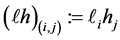 for all pairs of subscripts
 ,
, .
.
The preceding proof has shown that . Therefore, the action of the permutation
  on the set
  is given by
 . The action on the second component j depends
on the first component i (via the permutation ), whereas the action on the first component i is independent of the second component j. Therefore, the permutation
  can be identified with the multiplet
 , which will be written in twisted form in the sequel.
The permutations , which arise as second components of the monomial representation

are of a very special kind. They belong to the stabilizer of the natural equipartition of the set [1, n] × [1, m] into the n rows of the corresponding matrix (rectangular array). Using the peculiarities of the composition of Artin transfers in the previous section, we show that this stabilizer is isomorphic to the wreath product  of the symmetric groups
  and
and  with respect to
 , whose underlying set
  is endowed with the following law of composition in the left-sided variant.
 (3.7)
(3.7)
for all .
.
This law reminds of the chain rule  for the Fréchet derivative in
xÎE of the compositum of differentiable functions  and
and  between complete normed spaces.
The above considerations establish a third representation, the stabilizer representation,

of the group G in the wreath product , similar to the permutation representation and the monomial representation. As opposed to the latter, the stabilizer representation cannot be injective, in general. For instance, certainly not, if G is infinite.
Formula (3.7) proves the following statement.
Theorem 3.4. The stabilizer representation  of the group G in
the wreath product  of symmetric groups is a group homomorphism.
3.6. Cycle Decomposition
Let  be a left transversal of a subgroup
  of finite index
  in a group G. Suppose the element
  gives rise to the permutation
  of the left cosets of H in G such that
 , resp.
 , for each
 .
.
Theorem 3.5. See also ([2] , §2, p. 50); ([16] , §27.4, p. 170); ([8] , Hilfssatz 1.7, p. 415); ([9] , Thm.3.3, p. 249); ([10] , (37.3), p. 198); ([12] , p. 154); ([13] , Lem.5.5, p. 153); ([15] , p. 5).
If the permutation  has the decomposition
  into pairwise disjoint (and thus commuting)
cycles  of lengths
 , which is unique up to the ordering of the cycles, more explicitly, if
 (3.8)
(3.8)
for , and
, and , then the image of
  under the Artin transfer
  is given by
 (3.9)
(3.9)
Proof. The reason for this fact is that we obtain another left transversal of H in G by putting  for
for  and
and , since
 (3.10)
is a disjoint decomposition of G into left cosets of H.
Let us fix a value of . For
. For , we have

However, for , we obtain

Consequently,

□
P 3.3. The cycle decomposition corresponds to a double coset decomposition  of the group
G modulo the cyclic group  and modulo the subgroup H. It was actually this cycle decomposition form of the transfer homomorphism which was given by E. Artin in his original 1929 paper ([2] , §2, p. 50).
3.7. Transfer to a Normal Subgroup
P 3.4. Now let  be a normal subgroup of finite index
 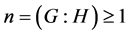 in a group G. Then we have
 , for all
 , and there exists the quotient group
  of order n. For an element
 , we let
  denote the order of the coset
  in
in , and we let
  be a left transversal of the subgroup
  in G, where
 .
.
Theorem 3.6. See also ([16] , §27.4, VII, p. 171).
Then the image of  under the Artin transfer
  is given by
 (3.11)
Proof.  is a cyclic subgroup of order f in
 , and a left transversal
  of the subgroup
 in G, where
  and
and  is the corresponding disjoint left coset decomposition,
can be refined to a left transversal 
 with disjoint left coset decomposition
 (3.12)
of H in G. Hence, the formula for the image of x under the Artin transfer  in the previous section takes the particular shape

with exponent f independent of j. □
Corollary 3.1. See also ([13] , Lem.10.6, p. 300) for a special case.
In particular, the inner transfer of an element  is given as a symbolic power
 (3.13)
with the trace element
 (3.14)
of H in G as symbolic exponent.
The other extreme is the outer transfer of an element  which generates G modulo H, that is
 . It is simply an nth power
 (3.15)
Proof. The inner transfer of an element , whose coset
  is the principal set in
  of order
 , is given as the symbolic power

with the trace element

of H in G as symbolic exponent.
The outer transfer of an element  which generates G modulo H, that is
 , whose coset
  is generator of
  with order
 , is given as the nth power
 .
.
□
P 3.5. Transfers to normal subgroups will be the most important cases in the sequel, since the central concept of this article, the Artin pattern, which endows descendant trees with additional structure, consists of targets and kernels (§5) of Artin transfers from a group G to intermediate groups  between G and its com- mutator subgroup
 . For these intermediate groups we have the following lemma.
Lemma 3.1. All subgroups  of a group G which contain the commutator subgroup
  are normal subgroups
 .
.
Proof. Let . If H were not a normal subgroup of G, then we had
  for some element
 . This would imply the existence of elements
  and
and  such that
 , and consequently the commutator
  would be an element in
  in contradiction to
 . □
. □
Explicit implementations of Artin transfers in the simplest situations are presented in the following section.
4. Computational Implementation
4.1. Abelianization of Type (p, p)
P 4.1. Let G be a pro-p group with abelianization  of elementary abelian type
 . Then G has
  maximal subgroups
 of index
 . In this particular case, the Frattini
subgroup , which is defined as the intersection of all maximal subgroups, coincides with the
commutator subgroup , since the latter contains all pth powers
 , and thus we have
 .
.
For each , let
, let  be the Artin transfer homomorphism from G to the abelianization of
 . According to Burnside's basis theorem, the group G has generator rank
  and can therefore be generated as
  by two elements
  such that
 . For each of the normal subgroups
 , we need a generator
  with respect to
 , and a generator
  of a transversal
such that 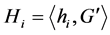 and
and .
.
A convenient selection is given by
 (4.1)
(4.1)
Then, for each , it is possible to implement the inner transfer by
 (4.2)
(4.2)
according to Equation (3.13) of Corollary 3.1, which can also be expressed by a product of two pth powers,
 (4.3)
(4.3)
and to implement the outer transfer as a complete pth power by
 (4.4)
(4.4)
according to Equation (3.15) of Corollary 3.1. The reason is that  and
and  in the quotient group
 .
.
It should be pointed out that the complete specification of the Artin transfers  also requires explicit knowledge of the derived subgroups
 . Since
  is a normal subgroup of index p in
 , a certain general reduction is possible by
  ([17] , Lem.2.1, p. 52), but an explicit pro-p pre- sentation of G must be known for determining generators of
 , whence
 (4.5)
(4.5)
4.2. Abelianization of Type (p2, p)
P 4.2. Let G be a pro-p group with abelianization  of non-elementary abelian type
 . Then G has
  maximal subgroups
 of index
  and
and  subgroups
 of index
 .
.
Figure 1 visualizes this smallest non-trivial example of a multi-layered abelianization  ([18] , Dfn.3.1- 3, p. 288).
For each , let
, let , resp.
 , be the Artin transfer homo- morphism from G to the abelianization of
 , resp.
 . Burnside’s basis theorem asserts that the group G has generator rank
  and can therefore be generated as
  by two elements
  such that

Figure 1. Layers of subgroups  for
for .
.
 .
.
We begin by considering the first layer of subgroups. For each of the normal subgroups 
 , we select a generator
 (4.6)
(4.6)
These are the cases where the factor group  is cyclic of order
 . However, for the distinguished maximal subgroup
 , for which the factor group
  is bicyclic of type
 , we need two generators
 (4.7)
(4.7)
Further, a generator  of a transversal must be given such that
 , for each
 . It is convenient to define
 (4.8)
(4.8)
Then, for each , we have the inner transfer
 (4.9)
(4.9)
which equals , and the outer transfer
 (4.10)
since  and
and .
.
Now we continue by considering the second layer of subgroups. For each of the normal subgroups 
 , we select a generator
 (4.11)
such that . Among these subgroups, the Frattini subgroup
  is par- ticularly distinguished. A uniform way of defining generators
  of a transversal such that
 , is to set
 (4.12)
Since , but on the other hand
  and
and , for
, for , with the single exception that
 , we obtain the following expressions for the inner transfer
 (4.13)
and for the outer transfer
 (4.14)
exceptionally
 (4.15)
and
 (4.16)
for . Again, it should be emphasized that the structure of the derived subgroups
  and
and  must be known explicitly to specify the action of the Artin transfers completely.
5. Transfer Kernels and Targets
P 5.1. After our thorough treatment of the general theory of Artin transfers in §§2 and 3, and their computational implementation for some simple cases in §4, we are now in the position to introduce Artin transfer patterns, which form the central concept of this article. They provide an incredibly powerful tool for classifying finite and infinite pro-p groups and for identifying a finite p-group G with sufficiently many assigned components of its Artin pattern by the strategy of pattern recognition. This is done in a search through the descendant tree with root  by means of recursive applications of the p-group generation algorithm by Newman [4] and O’Brien [5] .
An Artin transfer pattern consists of two families of transfer targets, resp. kernels, which are also called multiplets, whereas their individual components are referred to as singulets.
5.1. Singulets of Transfer Targets
Theorem 5.1. Let G and T be groups. Suppose that  is the image of G under a homomorphism
 , and
, and  is the image of an arbitrary subgroup
 . Then the following claims hold without any further necessary assumptions.
1) The commutator subgroup of V is the image of the commutator subgroup of U, that is
 (5.1)
(5.1)
2) The restriction  is an epimorphism which induces a unique epimorphism
 (5.2)
(5.2)
Thus, the abelianization of V,
 (5.3)
(5.3)
is an epimorphic image of the abelianization of U, namely the quotient of  by the kernel of
 , which is given by
 (5.4)
(5.4)
3) Moreover, the map  is an isomorphism, and the quotients
  are isomorphic, if and only if
 (5.5)
(5.5)
See Figure 2 for a visualization of this situation.
Proof. The statements can be seen in the following manner. The image of the commutator subgroup is given by

The homomorphism  can be restricted to an epimorphism
 . According to Theorem 7.1, in particular, by the Formulas (7.5) and (7.4) in the appendix, the condition
  implies the existence of a uniquely determined epimorphism
  such that
 . The Isomor- phism Theorem in Formula (7.7) in the appendix shows that
 . Furthermore, by the Formulas (7.4) and (7.1), the kernel of
  is given explicitly by

Thus,  is an isomorphism if and only if
 . □
. □
P 5.2. Functor of derived quotients. In analogy to section §7.6 in the appendix, a covariant functor  can be used to map a morphism
  of one category to an induced morphism
  of another category.
In the present situation, we denote by  the category of groups and we define the domain of the functor F as the following category
 . The objects of the category are pairs
  consisting of a group G and a subgroup
 ,
,
 (5.6)
(5.6)
For two objects , the set of morphisms
  consists of epimor- phisms
  such that
  and
and , briefly written as arrows
 ,
,
 (5.7)
(5.7)
The functor  from this category
  to the category
  of abelian groups maps a pair
  to the commutator quotient group
  of the subgroup
 , and
, and
it maps a morphism  to the induced epimorphism
  of the restriction
 ,
,
 (5.8)
(5.8)
Existence and uniqueness of  have been proved in Theorem 5.1 under the assumption that
 , which is satisfied according to the definition of the arrow
  and automatically implies
 .
.

Figure 2. Induced homomorphism of derived quotients.
Definition 5.1. Due to the results in Theorem 5.1, it makes sense to define a pre-order of transfer targets on the image  of the functor F in the object class
  of the category
  of abelian groups in the following manner.
For two objects , a morphism
 , and the images
 , and
, and ,
,
let (non-strict) precedence be defined by
 (5.9)
(5.9)
and let equality be defined by
 (5.10)
if the induced epimorphism  is an isomorphism.
Corollary 5.1. If both components of the pairs  are restricted to Hopfian groups, then the pre-order of transfer targets
  is actually a partial order.
Proof. We use the functorial properties of the functor F. The reflexivity of the partial order follows from the functorial identity in Formula (7.14), and the transitivity is a consequence of the functorial compositum in Formula (7.15), given in the appendix. The antisymmetry might be a problem for infinite groups, since it is known that there exist so-called non-Hopfian groups. However, for finite groups, and more generally for Hop- fian groups, it is due to the implication 
 . □
. □
5.2. Singulets of Transfer Kernels
Suppose that G and T are groups,  is the image of G under a homomorphism
 , and
, and  is the image of a subgroup
  of finite index
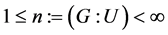 . Let
. Let  be the Artin transfer from G to
 .
.
Theorem 5.2. If , then the image
  of a left transversal
  of U in G is a left transversal of V in H, the index
  remains the same and is therefore finite, and the Artin transfer
  from H to
  exists.
1) The following connections exist between the two Artin transfers: the required condition for the composita of mappings in the commutative diagram in Figure 3,
 (5.11)
and, consequently, the inclusion of the kernels,
 (5.12)
2) A sufficient (but not necessary) condition for the equality of the kernels is given by
 (5.13)

Figure 3. Epimorphism and Artin transfer.
See Figure 3 for a visualization of this scenario.
Proof. The truth of these statements can be justified in the following way. The first part has been proved in
Proposition 2.1 already: Let  be a left transversal of U in G. Then
  is a disjoint union but the union
  is not necessarily disjoint. For
 , we have


 for some
element


 . However, if the condition
  is satisfied, then we are able to conclude that
 , and thus
 .
.
Let  be the epimorphism obtained in the manner indicated in the proof of Theorem 5.1 and Formula (5.2). For the image of
  under the Artin transfer, we obtain

Since , the right hand side equals
 , provided that
  is a left transversal of V in H, which is correct when
 . This shows that the diagram in Figure 3 is commutative, that is,
 . It also yields the connection between the permutations
  and the monomials
  for all
 . As a consequence, we obtain the inclusion
 , if
, if . Finally, if
 , then the previous section has shown that
 is an isomorphism. Using the inverse isomorphism, we get
 , which proves the equation
 . More explicitly, we have the following chain of equivalences and implications:

Conversely,  only implies
 . Therefore, we cer-
tainly have  if
if , which is, however, not necessary. □
P 5.3. Artin transfers as natural transformations. Artin transfers  can be viewed as components of a natural transformation T between two functors
  and F from the following category
  to the usual category
  of groups.
The objects of the category  are pairs
  consisting of a group G and a subgroup
  of finite index
 ,
,
 (5.14)
For two objects , the set of morphisms
  consists of epimor- phisms
  satisfying
 ,
,  , and the additional condition
  for their kernels, briefly written as arrows
 ,
,
 (5.15)
The forgetful functor  from this category
  to the category
  of groups maps a pair.
  to its first component
 , and it maps a morphism
  to the underlying epimorphism
 .
.
 (5.16)
The functor  from
from  to the category
  of groups maps a pair
  to the commutator quotient group
  of the subgroup U, and it maps a morphism
  to the induced epimorphism
  of the restriction
 . Note that we must abstain here from letting F map into the subcategory
  of abelian groups.
 (5.17)
The system T of all Artin transfers fulfils the requirements for a natural transformation  between these two functors, since we have
 (5.18)
for every morphism  of the category
 .
.
Definition 5.2. Due to the results in Theorem 5.2, it makes sense to define a pre-order of transfer kernels on the kernels  of the components
  of the natural transformation T in the object class
  of the category
  of groups in the following manner.
For two objects , a morphism
 , and the images
 , and
, and ,
,
let (non-strict) precedence be defined by
 (5.19)
and let equality be defined by
 (5.20)
if the induced epimorphism  is an isomorphism.
Corollary 5.2. If both components of the pairs  are restricted to Hopfian groups,
then the pre-order of transfer kernels  is actually a partial order.
Proof. Similarly as in the proof of Corollary 5.1, we use the properties of the functor F. The reflexivity is due to the functorial identity in Formula (7.14). The transitivity is due to the functorial compositum in Formula (7.15), where we have to observe the relations ,
,  , and Formula (7.1) in the appendix for verifying the kernel relation

additionally to the image relation

The antisymmetry is certainly satisfied for finite groups, and more generally for Hopfian groups. □
5.3. Multiplets of Transfer Targets and Kernels
Instead of viewing various pairs  which share the same first component G as distinct objects in the categories
 , resp.
 , which we used for describing singulets of transfer targets, resp. kernels, we now consider a collective accumulation of singulets in multiplets. For this purpose, we shall define a new category
  of families, which generalizes the category
 , rather than the category
 . However, we have to pre- pare this definition with a criterion for the compatibility of a system of subgroups with its image under a homo- morphism.
Proposition 5.1. See also ([7] , Thm.2.3.4, p. 29); ([8] , Satz 3.10, p. 16); ([9] , Thm.2.4, p. 6); ([13] , Thm.X.21, p. 340).
For an epimorphism  of groups, the associated set mappings
 (5.21)
are inverse bijections between the following systems of subgroups
 (5.22)
Proof. The fourth and fifth statement of Lemma 7.1 in the appendix show that usually the associated set mappings  and
and  of a homomorphism
  are not inverse bijections between systems of sub- groups of G and H. However, if we replace the homomorphism
  by an epimorphism with
 , then the Formula (7.2) yields the first desired equality

Guided by the property  of all pre-images
  of
of , we define a re- stricted system of subgroups of the domain G,

and, according to Formula (7.1.), we consequently obtain the second required equality

which yields the crucial pair of inverse set bijections

□
P 5.4. After this preparation, we are able to specify the new category . The objects of the category
are pairs  consisting of a group G and the family of all subgroups
  with finite index
 ,
,
 (5.23)
where I denotes a suitable indexing set. Note that G itself is one of the subgroups .
.
The morphisms of the new category are subject to more restrictive conditions, which concern entire families of subgroups instead of just a single subgroup.
For two objects , the set
  of
of
morphisms consists of epimorphisms  satisfying
 , the image conditions
 , and the kernel conditions
 , which imply the pre-image conditions
 , for all
 , briefly written as arrows
 ,
,
 (5.24)
Note that, in view of Proposition 5.1, we can always use the same indexing set I for the domain and for the codomain of morphisms, provided they satisfy the required kernel condition.
Now we come to the essential definition of Artin transfer patterns.
Definition 5.3. Let  be an object of the category
 .
.
The transfer target type (TTT) of G is the family
 (5.25)
The transfer kernel type (TKT) of G is the family
 (5.26)
The complete Artin pattern of G is the pair
 (5.27)
P 5.5. The natural partial order on TTTs and TKTs is reduced to the partial order on the components, according to the Definitions 5.1 and 5.2.
Definition 5.4. Let  be two objects of the category
 , where all members of the families
  and
and  are Hopfian groups.
Then (non-strict) precedence of TTTs is defined by
 (5.28)
and equality of TTTs is defined by
 (5.29)
(Non-strict) precedence of TKTs is defined by
 (5.30)
and equality of TKTs is defined by
 (5.31)
We partition the indexing set I in two disjoint components, according to whether components of the Artin pattern remain fixed or change under an epimorphism.
Definition 5.5. Let  be two objects of the category
 , and let
  be a morphism between these objects.
The stable part and the polarized part of the Artin pattern  of G with respect to
  are defined by
 (5.32)
Accordingly, we have
 (5.33)
Note that the precedence of polarized targets is strict as opposed to polarized kernels.
5.4. The Artin Pattern on a Descendant Tree
P 5.6. Before we specialize to the usual kinds of descendant trees of finite p-groups ([3] , §4, pp. 163-164) we consider an abstract form of a rooted directed tree , which is characterized by two relations.
Firstly, a basic relation  between parent and child (also called immediate descendant), corre- sponding to a directed edge
  of the tree, for any vertex
  which is different from the root R of the tree.
Secondly, an induced non-strict partial order relation,  for some integer
 , between ancestor and descendant, corresponding to a path
  of directed edges, for an arbitrary vertex
 , that is, the ancestor
  is an iterated parent of the descendant. Note that only an empty path with
  starts from the root R of the tree, which has no parent.
Just a brief justification of the partial order: Reflexivity is due to the relation . Transitivity
follows from the rule . Antisymmetry is a consequence of the absence of cycles, that is,
  implies
  and thus
 .
.
P 5.7. The category of a tree. Now let  be a rooted directed tree whose vertices are groups
 . Then we define
 , the category associated with
 , as a subcategory of the category
  which was introduced in the Formulas (5.23) and (5.24).
The objects of the category  are those pairs
  in the object class of the category
  whose
whose
first component is a vertex of the tree ,
,
 (5.34)
The morphisms of the category  are selected along the paths of the tree
  only.
only.
For two objects , the set
  of morphisms is either empty or consists of a single element only,
 (5.35)
In the case of an ancestor-descendant relation between H and G, the specification of the supercategory 
enforces the following constraints on the unique morphism : the image relations
  and the kernel relations
 , for all
 .
.
P 5.8. At this position, we must start to be more concrete. In the descendant tree  of a group R, which is the root of the tree, the formal parent operator
  gets a second meaning as a natural projection
 ,
,  , from the child G onto its parent
 , which is always the quotient of G by a suitable normal subgroup
 . To be precise, the epimorphism
  with kernel
  is actually dependent on its domain G. Therefore, the formal power
  is only a convenient
abbreviation for the compositum .
.
As described in [3] , there are several possible selections of the normal subgroup N in the parent definition . Here, we would like to emphasize the following three choices of characteristic subgroups N of the child G. If p denotes a prime number and
  is the descendant tree of a finite p-group R, then it is usual to take for
1) either the last non-trivial member  of the lower central series of G
2) or the last non-trivial member  of the lower exponent-p central series of G
3) or the last non-trivial member  of the derived series of G,
where  denotes the nilpotency class,
  the lower exponent p-class, and
  the derived length of G, respectively.
Note that every descendant tree of finite p-groups is subtree of a descendant tree with abelian root. Therefore, it is no loss of generality to restrict our attention to descendant trees with abelian roots.
Theorem 5.3. A uniform warranty for the comparability of the Artin patterns  of all vertices G of a descendant tree
  of finite p-groups with abelian root R, in the sense of the natural partial
order, is given by the following restriction of the family of subgroups  in the corresponding object
  of the category
 . The restriction depends on the definition of a parent
  in the
descendant tree.
1)  for all
 , when
  with
with .
.
2)  for all
 , when
  with
with .
.
3)  for all
 , when
  with
with .
.
Proof. If parents are defined by  with
with , then we have
  and
and  for any
 . The largest of these kernels arises for
 . Therefore, uniform comparability of Artin patterns is warranted by the restriction
  for all
 .
.
The parent definition  with
with  implies
  and
and  for any
 . The largest of these kernels arises for
 . Consequently, a uniform comparability of Artin patterns is guaranteed by the restriction
  for all
 .
.
Finally, in the case of the parent definition  with
with , we have
  and
and  for any
 . The largest of these kernels arises for
 . Consequently, a uniform comparability of Artin patterns is guaranteed by the condition
  for all
 .
.
□
P 5.9. Note that the first and third condition coincide since both,  and
and , denote the commutator subgroup
 . So the family
  is restricted to the normal subgroups which contain
 , as announced in the paragraph preceding Lemma 3.1.
The second condition restricts the family  to the maximal subgroups of G inclusively the group G
itself and the Frattini subgroup .
.
P 5.10. Since we shall mainly be concerned with the first and third parent definition for descendant trees, that is, either with respect to the lower central series or to the derived series, the comparability condition in Theorem 5.3 suggests the definition of a category  whose objects are subject to more severe conditions than those in Formula (5.23),
 (5.36)
but whose morphism are defined exactly as in Formula (5.24). The new viewpoint leads to a corresponding modification of Artin transfer patterns.
Definition 5.6. Let  be an object of the category
 .
.
The Artin pattern, more precisely the restricted Artin pattern, of G is the pair
 (5.37)
whose components, the TTT and the TKT of G, are defined as in the Formulas (5.25) and (5.26), but now with respect to the smaller system of subgroups of G.
P 5.11. The following Main Theorem shows that any non-metabelian group G with derived length  and finite abelianization
  shares its Artin transfer pattern
 , in the restricted sense, with its metabelianization, that is the second derived quotient
 .
.
Theorem 5.4. (Main Theorem.) Let G be a (non-metabelian) group with finite abelianization , and denote by
 ,
,  , the terms of the derived series of G, that is
  and
and  for
for , in particular,
  and
and , then
1) every subgroup  which contains the commutator subgroup
  is a normal subgroup
  of finite index
 ,
,
2) for each , there is a chain of normal subgroups
 (5.38)
3) for each , the targets of the transfers
  and
and
 are equal in the sense of the natural order,
 (5.39)
4) for each , the kernels of the transfers
  and
and
 are equal in the sense of the natural order,
 (5.40)
Proof. We use the natural epimorphism ,
, .
.
1) If U is an intermediate group , then
  is a normal subgroup of G, according to Lemma 3.1. The assumption
  implies that
 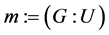 is a divisor of the integer
 . Therefore, the Artin transfer
  exists.
2) Firstly,  implies
 . Since
  is characteristic in U, we also have
 . Similarly,
  is characteristic in
  and thus normal in
 . Finally, we obtain
 .
.
3) The mapping ,
,  , is an epimorphism with kernel
 . Consequently, the isomorphism theorem in Remark 7.3 of the appendix yields the isomorphism
  .
.
4) Firstly, the restriction  is an epimorphism which induces an isomorphism
 , since
  and
and
 , according to Theorem 5.1. Secondly, according
to Theorem 5.2, the condition  implies that the index
  is finite, the Artin transfer
  exists, the composite mappings
  commute, and, since we even have
 , the transfer kernels satisfy the relation
 . In the sense of the natural partial order on transfer kernels this
means equality , since
  and thus, similarly as in Proposition 5.1, the map
  establishes a set bijection between the systems of subgroups
  and
and
 , where
 .
.
□
Remark 5.1. At this point it is adequate to emphasize how similar concepts in previous publications are related to the concept of Artin patterns. The restricted Artin pattern  in Definition 5.6 was essentially introduced in ([19] , Dfn.1.1, p. 403), for a special case already earlier in ([20] , §1, p. 417). The name Artin pattern appears in ([21] , Dfn.3.1, p. 747) for the first time. The complete Artin pattern
  in Definition 5.3 is new in the present article, but we should point out that it includes the iterated IPADs (index-p abelianization data) in ([18] , Dfn.3.5, p. 289) and the iterated IPODs (index-p obstruction data) in ([22] , Dfn.4.5).
In a second remark, we emphasize the importance of the preceding Main Theorem for arithmetical applications.
Remark 5.2. In algebraic number theory, Theorem 5.4 has striking consequences for the determination of the length  of the p-class tower
 , that is the maximal unramified pro-p extension, of an algebraic number field K with respect to a given prime number p. It shows the impossibility of deciding, exclusively with the aid of the restricted Artin pattern
 , which of several assigned candidates G with distinct derived lengths
  is the actual p-class tower group
 . (In contrast,
  can always be recognized with
 .)
.)
This is the point where the complete Artin pattern  enters the stage. Most recent investigations by means of iterated IPADs of 2nd order, whose components are contained in
 , enabled decisions between
  in [18] [22] .
Another successful method is to employ cohomological results by I.R. Shafarevich on the relation rank  for selecting among several candidates G for the p-class tower group, in dependence on the torsion-free unit rank of the base field K, for instance in [21] [23] .
Important examples for the concepts in §5 are provided in the following subsections.
5.5. Abelianization of Type (p,p)
Let G be a p-group with abelianization  of elementary abelian type
 . Then G has
  maximal subgroups
 of index
 . For each
 , let
, let  be the Artin transfer homomorphism from G to the abelianization of
 .
.
Definition 5.7. The family of normal subgroups  is called the transfer kernel type
(TKT) of G with respect to .
.
Remark 5.3. For brevity, the TKT is identified with the multiplet , whose integer components
are given by
 (5.41)
Here, we take into consideration that each transfer kernel  must contain the commutator subgroup
  of G, since the transfer target
  is abelian. However, the minimal case
  cannot occur, according to Hilbert’s Theorem 94.
A renumeration of the maximal subgroups  and of the transfers
  by means of a per-
mutation  gives rise to a new TKT
  with respect to
 , identified with
 , where

It is adequate to view the TKTs  as equivalent. Since we have
 ,
,
the relation between  and
and  is given by
 . Therefore,
  is another representative of the orbit
  of
of  under the operation
  of the symmetric group
  on the set of all mappings from
  to
to , where the extension
  of the permutation
  is defined by
 , and we formally put
 ,
, .
.
Definition 5.8. The orbit  of any representative
  is an invariant of the p-group G and is called its transfer kernel type, briefly TKT.
Remark 5.4. This definition of  goes back to the origins of the capitulation theory and was introduced by Scholz and Taussky for
  in 1934 [24] . Several other authors used this original definition and investigated capitulation problems further. In historical order, Chang in 1977 [25] , Chang and Foote in 1980 [26] , Heider and Schmithals in 1982 [27] , Brink in 1984 [28] , Brink and Gold in 1987 [29] , Nebelung in 1989 [30] , and ourselves in 1991 [31] and in 2012 [32] .
In the brief form of the TKT , the natural order is expressed by
  for
for .
.
Let  denote the counter of total transfer kernels
 , which is
an invariant of the group G. In 1980, Chang and Foote [26] proved that, for any odd prime p and for any integer , there exist metabelian p-groups G having abelianization
  of type
  such that
 . However, for
 , there do not exist non-abelian 2-groups G with
 , such that
 . Such groups must be metabelian of maximal class. Only the elementary abelian 2-group
  has
has .
.
In the following concrete examples for the counters , and also in the remainder of this article, we use identifiers of finite p-groups in the SmallGroups Library by Besche, Eick and O’Brien [33] [34] .
Example 5.1. For , we have the following TKTs
 :
:
・  for the extra special group
  of exponent 9 with
 ,
,
・  for the two groups
  with
with ,
,
・  for the group
  with
with ,
,
・  for the group
  with
with ,
,
・  for the extra special group
  of exponent 3 with
 .
.
5.6. Abelianization of Type (p2, p)
Let G be a p-group with abelianization  of non-elementary abelian type
 . Then G possesses
  maximal subgroups
 of index
 , and
, and  subgroups
 of index
 . See Figure 1.
P 5.12. Convention. Suppose that  is the distinguished maximal subgroup which is the product of all subgroups of index
 , and
, and  is the distinguished subgroup of index
which is the intersection of all maximal subgroups, that is the Frattini subgroup  of G.
of G.
P 5.13. First layer. For each , let
, let  be the Artin transfer homomorphism from G to the ab- elianization of
 .
.
Definition 5.9. The family  is called the first layer transfer kernel type of G with respect to
  and
and , and is identified with
 , where
 (5.42)
Remark 5.5. Here, we observe that each first layer transfer kernel is of exponent p with respect to  and consequently cannot coincide with
  for any
 , since
  is cyclic of order
 , whereas
  is bicyclic of type
 .
.
P 5.14. Second layer. For each , let
, let  be the Artin transfer homomorphism from G to the abelianization of
 .
.
Definition 5.10. The family  is called the second layer transfer kernel type of G with respect to
  and
and , and is identified with
 , where
 (5.43)
P 5.15. Transfer kernel type.
Combining the information on the two layers, we obtain the (complete) transfer kernel type

of the p-group G with respect to  and
and .
.
Remark 5.6. The distinguished subgroups  and
and  are unique invariants of G and should not be renumerated. However, independent renumerations of the remaining maximal subgroups
 and the transfers
  by means of a permutation
 , and of the remaining subgroups
 of index
  and the transfers
  by means of a permutation
 , give rise to new TKTs
  with respect to
  and
and , identified with
 , where

and  with respect to
  and
and , identified with
 ,
,
where

It is adequate to view the TKTs  and
and  as equivalent. Since we have

resp.

the relations between  and
and , resp.
  and
and , are given by
 , resp.
 . Therefore,
  is another representative of the orbit
  of
of  under the operation

of the product of two symmetric groups  on the set of all pairs of mappings from
  to
to , where the extensions
  and
and  of a permutation
  are defined by
  and
and , and formally
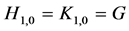 ,
,  ,
,  , and
, and .
.
Definition 5.11. The orbit  of any representative
  is an invariant of the p- group G and is called its transfer kernel type, briefly TKT.
P 5.16. Connections between layers.
The Artin transfer  from G to a subgroup
  of index

is the compositum  of the induced transfer
  from
from  to
to
 (in the sense of Corollary 7.1 or Corollary 7.3 in the appendix) and the Artin transfer
  from G to
 , for any intermediate subgroup
  of index
  (
( ). There occur two situations:
・ For the subgroups  only the distinguished maximal subgroup
  is an intermediate subgroup.
・ For the Frattini subgroup  all maximal subgroups
  are intermediate subgroups.
This causes restrictions for the transfer kernel type  of the second layer,
since , and thus
・  , for all
 ,
,
・ but even .
.
Furthermore, when  with
with  and
and , an element
  (
( ) which is of order
  with respect to
 , can belong to the transfer kernel
  only if its pth power
  is contained in
 , for all intermediate subgroups
 , and thus:
・  , for certain
 , enforces the first layer TKT singulet
 ,
,
・ but , for some
 , even specifies the complete first layer TKT multiplet
 , that is
 , for all
 .
.
6. Stabilization and Polarization in Descendant Trees
P 6.1. Theorem 5.4 has proved that it suffices to get an overview of the restricted Artin patterns of metabelian groups G with , since groups G of derived length
  will certainly reveal exactly the same patterns as their metabelianizations
 .
.
In this section, we present the complete theory of stabilization and polarization of the restricted Artin patterns for an extensive exemplary case, namely for all metabelian 3-groups G with abelianization  of type (3,3).
Since the bottom layer, resp. the top layer, of the restricted Artin pattern will be considered in Theorem 6.4 on the commutator subgroup , resp. Theorem 6.5 on the entire group G, we first focus on the intermediate layer
  of the maximal subgroups
 .
.
6.1. 3-Groups of Non-Maximal Class
P 6.2. We begin with groups G of non-maximal class. Denoting by m the index of nilpotency of G, we let  with
with  be the centralizers of two-step factor groups
  of the lower central series, that is, the biggest subgroups of G with the property
 . They form an as- cending chain of characteristic subgroups of G,
  , which contain the commutator subgroup.
  coincides with G if and only if
 . We characterize the smallest two-step centralizer different from the commutator group by an isomorphism invariant
  . According to Nebelung [30] , we can assume that G has order
 , class
 , and coclass
 , where
 . Let generators of
  be selected such that
 ,
,  , if
, if , and
, and . Suppose that a fixed ordering of the four maximal subgroups of G is defined by
  with
with ,
,  ,
,  , and
, and . Let the main commutator of G be declared by
  and higher commutators recursively by
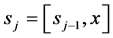 ,
,  for
for . Starting with the powers
 ,
,  , let
, let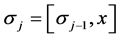 ,
, 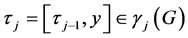 for
for , and put
 ,
, .
.
Theorem 6.1. (Non-maximal class.) Let G be a metabelian 3-group of nilpotency class  and coclass
  with abelianization
 . With respect to the projection
 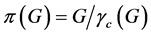 onto the parent, the restricted Artin pattern
  of G reveals
1) a bipolarization and partial stabilization, if G is an interface group with bicyclic last lower central equal to the bicyclic first upper central, more precisely
 (6.1)
(6.1)
2) a unipolarization and partial stabilization, if G is a core group with cyclic last lower central and bicyclic first upper central, more precisely
 (6.2)
(6.2)
3) a nilpolarization and total stabilization, if G is a core group with cyclic last lower central equal to the cyclic first upper central, more precisely
 (6.3)
(6.3)
Proof. Theorems 5.1 and 5.2 tell us that for detecting whether stabilization occurs from parent  to child G, we have to compare the projection kernel
  with the commutator subgroups
  of the four maximal normal subgroups
 ,
, . According to ([35] , Cor.3.2, p. 480) these derived subgroups are given by
 (6.4)
(6.4)
provided the generators of G are selected as indicated above. On the other hand, the projection kernel  is given by
 (6.5)
(6.5)
Combining this information with , we obtain the following results.
・  for
for  if
if , independently of
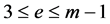 .
.
・  for
for  if
if , which implies
 .
.
・  but
but  if
if ,
,  , which also implies
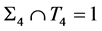 .
.
・  for
for  if
if ,
,  , which implies
  .
.
Taken together, these results justify all claims. □
Example 6.1. Generally, the parent  of an interface group G ([19] , Dfn.3.3, p. 430) with bicyclic last non-trivial lower central is a vertex of a different coclass graph with lower coclass. In the case of a bipolarization ([19] , Dfn.3.2, p. 430), which is now also characterized via the Artin pattern by Formula (6.1) for
 , we can express the membership in coclass graphs by the implication: If
  with
with , then
 . A typical example is the group
  of coclass 3 with parent
  of coclass 2 (again with identifiers in the SmallGroups database [33] [34] ), where

and

In contrast, a core group G ([19] , Dfn.3.3, p. 430) with cyclic last non-trivial lower central and its parent  are vertices of the same coclass graph. In dependence on the p-rank of its centre
 , the Artin pattern either shows a unipolarization as in Formula (6.2), if the centre is bicyclic, or a total stabilization as in Formula (6.3), if the centre is cyclic. Typical examples are the group
  with parent
 , both of coclass 2, where the Artin pattern shows a unipolarization

and

and the group  with parent
 , both of coclass 2, where the Artin pattern shows a total stabilization

and

6.2. p-Groups of Maximal Class
P 6.3. Next we consider p-groups of maximal class, that is, of coclass , but now for an arbitrary prime number
 . According to Blackburn [17] and Miech [36] , we can assume that G is a metabelian p-group of order
  and nilpotency class
 , where
 . Then G is of coclass
  and the commutator factor group
  of G is of type
 . The lower central series of G is defined recursively by
  and
and  for
for , in particular
 .
.
The centralizer  of the two-step factor group
 , that is,

is the biggest subgroup of G such that . It is characteristic, contains the commutator subgroup
 , and coincides with G, if and only if
 . Let the isomorphism invariant
  of G be defined by

where  for
for ,
,  for
for , and
, and  for
for , according to Miech ([36] , p. 331).
Suppose that generators of  are selected such that
 , if
, if , and
, and .
.
We define the main commutator  and the higher commutators
  for
for .
.
The maximal subgroups  of G contain the commutator subgroup
  of G as a normal subgroup of index p and thus are of the shape
 . We define a fixed ordering by
  and
and  for
for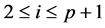 .
.
Theorem 6.2. (Maximal class.) Let G be a metabelian p-group of nilpotency class  and coclass
 , which automatically implies an abelianization
  of type
 . With respect to the projection
 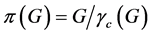 onto the parent, the restricted Artin pattern
  of G reveals
1) a unipolarization and partial stabilization, if the first maximal subgroup  of G is abelian, more precisely
 (6.6)
(6.6)
2) a nilpolarization and total stabilization, if all four maximal subgroups  of G are non-abelian, more precisely
 (6.7)
(6.7)
In both cases, the commutator subgroups of the other maximal normal subgroups of G are given by
 (6.8)
(6.8)
Proof. We proceed in the same way as in the proof of Theorem 6.1 and compare the projection kernel  with the commutator subgroups
  of the
  maximal normal subgroups
 ,
, . According to ([35] , Cor.3.1, p. 476) they are given by
 (6.9)
(6.9)
if the generators of G are chosen as indicated previously. The cyclic projection kernel is given uniformly by
 (6.10)
Using the relation , we obtain the following results.
・  for
for 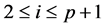 if
if .
.
・  if and only if
 , that is,
 .
.
The claims follow by applying Theorems 5.1 and 5.2. □
Example 6.2. For , typical examples are the group
  with parent
 , both of coclass 1, where the Artin pattern shows a unipolarization ([19] , Dfn.3.1, p. 413)

and

and the group  with parent
 , both of coclass 1, where the Artin pattern shows a total stabilization

and

6.3. Extreme Interfaces of p-Groups
P 6.4. Finally, what can be said about the extreme cases (excluded in Theorems 6.1 and 6.2) of non-abelian p-groups having the smallest possible nilpotency class  for coclass
  and
and  for coclass
 ? In these particular situations, the answers can be given for arbitrary prime numbers
 .
.
Theorem 6.3. Let G be a metabelian p-group with abelianization  of type
 .
.
1) If G is of coclass  and nilpotency class
 , then
  must be odd and the coclass must be
  exactly.
2) If G is of coclass  and nilpotency class
 , then G is an extra special p-group of order
  and exponent p or
 .
.
In both cases, there occurs a total polarization and no stabilization at all, more explicitly
 (6.11)
Proof. Suppose that G is a metabelian p-group with .
.
1) According to O. Taussky [37] , a 2-group G with abelianization  of type
  must be of coclass
 . Consequently,
  implies
 .
.
Since the minimal nilpotency class c of a non-abelian group with coclass  is given by
 , the case
  cannot occur for
 .
.
So we are considering metabelian p-groups G with , nilpotency class
  and coclass
  for odd
 , which form the stem of the isoclinism family
  in the sense of P. Hall. According to ([19] , Lem.3.1, p. 446), the commutator subgroups
  of the maximal subgroups
  are cyclic of degree p, for such a group
 . However, the kernel of the parent projection
  is the bicyclic group
  of type
  ([19] , §3.5, p. 445), which cannot be contained in any of the cyclic
  with
with .
.
2) According to ([35] , Cor.3.1, p. 476), the commutator subgroups  of all maximal subgroups
  are trivial, for a metabelian p-group G of coclass
  and nilpotency class
 , which implies
 . Thus, the kernel of the parent projection
  is not contained in any
 .
.
In both cases, the final claim is a consequence of the Theorems 5.1 and 5.2. □
Example 6.3. For , a typical example for the interface between groups of coclass 2 and 1 is the group
  of coclass 2 with parent
  of coclass 1, where the Artin pattern shows a total polarization

and

For , a typical example for the interface between non-abelian and abelian groups is the extra special quaternion group
  with parent
  both of coclass 1, where the Artin pattern shows a total polarization

and

Summarizing, we can say that the last three Theorems 6.1, 6.2, and 6.3 underpin the fact that Artin transfer patterns provide a marvellous tool for classifying finite p-groups.
6.4. Bottom and Top Layer of the Artin Pattern
P 6.5. We conclude this section with supplementary general results concerning the bottom layer and top layer of the restricted Artin pattern.
Theorem 6.4. (Bottom layer.) The type of the commutator subgroup  can never remain stable for a metabelian vertex
  of a descendant tree
  with respect to the lower central series, lower exponent-p central series, or derived series. The kernel of
  is equal to G (Principal Ideal Theorem).
Proof. All possible kernels  , resp.
  , resp.
  , of the parent projections
  are non trivial, and can therefore never be contained in the trivial second derived subgroup G". According to Theorem 5.1, the type of the commutator subgroup G' cannot be stable. The Principal Ideal Theorem is due to Furtwängler [38] and is also proved in ([13] Thm.10.18, p. 313). □
Example 6.4. In Example 6.1, we point out that the group 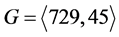 with cyclic centre and its parent
 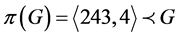 , both of coclass 2, cannot be distinguished by their TTT

and TKT

due to a total stabilization of the restricted Artin pattern as in Formula (6.3). However, the type of their commutator subgroup (the second layer of their TTT) admits a distinction, since

Theorem 6.5. (Top layer.) In a descendant tree  with respect to the lower central series or derived series, the type of the abelianization
  of
of  remains stable. The kernel of
  is equal to
  .
.
Proof. This follows from Theorem 5.1, since even the maximal possible kernel  , resp.
 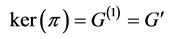 , of the parent projections
  is contained in the commutator subgroup
  of G.
of G.
□
We briefly emphasize the different behaviour of trees where parents are defined with the lower exponent-p central series.
Theorem 6.6. In a descendant tree  with respect to the lower exponent-p central series, only the p-rank of the abelianization
  of the vertices
  remains stable.
Proof. Denote by 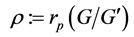 the p-rank of the abelianization of G. According to Theorem 5.1, the maximal possible kernel
  of the parent projections
  is the Frattini subgroup which is contained in all maximal subgroups
  of G. According to Proposition 5.1, the map
  induces a bijection between the sets of maximal subgroups of the child G and the parent
  , whose cardinality is given by
 . Consequently, we have
  . □
. □
Acknowledgements
The author would like to express his heartfelt gratitude to Professor Mike F. Newman from the Australian National University in Canberra, Australian Capital Territory, for his continuing encouragement and interest in our endeavour to strengthen the bridge between group theory and class field theory which was initiated by the ideas of Emil Artin, and for his untiring willingness to share his extensive knowledge and expertise and to be a source of advice in difficult situations.
We also gratefully acknowledge that our research is supported by the Austrian Science Fund (FWF): P 26008- N25.
Cite this paper
Daniel C.Mayer, (2016) Artin Transfer Patterns on Descendant Trees of Finite p-Groups. Advances in Pure Mathematics,06,66-104. doi: 10.4236/apm.2016.62008
References
- 1. Artin, E. (1927) Beweis des allgemeinen Reziprozitätsgesetzes. Abhandlungen aus dem Mathematischen Seminar der Universität Hamburg, 5, 353-363.
http://dx.doi.org/10.1007/BF02952531 - 2. Artin, E. (1929) Idealklassen in Oberkörpern und allgemeines Reziprozitätsgesetz. Abhandlungen aus dem Mathematischen Seminar der Universität Hamburg, 7, 46-51.
http://dx.doi.org/10.1007/BF02941159 - 3. Mayer, D.C. (2015) Periodic Bifurcations in Descendant Trees of Finite p-Groups. Advances in Pure Mathematics, 5, 162-195.
http://dx.doi.org/10.4236/apm.2015.54020 - 4. Newman, M.F. (1977) Determination of Groups of Prime-Power Order. In: Bryce, R.A., Cossey, J. and Newman, M.F., Eds., Group Theory, Lecture Notes in Math, Vol.573, Springer, Berlin, 73-84.
- 5. O’Brien, E.A. (1990) The p-Group Generation Algorithm. Journal of Symbolic Computation, 9, 677-698.
http://dx.doi.org/10.1016/S0747-7171(08)80082-X - 6. Schur, I. (1902) Neuer Beweis eines Satzes über endliche Gruppen. Sitzungsb. Preuss. Akad. Wiss., 42, 1013-1019,.
- 7. Hall Jr., M. (1999) The Theory of Groups. AMS Chelsea Publishing, American Mathematical Society, Providence.
- 8. Huppert, B. (1979) Endliche Gruppen I. Grundlehren der mathematischen Wissenschaften, Vol. 134. Springer-Verlag, Berlin, Heidelberg and New York.
- 9. Gorenstein, D. (2012) Finite Groups. AMS Chelsea Publishing, American Mathematical Society, Providence.
- 10. Aschbacher, M. (1986) Finite Group Theory. Cambridge Studies in Advanced Mathematics, Vol. 10. Cambridge University Press, Cambridge.
- 11. Doerk, K. and Hawkes, T. (1992) Finite Soluble Groups, de Gruyter Expositions in Mathematics, Vol.4. Walter de Gruyter, Berlin and New York.
http://dx.doi.org/10.1515/9783110870138 - 12. Smith, G. and Tabachnikova, O. (2000) Topics in Group Theory. Springer Undergraduate Mathematics Series (SUMS), Springer-Verlag, London.
- 13. Isaacs, I.M. (2011) Finite Group Theory. Graduate Studies in Mathematics, Vol.92. American Mathematical Society, Providence.
- 14. Bourbaki, N. (2007) éléments de mathématique, Livre 2, Algèbre. Springer-Verlag, Berlin Heidelberg.
- 15. Olsen, J. (2010) The Transfer Homomorphism. Math 434. University of Puget Sound, Washington DC.
http://buzzard.ups.edu/courses/2010spring/projects/olsen-transfer-homomorphism-ups-434-2010.pdf - 16. Hasse, H. (1932) Bericht über neuere Untersuchungen und Probleme aus der Theorie der algebraischen Zahlkörper, Teil II: Reziprozitötsgesetz. Jahresbericht der Deutschen Mathematiker-Vereinigung, 6, 1-204.
- 17. Blackburn, N. (1958) On a Special Class of p-Groups. Acta Mathematica, 100, 45-92.
http://dx.doi.org/10.1007/BF02559602 - 18. Mayer, D.C. (2015) Index-p abelianization data of p-class tower groups. Advances in Pure Mathematics, 5, 286-313.
http://dx.doi.org/10.4236/apm.2015.55029 - 19. Mayer, D.C. (2011) The Distribution of Second p-Class Groups on Coclass Graphs. Journal de Théorie des Nombres de Bordeaux, 25, 401-456.
- 20. Mayer, D.C. (2014) Principalization Algorithm via Class Group Structure. Journal de Théorie des Nombres de Bordeaux, 26, 415-464.
http://dx.doi.org/10.5802/jtnb.874 - 21. Mayer, D.C. (2015) Periodic Sequences of p-Class Tower Groups. Journal of Applied Mathematics and Physics, 3, 746-756.
http://dx.doi.org/10.4236/jamp.2015.37090 - 22. Mayer, D.C. (2015) New Number Fields with Known p-Class Tower. 22nd Czech and Slovak International Conference on Number Theory, Liptovsky Ján, Conference date, page.
- 23. Bush, M.R. and Mayer, D.C. (2015) 3-Class Field Towers of Exact Length 3. Journal of Number Theory 147, 766-777.
http://dx.doi.org/10.1016/j.jnt.2014.08.010 - 24. Scholz, A. and Taussky, O. (1934) Die Hauptideale der kubischen Klassenkörper imaginär quadratischer Zahlkörper: ihre rechnerische Bestimmung und ihr Einfluß auf den Klassenkörperturm. Journal für die reine und angewandte Mathematik, 171, 19-41.
- 25. Chang, S.M. (1977) Capitulation Problems in Algebraic Number Fields. Ph.D. Thesis, University of Toronto, Toronto.
- 26. Chang, S.M. and Foote, R. (1980) Capitulation in Class Field Extensions of Type (p,p). Canadian Journal of Mathematics, 32, 1229-1243.
http://dx.doi.org/10.4153/CJM-1980-091-9 - 27. Heider, F.-P. and Schmithals, B. (1982) Zur Kapitulation der Idealklassen in unverzweigten primzyklischen Erweiterungen. Journal für die reine und angewandte Mathematik., 336, 1-25.
- 28. Brink, J.R. (1984) The Class Field Tower for Imaginary Quadratic Number Fields of Type (3,3). Dissertation, Ohio State University, Columbus.
- 29. Brink, J.R. and Gold, R. (1987) Class Field Towers of Imaginary Quadratic Fields. Manuscripta Mathematica, 57, 425-450.
- 30. Nebelung, B. (1989) Klassifikation metabelscher 3-Gruppen mit Faktorkommutatorgruppe vom Typ (3,3) und Anwendung auf das Kapitulationsproblem. Inaugural Dissertation, Universität zu Köln, Cologne.
- 31. Mayer, D.C. (1990) Principalization in Complex S3-Fields. Congressus Numerantium, 80, 73-87.
- 32. Mayer, D.C. (2012) Transfers of Metabelian p-Groups. Monatshefte für Mathematik., 166, 467-495.
- 33. Besche, H.U., Eick, B. and O’Brien, E.A. (2002) A Millennium Project: Constructing Small Groups. International Journal of Algebra and Computation, 12, 623-644.
http://dx.doi.org/10.1142/S0218196702001115 - 34. Besche, H.U., Eick, B. and O’Brien, E.A. (2005) The Small Groups Library—A Library of Groups of Small Order. An Accepted and Refereed GAP 4 Package, Available also in MAGMA.
- 35. Mayer, D.C. (2012) The Second p-class Group of a Number Field. International Journal of Number Theory, 8, 471-505.
http://dx.doi.org/10.1142/S179304211250025X - 36. Miech, R.J. (1970) Metabelian p-Groups of Maximal Class. Transactions of the American Mathematical Society, 152, 331-373.
- 37. Taussky, O. (1937) A Remark on the Class Field Tower. Journal London Mathematical Society, S1-12, 82-85.
http://dx.doi.org/10.1112/jlms/s1-12.1.82 - 38. Furtwängler, Ph. (1929) Beweis des Hauptidealsatzes für die Klassenkörper algebraischer Zahlkörper. Abhandlungen aus dem Mathematischen Seminar der Universität Hamburg, 7, 14-36.
http://dx.doi.org/10.1007/BF02941157 - 39. Lang, S. (1980) Algebra. World Student Series, Addison-Wesley Publishing Company, Reading.
- 40. Boston, N., Bush, M.R. and Hajir, F. (2014) Heuristics for p-Class Towers of Imaginary Quadratic Fields.
http://arxiv.org/abs/1111.4679
Appendix: Induced Homomorphism between Quotient Groups
Throughout this appendix, let  be a homomorphism from a source group (domain) G to a target group (codomain) H.
A.1. Image, Pre-Image and Kernel
P 7.1. First, we recall some basic facts concerning the image and pre-image of normal subgroups and the kernel of the homomorphism  .
.
Lemma 7.1. Suppose that  and
and  are subgroups, and
  are elements.
1) If  is a normal subgroup of G, then its image
  is a normal subgroup of the (total) image
 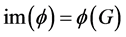 .
.
2) If  is a normal subgroup of the image
  , then the pre-image
  is a normal subgroup of G.
In particular, the kernel  of
of  is a normal subgroup of G.
3) If  , then there exists an element
  such that
  .
.
4) If  , then
  , i.e., the pre-image of the image satisfies
 (7.1)
(7.1)
5) Conversely, the image of the pre-image is given by
 (7.2)
(7.2)
The situation of Lemma 7.1 is visualized by Figure 4, where we briefly write  and
and  .
.
Remark 7.1. Note that, in the first statement of Lemma 7.1, we cannot conclude that  is a normal subgroup of the target group H, and in the second statement of Lemma 7.1, we need not require that
  is a normal subgroup of the target group H.
Proof. 1) If  , then
  for all
  ,
,
and thus  for all
  , i.e.,
 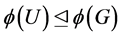 .
.
2) If  , then
  , that is,
  . In particular, we have
  , i.e.,
  , and
, and
consequently 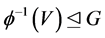 .
.
To prove the claim for the kernel, we put 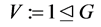 .
.
3) If 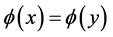 , then
  , and thus
 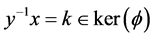 . (See also [7] , Thm.2.2.1, p. 27).
4) If 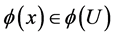 , then
  , and thus
  , by (3). This shows
  , and the opposite inclusion is obvious.
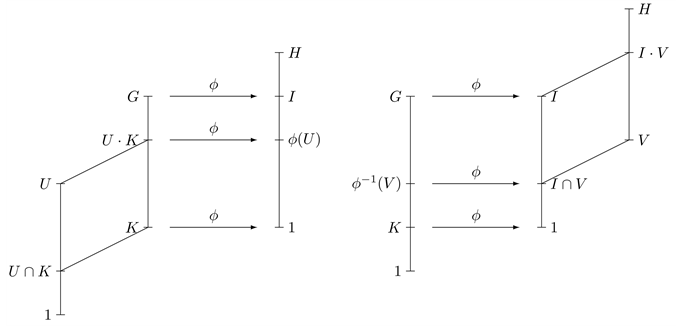
Figure 4. Kernel, image and pre-image under a homomorphism f.
Finally, since  is normal, we have
  .
.
5) This is a consequence of the properties of the set mappings  and
and  associated with the homomorphism
  .
.
□
A.2. Criteria for the Existence of the Induced Homomorphism
P 7.2. Now we state the central theorem which provides the foundation for lots of useful applications. It is the most general version of a series of related theorems, which is presented in Bourbaki ([14] , Chap.1), Structures algëriques, Prop.5, p. A I.35]. Weaker versions will be given in the subsequent corollaries.
Theorem 7.1. (Main Theorem)
Suppose that  is a normal subgroup of G and
  is a normal subgroup of H. Let
  and
and  denote the canonical projections onto the quotients.
・ The following three conditions for the homomorphism 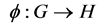 are equivalent.
1) There exists an induced homomorphism 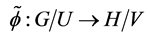 such that
 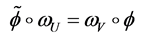 , that is,
 (7.3)
(7.3)
2)  .
.
3) 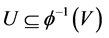 .
.
・ If the induced homomorphism  of the quotients exists, then it is determined uniquely by
  , and its kernel, image and cokernel are given by
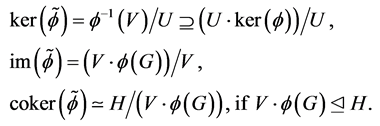 (7.4)
(7.4)
In particular,  is a monomorphism if and only if
  .
.
Moreover,  is an epimorphism if and only if
  .
.
In particular,  is certainly an epimorphism if
  is onto.
We summarize the criteria for the existence of the induced homomorphism in a formula:
 (7.5)
(7.5)
The situation of Theorem 7.1 is shown in the commutative diagram of Figure 5.
Remark 7.2. If the normal subgroup  in the assumptions of Theorem 7.17 is taken as
  , then the induced homomorphism
  exists automatically and is a monomorphism.

Figure 5. Induced homomorphism  of quotients.
Note that 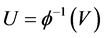 does not imply
  but only
 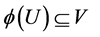 , if
, if  is not an epimorphism. Similarly,
  does not imply
 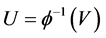 but only
 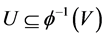 , if
, if  is not a monomorphism.
Proof.
・ (1) Þ (2): If there exists a homomorphism  such that
 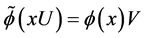 for all
  , then, for any
  , we have
 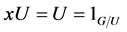 , and thus
  , which means
  . It follows that
  .
.
(2) Þ (1): If  , then the image
  of the coset
  under
under  is independent of the re- presentative
  : If
: If  for
for  , then
  and thus
  . Consequently, we have
  . Furthermore,
  is a homomorphism, since

(2) Þ (3): If  , then
  .
.
(3) Þ (2): If 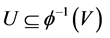 , then
  .
.
・ The image of any 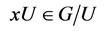 under
under  is determined uniquely by
  , since
  .
.
The kernel of  is given by
  , and for
  we have

that is  , which clearly contains
  , since
  .
.
The cokernel of  is given by
  , if
, if  .
.
Finally, if  is an epimorphism, then
  is also an epimorphism, which forces the terminal map
  to be an epimorphism. □
A.3. Factorization through a Quotient
P 7.3. Theorem 7.1 can be used to derive numerous special cases. Usually it suffices to consider the quotient group  corresponding to a normal subgroup U of the source group G of the homomorphism
 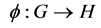 and to view the target group H as the trivial quotient H/1. In this weaker form, the existence criterion for the induced homomorphism occurs in Lang’s book ([39] , p. 17).
Corollary 7.1. (Factorization through a quotient)
Suppose  is a normal subgroup of G and
 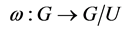 denotes the natural epimorphism onto the quotient.
If  , then there exists a unique homomorphism
  such that
  , that is,
  for all
  .
.
Moreover, the kernel of  is given by
  .
.
Again we summarize the criterion in a formula:
 (7.6)
(7.6)
In this situation the homomorphism  is said to factor or factorize through the quotient
  via the canonical projection
 and the induced homomorphism
  .
.
The scenario of Corollary 7.1 is visualized by Figure 6.
Proof. The claim is a consequence of Theorem 7.1 in the special case that  is the trivial group. The equivalent conditions for the existence of the induced homomorphism
  are
are  resp.
resp.  . □
. □
Remark 7.3. Note that the well-known isomorphism theorem (sometimes also called homomorphism theorem) is a special case of Corollary 7.1. If we put  and if we assume that
  is an epimorphism with
  , then the induced homomorphism
  is an isomorphism, since
 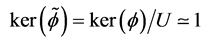 .
.
In this weakest form,
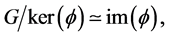 (7.7)
(7.7)

Figure 6. Homomorphism f factorized through a quotient.
actually without any additional assumptions being required, the existence theorem for the induced homomorphism appears in almost every standard text book on group theory or algebra, e.g., ([7] , Thm.2.3.2, p. 28) and ([13] , Thm.X.18, p. 339).
A.4. Application to Series of Characteristic Subgroups
P 7.4. The normal subgroup  in the assumptions of Corollary 7.1 can be specialized to various characteristic subgroups of G for which the condition
  can be expressed differently, namely by invariants of series of characteristic subgroups.
Corollary 7.2. The homomorphism 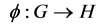 can be factorized through various quotients of G in the following way. Let n be a positive integer and p be a prime number.
1)  factors through the nth derived quotient
  if and only if the derived length of
  is bounded by
  .
.
2)  factors through the nth lower central quotient
  if and only if the nilpotency class of
  is bounded by
  .
.
3)  factors through the nth lower exponent-p central quotient
  if and only if the p-class of
  is bounded by
  .
.
We summarize these criteria in terms of the length of series in a formula:
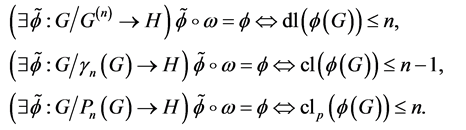 (7.8)
(7.8)
Proof. By induction, we show that, firstly,
 ,
,
secondly,  ,
,
and finally, 
 .
.
Now, the claims follow from Corollary 7.1 by observing that  iff
iff ,
,  iff
iff , and
, and  iff
iff  □
□
The following special case is particularly well known. Here we take the commutator subgroup  of G as our charecteristic subgroup, which can either be viewed as the term
  of the lower central series of G or as the term
  of the derived series of G.
Corollary 7.3. A homomorphism  passes through the derived quotient
  of its source group G if and only if its image
  is abelian.
Proof. Putting  in the first statement or
  in the second statement of Corollary 7.2 we obtain the well-known special case that
  passes through the abelianization
  if and only if
  is abelian, which is equivalent to
 , and also to
 . □
. □
The situation of Corollary 7.3 is visualized in Figure 7.
Using the first part of the proof of Corollary 7.2 we can recognize the behavior of several central series under homomorphisms.
Lemma 7.2. Let  be a homomorphism of groups and suppose that
  is an integer and
  a prime number. Let
  be a subgroup with image
 .
.
1) If , then

2) If , then

3) If , then

Proof. 1) Let , then
  and
and
 . Consequently, we have
  if
if and
and  if
if .
.
2) Let , then
  and
and . Thus, we have
  if
if and
and  if
if .
.
3) Let , then
  and
and . Therefore, we have
  if
if and
and  if
if .□
.□
A.5. Application to Automorphisms
Corollary 7.4. (Induced automorphism)

Figure 7. Homomorphism  passing through the derived quotient.
Let  be an epimorphism of groups,
  , and assume that
  is an auto- morphism of G.
1) There exists an induced epimorphism  such that
 , if and only if
 , resp.
 .
.
2) The induced epimorphism  is also an automorphism of H,
  , if and only if
 (7.9)
(7.9)
In the second statement,  is said to have the kernel invariance property (KIP) with respect to
 .
.
The situation of Corollary 7.4 is visualized in Figure 8.
Proof. Since  is supposed to be an epimorphism, the well-known isomorphism theorem in Remark 7.3 yields a representation of the image
  as a quotient.
1) According to Theorem 7.1, the automorphism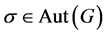 , simply viewed as a homomorphism
 , induces a homomorphism
  if and only if
 . Since
  is an epimorphism,
  is also an epimorphism with kernel
 .
.
2) Finally,



 .
.
□
Remark 7.4. If  is a characteristic subgroup of G, then Corollary 7.4 makes sure that any automorphism
  induces an automorphism
 , where
 . The reason is that, by definition, a characteristic subgroup of G is invariant under any automorphism of G.
P 7.5. We conclude this section with a statement about GI-automorphisms (generator-inverting auto- morphisms) which have been introduced by Boston, Bush and Hajir ([40] , Dfn.2.1). The proof requires results of Theorem 7.1, Corollary 7.4, and Corollary 7.2.
Theorem 7.2. (Induced generator-inverting automorphism)
Let  be an epimorphism of groups with
 , and assume that
  is an automorphism satisfying the KIP
 , and thus induces an automorphism
 .
.
If  is generator-inverting, that is,
 (7.10)
then  is also generator-inverting, that is,
  for all
 .
.
Proof. According to Corollary 7.4,
 induces an automorphism
 , since
 .
.
Two applications of the Remark 7.4 after Corollary 7.4, yield:
 induces an automorphism
 , since
  is characteristic in G, and
 induces an automorphism
 , since
  is characteristic in H.
Using Theorem 7.1 and the first part of the proof of Corollary 7.2, we obtain:
 induces an epimorphism
 , since
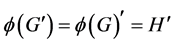 .
.
The actions of the various induced homomorphisms are given by
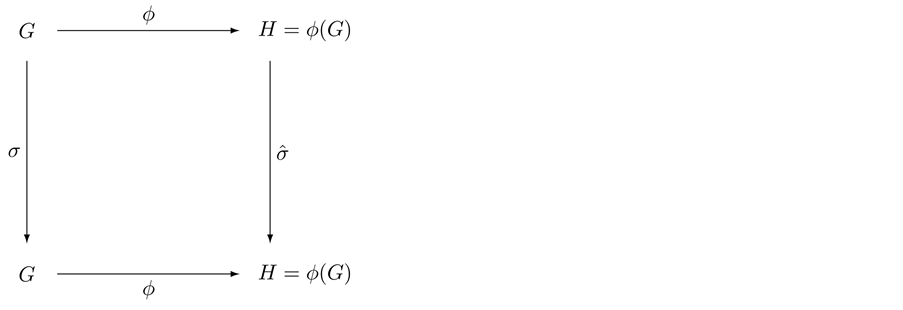
Figure 8. Induced automorphism .
.
 for
for ,
,
 for
for ,
,
 for
for , and
, and
 for
for .
.
Finally, combining all these formulas and expressing  for a suitable
 , we see that
  implies the required relation for
 :
:
 □
□
A.6. Functorial Properties
P 7.6. The mapping  which maps a homomorphism of one category to an induced homomorphism of another category can be viewed as a functor F.
In the special case of induced homomorphisms  between quotient groups, we define the domain of the functor F as the following category
 .
.
The objects of the category are pairs  consisting of a group G and a normal subgroup
 ,
,
 (7.11)
For two objects , the set of morphisms
  consists of homomorphisms
  such that
 , briefly written as arrows
 ,
,
 (7.12)
The functor  from this new category
  to the usual category
  of groups
maps a pair  to the corresponding quotient group
 ,and it maps a morphism
  to the induced homomorphism
  ,
,
 (7.13)
Existence and uniqueness of  have been proved in Theorem 7.1 under the assumption that
 , which is satisfied according to the definition of the arrow
 .
.
The functorial properties, which are visualized in Figure 9, can be expressed in the following form.
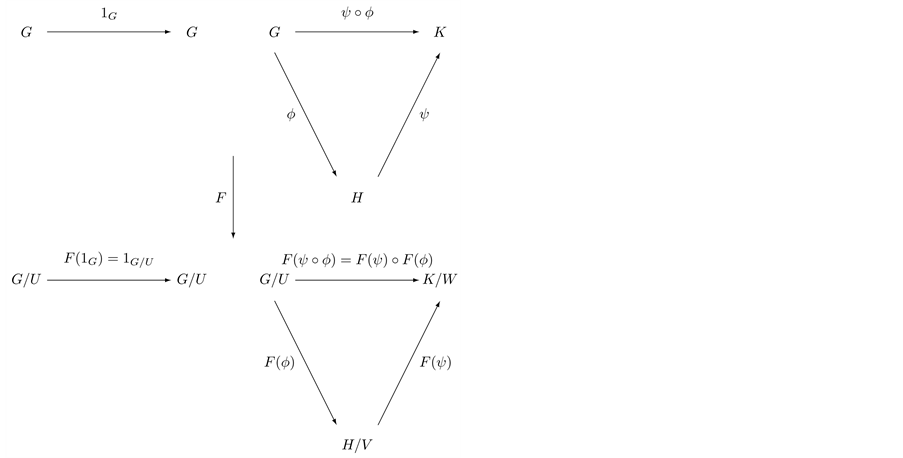
Figure 9. Functorial properties of induced homomorphisms.
Firstly, F maps the identity morphism  having the trivial property
  to the identity homomorphism
 (7.14)
and secondly, F maps the compositum  of two morphisms
 and
and , which obviously enjoys the required property

to the compositum
 (7.15)
of the induced homomorphisms in the same order.
The last fact shows that F is a covariant functor.
NOTES

*Respectfully dedicated to Professor M. F. Newman.