

Advances in Pure Mathematics
Vol.05 No.12(2015), Article ID:60383,6 pages
10.4236/apm.2015.512067
Farey Triangle Graphs and Farey Triangle Matrices
A. Gnanam, C. Dinesh
Department of Mathematics, Government Arts College, Trichy, India
Email: gnaanam@yahoo.com, dinesh.c916@gmail.com
Copyright © 2015 by authors and Scientific Research Publishing Inc.
This work is licensed under the Creative Commons Attribution International License (CC BY).
http://creativecommons.org/licenses/by/4.0/



Received 18 August 2015; accepted 17 October 2015; published 20 October 2015
ABSTRACT
In this paper, we introduce Farey triangle graph , Farey triangle matrix
 , complementary Farey triangle graph
  and complementary Farey triangle matrix
 , and we derive some properties of the following matrices.
Keywords:
Farey Triangle Graph, Farey Triangle Matrix, Complementary Farey Triangle Graph, Complementary Farey Triangle Matrix

1. Introduction
A Farey sequence of order N is a set of irreducible fractions between 0 and 1 arranged in an increasing order, the denominators of which do not exceed N.  could be obtained from
  by calculating the mediant between two successive values from which it was derived. In [1] -[3] Farey graph and Farey matrix have been constructed from Farey sequence of order N. In [4] Farey partition is derived and discussed some matrix property from Farey sequence. In [5] Farey graph is introduced in iterative process. In this paper we construct Farey tri-
angle graph , in iterative process, and it is constructed from the method of mediant property as follows in the Farey sequence. From the co-ordinates of this graph we form a Farey triangle matrix
 . Similarly we construct complementary Farey triangle graph
  and complementary Farey triangle matrix
 .
.
2. Farey Triangle Graph
2.1. Definition: Farey Triangle Graph: 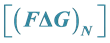
Farey triangle graph of order N is constructed from Farey Sequence. Consider X and Y axes with vertices as Farey Sequnence in . The Farey triangle graph of order N is formed from Farey triangle graph of order
 , iteratively as Farey sequence. In this graph, vertices from X to Y axis is joined only if the vertices (or Farey fractions) are same to obtain a Farey triangle.
2.2. Construction of Farey Triangle Graph
The Farey triangle graph of order 1 begin with vertices  and
and  in both axes. The vertex
  is the ori-
gin of the Farey triangle graph of order 1. In this graph join the vertices when X and Y axes have the same fractions to obtain a Farey triangle.  is constructed from
 . In this graph the vertices are inserted by the method of the mediant between each pair of consecutive fractions in both axes of
 . Si-
. Si-
milarly, we follow the same method to obtain  from
from . The Farey triangle graph
  of order N can be constructed from Farey triangle graph
  by using the Farey sum operation denoted as
 . In
. In  the vertices in X and Y axes are irreducible fractions in Farey sequence of order
 . For each edge in
  introduced in iteration
 ,
,  could be obtained
from  by calculating the mediant between each pair of consecutive fractions in both axes of
 . Some illustrations are presented below: Figures 1-4 denote the Farey triangle graph of different order, from this graph we define Farey triangle matrix.
In the above illustrations, the like coloured lines denote the edges inserted in successive iterations.

Figure 1. Farey triangle graph of order 1.

Figure 2. Farey triangle graph of order 2.

Figure 3. Farey triangle graph of order 3.

Figure 4. Farey triangle graph of order 4.
2.3. Farey Triangle Matrix
Let  be a Farey triangle. The vertices of the triangle are clearly Farey fractions. Let the abscissa be
  and ordinate
 , we obtain

The Farey triangle graph forms a matrix [6] ,

where a and b are the numerator of Farey fractions and c denote the order of the Farey sequence. k denote the number of vertices inserted to move from  to
to .
.
Illustrations
1) Farey triangle matrix of order 2.

2) Farey triangle matrix of order 3
Farey triangle graph of order 3 is derived from Farey triangle graph of order 2. Here two vertices are inserted, so two Farey triangle matrices are constructed.

2.4. Theorem
The sum of the determinants of the Farey triangle matrices of prime order is given by

Proof:
In Farey triangle graph of prime order ,
,  vertices are introduced.
The ordinates ;
;  are connected only if
  and it forms a matrix
 where
where
The sum of the determinant of these matrices is


2.5. Theorem
The sum of Farey triangle matrices of prime order is .
.
Proof:
The Farey triangle matrices of prime order

where .
.


3. Complementary Farey Triangle Graph
3.1. Definition
The complementary Farey triangle graph  of order N is a Farey triangle with edges as the line joining vertices whose numerators are complementary with respect to the order of the graph and it forms complementary Farey triangle.
3.2. Construction of Complementary Farey Triangle Graph
The complementary Farey triangle graph  of order
  can be constructed from complementary Farey triangle graph
 . The vertices are inserted as in Farey triangle graph. In this graph the
vertices are connected if the sum of the numerators of the fractions in each vertices of X and Y axis is equal to the order of the complementary Farey triangle graph. In complementary Farey triangle graph of order 2, we be-
gin with vertices  and
and  in both axes. The vertex
  is the origin of the complementary Farey
triangle graph. In this graph the vertices are inserted by the method of the mediant between each pair of consec-
utive fractions in both axes of . We follow the same method to obtain
  from
from .
.
Figures 5-7 denotes the complementary Farey Triangle Graph of different orders, from this graph we define Complementary Farey Triangle Matrix. Some illustrations are presented below:
3.3. Complementary Farey Triangle Matrix
The vertices of the complementary Farey triangle namely Farey fractions are used to construct this matrix. Let the abscissa be  and ordinate
 . Join these vertices to form a complementary Farey triangle graph and correspondingly complementary Farey triangle matrix as given below.

Figure 5. Complementary Farey triangle graph of order 2.

Figure 6. Complementary Farey triangle graph of order 3.

Figure 7. Complementary Farey triangle graph of order 4.

where a and b are the numerator of Farey fractions and c denote the order of the Farey sequence. k denote the number of vertices inserted to move from  to
to .
.
3.3.1. Illustrations
1) Complementary Farey triangle matrix of order 2.

2) Complementary Farey triangle matrix of order 3

3.3.2. Remark
 .
.
3.4. Theorem
The sum of determinants of the complementary Farey triangle matrices of prime order p is

Proof:
Consider the complementary Farey triangle matrices of prime order.
 ;
;
where 

Cite this paper
A.Gnanam,C.Dinesh, (2015) Farey Triangle Graphs and Farey Triangle Matrices. Advances in Pure Mathematics,05,738-744. doi: 10.4236/apm.2015.512067
References
- 1. Redmond, D. (1996) Number Theory: An Introduction. Marcel Dekker, Inc., New York.
- 2. Gnanam, A., Gopalan, M.A. and Dinesh, C. (2015) Farey Matrix. International Journal of Mathematics Trends and Techonology, 19.
http://dx.doi.org/10.14445/22315373/IJMTT-V19P501 - 3. Hardy, G.H. and Wright, E.M. (1975) An Introduction to the Theory of Numbers. 4th Edition, The Clarendon Press, Oxford.
- 4. Nogueria, A. and Sevennec, B. (2006) Multidimensional Farey Partitions. Indagationes Mathematicae, 17, 437-456.
http://dx.doi.org/10.1016/S0019-3577(06)80043-1 - 5. Zhang, Z.Z., Wu, B. and Lin, Y. (2012) Counting Spanning Trees in a Small-World Farey Graph. Physica A: Statistical Mechanics and Its Applications, 391, 3342-3349.
http://dx.doi.org/10.1016/j.physa.2012.01.039 - 6. Kwak, J.H. and Hong, S. (2010) Linear Algebra. Springer International Edition.