

Advances in Pure Mathematics
Vol.05 No.02(2015), Article ID:53847,10 pages
10.4236/apm.2015.52009
Oscillatory and Asymptotic Behavior of Solutions of Second Order Neutral Delay Difference Equations with “Maxima”
Ramalingam Arul, Manvel Angayarkanni
Department of Mathematics, Kandaswami Kandar’s College, Namakkal, India
Email: drrarul@gmail.com, angayarkanni66@rediffmail.com
Copyright © 2015 by authors and Scientific Research Publishing Inc.
This work is licensed under the Creative Commons Attribution International License (CC BY).
http://creativecommons.org/licenses/by/4.0/



Received 14 January 2015; accepted 2 February 2015; published 6 February 2015
ABSTRACT
In this paper, we study the oscillatory and asymptotic behavior of second order neutral delay difference equation with “maxima” of the form

Examples are given to illustrate the main result.
Keywords:
Second Order, Oscillatory, Asymptotic Behavior, Neutral Delay Difference Equations with “Maxima”

1. Introduction
Consider the oscillatory and asymptotic behavior of second order neutral delay difference equation with “maxima” of the form
 (1)
(1)
where Δ is the forward difference operator defined by  and
and  and
and  is a nonnegative integer subject to the following conditions:
(C1)  and
and  are positive integers;
(C2)  is a ratio of odd positive integers;
(C3)  and
and  are nonnegative real sequences with
  and
and 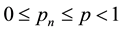 for all
 ;
;
(C4)  is a positive real sequence such that
 .
.
Let . By a solution of Equation (1), we mean a real sequence
  satisfying Equation (1) for all
 . Such a solution is said to be oscillatory if it is neither eventually positive nor eventually negative and nonoscillatory otherwise.
From the review of literature it is well known that there is a lot of results available on the oscillatory and asymptotic behavior of solutions of neutral difference equations, see [1] -[5] , and the references cited therein. But very few results are available in the literature dealing with the oscillatory and asymptotic behavior of solutions of neutral difference equations with “maxima”, see [6] -[9] , and the references cited therein. Therefore, in this paper, we investigate the oscillatory and asymptotic behavior of all solutions of Equation (1). The results obtained in this paper extend that in [4] for equation without “maxima”.
In Section 2, we obtain some sufficient conditions for the oscillation of all solutions of Equation (1). In Section 3, we present some sufficient conditions for the existence of nonoscillatory solutions for the Equation (1) using contraction mapping principle. In Section 4, we present some examples to illustrate the main results.
2. Oscillation Results
In this section, we present some new sufficient conditions for the oscillation of all solutions of Equation (1). Throughout this section we use the following notation without further mention:


and

Lemma 2.1. Let  be an eventually positive solution of Equation (1). Then one of the following holds
(I)  and
and ;
;
(II)  and
and .
.
Proof. Let  be an eventually positive solution of Equation (1). Then we may assume that
 ,
,  for all
 . Then inview of (C3) we have
  for all
 . From the Equation (1), we obtain

Hence  and
and  are of eventually of one sign. This completes the proof.
Lemma 2.2. Let  be an eventually negative solution of Equation (1). Then one of the following holds
(I)  and
and ;
;
(II)  and
and .
.
Proof. The proof is similar to that of Lemma 2.1. 
Lemma 2.3. The sequence  is an eventually negative solution of Equation (1) if and only if
  is an eventually positive solution of the equation

The assertion of Lemma 2.3 can be verified easily.
Lemma 2.4. Let  be an eventually positive solution of Equation (1) and suppose Case (I) of Lemma 2.1 holds. Then there exists
  such that

Proof. From the definition of  and condition (C3), we have
 . Further
  , since
  is nondecreasing. This completes the proof.
Lemma 2.5. Let  be an eventually positive solution of equation (1) and suppose Case (I) of Lemma 2.1 holds. Then there exists
  such that

Proof. Since , we see that

or

The proof is now complete. 
Lemma 2.6. Let  be an eventually positive solution of Equation (1) and suppose Case (II) of Lemma 2.1 holds. Then there exists
  such that
  is nonincreasing for all
 .
.
Proof. Since  and
and  then we have
  for
for . This completes the proof.
Theorem 2.1. Assume that , and there exists a positive integer k such that
 . If for all sufficiently large
  and for all constants
 ,
, . One has
 (2)
(2)
and
 (3)
(3)
then every solution of Equation (1) is oscillatory.
Proof. Assume to the contrary that there exists a nonoscillatory solution  of Equation (1). Without loss of generality we may assume that
  for all
 , where N is chosen so that both the cases of Lemma 2.1 hold for all
 . We shall show that in each case we are led to a contradiction.
Case(I). From Lemma 2.4 and Equation (1), we have

or
 (4)
(4)
Define , then we have

or
 (5)
(5)
Summing the last inequality from  to
to , we have

Letting , we get a contradictions to (2).
Case(II). Define
 (6)
(6)
Then  for
for . Since
  is nonincreasing, we have

Summing the last inequality from  to
to , we obtain

Since  and
and  by letting
 , in the last inequality we obtain

or

or

Thus

So, by  and (6), we have
 (7)
(7)
where . From (6), we obtain

By Mean Value Theorem,

where . Since
  and
and , we have

Therefore,

Since , we have
 (8)
(8)
From Lemma 2.6,  for
for , we have
 (9)
(9)
From (8) and (9), we have
 (10)
(10)
Multiply (10) by  and summing it from
  to
to , we have

Summation by parts formula yields

Using Mean Value Theorem, we obtain

Since , we have

or
 (11)
(11)
Therefore, from (7) and (11), we have

Letting  in the last inequality, we obtain a contradiction to (3). This completes the proof.
Theorem 2.2. Assume that , and there exists a positive integer k such that
 . If for all suffi- ciently large
  and for every constant
 , (2) holds, and
 (12)
(12)
hold, then every solution of equation (1) is oscillatory.
Proof. Proceeding as in the proof of Theorem 2.1, we see that Lemma 2.1 holds for .
.
Case(I). Proceeding as in the proof of Theorem 2.1 (Case(I)) we obtain a contradiction to (12).
Case(II). Proceeding as in the proof of Theorem 2.1 (Case(II)) we obtain (7) and (10). Multiplying (10) by  and summing it from
  to
to  we have

Using the summation by parts formula in the first term of the last inequality and rearranging, we obtain
 (13)
(13)
Inview of (7), we have  as
as  and
and

As  in the last inequality, we obtain a contradiction to (12). This completes the proof.
Theorem 2.3. Assume that , and there exists a positive integer k such that
 . If for all suffi- ciently large
  and for every constant
 , (2) holds, and
 (14)
(14)
then every solution of equation (1) is oscillatory.
Proof. Proceeding as in the proof of Theorem 2.1, we see that Lemma 2.1 holds and Case(I) is eliminated by the condition (2).
Case(II). Proceeding as in the proof of Theorem 2.1 (Case(II)) we have

where . From Equation (1), we have

and
 (15)
(15)
Hence

Summing the last inequality from  to
to , we obtain

Again summing the last inequality from  to
to , we have

Letting  in the above inequality, we obatin

a contradiction to (14). This completes the proof.
Next, we obtain sufficient conditions for the oscillation of all solutions of Equation (1) when .
.
Theorem 2.4. Assume that , and there exists a positive integer k such that
 . If for all sufficiently large
  and for every constant
 , one has
 (16)
(16)
and
 (17)
(17)
then every solution of equation (1) is oscillatory.
Proof. Proceeding as in the proof of Theorem 2.1, we see that Lemma 2.4 holds for .
.
Case(I). Define  by
by

Then  and from Equation (1) and Lemma 2.2, we have
 (18)
(18)
Using Lemma 2.5 in (18), we obtain
 (19)
(19)
From the monotoncity of , we have

and hence
 (20)
(20)
for some constant  for all large n. Using (20) in (19) and then summing the resulting inequality from
  to
to , we have
 (21)
(21)
Letting  in (21), we obtain a contradiction to (16).
Case(II). Define a function  by
by

Then  for
for , we have

Since , and
, and  is negative and decreasing we have

Therefore

Since  is a positive and decreasing, we have
 . Combining the last two inequalities, we have
 (22)
(22)
Now using (15) in (22), we obtain

for some constant . That is

Multiplying the last inequality by , and then summing it from
  to
to , we have

Using the summation by parts formula in the first term of the above inequality and rearranging we obtain

Using completing the square in the las term of the left hand side of the last inequality, we obtain

or

Letting  in the above inequality, we obtain a contradiction to (17). The proof is now complete.
3. Existence of Nonoscillatory Solutions
In this section, we provide sufficient conditions for the existence of nonoscillatory solutions of Equation (1) in case  or
or . Note that in this section we do not require
 .
.
Theorem 3.1. Assume that . If
. If
 (23)
(23)
and
 (24)
(24)
then Equation (1) has a bounded nonoscillatory solution.
Proof. Choose  sufficiently large so that
 (25)
(25)
and
 (26)
(26)
for . Let
. Let  be the set of all bounded real sequences defined for all
  with norm

and let

Define a mapping  by
by

Clearly, T is continuous. Now for every  and
and , (25) implies

Also, from (26) we have

Thus, we have that . Since S is bounded, closed and convex subset of
 , we only need to show that T is contraction mapping on S in order to apply the contraction mapping principle. For
  and
and , we have

By the Mean Value Theorem applied to the function , we see that for any
 , we have
  for all
 . Hence

Thus, T is a contraction mapping, so T has a unique fixed point  such that
 . It is easy to see that
  is a positive solution of Equation (1). This complete the proof of the theorem.
Theorem 3.2. Assume that . If
. If
 (27)
(27)
then Equation (1) has a bounded nonoscillatory solution.
Proof. Choose  sufficiently large so that

Let  be the set of all bounded real sequences defined for all
  with norm

and let

Define a mapping  by
by

It is easy to see that T is continuous,  , and for any
  and
and , we have

By the Mean Value Theorem applied to the function , we see that for any
 , we have
  for all
 . Hence

and we see that T is a contraction on S. Hence, T has a unique fixed point which is clearly a positive solution of Equation (1). This completes the proof of the theorem.
4. Examples
In this section we present some examples to illustrate the main results.
Example 4.1. Consider the difference equations
 (28)
(28)
Here  and
and . Then
 . Choosing
 , we
, we
see that . Further it is easy to verify that all other conditions of Theorem 2.1 are satisfied. Therefore every solution of Equation (28) is oscillatory.
Example 4.2. Consider the difference equations
 (29)
(29)
Here  and
and . Then
  and
and
 . Choosing
 , we see that
 . Further it is easy to verify that all other conditions of Theorem 2.4 are satisfied. Therefore every solution of Equation (29) is oscillatory.
Example 4.3. Consider the difference equations
 (30)
(30)
Here  and
and . By talking
 , we see that all conditions of Theorem 3.1 are satisfied and hence Equation (30) has a bounded nonoscillatory solution.
Example 4.4. Consider the difference equations
 (31)
(31)
Here  and
and . By talking
 , we see that all conditions of Theorem 3.2 are satisfied and hence Equation (31) has a bounded nonoscillatory solution.
References
- Agarwal, R.P. (2000) Difference Equations and Inequalities. 2nd Edition, Marcel Dekker, New York.
- Agarwal, R.P., Bohner, M., Grace, S.R. and O’Regan, D. (2005) Discrete Oscillation Theory. Hindawi Publ. Corp., New York. http://dx.doi.org/10.1155/9789775945198
- Kelley, W.G. and Peterson, A.C. (2001) Difference Equations: An Introduction with Applications. 2nd Edition, Academic Press, New York.
- Thandapani, E. and Selvarangam, S. (2012) Oscillation of Second Emden-Fowler Type Neutral Difference Equations. Dynamics Continous Discrete Impulise System, 19, 453-469.
- Zhang, G. and Geo, Y. (2001) Oscillation Theory for Difference Equations. Publishing House of Higher Education, Beijing.
- Arul, R. and Angayarkanni, M. (2013) Asymptotic Behavior of Second Order Nonlinear Neutral Difference Equations with “Maxima”. Far East Journal of Mathematical Science, 82, 79-92.
- Arul, R. and Angayarkanni, M. (2014) Oscillatory and Asymptotic Behavior of Second Order Neutral Difference Equations with “Maxima”. Journal of Advances in Mathematics, 1916-1924.
- Luo, J.W. and Bainov, D.D. (2001) Oscillatory and Asymptotic Behavior of Second-Order Neutral Difference Equations with “Maxima”. Journal of Computational and Applied Mathematics, 131, 333-341. http://dx.doi.org/10.1016/S0377-0427(00)00264-8
- Luo, J.W. and Petrov, V.A. (1999) Oscillation of Second Order Neutral Difference Equations with “Maxima”. Journal of Mathematical Sciences Research. Hot-Line, 3, 17-22.