
Advances in Pure Mathematics
Vol.04 No.05(2014), Article ID:45620,12 pages
10.4236/apm.2014.45023
Projective Tensor Products of C*-Algebras*
Ajay Kumar, Vandana Rajpal
Department of Mathematics, University of Delhi, Delhi, India
Email: akumar@maths.du.ac.in, vandanarajpal.math@gmail.com
Copyright © 2014 by authors and Scientific Research Publishing Inc.
This work is licensed under the Creative Commons Attribution International License (CC BY).
http://creativecommons.org/licenses/by/4.0/



Received 28 February 2014; revised 28 March 2014; accepted 6 April 2014
ABSTRACT
For
 -algebras
 and
and , the constant involved in the canonical embedding of
 into
into
 is shown to be
 . We also consider the corresponding operator space version of this embedding. Ideal structure of
 is obtained in case
 or
or
 has only finitely many closed ideals.
Keywords:
Banach Space Projective Tensor Norm, Operator Space Projective Tensor Norm

1. Introduction
The systematic study of various tensor norms on the tensor product of Banach spaces was begun with the work of Schatten [1] , which was later studied by Grothendieck in the context of locally convex topological space. One of the most natural and useful tensor norm is the Banach space projective tensor norm. For a pair of arbitrary Banach spaces
 and
and
 and
and
 an element in the algebraic tensor product
 , the Banach space projective tensor norm is defined to be
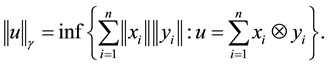
 will denote the completion of
 with respect to this norm. For operator spaces
 and
and , the operator space projective tensor product of
 and
and
 is denoted by
 and is defined to be the completion of
 with respect to the norm:

the infimum taken over
 and all the ways to write
 , where
 ,
,
 ,
,
Kumar and Sinclair defined an embedding
shown that this embedding satisfies
dieck’s theorem for jointly completely bounded (jcb) bilinear forms was obtained by Haagerup and Musat [3] . Using this form for jcb, the canonical embedding for the operator space projective tensor product have been studied by Jain and Kumar [4] , and they showed that the embedding
In Section 2, an alternate approach for the bi-continuity of the canonical embedding of
In the next section, it is shown that if the number of all closed ideals in one of the
ideals of
Section 4 is devoted to the inner automorphisms of
where infimum is taken over all the ways to write
where tion of
2. Isomorphism of Embeddings For Banach spaces
Banach space of nuclear bilinear forms is denoted by
where
Lemma 2.1 For
ticular,
Proof: The inequality of the right hand side follows directly from the definition of Since Now, for each By using
where
Since
Next, we consider the map
Proposition 2.2 For
nuous and Proof: By the above lemma, we have a map
since
Haagerup proved that every bounded bilinear form on
metric map
where
embedding is a bi-continuous map with lower bound
with an alternate proof and an improved lower bound Theorem 2.3 For
Proof: We know that the natural embedding
the Hahn Banach theorem,
where
where
Since
bilinear form
Remark 2.4 (i) Note that, for a
(ii) For a locally compact Hausdorff topological group amenable group is isometric by ([8] , Proposition 4.1). (iii) The natural embedding
where
where
We now discuss the operator space version of the above embedding, which is already discussed in [4] . Note that in this case the embedding is positive, and becomes an isomorphism under the conditions weaker than that required in case of the Banach space projective tensor product. For operator spaces
space structure determined by the identification For
where
Lemma 2.5 For
Proposition 2.6 For
Proof. By ([10] , Theorem 15.3.1) we have
14.3.1) implies that
completely integral operators from
By ([4] , Proposition 2.5), we have a continuous completely isometric map
where
For a matrix ordered space
Theorem 2.7 For
map which satisfies
Proof: Given
On the other hand, Note that, for
and hence the result follows from the separate
Now given an algebraic element
where
Since
The bi-continuity of the map
Remark 2.8 By ([14] , Theorem 2.2), the natural embedding
We now discuss the isomorphism of this embedding. For Proposition 2.9 For
Proof: Suppose that
by ([10] , Theorem 15.1) and ([5] ,
where in
In particular, the map
Now, as in Remark 2.4(iii), we have the following: Corollary 2.10 Let
Remark 2.11 The embedding in the case of the Haagerup tensor product turns out to be completely isometric, which can be seen as below. For operator spaces map
where
where
3. Closed Ideals in
It was shown in ([4] , Theorem 3.8) that if
every closed ideal in
Proposition 3.1 Let
Proof: Since
The following lemma can be proved as a routine modification to the arguments of ([16] , Lemma 1.1). Lemma 3.2 For closed ideals
In order to prove our main result. We first investigate the inverse image of product ideals of
Proposition 3.3 For
Proof: By ([4] , Proposition 3.2) and the Bipolar theorem, it suffices to show that
Let
where
where
Since the annihilator is reverse ordering, so converse is trivial.
Now we are ready to prove the main result. Theorem 3.4 If
Proof. Proof is by induction on Since there are only finitely many closed ideals in
So it is equal to
the closure of
which by using ([18] , Corollary 4.6), ([19] , Proposition 4), and Lemma 3.2, gives that
As in ([17] , Theorem 5.3),
ideal in
Also
where
and Theorem 3.3, We now claim that Let so there exist
containing
4. Inner Automorphisms of
For unital
Proposition 4.1 For unital
Proof: Suppose that
So, for dense in We now characterize the isometric inner automorphism of
Theorem 4.2 For unital
Proof: Suppose that
where
where
that
Now choose
The above inequality implies that Theorem,
However, by ([11] , Theorem 5), for unital
Corollary 4.3 For an infinite dimensional separable Hilbert space We now give an equivalent form of Proposition 4.1 in case of operator algebras. For operator algebras
Proposition 4.4 For operator spaces
Proof: For for
strongly independence of
where
Corollary 4.5 For operator algebras
Proof: By the functoriality of the Haagerup tensor product, the map
tely contractive. One can see that
vergent representation in
to that
This shows that the partial sums of
By the above corollary, for operator algebras
In the following, by a
Corollary 4.6 For
Proof: Using ([23] , Proposition 2.5.5), we have for all it admits a faithful
faithful so
Corollary 4.7 For any operator algebra
The following can be proved on the similar lines as those in ([21] , Lemma 2) by using ([23] , Proposition 2.5.4), so we skip the proof. Lemma 4.8 For unital Banach
Theorem 4.9 Let
Proof: Let
References NOTES
*2010 Mathematics Subject Classification. Primary 46L06, Secondary 46L07, 47L25. and
and
 and
and .
. from
from
 into
into , and using the non-com- mutative version of Grothendieck’s theorem to the setting of bounded bilinear forms on
 -algebras, it was
 ([2] , Theorem 5.1). Recently, analogue of Grothen-
 from
from
 into
into
 satisfies
 .
. into
into
 has been presented with an improved constant. Our proof essentially uses the fact that the dual of the Banach space projective tensor norm is the Banach space injective tensor norm. We also consider the corresponding operator space version of this embedding and discuss its isomorphism. As a consequence, one can obtain the equivalence between the Haagerup tensor norm and the Banach space projective tensor norm (resp. operator space projective tensor norm).
 -algebras is finite then every closed ideal of
 is a finite sum of product ideals. One can obtain all the closed ideals of
 as
as ,
,
 and
and , and the closed
 as
as , where
 or
or ,
, for each
 , for an infinite dimensional separable Hilbert space
 and locally compact Hausdorff topological space
 . Similarly, the closed ideal structure of
 , where
 is any
 -algebra and
 is the multiplier algebra of
 ,
,
 being a nonunital, non-element- ary, separable, simple AF
 -algebra, can be obtained. We may point that such result fails for
 , the minimal tensor product of
 -algebras
 and
and .
. and
and
 for
for
 -algebras as well as for operator algebras. Recall that the Haagerup norm on the algebraic tensor product of two operator spaces
 and
and
 is defined, for
 , by
, by

 . The Haagerup tensor product
 is defined to be the comple-
 in the norm
 [5] .
[5] . and
and
 and
and ,
,
 , define a linear map
 as
as , for
, for
 and
and . Using ([6] , Proposition 1.2), it is easy to see that
 is well defined. Also, clearly this map is linear and contractive with respect to
 , and in fact
 , and hence can be extended to
 with
with . A bilinear form
 in
in
 is called nuclear if
 , and the nuclear norm of
 is defined to be
 . The
. The . For
. For
 -algebras
 and
and , consider the canonical map
 from
from
 into
into , the dual of the Banach space injective tensor product of
 and
and , defined by
 is the natural isometry of
 into
into ,
,
 is as above with
 and
and ,
,
 is the natural inclusion of
 into
into , the space of integral bilinear forms.
 -algebras
 and
and , the canonical map
 the space of integral operators from
 to
to
 satisfies
 for all
 . In par-
 is bi-continuous.
 . Let
. Let
 and
and . By the Hahn Banach Theorem, there exists
 with
with
 such that
 .
. , so
, so , for some
 , for all
 and
and
 with
with . By ([7] , Proposition 2.1(2)), there is a net
 of finite rank operators from
 to
to
 such that
 and
and
 for any
 .
. , corresponding to
 we can associate
 . For
. For , there is
 such that
 for all
 . Thus
 . Since
 is a finite rank operator, so let
 . Choose an Auerbach basis
 for
for
 with associated coordinate functionals
 in
in . Thus, for any
 ,
,
 ,
,
 for
for .
. , it follows that
 ,
,
 for
for . Therefore, for any
 and
and ,
,
 is the canonical isometric map from
 to
to . Thus
 and so
 . Moreover, for
 , we have
 is arbitrary, so
 .
.

 defined by
 .
. -algebras
 and
and , the natural map
 is bi-conti-
 , for all
 .
. with
with
 for all
 . Also, ([6] , Proposition 3.21) shows that the natural inclusion map
 is isometric. We will show that
 . For
. For ,
,
 ,
,
 and
and ,
, ,
, for
for . Thus
 . Therefore, by linearity and continuity,
 , and hence the map
 satisfies
 for all
 .
.

 can be extended uniquely to a separately normal norm preserving bounded bilinear form on
 ([7] , Corollary 2.4), so we have a continuous iso-
 . Set
. Set
 is the natural embedding of
 into
into . Kumar and Sinclair proved that this
 ([2] , Theorem 5.1). We re-establish its bi-continuity
 .
. -algebras
 and
and , the natural embedding
 satisfies
 for all
 .
. is isometric. Thus, by
 is a quotient map. We will show that
 is as in Proposition 2.2. Since
 and
and
 are linear and continuous, it suffices to show that
 and
and
 agree on
 . Note that, for
 ,
,
 ,
,
 and
and ,
,
 is the bilinear form corresponding to
 .
. and
and
 so, by Goldstine’s Lemma, there are nets
 and
and
 such that
 converges to
 in
in
 and
and
 converges to
 in
in . The separate
 -continuity of the
 and the equality
 shows that
 . Thus,
 . Hence, by Proposition 2.2, we deduce that
 .
.

 -algebra
 having Completely positive approximation property, the canonical embedding of
 into
into
 is isometric by ([8] , Theorem 3.6) and ([9] , Theorem 3.6). However, for the largest Banach space tensor norm, the embedding
 is isometic if one of the
 -algebra has the metric approximation property, which follows directly by using ([6] , Theorem 4.14) in the above theorem.
 , let
, let
 and
and
 be the group
 - algebra and the reduced group
 -algebra of
 , respectively. Then, for any
 -algebra
 and a discrete
 , the natural embedding of
 into
into
 is isometric by ([8] , Theorem 4.2); and for any amenable group
 , the natural embedding of
 into
into

 is isomorphism if
 has the approximation property,
 has the Radon Nikodym property and every bilinear form on
 is nuclear. This follows directly by observing that if
 has the Radon Nikodym property then ([6] , Theorem 5.32) gives us
 and
and
 denote the Pietsch integral and nuclear operators from
 to
to , respectively [6] . Clearly, bijectivity follows if we show that
 is an onto map. For this, let
 so it is nuclear. Since
 has the approximation property, so there exists an element
 such that
 is an isometric isomorphism from
 to
to
 ([6] , Corollary 4.8). Consider the canonical map
 . Of course
 on
on , and hence by linearity and con- tinuity
 .
. and
and , an operator from
 into
into
 is called completely nuclear if it lies in the image of the map
 [10] . The space of completely nuclear operators will be denoted by
 . This space has the natural operator
 .
. -algebras
 and
and , consider the map
 from
from
 into the dual of operator space injective tensor product
 given by
 is the natural completely isometric map,
 and
and
 [10] . Making use of the fact that the dual of the operator space projective tensor norm is the operator space injective ([10] , Proposition 8.1.2) and an application of Grothendieck’s theorem for jcb ([11] , Proposition 1) and the techniques of Lemma 2.1, we obtain the following:
 -algebras
 and
and , the canonical map
 satisfies
 for all
 . In particular,
 is bi-continuous.
 -algebras
 and
and , the natural map
 , defined by
 , is bi-continuous satisfying
 for all
 .
. is locally reflexive operator space. Therefore, ([10] , Theorem
 can be identified with
 , where
 denotes the space of
 to
to . Now, the result follows by using the techniques of Proposition 2.2 and ([10] , Proposition 15.4.4).
 . Let
. Let
 is the natural embedding of
 into
into . Then clearly
 .
. and its dual space
 , we define
 -operation on
 by
by ,
,
 and
and . Note that, for
 -algebras
 and
and ,
,
 is a Banach
 -algebra ([12] , Proposition 3).
 -algebras
 and
and , the natural embedding
 is
is
 -preserving positive bounded
 for all
 .
. ,
,
 ,
,
 ,
,
 and
and ,
,
 . So in order to prove that
 is
is
 - preserving, we have to show that
 .
. and
and ,
,
 ,
, -continuity of the bilinear forms corresponding to
 and
and .
. , where
 is defined as in [13] . For the positivity of
 , we have to show that
 for
for . By ([13] , Theorem 1.9), it suffices to show that if
 then
then
 for all
 ,
,
 and
and
 for all
 ,
, .
. is
is
 -dense in
 , so given
 we obtain a net
 which is
 -convergent to
 . Now note that
 . Hence the result follows.
 follows as in Theorem 2.3.

 is completely isometric if one of the
 -algebras has the
 MAP.
MAP. , the map
 , for
, for
 and
and , has a unique continuous extension to a map
 , with
 . The next proposition does not have counterpart in the Banach space context.
 -algebras
 and
and , the family
 is total on
 .
. such that
 for all
 . Let
. Let
 with
with . Since
 , so
, so
 for some
 , for all
 and
and , with
 . If
. If
 is taken in the universal representation of
 then
then
 satisfies the

 1.4.10). So there exists a net
 of finite rank
 -continuous mapping from
 to
to
 such that
 , and
, and
 for all
 . Thus for
 and
and , there exists
 such that
 for all
 . Since
 , we have
 such that
 . Since
 is a finite rank operator so, as in Lemma 2.1,
 for
for
 and
and . Thus, for
 ,
,
 ,
,
 , and
, and , a norm convergent representation
 [10] ,
 . Given
 for all
 . Therefore,
 for any
 . Thus
 , giving that
 for all
 , and hence
 .
.

 defined above is 1-1. Thus
 .
. and
and
 be
be
 -algebras such that every completely bounded operator from
 to
to
 is completely nuclear and the map
 defined in the Proposition 2.6 is onto. Then the natural embedding
 is an isomorphism map.
 ,
,
 , using the fact that
 and ([5] ,
 1.6.7), the
 is completely isometric. Set
 . Then, clearly
 . By the self-duality of the Haagerup norm, the map
 is completely isometric. As in Theorem 2.3,
 ,
, is the completely isometric map from
 to
to , which further gives
 for any
 . Thus
 is completely isometric.
 or
or
 is a simple
 -algebra then every closed ideal of
 is the product ideal, i.e. of the form
 or
or
 for closed ideal
 of
of
 and
and
 of
of . In the following, we generalize this result to the
 -algebra which has only a finite number of closed ideals. More precisely, it is shown that if one of the
 -algebras
 and
and
 has only finitely many closed ideals, then
 is precisely of the form
 , for some
 and closed ideals
 in
in ,
,
 in
in ,
, . Thus obtaining the complete lattice of closed ideals of
 ,
,
 ,
,
 , where
 is an infinite dimensional separable Hilbert space,
 is a locally compact Hausdorff space,
 is any
 -algebra and
 is the multiplier algebra of
 ,
,
 being a nonunital, non-elementary, separable, simple AF
 -algebra ([15] , Theorem 2). We would like to remark that in [4] the lattice of closed ideals of
 has already been explored.
 and
and
 be
be
 -algebras and
 a closed ideal in
 . If
. If , the closure of
 in
in , then
 , where
 is the natural map from
 into
into .
. so there exists a sequence
 such that
 as
as
 tends to infinity. Consider the identity map
 and
and . Of course,
 on
on , and hence by continuity
 . Thus
 and so
 by ([12] , Theorem 6).

 of
of
 and
and
 of
of ,
, .
. for
for
 -algebras
 and
and , which is largely based on the ideas of ([10] , Proposition 7.1.7)
 -algebras
 , and
, and
 and the complete quotient maps
 ,
, . Let
. Let
 and
and
 be closed ideals in
 and
and , respectively. Then

 then
then
 and
and
 . Since
 , so
, so
 for some
 , for all
 and
and . Define a bilinear map
 as
as
 and
and . Clearly,
 is well defined. Note that, for
 ,
,
 and
and , we have
 . For any
 , there are
 and
and
 with
with ,
,
 such that
 . We can find
 such that
 ,
, . By defini- tion, we may write
 and
and
 ,
,
 both have norm
 1. Thus
 , and so
 . This shows that
 is jcb bilinear form. Thus it will determine a
 . We have
 for all
 and
and . This implies that
 on
on , and so by continuity
 . Now let
 . We may assume that
 . Then
 and
and . So
. So
 with
with ,
,
 and
and ,
,
 [10] . Since
 and
and
 are complete quotient maps and
 , so it follows that
 . Hence

 and
and
 are
are
 -algebras such that number of closed ideals in
 is finite. Then every closed ideal in
 is a finite sum of product ideals.
 , the number of closed ideals in
 counting both
 and
and . If
. If
 then the result follows directly by ([4] , Theorem 3.8). Suppose that the result is true for all
 - algebras with
 . Let
. Let
 be a
be a
 -algebra with
 .
. so there exists a minimal non-zero closed ideal, say
 , which is simple by definition. Let
 be a closed ideal in
 then
then
 is a closed ideal in
 .
. for some closed ideal
 in
in
 by ([4] , Theorem 3.8). Consider the closed ideal
 ,
, in
in , where
 is an injective map ([11] , Theorem 1). Then
 for some closed ideal
 in
in
 by ([17] , Proposition 5.2). We first show that
 . Since the map
 is injective so
 . Thus
 ,
, and so
 . To see the equality, let
 . Take any
 then
then
 so it belongs to
 by Proposi- tion 3.1. Thus
 . Hence
 .
. for
for . Thus
 by Lemma 3.2. Since
 cannot contain
 , so
, so . Thus
 , which is a closed
 , is a finite sum of product ideals by induction hypothesis. Let
 then clearly
 contains
 . Corresponding to the complete quotient map
 , we have a quotient map
 with kernel
 and
and
 is a closed ideal of
 ([19] , Lemma 2).
 and so by the induction hypothesis
 and
and
 are closed ideals in
 and
and , for
, for , respectively. Thus, by ([19] , Lemma 2)
 . So
. So
 is a finite sum of product ideal and hence closed by ([4] , Proposition 3.2).
 .
. . Since the closed ideal
 has a bounded approximate identity
 such that
 and
and
 belongs to the least closed ideal of

 ([20] ,
 11, Corollary 11). This implies that
 so
so . Hence
 . Therefore
 is a finite sum of product ideals.
 -algebras
 and
and , isometric automorphism of
 is either of the form
 or
or , where
 ,
,
 ,
,
 and
and
 are isometric isomorphisms ([11] , Theorem 4). In the following, we characterize the isometric inner
 -automorphisms of
 completely.
 -algebras
 and
and , the map

 is inner automorphism of
 (resp.
 ) if and only if
 is inner automorphism of
 and
and
 is inner automorphism of
 .
. is implemented by
 . We will show that
 is implemented by
 , where
 is
is
 -homomorphism from
 into
into
 [11] . It is easy to see that
 .
. ,
, . As
. As
 is
is
 -
- , so
, so
 is implemented by
 . Hence the result follows from ([21] , Theorem 1). Converse is trivial.

 for
for
 -algebras
 and
and
 other than
 .
. -algebras
 and
and
 other than
 for some
 , the isometric inner
 - automorphism of
 is of the form
 , where
 and
and
 are inner
 -automorphisms of
 and
and , respectively.
 is the isometric inner
 -automorphism of
 . So
. So
 and
and
 are
are
 -automorphisms of
 and
and , respectively or
 and
and
 are
are
 -isomorphisms,
 is a flip map [11] . In view of Proposition 4.1, it suffices to show that the second case will never arise for
 -algebras
 and
and
 other than
 . Let
. Let
 be a proper closed ideal in
 and
and , which is a closed ideal in
 by ([12] , Theorem 5). Since
 is inner so it preserves
 . Thus, for any
 ,
, . Therefore
 [19] , which further gives that
 . Hence
 and so
 is simple. Similarly, one can show that
 is simple. By hypothesis there exists
 which implements
 so
so for all
 and
and . Choose
 such that
 ,
,
 , and
, and . Thus, for
 and
and , we have
 , hence
 .
. such that
 . Therefore,
 for all
 . Take any
 ,
,
 being an isomorphism, there exists a unique
 such that
 . Thus
 for any
 . Now define a finite dimensional subspace
 of
of
 by
by
 , where
 is the closed ball center at
 and radius
 . If
. If
 is proper then Riesz Lemma implies that for
 there exists
 such that
 and
and . Since
 for any
 , so we can choose
 such that
 , and, because
 , a contradiction arises. Therefore,
 . Thus, by the classical Wedderburn-Artin
 for some
 . Similarly,
 for some
 .
.

 -algebras
 and
and
 with at least one being non-commutative, isometric inner automorphism of
 is of the form
 , where
 and
and
 are inner automorphisms of
 and of
 , respec- tively.
 , every inner automorphism of
 is of the form
 , where
 and
and
 are inner automorphisms of
 .
. and
and , we do not know if
 (or
(or ) is inner then
 and
and
 are inner or not. However, if one of the automorphism is an identity map then we have an affirmative answer for the Haagerup tensor product. In order to prove this, we need the following results.
 and
and , the family

 is total on
 .
. , assume that
 for all
 . We can assume that
 . Therefore,
 a norm convergent representation in
 , where
 and
and
 are strongly independent with
 and
and . Then we have
 for all
 . From the
 , choose linear functionals
 such that
 are the standard basis for
 by the equivalent form of ([17] , Lemma 2.2). Thus
 and so
 . Because
 was arbitrary, we conclude that
 for each
 , hence
 .
. and
and , if
, if
 and
and
 are completely contractive automorphisms of
 and
and , respectively. Then
 is a completely contractive automorphism of
 .
. is comple-
 is an algebra homomorphism. Let
 be a norm con-
 . Since
 and
and
 are bijective maps, so there exist unique
 and
and , for each
 , such that
 . By [22] , there is a new norm on
 and
and
 with respect
 and
and
 become a new operator algebras, say
 and
and , and the natural maps
 from
from
 to
to ,
,
 from
from
 to
to
 and their inverses are completely bounded, and the maps
 and
and
 are completely isometric. Therefore,
 is completely isometric, so for all positive integers


 form a Cauchy sequence in
 , and so we may define an element
 . Then, clearly
 . Thus the map
 is onto. To prove the injectivity of the map
 , let
, let
 for
for . Then, for
 a norm con- vergent representation in
 , we have
 . Thus, for any
 ,
, . But
. But
 is one-to-one, so
 . Now Proposition 4.4 yields that
 . Again by applying the same technique we obtain
 .
.

 and
and
 and automorphisms
 of
of
 and
and
 of
of , it is clear that if
 and
and
 are inner then
 is.
is. -reduced operator algebra we mean an operator algebra having isometric involution with respect to which it is
 -reduced, and for any
 -reduced operator algebra
 having approximate identity, we denote by
 the set of all pure states of
 .
. -reduced operator algebra
 having approximate identity and any operator algebra
 , the family
 is total on
 .
. , where
 is the set of continuous positive forms on
 of norm less than equal to 1. Therefore, if
 for all
 then
then

 . Thus
 for any
 and
and . Since the algebra
 is
is
 -reduced, so
 -representation, say
 , on some Hilbert space, say
 . For a fix
 in the closed unit ball of
 , define
 as
as
 for
for . One can easily verify that
 . As
. As
 is
is is one-to-one. Therefore,
 for any
 and hence the result follows from Proposition 4.4.

 and
and
 -reduced operator algebra
 having approximate identity, the family
 is total on
 .
. -algebra
 and any Banach algebra
 and a pure state
 of
of , we have
 for
for
 and
and
 (Similarly, for any Banach algebra
 and unital Banach
 -algebra
 ,
,
 for
for
 and
and ,
, ).
). and
and
 be unital operator algebras. Suppose that
 is
is
 -reduced and
 has a completely contractive outer automorphism. Then
 has a completely contractive outer automorphism.
 be a completely contractive outer automorphism. Define a map
 from
from
 into
into as
as . By Corollary 4.5,
 is a completely contractive automorphism of
 . Assume that
 is a inner automorphism implemented by
 . Then
 . As
. As
 so we can find the pure state
 on
on
 such that
 by Corollary 4.7. Let
 . Note that for any
 we have
 . This implies that
 , the relative commutant of
 in
in , which is
 by ([18] , Corollary 4.7). For
 ,
, by the module property of the slice map. Since
 is invertible, so
 is invertible by Lemma 4.8. Therefore,
 and hence
 is inner, a contradiction. Thus
 is an outer automorphism.

