

Journal of Mathematical Finance
Vol.05 No.02(2015), Article ID:55496,2 pages
10.4236/jmf.2015.52010
On Historical Value at Risk under Distribution Uncertainty
Atsushi Iizuka1, Yumiharu Nakano2
1Informatix Inc., Kanagawa, Japan
2Tokyo Institute of Technology, Tokyo, Japan
Email: senkonoshine@yahoo.co.jp, nakano.y.ai@m.titech.ac.jp
Copyright © 2015 by authors and Scientific Research Publishing Inc.
This work is licensed under the Creative Commons Attribution International License (CC BY).
http://creativecommons.org/licenses/by/4.0/


Received 11 February 2015; accepted 7 April 2015; published 10 April 2015
ABSTRACT
We investigate the asymptotics of the historical value-at-risk under capacities defined by sublinear expectations. By generalizing Glivenko-Cantelli lemma, we show that the historical value-at- risk eventually lies between the upper and lower value-at-risks quasi surely.
Keywords:
Value-at-Risk, Sublinear Expectation, Capacities, Glivenko-Cantelli Lemma

1. Introduction
In financial industry, the value-at-risk has been one of main tools for risk management (see, e.g., McNeil et al. [1] , and Föllmer and Schied [2] ). In this framework, the random variables for assets or asset returns are assumed to have distributions without uncertainty. In other words, it is implicitly assumed that there are true asset distributions and the estimation difficulty comes from our limited capability. However, it should be remarked that there is a possibility that the assets have the distribution uncertainty, i.e., the assets may have Knightian uncertainty (see Knight [3] ).
To capture the distribution uncertainty, the theory of sublinear expectation is introduced and developed (see Peng [4] [5] and the references therein). In this theory, the term probability is replaced by the ones of the upper and lower capacities induced by the upper and lower expectations, respectively, and the distribution uncertainty is described by the gap between the upper and lower expectations.
In this paper, we consider the value-at-risk type risk measure under the sublinear expectation, where the reference probability measure in the classical framework is replaced by the upper and lower capacities. We call these the upper and lower value-at-risk, respectively. Our aim is to study the asymptotic behavior of the historical value-at-risk under uncertainty. In doing so, we prove a generalization of Glivenko-Cantelli lemma under uncertainty, and then show that the historical value-at-risk eventually lies in between the upper and lower value- at-risks quasi surely.
This paper is organized as follows: In Section 2, we recall the theory of sublinear expectation. Section 3 is devoted to the statement of the main results and its proofs.
2. Sublinear Expectation and Capacities
In this section, we recall the basis of the sublinear expectation, introduced by Peng [4] . Let Ω be a given set and  a linear space of
  -valued functions on Ω. We assume that
 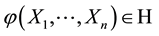 whenever
  and
and  is a bounded function on
  or
or  where
where  denotes the linear space of functions
  on
on  satisfying

for some  and
and  depending on
 . We call an element in
  a random variable.
We consider a sublinear expectation , in the sense of [4] . Namely, E is assumed to be satisfy the following conditions: for any
 ,
,
1) Monotonicity: if  then
then .
.
2) Constant preserving:  for
for .
.
3) Subadditivity: .
.
4) Positive homogeneity:  for
for .
.
Moreover, we assume that  for
for  with
with  for each
 . Then, by Theorem 2.1 and Remark 2.2 in [5] , there exists a set
  of probability measures on
  such that

where  denotes the linear expectation with respect to
 . Then, the
  -valued set functions

define capacities, where 1A denotes the indicator function of a set A. That is, each  satisfies the following:
1) ,
, .
.
2) If  satisfy
  then
then .
.
We refer to Denenberg [6] for the theory of capacities. Throughout this paper, we assume that each  satisfies the following:
3) If  satisfies
 , then
 .
.
4) If  satisfies
 , then
 .
.
Let us recall several concepts in the sublinear expectation theory. The random variable  is said to be independent of
 , where
 ,
,  , if
, if

We say that  and
and  have the same distribution if

A sequence  is called the one of independent, identically distributed random variables if
  and
and  have the same distribution, and if
  is independent of
  for any
 . As in the linear case, we call a sequence of independent, identically distributed random variables an IID sequence. We say that the distribution of X has an uncertainty if
  is nonlinear in
 . In particular, set

Then if , then we say that X has the mean uncertainty. Similarly, X is said to have the volatility or variance uncertainty if
 .
.
3. Main Resutls
For any , we define the functions
  by
by
 (1)
(1)
Proposition 3.1 Let  and let
  and
and  be as in (1). Then each
  satisfies the following:
1)  for
for  with
with .
.
2) ,
, .
.
3)  for
for .
.
Proof. The assertion (1) follows from the monotonicity of  and
and .
.
To prove (2), take  and set
 . We will see
  for any sequence
  with
with . By setting
  we have
  and
and  . It follows from the definition of the capacity that

Similarly,  follows.
Finally, by an argument similar to the proof of (2) with , we can show
  for any sequence
  with
with , implying (3). □
The proposition above justifies the following definition:
Definition 3.2 For a random variable X, we call the function  and
and  as in (1) the upper and lower cumulative distribution functions of X, respectively.
For an IID sequence , the empirical distribution function
  of
of  is defined by

If  satisfies
  for some
 , then by Strong law of large number under sublinear expectation (see Theorem 1 in Chen [7] ),
 (2)
(2)
Indeed,


We show a stronger result, which is a generalization of Glivenko-Cantelli lemma.
Theorem 3.3 Let  be an IID sequence with
  for some
 . Denote by
  and
and 
the upper and lower cumulative distribution functions of X respectively, and denote by  the empirical disribution function of
 . Then,

We need the following lemma for the proof of the theorem.
Lemma 3.4 Under the assumtions imposed in Theorem 3.3, for , there exist
  and
and
 such that
  and
and

where ,
,  , for each
 .
.
Proof. Let . Then there exists
  such that
 . Starting with
 , we recursively define
  by
by

By this recursion, we can find  such that
  or
or  hold, and set
 . With this sequence, the lemma follows. □
With the help of Lemma 3.4, we can show Theorem 3.3.
Proof of Theorem 3.3. Let  be fixed. By Lemma 3.4, there exists a partion of
  such that
  and
and
 (3)
(3)
By (2), we have,  for any
 , where

Thus,  for any
  and so
  for any
 . Hence
 ,
,
where for 

So we have

Now, for any  there exists j such that
 . Thus, by (3),


so

Therefore, on , letting
  we get
  and
and  for all
 . Thus

If we write  for the event inside the brace above and denote
 , then by the continuity of the capacity

meaning the assertion of the theorem. □
Recall that for a function  satisfying (1)-(3) in Proposition 3.1 and for
 , the
, the  - quantile
  of F is defined by

Then we have the following:
Theorem 3.5 Let  be an IID sequence with
  for some
 . Denote by
  and
and  the upper and lower cumulative distribution functions of X respectively, and denote by
  the empirical disribution function of
 . Consider the upper, lower, and historical value-at-risk defined respectively by

Suppose that for 
 (4)
(4)
Then, the historical value-at-risk eventually lies in between the upper and lower value-at-risk, i.e.,

Proof. Consider the event A defined by

In view of Theorem 3.3, it suffices to show that for a given  and
and  there exists
  such that
 (5)
(5)
To this end, fix  and set
 ,
, . By the definition of the infimum and the condition (4),

Thus we can take  such that

Next, take  such that

and set . Then,

So we have . Similarly, we see

leading to . Thus (5) follows. □
References
- McNeil, A. J., Frey, R. and Embrechts, P. (2005) Quantitative Risk Management: Concepts, Techniques and Tools. Princeton University Press, Princeton.
- Föllmer, H. and Schied, A. (2004) Stochastic Finance: An Introduction in Discrete Time. 2nd Edition, Walter de Gruyter, Berlin. http://dx.doi.org/10.1515/9783110212075
- Knight, F.H. (1921) Risk, Uncertainty, and Profit. Houghton Mifflin, Boston.
- Peng, S. (2006) G-Expectation, G-Brownian Motion and Related Stochastic Calculus of Itô’s type, In: Benth, F.E., et al., Eds., Stochastic Analysis and Applications: The Abel Symposium 2005, Springer-Verlag, Berlin, 541-567.
- Peng, S. (2010) Nonlinear Expectations and Stochastic Calculus under Uncertainty. arXiv:1002.4546[math.PR]
- Denneberg, D. (1994) Non-Additive Measure and Integral. Kluwer Academic Publishers, Dordrecht. http://dx.doi.org/10.1007/978-94-017-2434-0
- Chen, Z. (2010) Strong Laws of Large Numbers for Capacities. arXiv:1006.0749[math.PR]