

Advances in Pure Mathematics
Vol.04 No.09(2014), Article ID:49455,6 pages
10.4236/apm.2014.49057
Notes on the Variety of Ternary Algebras
Aldo V. Figallo1, Claudia M. Gomes1, Lucía S. Sarmiento2, Mario E. Videla2
1Instituto de Ciencias Básicas, Universidad Nacional de San Juan, San Juan, Argentina
2Departamento de Matemática, Universidad Nacional de San Juan, San Juan, Argentina
Email: avfigallo@gmail.com, gomescostela@gmail.com, lussarmiento@gmail.com, maredvid@gmail.com
Copyright © 2014 by authors and Scientific Research Publishing Inc.
This work is licensed under the Creative Commons Attribution International License (CC BY).
http://creativecommons.org/licenses/by/4.0/



Received 5 July 2014; revised 3 August 2014; accepted 12 August 2014
ABSTRACT
In this work we review the class  of ternary algebras introduced by J. A. Brzozowski and C. J. Serger in [1] . We determine properties of the congruence lattice of a ternary algebra A. The most important result refers to the construction of the free ternary algebra on a poset. In particular, we describe the poset of the join irreducible elements of the free ternary algebra with two free generators.
Keywords:
De Morgan Algebra, Free Algebra, Congruence, Variety

1. Introduction and Preliminaries
Different algebras began to be used in the thirties as a tool for the analysis and design of digital circuits. One of the pioneers in this field was C. E. Shannon, who in 1938 applied Boolean algebras in his work “ Symbolic Analysis of Change and Retransmission circuits”. Even though technology has changed substantially, these algebras still play a very important role in this field. In contrast, the use of ternary algebras has been much more limited, and the first applications of trivaluada logic to switching circuits were made by Goto in 1948. He worked with the algebra
 , of type
 , where
 ,
,  ,
, . He interpreted
  as an indefinite value, and used it to represent a transition state between 0 and 1. In addition, by means of the resolution of trivalued logic equations, he managed to derive the necessary conditions to prevent hazardous behavior in sequential relay contact networks. In 1959, Muller worked with this same ternary algebra, and applied it to the study of the transient phenomena in switching circuits, and observed, among other things, that it satisfies Kleene’s law:
 .
.
In 1964, Yoeli and Rinon applied them to the study of static hazards in combinational switching circuits. In 1965, Eichelberger used them in the analysis of hazard phenomena in combinational and sequential switching circuits.
In 1983, Mukaidono studied a special class of ternary functions, the regular ones, and indicated a set of axioms to define a ternary algebra, calling the resulting algebra Kleene algebra with a centre. However, it was not until 1995 that Brozozowski and Serger presented them as a De Morgan algebra with an additional constant,  , which satisfies these identities:
1) ,
,
2) .
.
The same year Negulescu introduced the process spaces, a formalism which allows the modelling of the behaviour of interacting systems.
In 1996, Brozozowski, Lou and Negulescu considered certain subalgebras of the process spaces, i.e. the subset-pair algebras, and showed that each finite ternary algebra is isomorphic to a subset-pair algebra. In 1997, Esik showed that this property is valid for any ternary algebra and that, in general, each ternary algebra is isomorphic to an algebra of ternary functions, this result being analogous to Caley’s representation for Boolean algebras.
This class of algebras is applied in the detection of hazards in the combinational circuits, in the modelling of interacting systems by means of process spaces and in the analysis of asynchronous sequential circuits by means of Eichelberger’s method of ternary simulation, among other applications.
This article is organized as follows. Firstly, we summarize the main definitions and necessary results for a better comprehension of the article. In Section 2, we characterize the subdirectly irreducible algebras, examine the congruence lattice of a ternary algebra and establish properties of the variety . Finally, in Section 4, we indicate a construction of the free ternary algebra on a poset, and apply it to the free ternary algebra on one free generator and describe the poset of the join irreducible elements of the free ternary algebra on two free generators.
Definition 1.1 A ternary algebra is an algebra  of type
 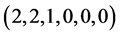 which satisfies these conditions:
(T1)  is a De Morgan algebra,
(T2)  for all
 ,
,
(T3) .
.
This class of algebras forms a variety which will be denoted by .
.
The following properties are satisfied on :
:
(T4)  for all
 .
.
(T5)  for all
 .
.
(T6) In each ternary algebra the only element that satisfies the condition  is
is .
.
(T7) Every finite ternary algebra has an odd number of elements.
(T8) There exist, up to isomorphism, one ternary algebra with five elements, two with seven, and four with nine.
(T9) For each odd natural number , there exists at least one ternary algebra with
  elements.
Clearly, (T4) is the dual property of (T2) while (T5) is equivalent to (T2).
Two well known examples of ternary algebras, of significant importance for the rest of this work, are:
Example 1.1
1) T0 is the ternary algebra , where
 ,
,  ,
, 
 and
and .
.
2) For each odd integer  is the ternary algebra
 , where
 ,
,
 .
.
2. The Congruence Lattice and Subdirectly Irreducible Algebras
In order to characterize the subdirectly irreducible ternary algebras we first observe that the ternary algebras arises from Kleene algebras endowed with a nullary operation.
Definition 2.1 A Kleene algebra  is a De Morgan algebra which satisfies the property
 for every
 .
.
Definition 2.2 A Kleene algebra  is centered if there exists an element
  such that
 ,
,  is said the centre of
 .
.
We represent this class of algebras by .
.
Remark 2.1 From Definitions 2.1 y 2.2 we have that:
1) If , then the reduct
 , with centre in
 .
.
2) If  with centre in
 , entonces
 .
.
Well known results from Kleene algebra theory allow us to state the following:
Theorem 2.1 The only subdirectly irreducible centered Kleene algebra is the three-elements chain.
As a direct consequence of Theorem 2.1, we can establish
Corollary 2.1 The only subdirectly irreducible ternary algebra is .
.
The preceding results and some from universal algebra allow us to ensure that:
Theorem 2.2
1) The simple algebras in this variety coincide with the subdirectly irreducible.
2) Variety  is semisimple, residually finite and locally finite.
Besides, with respect to the directly indecomposable algebras we can state that:
Theorem 2.3 In  there exist directly indecomposable algebras which are not subdirectly irreducible.
Proof. Any ternary algebra  with
with  a prime number greater than or equal to 3 is directly indecomposable but not subdirectly irreducible.
From the above results we can conclude that:
Corollary 2.2 Variety  is not directly representable.
Lattice 
Now we will consider the congruence lattice of a ternary algebra ,
,  , and will establish some of its most relevant properties.
Theorem 2.4 Variety  is not congruence-permutable.
Proof. In the ternary algebra , the congruences
  associated to partitions
 and
and  of the set
  respectively, satisfy that
 ,
,
Theorem 2.5 Variety  is not congruence-uniform.
Proof. It is sufficient to consider the equivalence classes  and
and  in the congruence
  considered in the proof of the theorem 2.4.
Theorem 2.6 Variety  is not congruence-regular.
Proof. In the ternary algebra , it is sufficient to consider the congruences
  associated to partitions
  and
and  of the set
 , respectively.
As a direct consequence of Theorems 2.4 y 2.5, we can formulate:
Corollary 2.3 Variety  is neither arithmetic nor discriminatory.
The equations that define the principal congruences in the De Morgan algebras obtained by H. P. Sankappanavar in [2] allows the following:
Theorem 2.7 Variety  has equationally definable principal congruences.
From the results obtained by A. Day in 1971 [3] , and for W. J. Blok y D. Pigozzi in 1982 [4] , we can conclude that:
Theorem 2.8
1) Variety  is congruence-distributive, it has the congruence extension property and the principal congruence extension property.
2)  for all
 , being
  a subalgebra of
  and
and .
.
In addition, taking into account the characterization given by P. Kholer y D. Pigozzi in 1980 [5] , we have that:
Theorem 2.9 For all ,
,  is a
is a  -semilattice with dual relative pseudo-complement, where
  is the set of the finitely generated congruences of the algebra
 .
.
3. Free Ternary Algebras over an Poset
In 1945, R. Dilworth [6] introduced the notion of free lattice over a poset. Later on, this subject was studied by many authors and in different classes of algebras. In this section we indicate a construction of the free ternary algebra over a poset, a result that generalizes those obtained by R. Balbes over free ternary algebras [7] .
Let  be a variety of similar algebras which have an underlying ordered structure definable by a set of equations
 ,
,  , which are in terms of the algebra operations. The notion of free algebra over an poset
  on
on  can be defined as follows:
Definition 3.1 A —algebra
  is free over
  if it satisfies the conditions that follow:
(L1) there exists an order-embedding  such that
  where
where  is the
 —subalgebra of
  generated by
 ,
,
(L2) for each —algebra
  and each increasing function
 , there exists a homomorphism
  such that
 .
.
Remark 3.1 It is clear that:
1) If the free algebra over an poset  exists, it is unique up to isomorphism.
2) The homomorphism  is unique.
3) If  is an poset of cardinality
 ,
,  , and the order over
  is the identity, then
  is the free algebra with a set of
  free generators.
4) In variety  each algebra has a underlying ordered structure defined by the equation
  if, and only if,
 .
.
In what follows, we determine the structure of .
.
3.1. Construction of the Free Ternary Algebra over a Poset I
A. Figallo Jr. and A. Ziliani in [8] construct the free algebra over a poset in finitely generated varieties; by using a similar argument, we indicate a construction of the free ternary algebra over a poset.
We consider a poset , the set
  of the increasing functions of
  in the ternary algebra
  and the function
  defined by
  where
where  is such that
  for each
  and for each
 .
.
Theorem 3.1 The free ternary algebra  over the poset
  is
is  where
where .
.
Proof.
(L1) It is clear that if  are such that
 , then
 .
.
Conversely, let us suppose that , the function
  defined by

is an increasing function such that . From what has been stated, we conclude that
  on
on  if, and only if,
  on
on , from which it turns out that
  is an order isomorphism, such that
 . Therefore, (L1) holds.
(L2) Let  be a ternary algebra and
  an increasing function, by Corollary 2.1,
  is isomorphic to a subalgebra of
  being X an arbitrary set, then there exists a subalgebra
  of
of  and an isomorphism
 . We claim that there is a homomorphism
  such that
 . Indeed, for each
 let us consider the function
  defined by
 . It is easily shown that
 for each
 , therefore
  defined by
  is function. From what has been stated it follows that the function
  defined by
  is a homomorphism such that
 .
.
In addition, as  is a homomorphism and
  is a ternary subalgebra of
  which
which
contains , it turns out that
 . Therefore, (L2) holds.
3.2. Free Ternary Algebra on One Free Generator
If  is a ternary algebra and
 , we denote by
  the ternary algebra generated by the set
  and by
  the free ternary algebra with
  as the set of free generators, and we set
  and
and .
.
In [7] , R. Balbes proves that , we apply this result and those ob-
tained before in order to get the free ternary algebra on one free generator.
Let  and
and  where
where  are defined as follows
 ,
,  y
y 
Let  defined by
  where
where  such that
 ,
,  y
y . Some of the elements of
  are specified in the Table 1.
Then, the free ternary algebra on one free generator is:

where . Then,
  which coincides with the result obtained by R. Balbes en [7] .
The algebra  is that indicated in Figure 1.
3.3. The Poset of the Join Irreducible Elements of the Free Ternary Algebra on Two Free Generators
In [7] R. Balbes proves that the poset of the join irreducible elements of the free ternary algebra  with a finite set of free generators X is isomorphic with
 , being
 and,
and,
ordered by the relation  if, and only if,
 .
.
We apply this result and those obtained above in order to determine the poset of the join irreducible elements of a free ternary algebra on two free generators. We consider the set  ordered by the identity relation,
  where each of the functions are defined in the Table 2, and
  defined by
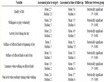
Table 1. Elements of .
.

Figure 1. The free ternary algebra on one free generator.

where  such that
  for each
 .
.
In the Table 3, we specify some of the elements of .
.
Table 2. The elements of E.
Table 3. Elements of .
.

Figure 2. The poset of join irreducible elements of the free ternary algebra on two free generators.
Then,

The poset  coincides with that obtained by R. Balbes in [7] and it is the one indicated in Figure 2.
References
- Brzozowski, J.A. and Serger, C.J. (1995) Asynchronous Circuits. Springer-Verlag, Berlin. http://dx.doi.org/10.1007/978-1-4612-4210-9
- Sankappanavar, H.P. (1980) A Characterization of Principal Congruences of De Morgan Algebras and Its Applications. In: Arruda, A.I., Chuaqui, R. and da Costa, N.C.A., Eds., Mathematical Logic in Latin American, North-Holland Publishing Company, Amsterdam, 341-349.
- Day, A. (1971) A Note on the Congruence Extension Property. Algebra Universalis, 1, 234-235. http://dx.doi.org/10.1007/BF02944983
- Blok, W.J. and Pigozzi, D. (1982) On the Structure of Varietes with Equationally Definable Principal Congruences I. Algebra Universalis, 15, 195-227. http://dx.doi.org/10.1007/BF02483723
- Kholer, P. and Pigozzi, D. (1980) Varietes with Equationally Definable Principal Congruences. Algebra Universalis, 11, 213-219. http://dx.doi.org/10.1007/BF02483100
- Dilworth, R.P. (1945) Lattices with Unique Complements. Transactions of the American Mathematical Society, 57, 123-154. http://dx.doi.org/10.1090/S0002-9947-1945-0012263-6
- Balbes, R. (2000) Free Ternary Algebras. International Journal of Algebra and Computation, 10, 739-749. http://dx.doi.org/10.1142/S0218196700000340
- Figallo Jr., A. and Ziliani, A. (2011) Free Algebras over a Poset in Varieties. Communications of the Korean Mathematical Society, 26, 543-549.