
American Journal of Analytical Chemistry
Vol.05 No.16(2014), Article ID:51704,3 pages
10.4236/ajac.2014.516113
On the Question of defining the association Constants by the Method of fluorescence quenching
Nikolay L. Lavrik, Nikolay M. Bazhin
Voevodsky Institute of Chemical Kinetics and Combustion SB RAS, Novosibirsk, Russian Federation
Email: lavrik@kinetics.nsc.ru
Copyright © 2014 by authors and Scientific Research Publishing Inc.
This work is licensed under the Creative Commons Attribution International License (CC BY).
http://creativecommons.org/licenses/by/4.0/



Received 5 September 2014; revised 20 October 2014; accepted 5 November 2014
ABSTRACT
A study is made on the previously ignored problem of the dependence of a static fluorescence quenching Stern-Volmer constant  on the initial concentration of
  fluorophore F. This correlation is shown to exist. It is concluded that the Stern-Volmer quenching constant may be used as association constant K only with
 .
.
Keywords:
fluorescence quenching, associationconstants, Stern-Volmer Constant

1. Introduction
Determination of the association constants K is one of the most common tasks of physical chemistry, biochemistry, chemistry, etc. The constant K in equation (1) is taken as the association constant
 (1)
(1)
 . (2)
. (2)
In (1) and (2), F and Q are the complexing reagents; FQ is the complex of reagents;  and
and  are the
initial concentrations of F and Q according to preparation.
From equation (2) it easily follows [1] that the relative concentration (y) of complex FQ can be calculated from the equation
 (3)
(3)
where
 . (4)
. (4)
One of the numerous methods to determine the value of K is the fluorescence one [2] . The basis of the described method is the assumption that the complexes FQ do not fluoresce (static quenching) and that the dynamic quenching of excited molecules F is absent.
The essence of this approach is that the fluorescence quenching constant  is estimated from the Stern-Volmer equation
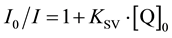 . (5)
. (5)
In (3), I0 and I are the fluorescence intensities of the fluorophore F in the absence and in the presence of quencher Q. The resulting constant  is taken as the K value [2]
 . (6)
. (6)
However, in the case of static quenching, the constant  depends on the initial concentration of the fluorophore. This factor does not take into account usually [2] . The cause of such dependence is the formation of complexes FQ, which leads to a decrease in the concentration of free molecules F in contrast to the usual practice of using Stern-Volmer equation in the systems in which the concentration of the fluorophore does not depend on the concentration of the quencher.
The present work is devoted to the extent of correction to the experimental Stern-Volmer constant  for the case of static fluorescence quenching under continuous illumination.
2. Fluorescence Quenching under the Conditions of nonfluorescent complex Formation
Consider now luminescence quenching in the presence of complex formation under stationary excitation. The following scheme holds for this case:

 (7)
(7)
 (8)
(8)
 (9)
(9)
In (7)-(9),  is the coefficient depending on experimental conditions and molar absorption coefficient of fluorofor, Iex is the intensity of exciting illumination, k1 and k2 are the radiative and non-radiative constants of the excited electronic states of fluorophore F*, respectively, and the K value is the same as that in (1). From (7)-(9), we get
 . (10)
Thus, in general, from (10) the fluorescence intensity I is of the form
 . (11)
However, for a particular case of , the fluorescence intensity is
 . (12)
In fluorescence quenching the  value is used. From (10)-(12) we obtain
 . (13)
Taking into account that
 (14)
(14)
we get either
 (15)
(15)
or
 . (16)
For the small values of р, we have
 . (17)
To determine the Stern-Volmer constants,  is measured as a function of
  (the dependence of
on ). For this dependence with small
  values, we get
 . (18)
Comparing (18) with (6) indicates that in the case of complex formation, the Stern-Volmer quenching constant  is not equal to K,
 . (19)
Thus,  rather than K is measured experimentally. The latter is usually associated with a complex
constant. This correction to unity in the denominator of Equation (19), equal to  takes into account the fact that the concentration of molecules F is less than
  because of complex formation. Thus, the generally
accepted equating of the experimental quenching constant  to the equilibrium one (complexing) K [2] is
valid only if .
.
The value of K can be estimated from the dependence of  on
on 
 . (20)
The  value and then, respectively, that of K are determined from the cut on the Y-axis.
3. Conclusion
It is concluded then that introducing the above correction may be a key moment in obtaining the true values of
the association constants. The relation  may fail in the case of reagents (fluorophores) with a low
quantum yield. In this case, the high concentrations of  are used to provide reliable observations. This
necessitates the introduction of a corrective factor which is also obligatory for the case of large complexing constants.
Cite this paper
Nikolay L.Lavrik,Nikolay M.Bazhin, (2014) On the Question of Defining the Association Constants by the Method of Fluorescence Quenching. American Journal of Analytical Chemistry,05,1065-1068. doi: 10.4236/ajac.2014.516113
References
- 1. De Weert, M. and Stella, L. (2011) Fluorescence Quenching and Ligand Binding: A Critical Discussion of a Popular Methodology. Journal of Molecular Structure, 998, 144-150.
http://dx.doi.org/10.1016/j.molstruc.2011.05.023 - 2. Lakovicz, J. (2010) Principles of Fluorescence Spectroscopy. 3rd Edition, Springer, Berlin.