

American Journal of Computational Mathematics
Vol.04 No.03(2014), Article ID:45993,15 pages
10.4236/ajcm.2014.43012
Nonlinear Interaction of N Conservative Waves in Two Dimensions
Victor A. Miroshnikov
Department of Mathematics, College of Mount Saint Vincent, New York, USA
Email: victor.miroshnikov@mountsaintvincent.edu
Copyright © 2014 by author and Scientific Research Publishing Inc.
This work is licensed under the Creative Commons Attribution International License (CC BY).
http://creativecommons.org/licenses/by/4.0/



Received 20 February 2014; revised 20 March 2014; accepted 27 March 2014
ABSTRACT
Kinematic Fourier (KF) structures, exponential kinematic Fourier (KEF) structures, dynamic exponential (DEF) Fourier structures, and KEF-DEF structures with constant and space-dependent structural coefficients are developed in the current paper to treat kinematic and dynamic problems for nonlinear interaction of N conservative waves in the two-dimensional theory of the Newtonian flows with harmonic velocity. The computational method of solving partial differential equations (PDEs) by decomposition in invariant structures, which continues the analytical methods of undetermined coefficients and separation of variables, is extended by using an experimental and theoretical computation in Maple™. For internal waves vanishing at infinity, the Dirichlet problem is formulated for kinematic and dynamics systems of the vorticity, continuity, Helmholtz, Lamb-Helmholtz, and Bernoulli equations in the upper and lower domains. Exact solutions for upper and lower cumulative flows are discovered by the experimental computing, proved by the theoretical computing, and verified by the system of Navier-Stokes PDEs. The KEF and KEF-DEF structures of the cumulative flows are visualized by instantaneous surface plots with isocurves. Modeling of a deterministic wave chaos by aperiodic flows in the KEF, DEF, and KEF-DEF structures with 5N parameters is considered.
Keywords:
Structures, Waves, Computation, Experiment, Theory

1. Introduction
The two-dimensional (2d) Navier-Stokes system of partial differential equations (PDEs) for a Newtonian fluid with a constant density
 and a constant kinematic viscosity
 in a gravity field
 is
is
 , (1-2)
where
 is a vector field of the flow velocity,
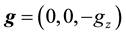 is a vector field of the gravitational acceleration,
 is a scalar field of the total pressure,
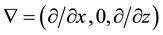 and
and
 are the gradient and the Laplacian in the 2d Cartesian coordinate system
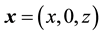 of the three-dimensional (3d) space with unit vectors
 , respectively, and
 is time.
By a flow vorticity
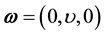 of the velocity field
 (3)
(3)
Equation (1) may be written into the Lamb-Pozrikidis form [1] [2]
 (4)
(4)
which sets a dynamic balance of inertial, potential, vortical, and viscous forces, respectively.
Using a dynamic pressure per unit mass [3]
 (5)
(5)
where
 is a reference pressure, a kinetic energy per unit mass
 the 2d Helmholtz decomposition [4] of the velocity field
 (6)
(6)
and the vortex force
 (7)
(7)
Equation (4) is reduced to the Lamb-Helmholtz PDE
 (8)
(8)
for a scalar Bernoulli potential
 (9)
(9)
and a vector Helmholtz potential
 (10)
(10)
where
 and
and
 are scalar potentials,
 and
and
 are vector potentials,
 and
and
 are pseudovector potentials of
 and
and
 respectively. The Lamb-Helmholtz PDE (8) means a dynamic balance between potential and vortical forces of the Navier-Stokes PDE (1), which are separated completely.
A linear part of the kinematic problem for free-surface waves of the theory of the ideal fluid with
 implies the exponential Fourier eigenfunctions [5] , which are obtained by the classical method of separation of variables of the 2d Laplace Equation in [4] and [1] . This analytical method was recently developed into the computational method of solving PDEs by decomposition into invariant structures. In [3] , the Boussinesq-Rayleigh- Taylor structures were developed for topological flows away from boundaries. The trigonometric Taylor structures and the trigonometric-hyperbolic structures [6] were used to describe spatiotemporal cascades of exposed and hidden perturbations of the Couette flow, respectively. In [7] , the theory of the invariant trigonometric, hyperbolic, and elliptic structures was constructed and applied for modeling dual perturbations of the Poiseuille-Hagen flow.
To treat linear and nonlinear parts of kinematic and dynamic problems for 2d internal waves in the theory of Newtonian flows with harmonic velocity, kinematic Fourier (KF) structures, exponential kinematic Fourier (KEF) structures, dynamic exponential Fourier (DEF) structures, and KEF-DEF structures with constant structural coefficients are developed in the current paper. The structure of this paper is as follows. In section 2, the kinematic problems for velocity components and dual potentials of the velocity field are formulated in upper and lower domains and treated in the KF and KEF structures. To compute and explore Jacobian determinants (JDs) of the velocity field, the DEF structure is also constructed in this section. In section 3, the dynamic problems for the Bernoulli potential and the total pressure are formulated and computed in the KF, KEF, and KEF-DEF structures. The Navier-Stokes system of PDEs is employed for verification of experimental and theoretical solutions for cumulative upper and lower flows in this section, as well. Visualization and discussion of the developed structures and fluid-dynamic variables is given in section 4, which is followed by a summary of main results in Section 5.
2. Kinematic Problems for Conservative Flows
The following solutions and admissible boundary conditions for the kinematic problems of section 2 in the KF and DEF structures were primarily computed experimentally in Maple™ by programming with lists of equations and expressions in the virtual environment of a global variable Eqs with 29 procedures of 670 code lines.
2.1. Formulation of Theoretical Kinematic Problems for Velocity Components
Theoretical kinematic problems for harmonic velocity components
 and
and
 of a cumulative flow
 of a Newtonian fluid are given by vanishing the
 component of the vorticity Equation (3) and the continuity Equation (2), respectively,
 (11-12)
To consider nonlinear interaction of
 internal, conservative waves with a harmonic velocity field, the cumulative flow is decomposed into a superposition of local flows
 (13)
(13)
such that the local vorticity and continuity equations are
 (14-15)
where
 If Equations (14)-(15) for the local flows are fulfilled, then substitution of superpositions (13) into (11)-(12) and changing order of summation and differentiation yield that Equations (11)-(12) for the cumulative flow are also satisfied.
Upper flows are specified by the Dirichlet condition in the KF structure on a lower boundary
 of an upper domain
 and
and
 (see Figure 1)
 (16)
(16)
and a vanishing condition as

 (17)
(17)
Lower flows are identified by the Dirichlet condition on a lower boundary
 of a lower domain
 and
and
 (see Figure 1)
 (18)
(18)
and a vanishing condition as

 (19)
(19)
Thus, an effect of surface waves on the internal waves is described by the Dirichlet conditions (16) and (18). Here, a structural notation
 (20)
(20)
is used for kinematic structural functions
 and
and
 where
where
 and
and
 are boundary coefficients,
 is an argument of the kinematic and dynamic structural functions,
 is a propa-

Figure 1. Configuration of upper and lower domains for internal, conservative waves.
gation coordinate,
 is a wavenumber,
 is a celerity, and
 is an initial coordinate for all

As we will see later, boundary conditions for
 are then redundant since boundary parameters of

 (21-22)
for the upper and lower flows, respectively, depend on boundary parameters of . Similarly to

 vanishes as

 (23-24)
for the upper and lower flows, respectively.
Thus, the and
and components of the velocity field of the cumulative flows are expanded in the KF structures with constant structural coefficients
 (25)
(25)
 (26)
(26)
and the velocity components vanish as

 (27)
(27)
 (28)
(28)
for the upper and lower cumulative flows, respectively.
2.2. Theoretical Solutions for the Velocity Field
Theoretical solutions of kinematic problems (11)-(28) are constructed in the KF structure
 of two spatial variables
 and time
 with a general term
 which in the structural notation may be written as
 (29)
(29)
where first letters
 and
and
 of structural coefficients
 and
and
 refer to the kinematic structural functions
 and a second letter to the expanded variable
 Thus, general terms of the velocity components of the local flows in the structural notation become
 (30-31)
It may be shown that spatial derivatives of
 are
are
 (32-33)
Application of (32)-(33) to (30)-(31), substitution in (14)-(15), and collection of the structural functions reduce the vorticity and continuity PDEs to the following system of two vorticity and continuity ordinary differential equations (ODEs) in the KF structures:
 (34-35)
For Equations (34)-(35) to be satisfied exactly for all variables, parameters, and functions of the local flows:


 and
and
 all coefficients of two kinematic structural functions must vanish. Thus, two ODEs (34)-(35) are reduced to two systems of ODEs for

 and
and

 respectively:
 (36-37)
 (38-39)
Since boundary conditions (25)-(26) are expanded in the KF structure exactly, remainders of structural approximations (34)-(35) vanish, and exact solutions of ODEs (36)-(39) produce exact solutions of vorticity and continuity PDEs (14)-(15). If (25)-(26) are replaced with series approximations, then their remainders constitute errors of the series approximations.
Solutions of ODEs for structural coefficients (36)-(39) are constructed in an exponential structure
 (40)
(40)
where
 and
and
 are structural coefficients. Substitution of exponential structure (40) in Equations (36) and (38) reduces these ODEs to algebraic equations (AEs) for structural parameters:
 (41)
(41)
Substitution of (40) and (41) in (37) and (39) reduces these ODEs to AEs for admissible values of the structural coefficient
 with the following solutions for the upper and lower flows, respectively:
 (42)
(42)
Since the admissible values of
 coincide for Equations (37) and (39), ODEs for structural coefficients (36)-(39) are compatible both for the upper and lower flows.
Finally, substitutions of (40)-(42) in (30)-(31) and (13) yield the velocity components in the KEF structures for the upper cumulative flow
 (43-44)
and the lower cumulative flow
 (45-46)
while boundary conditions (16)-(19) and (21)-(28) are obviously satisfied.
2.3. The DEF structure and Theoretical Jacobian Determinants of the Velocity Components
Define two KEF structures
 and
and
 with general terms
 and
and
 by using a generalized Einstein notation for summation, which is extended for exponents,
 (47)
(47)
Computation of a general term by summation of diagonal terms yields
 (48)
(48)
Trigonometric structural functions


 and
and
 of the DEF structure are defined by the following expressions:
 (49)
(49)
where capital letters
 and
and
 stand for dynamic structural functions cosine and sine, letter
 for arguments
 and letters
 and
and
 for sum and difference of arguments
 and
and

A general term
 computed by rectangular summation of non-diagonal terms becomes
 (50)
(50)
By triangular summation,
 is reduced to
 (51)
(51)
Using general terms (48) and (51), summation formula for the product of the KEF structures is written as the DEF structure
 (52)
(52)
with the following structural coefficients:
 (53)
(53)
where first two letters


 and
and
 of structural coefficients


 and
and stand for dynamic structural functions


 and
and , respectively, and a third letter for variable

Computation of local JDs for the velocity components of the upper and lower flow, respectively, yields
 (54)
(54)
Thus, velocity components
 and
and
 are independent for non-trivial structural coefficients
 and
and
 since the local JDs vanish when

Computation of a global JD by using (52)-(53) for velocity components of the upper and lower cumulative flows (43)-(46) with slant internal waves gives
 (55)
(55)
So,
 is a superposition of a propagation JD with general term
 proportional to
 an interaction JD with
 proportional to
 and an interaction JD with
 proportional to
 which describe interaction between parallel and orthogonal internal waves, respectively.
 coincides with (54). They describe propagation of internal waves and vanish only for internal waves with

 vanishes for parallel waves with
 (56)
(56)
Global JD (55) then becomes
 (57)
(57)
Thus, the global JD does not vanish for parallel waves with non-vanishing

 vanishes for orthogonal waves with
 (58)
(58)
In this case, global JD (55) is reduced to
 (59)
(59)
Thus, the global JD does not vanish also for orthogonal waves with non-vanishing
 In the general case (55) of slant internal waves, both
 and
and
 are non-vanishing. So, both propagating and interacting waves are independent for structural coefficients with
 for all

2.4. Theoretical Solutions for the Pseudovector and Scalar Potentials in the KEF Structures
Theoretical kinematic problems for cumulative pseudo-vector potential
 and cumulative scalar potential
 of
of
 are set by the global Helmholtz PDEs (6)
 (60)
(60)
 (61)
(61)
since the potential-vortical duality the velocity field admits two presentations:
 for
for
 and
and for
for
 The cumulative kinematic potentials are decomposed into a superposition of local kinematic potentials
 (62)
(62)
such that the local Helmholtz PDEs are
 (63)
(63)
 (64)
(64)
where
 The boundary conditions for
 and
and
 and redundant when the problem is formulated in the KF structures.
Construct general terms of the kinematic potentials of the local flows in the KF structure with space-depen- dent coefficients
 (65-66)
Application of (32)-(33) to (65)-(66), substitution in (63)-(64), and collection of the structural functions reduce four Helmholtz PDEs to the following system of two Helmholtz ODEs and two Helmholtz AEs for the upper flows
 (67-68)
 (69-70)
and the lower flows
 (71-72)
 (73-74)
For Equations (67)-(74) to be satisfied exactly for all variables, parameters, and functions of the upper and lower flows:
 and
and
 all coefficients of structural functions
 and
and must vanish. Thus, two Helmholtz ODEs and two Helmholtz AEs are reduced to the following four AEs and four ODEs with respect to


 and
and
 for the upper flows
 (75)
(75)
 (76)
(76)
and the lower flows
 (77)
(77)
 (78)
(78)
Since general terms of remainders of structural approximations (67)-(74) vanish, exact solutions of AEs and ODEs (75)-(78) produce exact solutions of the Helmholtz PDEs (63)-(64).
Solving AEs (75) and (77) with respect to


 and
and
 gives for the upper flows
 (79)
(79)
and the lower flows
 (80)
(80)
Substitution of solutions (79)-(80) in ODEs (76) and (78) reduces them to identities.
Substitution of structural coefficients (79)-(80) in the KF structures (65)-(66) and super positions (62) returns the cumulative pseudo vector and scalar potentials in the KEF structures for the upper cumulative flow
 (81-82)
and the lower cumulative flow
 (83-84)
2.5. Harmonic Relationships for the Velocity Components and the Kinematic Potentials
Comparison of solutions for
 and
and
 with spatial derivatives in
 of
of
 and
and
 shows that they are directly proportional to each other, respectively, for the upper flows
 (85)
(85)
and the lower flows
 (86)
(86)
In fluid dynamics, these connections mean that a non-uniform vertical flow generates a horizontal flow and a non-uniform horizontal flow produces a vertical flow.
Similarly, comparison of solutions for
 and
and
 with solutions for
 and
and
 shows that they are also directly proportional, respectively, for the upper flows
 (87)
(87)
and the lower flows
 (88)
(88)
Finally, comparison of solutions for
 and
and
 with spatial derivatives in
 of
of
 and
and
 shows that they are proportional to each other, respectively, for the upper flows
 (89)
(89)
and the lower flows
 (90)
(90)
Connections (85)-(90) between solutions in the KEF structures are available since there are only two independent combinations of trigonometric structural functions
 and
and

Computation of
 by using (81)-(84) both for the upper and lower flows gives
 (91)
(91)
Thus, local isocurves of
 and
and
 remain orthogonal for all times in agreement with the Helmholtz Equations (63)-(64). Similarly, local isocurves of
 and
and remain orthogonal since both for the upper and lower flows
 (92)
(92)
in agreement with the local vorticity and continuity Equations (14)-(15).
Computation of
 by (52)-53) and (81)-(84) both for the upper and lower cumulative flows gives
 (93)
(93)
Thus, global isocurves of
 and
and
 also remain orthogonal for all times in agreement with the cumulative Helmholtz Equations (60)-(61). Finally, global isocurves of
 and
and
 remain orthogonal since both for the upper and lower cumulative flows
 (94)
(94)
in agreement with the cumulative vorticity and continuity Equations (11)-(12).
It is a straightforward matter to show that for the KEF structure
 with a general term

 (95)
(95)
spatial derivatives of second order in the
 and
and
 directions are
 (96-97)
and the Laplacian of
 vanishes. Thus, the KEF structure is an invariant, harmonic structure both for the upper and lower flows.
Application of (96)-(97) to (43)-(46) shows that
 and
and
 are conjugate harmonic functions since
 (98)
(98)
both for the upper and lower flows, in agreement with vector identity
 By Equations (13),
 and
and
 are also conjugate harmonic functions
 (99)
(99)
both for the upper and lower cumulative flows, in agreement with vector identity

Similarly, applying (96)-(97) to (81)-(84) shows that
 and
and
 are conjugate harmonic functions as
 (100)
(100)
both for the upper and lower flows, in agreement with
 and
and
 By Equation (62),
 and
and
 are also conjugate harmonic functions
 (101)
(101)
both for the upper and lower cumulative flows, in agreement with vector identities
 and
and

The theoretical solutions in the KEF and DEF structures for the kinematic problems of section 2 were computed theoretically in Maple™ by programming with symbolic general terms in the virtual environment of a global variable Equation with 26 procedures of 591 code lines. The theoretical solutions for velocity components (43)-(46), the products of the KEF structures (52)-(53), and the kinematic potentials (81)-(84) of the upper and lower cumulative flows were justified by the correspondent experimental solutions for

3. Dynamic Problems for Conservative Flows
The following solutions for the dynamic problems of section 3 in the KF, DEF, and KEF-DEF structures were primarily computed experimentally by programming with lists of equations and expressions in the virtual environment of the global variable Equations with 19 procedures of 472 code lines.
3.1. Theoretical Solutions for the Helmholtz and Bernoulli Potentials in the KEF Structures
Theoretical dynamic problems in the KF structures for the Helmholtz and Bernoulli potentials of the cumulative flows are set by the Lamb-Helmholtz PDEs (8)
 (102-103)
while (10) for the vortical presentation with
 is reduced to
 (104)
(104)
Equations (102-104) are complemented by the local Lamb-Helmholtz PDEs
 (105-106)
where
 (107)
(107)
since the cumulative dynamic potentials are again decomposed into the local dynamic potentials as follows:
 (108)
(108)
Boundary conditions are again redundant because the problem is formulated in the KF structures.
Construct a general term of the Bernoulli potential of the local flows in the KF structure with space-dependent coefficients
 (109)
(109)
Computation of the temporal derivative of
 application of (32)-(33), substitution in (105)-(106), and collection of the structural functions reduce two Lamb-Helmholtz PDEs to the following system of the Lamb-Helmholtz AE and ODE for the upper flows
 (110)
(110)
and the lower flows
 (111)
(111)
For Equations (110)-(111) to be satisfied exactly for all
 and
and
 all coefficients of structural functions
 and
and
 must vanish. Thus, the Lamb-Helmholtz AE and ODE are reduced to the following two AEs and two ODEs for space-dependent structural coefficients
 and
and
 for the upper flows
 (112-113)
and the lower flows
 (114-115)
Since general terms of remainders of structural approximations (110)-(111) vanish, exact solutions of (112)-(115) produce exact solutions of (105)-(106).
Solving AEs (112) and (114) for structural coefficients
 and
and
 yields for the upper flows
 (116)
(116)
and the lower flows
 (117)
(117)
Substitution of solutions (116)-(117) in ODEs (113) and (115) reduced them to identities.
Substitution of structural coefficients (116)-(117) in super positions (108) and the KF structure (109) gives the cumulative Helmholtz and Bernoulli potentials in the KEF structures for the upper cumulative flow
 (118-119)
and the lower cumulative flow
 (120-121)
Similar to the kinematic potentials (87)-(88), the dynamic potentials and the velocity components are directly proportional both for the upper and lower flows
 (122)
(122)
Like in (89)-(90), the Helmholtz and Bernoulli potentials and derivatives of the Bernoulli and Helmholtz potentials in are directly proportional to each other both for the upper flows
 (123)
(123)
and the lower flows
 (124)
(124)
Analogous to (91)-(94), isocurves of
 and global isocurves of
 are orthogonal for all times
 (125-126)
in agreement with the Lamb-Helmholtz Equations (105)-(106) and (102)-(103). For the same reason,
 and
and
 are local and global conjugate harmonic functions as
 (127-128)
3.2. Theoretical Solutions for the Total Pressure in the KEF-DEF Structures
Theoretical dynamic problems in the KEF-DEF structures for the kinetic energy per unit mass
 the dynamic pressure per unit mass
 and the total pressure
 of the cumulative flows are formulated by definition
 (129)
(129)
the Bernoulli Equation (9) with

 (130)
(130)
and the hydrostatic Equation (5)
 (131)
(131)
where
 is the reference pressure at

Computation of
 by (52)-(53) and (43)-(46) returns
 (132)
(132)
for the upper and lower cumulative flows, respectively. Substitution of (119), (121), and (132) in (131) yields
 (133)
(133)
for the upper and lower cumulative flows, respectively.
3.3. Theoretical Verification by the System of Navier-Stokes PDEs
The system of the Navier-Stokes PDEs (1)-(2) in the scalar notation becomes
 (134-135)
 (136)
(136)
Computation of spatial derivatives of (43)-(46) by (32)-(33) immediately reduces (136) to identity. Temporal derivatives of
 in the KEF structures for the upper and lower cumulative flows, respectively, are
 (137-138)
The directional derivatives of (134)-(135) computed by (52)-(53) in the DEF structures for the upper and lower cumulative flows, respectively, become
 (139)
(139)
 (140)
(140)
By using (32) and (33), components of the gradient of (133) may be written in the KEF-DEF structures for the upper and lower cumulative flows, respectively, as
 (141)
(141)
 (142)
(142)
Substitution of Equations (137)-(142) and (99) in (134)-(135) reduces then to identities. Thus, Equations (43)-(46) and (133) constitute exact solutions in the KEF, DEF, and KEF-DEF structures for interaction of
 internal waves both in the upper and lower domains.
The theoretical solutions in the KEF, DEF, and KEF-DEF structures for the dynamic problems of section 3 were computed theoretically by programming with symbolic general terms in the virtual environment of the global variable Equation with 15 procedures of 405 code lines. The theoretical solutions for the Helmholtz and Bernoulli potentials (118)-(121), the total pressure (133), the temporal derivatives (137)-(138), the directional derivatives (139)-(140), and the pressure gradient (141)-(142) of the upper and lower cumulative flows were justified by the correspondent experimental solutions for

4. Visualization and Discussion
The Fourier series with eigenfunctions
 and
and
 where
where
 is an integer, model a periodic function with a constant period
 and a wavenumber
 [4] . The trigonometric structural functions
 and
and
 of the KF, KEF, DEF, and KEF-DEF structures coincide with the Fourier eigenfunctions if
 When
When
 where
where
 is a prime number,
 and
and
 model a function with a period approaching infinity as
 [6] . For instance, if a sequence of
 is
is
 (143)
(143)
local periods of the structural functions grow as

 (144)
(144)
and a global period of the interaction solution (43)-(46) increases as

 (145)
(145)
The KEF structures of conjugate harmonic solutions are visualized in Figure 2 by instantaneous 3d surface plots with isocurves for
 and
and , for
, for


 and
and
 at
at . In two dimensions, the pseudovector potential coincides with the stream function and isocurves of
 coincides with streamlines [2] .
The DEF and KEF-DEF structures are visualized in Figure 3 by instantaneous 3d surface plots with isocurves


Figure 2. Pseudovector potential
 and scalar potential
 of the lower cumulative flow.


Figure 3. Kinetic energy (left) and dynamic pressure (right) of the lower cumulative flow.
for
 and
and
 where
where
 is given by (133), for


 and
and
 at
at . In agreement with the Bernoulli Equation [1] , local maximums of the DEF structure for
 correspond to local minimums of the KEF-DEF structure for

The rate of vanishing of the DEF structure is larger than that of the KEF structure. Animations of
 and
and show a transitional behavior of these variables that approach a deterministic chaos, which is determined by
 parameters:
 and
and
 as
as .
.
5. Conclusions
The analytical methods of undetermined coefficients and separation of variables are extended by the computational method of solving 2d PDEs by decomposition in invariant structures. The method is developed by the experimental computing with lists of equations and expressions and the theoretical computing with symbolic general terms. The experimental computing of the kinematic and dynamic problems is implemented by 48 procedures of 1142 code lines and the theoretical computing by 41 procedures of 996 code lines.
To compute the upper and cumulative flows for nonlinear interaction of
 internal waves in the KF structures, the KEF, DEF, and KEF-DEF structures were treated both experimentally and theoretically. These structures with constant and space-dependent structural coefficients are invariant with respect to various differential and algebraic operations. The structures continue the Fourier series for linear and nonlinear problems with solutions vanishing at infinity and model flows of a deterministic wave chaos with the period that approaches infinity.
The exact solutions of the Navier-Stokes PDEs for the nonlinear interaction of
 conservative waves are computed in the upper and lower domains by formulating and solving the Dirichlet problem for the vorticity, continuity, Helmholtz, Lamb-Helmholtz, and Bernoulli equations. The conservative waves are not affected by dissipation since they are derived in the class of flows with the harmonic velocity field. The harmonic relationships between fluid-dynamic variables and their spatial derivatives with respect to
 both for upper and lower flows are obtained.
Acknowledgements
The author thanks S. P. Bhavaraju for the stimulating discussion at the 2013 SIAM Annual Meeting. Support of the College of Mount Saint Vincent and CAAM is gratefully acknowledged.
Cite this paper
Victor A.Miroshnikov, (2014) Nonlinear Interaction of N Conservative Waves in Two Dimensions. American Journal of Computational Mathematics,04,127-142. doi: 10.4236/ajcm.2014.43012
References
- 1. Lamb, S.H. (1945) Hydrodynamics.6th Edition, Dover Publications, New York.
- 2. Pozrikidis, C. (2011) Introduction to Theoretical and Computational Fluid Dynamics. 2nd Edition, Oxford University Press, Oxford.
- 3. Miroshnikov, V.A. (2005) The Boussinesq-Rayleigh Series for Two-Dimensional Flows Away from Boundaries. Applied Mathematics Research Express, 2005, 183-227. http://dx.doi.org/10.1155/amrx.2005.183
- 4. Korn, G.A. and Korn, T.A. (2000) Mathematical Handbook for Scientists and Engineers: Definitions, Theorems, and Formulas for Reference and Review. 2nd Revised Edition, Dover Publications, New York.
- 5. Kochin, N.E., Kibel, I.A. and Roze, N.V. (1964) Theoretical Hydromechanics. John Wiley & Sons Ltd., Chichester.
- 6. Miroshnikov, V.A. (2009) Spatiotemporal Cascades of Exposed and Hidden Perturbations of the Couette Flow. Advances and Applications in Fluid Dynamics, 6, 141-165.
- 7. Miroshnikov, V.A. (2012) Dual Perturbations of the Poiseuille-Hagen Flow in Invariant Elliptic Structures. Advances and Applications in Fluid Dynamics, 11, 1-58.