

Journal of Modern Physics
Vol.05 No.18(2014), Article ID:52750,24 pages
10.4236/jmp.2014.518210
A Wave Equation including Leptons and Quarks for the Standard Model of Quantum Physics in Clifford Algebra
Claude Daviau, Jacques Bertrand
Le Moulin de la Lande, Pouillé-les-Coteaux, France
Email: Claude.Daviau@nordnet.fr, bertrandjacques-m@orange.fr
Copyright © 2014 by authors and Scientific Research Publishing Inc.
This work is licensed under the Creative Commons Attribution International License (CC BY).
http://creativecommons.org/licenses/by/4.0/


Received 31 October 2014; revised 27 November 2014; accepted 21 December 2014
ABSTRACT
A wave equation with mass term is studied for all fermionic particles and antiparticles of the first generation: electron and its neutrino, positron and antineutrino, quarks u and d with three states of color and antiquarks
 and
and . This wave equation is form invariant under the
 group generalizing the relativistic invariance. It is gauge invariant under the
 group of the standard model of quantum physics. The wave is a function of space and time with value in the Clifford algebra
 . Then many features of the standard model, charge conjugation, color, left waves, and Lagrangian formalism, are obtained in the frame of the first quantization.
Keywords:
Invariance Group, Dirac Equation, Electromagnetism, Weak Interactions, Strong Interactions, Clifford Algebras

1. Introduction
We use here all notations of “new insights in the standard model of quantum physics in Clifford algebra” [1] . The wave equation for all particles of the first generation is a generalization of the wave equation obtained in 6.7 for the electron and its neutrino. This wave equation has obtained a proper mass term compatible with the gauge invariance in [2] . It is a generalization of the homogeneous nonlinear Dirac equation for the electron alone [3] - [9] .
 (1.1)
(1.1)
with
 (1.2)
(1.2)
 (1.3)
(1.3)
Here
 and
and
 are respectively the right and left Weyl spinors of the electron. The
 angle is the Yvon- Takabayasi angle satisfying
 (1.4)
(1.4)
The link with the usual presentation of the standard model is made by the left and right Weyl spinors used for waves of each particle. These right and left waves are parts of the wave with value in .
.
We used previously the same algebra . It is the same algebra, and this explains very well why sub-algebras
 and
and
 have been equally used to describe relativistic physics [10] [11] . But the sig- nature of the scalar product cannot be free, this scalar product being linked to the gravitation in the general relativity. It happens that vectors of
 are pseudo-vectors of
 and more generally that
 -vectors of
 are
are
 -vectors of
 . The generalization of the wave equation for electron-neutrino is simpler if we use
 . This is the first indication that the signature
 is the true one. We explain in Appendix A how the reverse in
 is linked to the reverse in
 , a necessary condition to get the wave equation of all particles of the first generation.
We have noticed, for the electron alone firstly (see [8] 2.4), next for electron + neutrino [2] the double link existing between the wave equation and the Lagrangian density: It is well known that the wave equation may be obtained from the Lagrangian density by the variational calculus. The new link is that the real part of the invariant wave equation is simply . The Lagrangian formalism is then necessary, being a consequence of the wave equation. Next we have extended the double link to electro-weak interactions in the leptonic case (electron + neutrino). Now we are extending the double link to the gauge group of the standard model. The Lagrangian density must then be the real part of the invariant wave equation.
Moreover we generalized the non-linear homogeneous wave equation of the electron, and we got a wave equation with mass term [2] , form invariant under the
 group and gauge invariant under the
 gauge group of electro-weak interactions. Our aim is to explain how this may be extended to a wave equation with mass term, both form invariant under
 and gauge invariant under the
 gauge group of the standard model, including both electro-weak and strong interactions.
2. From the Lepton Case to the Full Wave
The standard model adds to the leptons (electron
 and its neutrino
 ) in the “first generation” two quarks
 and
and
 with three colour states each. Weak interactions acting only on left waves of quarks (and right waves of antiquarks) we write the wave of all fermions of the first generation as follows:
 (2.1)
(2.1)
 (2.2)
(2.2)
The electro-weak theory [12] needs three spinorial waves in the electron-neutrino case: the right
 and the left
 of the electron and the left spinor
 of the electronic neutrino. The form invariance of the Dirac theory imposes to use
 for the electron and
 for its neutrino satisfying
 (2.3)
(2.3)
 (2.4)
(2.4)
Waves
 and
and
 are functions of space and time with value into the Clifford algebra
 of the physical space. The standard model uses only a left
 wave for the neutrino. We always use the matrix representation (A.1) which allows to see the Clifford algebra
 as a sub-algebra of
 . Under the dilation
 with ratio
 induced by any
 in
in
 we have (for more details, see [6] ):
 (2.5)
(2.5)
 (2.6)
(2.6)
 (2.7)
(2.7)
The form (2.3) of the wave is compatible both with the form invariance of the Dirac theory and with the charge conjugation used in the standard model: the wave
 of the positron satisfies
 (2.8)
(2.8)
We can then think the
 wave as containing the electron wave
 , the neutrino wave
 and also the positron wave
 and the antineutrino wave
 :
:
 (2.9)
(2.9)
And the antineutrino has only a right wave. The multivector
 is usually an invertible element of the space-time algebra because (see [1] (6.250)) with:
 (2.10)
 (2.11)
 (2.12)
we got
 (2.13)
Most of the preceding presentation is easily extended to quarks. For each color ,
,
 ,
,
 the electro- weak theory needs only left waves:
 (2.14)
The
 wave is now a function of space and time with value into
 which is a sub-algebra (on the real field) of
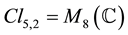 :
:
 (2.15)
The link between the reverse in
 and the reverse in
 is not trivial and is detailed in Appendix A. The wave equation for all objects of the first generation reads
 (2.16)
The mass term reads
 (2.17)
where we use the scalar densities
 and
and
 terms of Appendix B, with
 (2.18)
The covariant derivative
 uses the matrix representation (A.1) and reads
 (2.19)
 (2.20)
 (2.21)
 (2.22)
We use two projectors satisfying
 (2.23)
Three operators act on quarks like on leptons:
 (2.24)
 (2.25)
 (2.26)
The fourth operator acts differently on the leptonic and on the quark sector. Using projectors:
 (2.27)
we can separate the lepton part
 and the quark part
 of the wave:
 (2.28)
and we get (see [1] (B.4) with )
)
 (2.29)
 (2.30)
This last relation comes from the non-existence of the right part of the
 waves.
3. Chromodynamics
We start from generators
 of the
 gauge group of chromodynamics
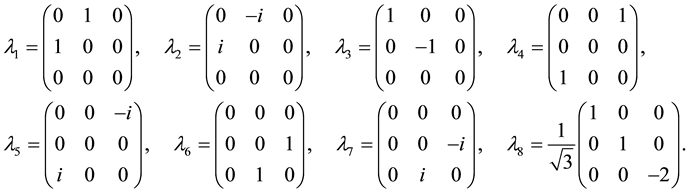 (3.1)
(3.1)
To simplify here notations we use now l, r,
 ,
,
 instead
 ,
,
 ,
,
 ,
, . So we have
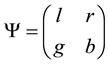 .
.
Then (2.1) gives
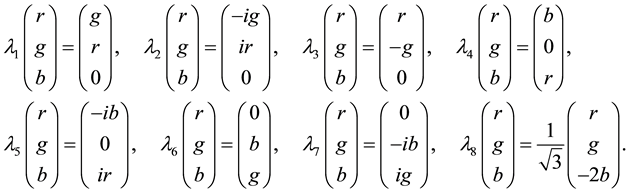 (3.2)
(3.2)
We name
 operators corresponding to
 acting on
 . We get with projectors
 and
and
 in (2.27):
 (3.3)
(3.3)
 (3.4)
(3.4)
 (3.5)
(3.5)
 (3.6)
(3.6)
 (3.7)
(3.7)
 (3.8)
(3.8)
Everywhere the left up term is 0, so all
 project the wave
 on its quark sector.
We can extend the covariant derivative of electro-weak interactions in the electron-neutrino case:
 (3.9)
(3.9)
to get the covariant derivative of the standard model
 (3.10)
where
 is another constant and
 are eight terms called “gluons”. Since
 commute with any element of
 and since
 for
for
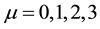 and
and
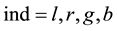 each operator
 com- mutes with all operators
 .
.
Now we use 12 real numbers ,
,
 ,
,
 ,
,
 ,
,
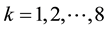 , we let
 (3.11)
and we get, using exponentiation
 (3.12)
in any order. The set of these operators
 is a
is a
 Lie group. Only difference with the standard model: the structure of this group is not postulated but calculated. With
 (3.13)
the gauge transformation reads
 (3.14)
 (3.15)
 (3.16)
 (3.17)
The
 group generated by operators
 acts only on the quark sector of the wave:
 (3.18)
The physical translation is: Leptons do not act by strong interactions. This comes from the structure of the wave itself. It is fully satisfied in experiments. We get then a
 gauge group for a wave including all fermions of the first generation. This group acts on the lepton sector only by its
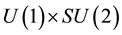 part. Consequently the wave equation is composed of a lepton wave equation and a quark wave equation:
 (3.19)
 (3.20)
The wave equation (3.19) is equivalent to the wave equation
 (3.21)
studied in [2] [13] , where
 (3.22)
 (3.23)
This wave equation is equivalent to the invariant equation:
 (3.24)
This wave equation is form invariant under the Lorentz dilation
 induced by any invertible matrix
 satisfying (2.5), (2.6), (2.7) [1] . It is gauge invariant under the
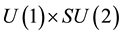 group [2] generated by operators
 which are projections on the lepton sector of the operators defined in (2.23) to (2.29). Therefore we need to study only the quark sector and its wave equation (3.20).
We begin by the double link between wave equation and Lagrangian density that we have remarked firstly in the Dirac equation [8] , next in the lepton case electron + neutrino [1] .
4. Double Link between Wave Equation and Lagrangian Density
The existence of a Lagrangian mechanism in optics and mechanics is known since Fermat and Maupertuis. This principle of minimum is everywhere in quantum mechanics from its beginning, it is the main reason of the hypothesis of a wave linked to the move of any material particle made by L. de Broglie [14] . By the calculus of variations it is always possible to get the wave equation from the Lagrangian density. But another link exists: the Lagrangian density is the real scalar part of the invariant wave equation. This was obtained firstly for the electron alone [8] , next for the pair electron-neutrino [2] where the Lagrangian density reads
 (4.1)
(4.1)
 (4.2)
(4.2)
 (4.3)
(4.3)
 (4.4)
(4.4)
We shall establish the double link now for the wave equation (2.16). It is sufficient to add the property for (3.20). This equation is equivalent to the invariant equation:
 (4.5)
(4.5)
 (4.6)
(4.6)
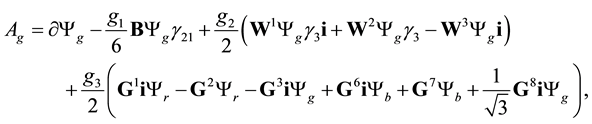
We get from the covariant derivative (2.19) with the operators
 in (2.24), (2.25), (2.26) and (2.30) and
 in (3.3) to (3.8) and with
 in (2.28)
 (4.7)
(4.7)
 (4.8)
(4.8)
 (4.9)
(4.9)
 (4.10)
Next we get
 (4.11)
The calculation of the Lagrangian density in the general case is similar to the lepton case. We get
 (4.12)
 (4.13)
The calculation of ,
,
 replaces the pair e-n by the pair dc-uc and suppress the
 terms, then (4.2) (4.3) (4.4) become
 (4.14)
 (4.15)
 (4.16)
Since three
 group are included in
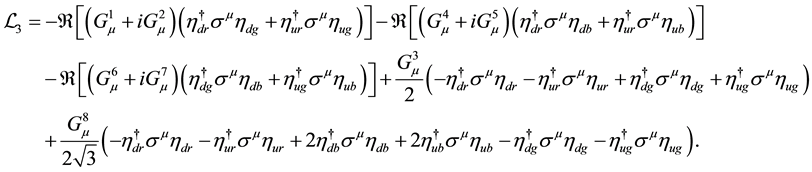
 the calculation of
 has similarities with the calculation of
 and we get
 (4.17)
This new link between the wave equation and the Lagrangian density is much stronger than the old one, because it comes from a simple separation of the different parts of a multivector in Clifford algebra. The old link, going from the Lagrangian density to the wave equation, supposes a condition of cancellation at infinity which is dubious in the case of a propagating wave. On the physical point of view, there are no difficulties in the case of a stationary wave. Difficulties begin when propagating waves are studied. Our wave equations, since they are compatible with an oriented time and an oriented space, appear as more general, more physical, than Lagran- gians. These are only particular consequences of the wave equations.
On the mathematical point of view the old link is always available. It is from the Lagrangian density (4.12) and using Lagrange equations that we have obtained the wave equation (2.16).
5. Invariances
5.1. Form Invariance of the Wave Equation
Under the Lorentz dilation
 induced by an invertible
 matrix satisfying
 (5.1)
(5.1)
 (5.2)
(5.2)
 (5.3)
(5.3)
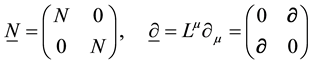
We then let
 (5.4)
(5.4)
which implies
 (5.5)
(5.5)
Then we get
 (5.6)
(5.6)
and we shall now study the form invariance of the mass term. All
 are determinants of a
 matrix, this implies
 (5.7)
(5.7)
 (5.8)
(5.8)
This gives
 (5.9)
(5.9)
 (5.10)
 (5.11)
 (5.12)
Then the form invariance of the wave equation is equivalent to the condition on the mass term
 (5.13)
 (5.14)
linked to the existence of the Planck factor [13] .
5.2. Gauge Invariance of the Wave Equation
Since we have previously proved the gauge invariance of the lepton part of the wave equation, it is reason enough to prove the gauge invariance of the quark part of the wave equation.
5.2.1. Gauge Group Generated by

We have here
 (5.15)
 (5.16)
 (5.17)
To get the gauge invariance of the wave equation we must get
 (5.18)
This is satisfied because
 (5.19)
 (5.20)
 (5.21)
All up terms in the matrix
 contain
 and
and
 terms. We get
 (5.22)
 (5.23)
 (5.24)
 (5.25)
And we finally get
 (5.26)
The wave equation with mass term is gauge invariant under the group generated by .
.
5.2.2. Gauge Group Generated by

We have here
 (5.27)
 (5.28)
 (5.29)
Since
 we get
 (5.30)
 (5.31)
We let
 (5.32)
Then (5.31) is equivalent to the system
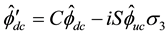 (5.33)
 (5.34)
or to the system
 (5.35)
 (5.36)
 (5.37)
 (5.38)
We then get
 (5.39)
 (5.40)
 (5.41)
 (5.42)
This implies
 (5.43)
Similarly, permuting colors, we get
 (5.44)
 (5.45)
 (5.46)
 (5.47)
This implies
 (5.48)
and also
 (5.49)
 (5.50)
 (5.51)
 (5.52)
This implies
 (5.53)
Moreover we get
 (5.54)
We then get
 (5.55)
Next we have
 (5.56)
 (5.57)
 (5.58)
and we get
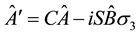 (5.59)
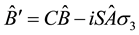 (5.60)
 (5.61)
Since we get the same relation for g and b colors we finally get
 (5.62)
The wave equation with mass term is then gauge invariant under the group generated by .
.
5.2.3. Gauge Group Generated by

We have here
 (5.63)
 (5.64)
 (5.65)
Since
 we get
 (5.66)
 (5.67)
We let
 (5.68)
Then (5.67) is equivalent to the system
 (5.69)
 (5.70)
or to the system
 (5.71)
 (5.72)
 (5.73)
 (5.74)
We then get
 (5.75)
 (5.76)
 (5.77)
 (5.78)
This implies
 (5.79)
Similarly, permuting colors, we get
 (5.80)
 (5.81)
 (5.82)
 (5.83)
This implies
 (5.84)
and also
 (5.85)
 (5.86)
 (5.87)
 (5.88)
This implies
 (5.89)
Moreover we get
 (5.90)
We then get
 (5.91)
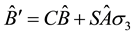
Next we get with (5.56)
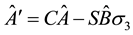 (5.92)
 (5.93)
 (5.94)
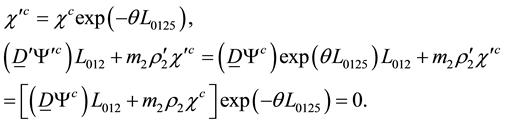
Since we get the same relation for g and b colors we finally get
 (5.95)
The wave equation with mass term is then gauge invariant under the group generated by .
.
5.2.4. Gauge Group Generated by

We have here
 (5.96)
 (5.97)
 (5.98)
Since
 we get
 (5.99)
 (5.100)
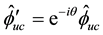
Then (5.97) is equivalent to the system
 (5.101)
 (5.102)
or to the system
 (5.103)
 (5.104)
 (5.105)
 (5.106)
We then get
 (5.107)
 (5.108)
 (5.109)
 (5.110)
 (5.111)
This implies
 (5.112)
Next we get with (5.56)
 (5.113)
 (5.114)
 (5.115)
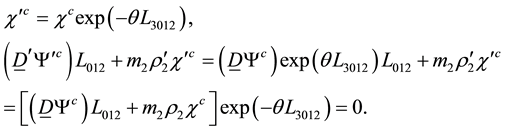
Since we get the same relation for g and b colors we finally get
 (5.116)
The wave equation with mass term is then gauge invariant under the group generated by .
.
5.2.5. Gauge Group Generated by

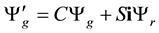
We use now the gauge transformation
 (5.117)
 (5.118)
 (5.119)
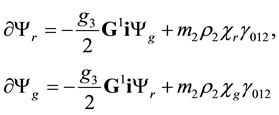
We can then forget here . The gauge invariance signifies that the system
 (5.120)
must be equivalent to the system
 (5.121)
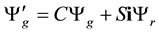
Using relations (5.117) and (5.118) the system (5.121) is equivalent to (5.120) if and only if
 (5.122)
We name
 the gauge transformation
 (5.123)
which implies with
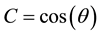 and
and

 (5.124)
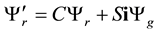 (5.125)
 (5.126)
 (5.127)
The equality (5.117) is equivalent to the system
 (5.128)
 (5.129)
The equality (5.118) is equivalent to the system
 (5.130)
 (5.131)
This gives for the invariant scalars

 (5.132)
 (5.133)
 (5.134)
 (5.135)
 (5.136)
 (5.137)
 (5.138)
 (5.139)
 (5.140)
We then get
 (5.141)
 (5.142)
 (5.143)
 (5.144)
 (5.145)
 (5.146)
Next we let
 (5.147)
 (5.148)
and we get with (B.17) and (B.18)
 (5.149)
 (5.150)
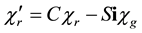
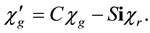
This gives the awaited result
 (5.151)
 (5.152)
 (5.153)
The change of sign of the phase between (5.117) and (5.152) comes from the anticommutation between
 and
and .
.
5.2.6. Gauge Groups Generated by ,
,

We use with
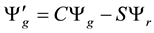
 the gauge transformation
 (5.154)
 (5.155)
 (5.156)
The gauge invariance signifies that the system
 (5.157)
must be equivalent to the system
 (5.158)
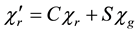
Using relations (5.154) and (5.155) the system (5.158) is equivalent to (5.157) if and only if
 (5.159)
because we get
 (5.160)
 (5.161)
 (5.162)
The case
 is detailed in C.1 and the case
 is detailed in C.2. Cases
 and
and
 are similar to
 and cases
 and
and
 are similar to
 by permutation of indexes of color.
6. Concluding Remarks
From experimental results obtained in the accelerators physicists have built what is now known as the “standard model”. This model is generally thought to be a part of quantum field theory, itself a part of axiomatic quantum mechanics. One of these axioms is that each state describing a physical situation follows a Schrödinger wave equation. Since this wave equation is not relativistic and does not account for the spin 1/2 which is necessary to any fermion, the standard model has evidently not followed the axiom and has used instead a Dirac equation to describe fermions. Our work also starts with the Dirac equation. This wave equation is the linear approximation of our nonlinear homogeneous equation of the electron.
The wave equation presented here is a wave equation for a classical wave, a function of space and time with value into a Clifford algebra. It is not a quantized wave with value into a Hilbertian space of operators. Never- theless and consequently we get most of the aspects of the standard model, for instance the fact that leptons are insensitive to strong interactions. The standard model is much stronger than generally thought. For instance we firstly did not use the link between the wave of the particle and the wave of the antiparticle, but then we needed a greater Clifford algebra and we could not get the necessary link between reversions1 that we used in our wave equation. We also needed the existence of the inverse to build the wave of a system of particles from the waves of its components. And we got two general identities which existed only if all parts of the general wave were left waves, only the electron having also a right wave.
The most important property of the general wave is its form invariance under a group including the covering group of the restricted Lorentz group. Our group does not explain why space and time are oriented, but it respects these orientations. The physical time is then compatible with thermodynamics, and the physical space is compatible with the violation of parity by weak interactions.
The wave accounts for all particles and anti-particles of the first generation. We have also given [2] [8] [9] [13] the reason of the existence of three generations; it is simply the dimension of our physical space. Since the
 gauge group of chromodynamics acts independently from the index of generations, the physical quarks may be combinations of waves of different generations. Quarks composing protons and neutrons are such combinations. Our wave equation allows only two masses at each generation, one for the lepton part of the wave, the other one for the two quarks. The mixing can give a different mass for the two quarks of each generation.
Since the wave equation with mass term is gauge invariant, there is no necessity to use the mechanism of spontaneous symmetry breaking. The scalar boson certainly exists, but it does not explain the masses.
A wave equation is only a beginning. It shall be necessary to study also the boson part of the standard model and the systems of fermions, from this wave equation. A construction of the wave of a system of identical particles is possible and compatible with the Pauli principle [1] [7] .
References
- Daviau, C. and Bertrand, J. (2014) New Insights in the Standard Model of Quantum Physics in Clifford Algebra. JePublie, Pouillé-les-Coteaux. http://hal.archives-ouvertes.fr/hal-00907848
- Daviau, C. and Bertrand, J. (2014) Journal of Modern Physics, 5, 1001-1022. http://dx.doi.org/10.4236/jmp.2014.511102
- Daviau, C. (1993) Equation de Dirac non linéaire. Ph.D. Thesis, Université de Nantes, Nantes.
- Daviau, C. (1997) Advances in Applied Clifford Algebras, 7, 175-194.
- Daviau, C. (2005) Annales de la Fondation Louis de Broglie, 30, 409-428.
- Daviau, C. (2011) L’espace-temps double. JePublie, Pouillé-les-coteaux.
- Daviau, C. (2012) Advances in Applied Clifford Algebras, 22, 611-623. http://dx.doi.org/10.1007/s00006-012-0351-7
- Daviau, C. (2012) Double Space-Time and More. JePublie, Pouillé-les-Coteaux.
- Daviau, C. (2012) Nonlinear Dirac Equation, Magnetic Monopoles and Double Space-Time. CISP, Cambridge.
- Deheuvels, R. (1993) Tenseurs et spineurs. PUF, Paris.
- Hestenes, D. (1986) A Unified Language for Mathematics and Physics and Clifford Algebra and the Interpretation of Quantum Mechanics. In: Chisholm, J.S.R. and Common, A.K., Eds., Clifford Algebras and Their Applications in Mathematics and Physics, Reidel, Dordrecht, 1-23.
- Weinberg, S. (1967) Physical Review Letters, 19, 1264-1266. http://dx.doi.org/10.1103/PhysRevLett.19.1264
- Daviau, C. (2014) Gauge Group of the Standard Model in Cl1,5. ICCA10, Tartu. http://hal.archives-ouvertes.fr/hal-01055145
- de Broglie, L. (1924) Annales de la Fondation Louis de Broglie, 17.
Appendix A. Calculation of the Reverse in

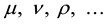
Here indexes
 have value 0, 1, 2, 3 and indexes
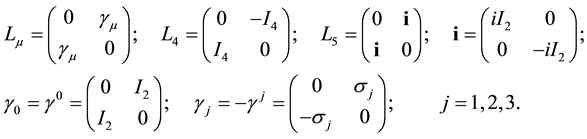
 have value 0, 1, 2, 3, 4, 5. We use2 the following matrix representation of
 :
:
 (A.1)
(A.1)
where
 are Pauli matrices. This gives
 (A.2)
(A.2)
 (A.3)
(A.3)
 (A.4)
(A.4)
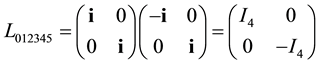
We get also
 (A.5)
(A.5)
 (A.6)
(A.6)
 (A.7)
(A.7)
Similarly we get3
 (A.8)
(A.8)
 (A.9)
(A.9)
 (A.10)
 (A.11)
 (A.12)
Scalar and pseudo-scalar terms read
 (A.13)
 (A.14)
For the calculation of the 1-vector term

we let
 (A.15)
This gives
 (A.16)
For the calculation of the 2-vector term

we let
 (A.17)
This gives
 (A.18)
For the calculation of the 3-vector term

we let
 (A.19)
This gives with (A.3) and (A.9)
 (A.20)
For the calculation of the 4-vector term

we let
 (A.21)
This gives with (A.4) and (A.10)
 (A.22)
For the calculation of the pseudo-vector term

we let
 (A.23)
This gives with (A.7) and (A.12)
 (A.24)
We then get

(A.25)
This implies
 (A.26)
 (A.27)
 (A.28)
 (A.29)
In
 the reverse of

is

we must change the sign of bivectors ,
,
 ,
,
 ,
,
 , and trivectors
 ,
,
 ,
,
 ,
,
 and we then get
 (A.30)
 (A.31)
 (A.32)
 (A.33)
The reverse, in
 now, of

is

Only terms which change sign, with (A.13), (A.18) and (A.20), are scalars
 and
and , vectors
 ,
,
 ,
,
 ,
,
 and bivectors
 ,
,
 ,
, . These changes of sign are not the same in
 as in
as in . Differences are corrected by the fact that the reversion in
 also exchanges the place of
 and
and
 terms. We then get from (A.25)

(A.34)
This link between the reversion in
 and the reversion in
 is necessary to get an invariant wave equation. It is not general, for instance the reversion in
 is not linked to the reversion in
 .
.
Appendix B. Scalar Densities and
 Terms
Terms
There are
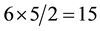 such complex scalar densities:
 (B.1)
(B.1)
 (B.2)
(B.2)
 (B.3)
(B.3)
 (B.4)
(B.4)
 (B.5)
(B.5)
 (B.6)
(B.6)
 (B.7)
(B.7)
 (B.8)
(B.8)
 (B.9)
(B.9)
 (B.10)
 (B.11)
 (B.12)
 (B.13)
 (B.14)
 (B.15)
We used in [2]
 (B.16)
with
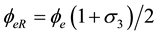 and
and , and we need now
 (B.17)
 (B.18)
 (B.19)
Appendix C. Gauge Invariance, Details
C.1. Gauge Group Generated by

We name
 the gauge transformation
 (C.1)
(C.1)
which implies
 (C.2)
(C.2)
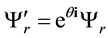 (C.3)
(C.3)
 (C.4)
(C.4)
 (C.5)
(C.5)
The equality (C.3) is equivalent to
 (C.6)
(C.6)
The equality (C.4) is equivalent to
 (C.7)
(C.7)
We get
 (C.8)
(C.8)
 (C.9)
(C.9)
 (C.10)
 (C.11)
This gives
 (C.12)
 (C.13)
 (C.14)
 (C.15)
 (C.16)
from which we get
 (C.17)
 (C.18)
 (C.19)
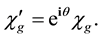 (C.20)
These relations are the awaited ones because
 (C.21)
 (C.22)
 (C.23)
C.2. Gauge Group Generated by

We name
 the gauge transformation
 (C.24)
which implies
 (C.25)
 (C.26)
 (C.27)
 (C.28)
This gives
 (C.29)
 (C.30)
 (C.31)
We then get
 (C.32)
 (C.33)
 (C.34)
 (C.35)
This implies
 (C.36)
 (C.37)
 (C.38)
 (C.39)
 (C.40)
We then get the awaited results
 (C.41)
 (C.42)
Notes

1The reversion is an anti-isomorphism changing the order of any product (see [1] 1.1). It is specific to each Clifford algebra. The Appendix A explains the link between the reversion in
 and the reversion in
 .
.

2 ,
,
 ,
,
 are unit matrices. The identification process allowing to include
 in each real Clifford algebra allows to read
 instead of
 for any complex number
 .
.
3 anti-commutes with any odd
element in space-time algebra and commutes with any even element.
anti-commutes with any odd
element in space-time algebra and commutes with any even element.