

Journal of Modern Physics
Vol.07 No.06(2016), Article ID:65297,6 pages
10.4236/jmp.2016.76058
Signature of Gravitational Waves in Stellar Spectroscopy
Shahen Hacyan
Instituto de Física, Universidad Nacional Autónoma de México, Ciudad de México, Mexico

Copyright © 2016 by author and Scientific Research Publishing Inc.
This work is licensed under the Creative Commons Attribution International License (CC BY).
http://creativecommons.org/licenses/by/4.0/



Received 16 January 2016; accepted 27 March 2016; published 31 March 2016
ABSTRACT
The possible detection of gravitational waves by interferometric observations of distant light sources is studied. It is shown that a gravitational wave affects the interferometric pattern of stellar light in a particular way. Michelson and Hanbury Brown-Twiss interferometers are considered, and it is shown that the latter is the most adequate for such a detection.
Keywords:
Gravitational Waves, Spectroscopy

1. Introduction
A gravitational wave (GW) could be detected indirectly by its interaction with the light emitted by astronomical objects. Thus, for instance, the passage of a GW produces a time delay in the signal received from distant sources (Estabrook and Wahlquist [1] ). Similarly, the presence of a stochastic background of GWs can be inferred from a statistical analysis of pulsar timing (Hellings and Downs [2] ). GWs can also interact with the polarization of electromagnetic waves (Hacyan [3] [4] ).
In this paper, we study the effect of GWs on the interferometry of stellar light. Two basic types of interfero- metric devices used in astronomy are considered: the Michelson (see, e.g., [5] ) and the Hanbury Brown-Twiss [6] interferometers. The former uses the interference between two signals, and the latter uses the interference between intensities of light. An intensity interferometer has, in general, some advantages over a Michelson interferometer. It will be shown in the following that the passage of a GW could be more easily detected by intensity interferometry.
Section 2 of the present paper is devoted to the analysis of an electromagnetic wave in the presence of a plane fronted GW. The analysis is based on previous works (Hacyan [3] [4] ) in which the form of the electromagnetic field is deduced using a short-wave length approximation. A general formula for the correlation of electric fields is obtained and the result is applied to interferometric analysis in Section 3; particular cases are worked out.
2. The Electromagnetic Field
The metric of a plane GW in the weak field limit is
 (1)
(1)
where the two degrees of polarization of the GW are given by the potentials  and
and , which are functions of u only. The relation with Minkowski coordinates t and z is

In the following, quadratic and higher order terms in f and g are neglected, and we set .
.
The direction of a light ray in the absence of a GW is k, with , the frequency of the (monochromatic) wave. We set

thus defining the angles  and
and . In the following, it will be convenient to define the functions
 (2)
(2)
 (3)
(3)
In the short-wave length approximation, the electromagnetic potential is taken as

where S is the eikonal function satisfying the equation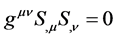 . Then,
  is a null-vector defining the direction of propagation of the electromagnetic wave, and
  is a four-vector such that
 .
.
The electromagnetic vector is [4]
 (4)
(4)
where  is a time-like four-vector and
  is the frequency measured by a detector with
  tangent to its world-line. Choosing
 , it follows that
 (5)
(5)
and the eikonal function is

As in Ref. [4] , for a plane wave we use a gauge such that , which is equivalent to

where  is the unit vector in the direction of propagation of the GW.
The four vector  depends on the coordinate u through the functions
  and
and . With the gauge
 , a particular solution is [4]
 (6)
(6)
where  and
and  are constants defining an electromagnetic plane wave in the absence of GWs.
Let us use a tetrad  such that
 , where
  is the Minkowski matrix. Then, if
 , the tetrad is defined by
 (7)
(7)
Accordingly the tetrad components of  and
and  are
are
 (8)
(8)
and
 (9)
(9)
Notice in particular that , and
, and , as it should be.
The electric field in tetrad components is
 (10)
(10)
and of course .
.
Correlations
For an electromagnetic plane wave with wave vector , we find after some lengthy but straightforward algebra (keeping only terms of first order)
 (11)
(11)
where


are Stokes parameters ( for linear and
  for circular polarizations).
3. Interferometry
Consider two detectors with space-time coordinates  and
and , each receiving two plane electromagnetic waves with wave-vectors
  and
and , and use the shorthand notation
 (12)
(12)
where
 (13)
(13)
 (14)
(14)
the subindexes a, b and j refer to the labels 1 and 2 of x and k.
A Michelson interferometer permits to measure the average intensity
 (15)
(15)
where the second term is the interference term.
A Hanbury Brown-Twiss interferometer permits to measure the interference between intensities:
 (16)
(16)
where the second term is the interference between the two intensities.
Define


With this notation, we have for a Michelson interferometer:
 (17)
(17)
and for a Hanbury Brown-Twiss interferometer:
 (18)
(18)
Define also the complex functions

and

Then
 (19)
(19)
and
 (20)
(20)
In the absence of GWs,  , and
, and


implying that  is time independent. It thus follows that the time variation of
  is due entirely to the presence of a GW. This time dependence can be made explicit setting


where ,
,  ,
,  , and
, and  are small terms due to the GW. This implies that the terms
  and
and  are of first order in the potentials f and g of the GW.
It should be noticed that the field correlation  contains terms such as
 , which are
highly oscillatory and hinder a precise measurement with a Michelson interferometer. On the other hand, such terms do not appear in the correlation of the intensities:
 (21)
(21)
The time dependence is included only in the terms  and
and , which are entirely due to the passage of the GW. The term with
  is not present in this last formula.
3.1. Temporal Coherence
As a particular application of the above formulas, we can calculate the temporal coherence of a single signal in the presence of a GW. This can be obtained setting ,
,  , and
, and . Then
  and accordingly
 (22)
(22)
and
 (23)
(23)
Explicitly, in this particular case,
 (24)
(24)
which is the only relevant term for the time correlation of the intensity correlation, and is entirely due to the GW.
3.2. Sinusoidal Waves and Pulses
In the particular case of a sinusoidal monochromatic GW of frequency , we can set
 (25)
(25)
where  is a complex constant and
  a constant phase.
As for a pulse of GW, it can be approximated by a delta function: . In this case, only
  is changed after
 . We have
 (26)
(26)
where  is a function such that
  if
if  and
and  otherwise. Thus, a pulse of gravitational wave would produce a change both in
  and
and .
.
4. Conclusion
The main conclusion from the present results is that the passage of a GW produces a time-dependent perturbation in the intensity interference of a distant light sources, an interference which would otherwise have a
static pattern. Thus, a time variation of  will denote the passage of a gravitational wave. A similar effect would be more difficult to observe with
 , a direct signal interferometer, due to the presence of highly oscillating terms, as shown above.
Cite this paper
Shahen Hacyan, (2016) Signature of Gravitational Waves in Stellar Spectroscopy. Journal of Modern Physics,07,552-557. doi: 10.4236/jmp.2016.76058
References
- 1. Estabrook, G.S. and Wahlquist, H.D. (1975) General Relativity and Gravitation, 6, 439-447.
http://dx.doi.org/10.1007/BF00762449 - 2. Hellings, R.W. and Downs, G.S. (1983) The Astrophysical Journal, 265, L39-L42.
http://dx.doi.org/10.1086/183954 - 3. Hacyan, S. (2012) General Relativity and Gravitation, 44, 2923-2931.
http://dx.doi.org/10.1007/s10714-012-1434-4 - 4. Hacyan, S. (2016) International Journal of Modern Physics A, 31, 1641023, 8 p.
http://dx.doi.org/10.1142/S0217751X16410232 - 5. Hariharan, P. (2007) Basics of Interferometry. 2nd Edition, Elsevier, Amsterdam.
- 6. Hanbury Brown, R. and Twiss, R.Q. (1956) Nature, 178, 1046-1048.
http://dx.doi.org/10.1038/1781046a0