

Open Journal of Statistics
Vol.06 No.01(2016), Article ID:63653,11 pages
10.4236/ojs.2016.61011
Improved Estimation of Rare Sensitive Attribute in a Stratified Sampling Using Poisson Distribution
Abdul Wakeel, Masood Anwar
Department of Mathematics, COMSATS Institute of Information Technology, Islamabad, Pakistan

Copyright © 2016 by authors and Scientific Research Publishing Inc.
This work is licensed under the Creative Commons Attribution International License (CC BY).
http://creativecommons.org/licenses/by/4.0/



Received 21 December 2015; accepted 20 February 2016; published 23 February 2016
ABSTRACT
In this study, we propose a two stage randomized response model. Improved unbiased estimators of the mean number of persons possessing a rare sensitive attribute under two different situations are proposed. The proposed estimators are evaluated using a relative efficiency comparison. It is shown that our estimators are efficient as compared to existing estimators when the parameter of rare unrelated attribute is known and in unknown case, depending on the probability of selecting a question.
Keywords:
Poisson Distribution, Rare Sensitive Attribute, Rare Unrelated Attribute, Stratified Sampling

1. Introduction
The collection of data through direct questioning on rare sensitive issues such as extramarital affairs, family disturbances and declaring religious affiliation in extremism condition is far-reaching issue. Warner [1] introduced the randomized response procedure to procure trustworthy data for estimating , the proportion of respondents in the population belonging to the sensitive group. Greenberg et al. [2] suggested an unrelated question randomized response model in which each individual selected in the samples was asked to reply “yes” or “no” to one of two statements: (a) Do you belong to Group A? (b) Do you belong to Group Y? with respective probabilities P and
 . Second question asked in the sampling does not have any effect on the first question. Greenberg et al. [2] considered
  and
and  the proportion of persons possessing sensitive and unrelated characteristic respectively and discussed both the cases when
  was known and unknown. The probability of yes responses
 , defined by them is
 . Mangat and Singh [3] proposed a two stage randomized response procedure which required the use of two randomization devices. The random device
  consists of two statements namely (a) I belong to the sensitive group, and (b) Go to random device
 , with probabilities T and
  respectively. The random device
  which uses two statements (a) I belong to the sensitive group, and (b) I do not belong to the sensitive group with known probabilities P and
  respectively. Then
 , the probability of yes responses is
 .
.
Later on, different modifications have been made to improve the methodology for collection of information. Some of them are Lee et al. [4] , Chaudhuri and Mukerjee [5] , Mahmood et al. [6] , Land et al. [7] , Bhargava and Singh [8] .
Land et al. [7] proposed the estimators for the mean number of persons possessing the rare sensitive attribute using the unrelated question randomized response model by utilizing a Poisson distribution. Recently, Lee et al. [4] extended the Land et al.’s [7] study to stratify sampling and propose the estimators when the parameter of rare unrelated attribute is known and unknown.
In this study, we propose improved estimators for the mean and its variance of the number of persons possessing a rare sensitive attribute based on stratified sampling by using Poisson distribution. The estimators are proposed when the parameter of the rare unrelated attribute is known and unknown. The proposed estimators are evaluated using a relative efficiency comparing the variances of the estimators reported in Lee et al. [4] .
2. Improved Estimation of a Rare Sensitive Attribute in Stratified Sampling-Known Rare Unrelated Attributes
Consider the population of size N individuals which is divided into L subpopulations (strata) of sizes . All the subpopulations are disjoint and together comprise the whole population. In stratum h,
  respondent are selected by simple random sampling with replacement (SRSWR) and asked to use the pair of randomization devices
  and
and , each consisting of the two statements. The randomization device
  is constructed as:
(i) “I possessrare sensitive attribute A”
(ii) “Go to randomization device Rh2”
with respective probabilities  and
and .
.
The randomization device  consists of two statements:
(i) “I possess rare sensitive attribute A”
(ii) “I possess rare unrelated attribute Y”
with probabilities  and
and  respectively.
By this randomized device, the probability of a yes response in stratum h is given by
 , (1)
, (1)
where  and
and  are the population proportions of individuals possessing rare sensitive and rare unrelated attributes in the
  stratum, respectively. Here
  is assumed to be known. Since A and Y are very rare attributes,
  is finite, assuming
  and
and .
.
Let  be an
be an  random sample in stratum h from a Poisson distribution with parameter
 . Then the maximum likelihood estimator for the mean number of persons who have the rare sensitive attribute in stratum h,
  , is given by
 , (2)
, (2)
where  is (known) mean of persons who have rare unrelated attribute in stratum h. The parameter
 , is the mean number of persons possessing rare sensitive attribute A, in a population of size N and its estimator
  is given by
 , (3)
, (3)
where .
.
The variance of the estimator  in each stratum is given by
 , (4)
, (4)
where
 .
.
Thus, the variance expression of the estimator  may be derived as
 . (5)
. (5)
THEOREM 1.  is an unbiased estimator of
 .
.
Proof. From (3), we have

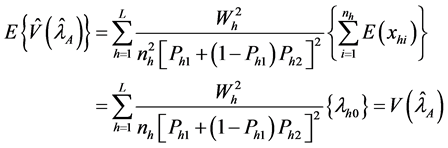
THEOREM 2. The unbiased estimator for  is given by
 . (6)
. (6)
Proof.
Now, we consider the proportional and optimal allocations of the total sample size n into different strata. The method of proportional allocation is used to define sample sizes in each stratum depending on each stratum size. Since the sample size in each stratum is defined as , the variance of the estimator
 , under proportional allocation of sample size is given by
 . (7)
. (7)
However, the optimal allocation is a technique to define sample size to minimize variance for a given cost or to minimize the cost for a specified variance. The  is proportionate to the standard deviation,
  of the va-
riable. In stratified sampling, let cost function is defined as , where
  is the fixed cost and
 is the cost for the each individual stratum. Within each stratum the cost is proportional to the size of sample, but the cost
  may vary from stratum to stratum. For fixed cost, using the Cauchy Schwarz inequality, the sample size
  to minimize
  is given by
 (8)
(8)
So the minimum variance of the estimator for the specified cost C under the optimum allocation of sample size is given by
 . (9)
. (9)
3. Improved Estimation of a Rare Sensitive Attribute in Stratified Sampling-Unknown Rare Unrelated Attributes
In this section, the estimators for the mean number of rare sensitive attribute are proposed under the assumptions that the sizes of stratum are known; however,  , the mean of the rare unrelated attribute is unknown. In this case each selected respondent from stratum h is asked to use the sequential pair of randomization devices. That in the hth stratum,
  , respondents are asked to use the randomization devices
  and
and  consisting of two statements. The device
  consists of two statements:
(i) “I possess a sensitive group A”
(ii) “Go to randomization device Rh2”
The statements occur with respective probabilities  and
and .
.
The two statements of the randomization device  are:
are:
(i) “I possess a sensitive attribute A”
(ii) “I possess unrelated attribute Y”
represented with respective probabilities  and
and . After using the first pair of randomized devices, respondent is asked to use the same pair of devices
  and
and  but with probabilities
 ,
,  and
and ,
,  , respectively.
The probabilities of the yes responses for the first and second use of pair of randomization devices are respectively given by
 (10)
(10)
and
 , (11)
where  and
and  are the respective population proportions of rare sensitive and rare unrelated attribute in the stratum h. As
  is large and
 , therefore
 . Now, obviously
 ,
,
 . Let
. Let  and
and  (
(
 ) be the pair of responses from the ith respondent selected in hth stratum. We have
 (12)
(12)
 (13)
(13)
 (14)
(14)
Following the expression given in Equations (12) and (13), we have the sample means for both set of responses as
 (15)
(15)
and
 . (16)
By solving (15) and (16), we get estimators of  and
and  as
as
 (17)
(17)
 (18)
(18)
where
 and
and .
.
 (19)
(19)
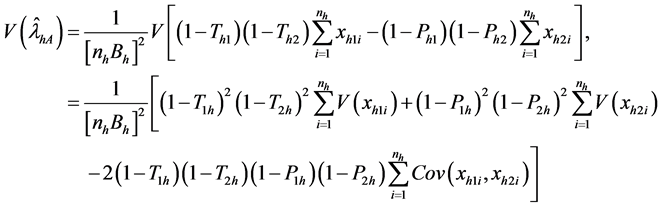
Puttinng (12), (13) and (14) in (19) we get
 , (20)
where


The stratified estimators of  and
and  are defined as
 , and
, and . (21)
THEOREM 3.  is an unbiased estimator for
 .
.
Proof.
 (22)
(22)
Putting the values of  and
and  in Equation (22), we get the result.
THEOREM 4. The variance of  is given by
 , (23)
where


Proof. Since , we have
 (24)
(24)
On putting (20) in (24) we have the theorem.
Corollary 1: An unbiased estimator for the variance of rare sensitive attribute is given by
 (25)
(25)
It can be proved easily.
THEOREM 5.  is an unbiased estimator of
 .
.
Proof. From (18), we have

Corollary 2: An unbiased estimator for  is given by
 (26)
(26)
where



Now under proportional allocation of sample size, the variance of  is given by
 .
.
However, in optimum allocation, the sample size in stratum h is

and the variance of  is given by
 .
.
4. Relative Efficiency
Lee et al. [4] proposed variance of  for rare sensitive attribute based on Poisson distribution when the rare unrelated attribute known and unknown respectively is:
 , (27)
 (28)
(28)
where


For comparison of the proposed estimator with , the relative efficiency is given by
 .
.
Large samples are required to estimate the means of rare sensitive attribute. So we consider a large hypothetical population, in order to study the relative efficiency, setting  with two strata having
  and
and . We choose values of the parameters
 ,
,  as
as  and
and , and we let the value
  range from 0.3 to 0.7, and let that of
  range from 0.6 to 0.9 when the weights
  (and
(and  ) and
) and  (and
(and ) which is proportional allocation. Also, let (
 ) and (
 ).
).
4.1. Relative Efficiency When Rare Unrelated Attribute Is Known
Let  be the variance of the proposed estimator
  for the rare sensitive attribute when the parameter of rare unrelated attribute is known. The relative efficiency of proposed estimator with respect to
  estimator is defined as
 . (29)
From Equation (29) it evident that the relative efficiency of proposed estimator is free from the sample size n. We set the design probabilities as  and
and . In Table 1, the relative efficiencies are given with parameter values
 ,
,  as
as  and
and ,
,  varies from 0.3 to 0.7, and
  from 0.6 to 0.9 having weights
 . It is evident that the proposed estimator has efficiency greater than 1 in all cases, and is always better than the
  estimator. A study of Figure 1 confirms this.
4.2. Relative Efficiency When Rare Unrelated Attribute Is Unknown
Let  be the variance of the proposed estimator
  for the rare sensitive attribute when the parameter of rare unrelated attribute is unknown. The relative efficiency of proposed estimator with respect to
  estimator is defined as
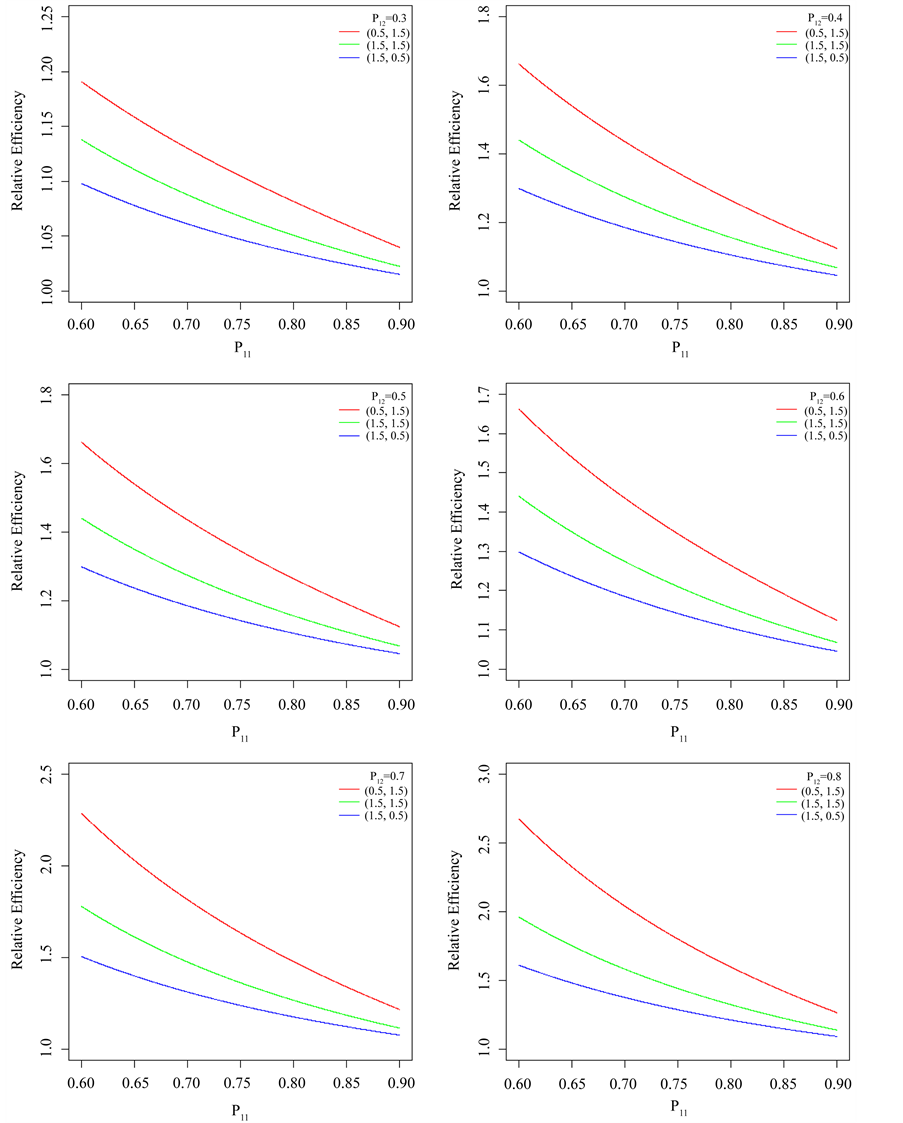
Figure 1. Relative Efficiency (RE) of the proposed model with respect to Lee et al. [4] for W1 = 0.4 and P12 = 0.3 to 0.8.
 . (30)
The relative efficiency of proposed estimator is free from the sample size n. For the analysis, the design probabilities are fixed as ,
,  ,
,  ,
, . Setting
 ,
,  with parameter values of
 ,
,  as
as  and
and ,
,  , T12 = 0.2, 0.3, 0.4, 0.5 and
 . The relative efficiencies are given in Table 2 depict that the proposed
estimator outer perform than  estimator having efficiency greater than 1 if we set the probabilities as
 . However the relative efficiency starts decreasing as we take
 . A study of Figure 2 confirms this. Also, when
  increasesthe relative efficiency of proposed estimator increases.
Table 1. Relative efficiency of the proposed estimator with Lee et al. (2013).
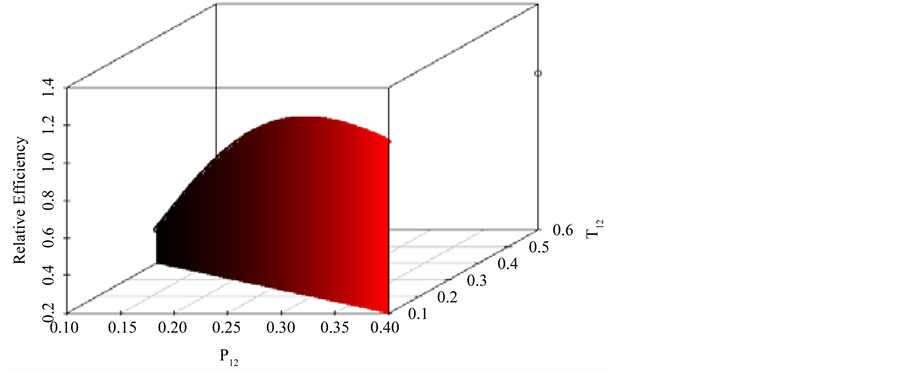
Figure 2. Relative Efficiency (RE) of the proposed model with respect to Lee et al. [4] for indicated values.
Table 2. Relative efficiency of the proposed estimator with Lee et al. (2013), W1 = 0.4, and W1 = 0.5.
5. Conclusion
In this study, a two stage randomized response model is proposed with improved estimators for the mean and its variance of the number of persons possessing a rare sensitive attribute based on stratified sampling by using Poisson distribution. It is shown that our proposed method have better efficiencies than the existing randomized response model, when the parameter of rare unrelated attribute is known and in unknown case, depending on the probability of selecting a question. For future work, we can obtain more sensitive information from respondents by using stratified double sampling with the proposed model.
Cite this paper
AbdulWakeel,MasoodAnwar, (2016) Improved Estimation of Rare Sensitive Attribute in a Stratified Sampling Using Poisson Distribution. Open Journal of Statistics,06,85-95. doi: 10.4236/ojs.2016.61011
References
- 1. Bhargava, M. and Singh, R. (2000) A Modified Randomization Device for Warner’s Model. Statistica, 60, 315-321.
- 2. Land, M., Singh, S. and Sedory, S.A. (2012) Estimation of a Rare Sensitive Attribute Using Poisson Distribution. Statistics, 46, 351-360.
http://dx.doi.org/10.1080/02331888.2010.524300 - 3. Mahmood, M., Singh, S. and Horn, S. (1998) On the Confidentiality Guaranteed under Randomized Response Sampling: A Comparison with Several New Techniques. Biometrical Journal, 40, 237-242.
http://dx.doi.org/10.1002/(SICI)1521-4036(199806)40:2<237::AID-BIMJ237>3.0.CO;2-N - 4. Chaudhuri, A. and Mukerjee, R. (1988) Randomized Response: Theory and Techniques. Marcel Dekker, New York.
- 5. Lee, G.S., Uhm, D. and Kim, J.M. (2013) Estimation of a Rare Sensitive Attribute in a Stratified Sample Using Poisson Distribution. Statistics, 47, 685-709.
http://dx.doi.org/10.1080/02331888.2011.625503 - 6. Mangat, N.S. and Singh, R. (1990) On the Confidentiality Guaranteed under Randomized Response Sampling: A Comparison with Several New Techniques. Biometrical Journal, 40, 237-242.
- 7. Greenberg, B.G., Abul-Ela, A.L.A., Simmons, W.R. and Horvitz, D.G. (1969) The Unrelated Question Randomized Response Model: Theoretical Framework. Journal of the American Statistical Association, 64, 520-539.
http://dx.doi.org/10.1080/01621459.1969.10500991 - 8. Warner, S.L. (1965) Randomized Response: A Survey Technique for Eliminating Evasive Answer Bias. Journal of Computational and Graphical Statistics, 60, 63-66.
http://dx.doi.org/10.1080/01621459.1965.10480775