

Advances in Linear Algebra & Matrix Theory
Vol.05 No.02(2015), Article ID:56990,8 pages
10.4236/alamt.2015.52004
Inverse Nonnegativity of Tridiagonal M-Matrices under Diagonal Element-Wise Perturbation
Mohamed A. Ramadan1, Mahmoud M. Abu Murad2
1Department of Mathematics, Faculty of Science, Menoufia University, Shebeen El-Kom, Egypt
2Department of Mathematics, Faculty of Science, Zagazig University, Ash Sharqiyah, Egypt
Email: ramadanmohamed13@yahoo.com, mramadan@eun.eg, abomorad1978@yahoo.com, mabumurad@su.edu.sa
Copyright © 2015 by authors and Scientific Research Publishing Inc.
This work is licensed under the Creative Commons Attribution International License (CC BY).
http://creativecommons.org/licenses/by/4.0/



Received 24 March 2015; accepted 6 June 2015; published 9 June 2015
ABSTRACT
One of the most important properties of M-matrices is element-wise non-negative of its inverse. In this paper, we consider element-wise perturbations of tridiagonal M-matrices and obtain bounds on the perturbations so that the non-negative inverse persists. The largest interval is given by which the diagonal entries of the inverse of tridiagonal M-matrices can be perturbed without losing the property of total nonnegativity. A numerical example is given to illustrate our findings.
Keywords:
Totally Positive Matrix, Totally Nonnegative Matrix, Tridiagonal Matrices, Compound Matrix, Element-Wise Perturbations

1. Introduction
In many mathematical problems,  -matrices and
  -matrices play an important role. It is often useful to know the properties of their inverses, especially when the
  -matrices and the M-matrices have a special combinatorial structure, for more details we refer the reader [1] . M-matrices have important applications, for instance, in iterative methods, in numerical analysis, in the analysis of dynamical systems, in economics, and in mathematical programming. One of the most important properties of some kinds of M-matrices is the nonegativity of their inverses, which plays central role in many of mathematical problems.
An  real matrix
  is called M-matrix if
 ,
,  and
and ,
,  , over the years, M-matrices have considerable attention, in large part because they arise in many applications [2] [3] . Recently, a noticeable amount of attention has turned to the inverse of tridiagonal M-matrices (those matrices which happen to be inverses of special form of M-matrices with property
  whenever
 ) and
) and  is generalized strictly diagonally dominant. A matrix is said to be generalized (strictly) diagonally dominant
if . Of particular importance to us is the fact that since
  is an M-matrix it is non-singular and
 >0where the inequality is satisfied element-wise. A rich class of M-matrices were introduced by Ostrowski in 1937 [4] , with reference to the work of Minkowski [5] [6] . A condition which is easy to check is that a matrix
  is an M-matrix if and only if
 ,
,  and
and , and
, and  is generalized strictly diagonally dominant.
In this paper, we consider the inverse of perturbed M-matrix. Specifically we consider the effect of changing single elements inside the diagonal of . We are interested in the large amount by which the single diagonal element of
  can be varied without losing the property of total nonnegativity.
The reminder of the paper is organized as follows. In section 2, we explain our notations and some needed important definitions are presented. In section 3, some auxiliary results and important prepositions and lemmas are stated. In section 4, we present our results.
2. Notations
In this section we introduce the notation that will be used in developing the paper. For  we denote by
  the set of all strictly increasing sequences of
  integers chosen from
 . For
. For ,
,  , we denote by
  the
the  submatrix of
  contained in the rows indexed by
  and columns indexed by
 . A matrix
  is called totally positive (abbreviated TP henceforth) if
  and totally nonnegative (abbreviated TN) if
  for all
 ,
, . For a given index
 , with property
 ,
,  , the dispersion of
 ,
,
denoted by , is defined to be
 .
.
Throughout this paper we use the following notation for general tridiagonal M-matrix:

where ,
,  and
and , and each
  is large enough that
  is strictly diagonally dominant.
We let  to be the square standard basis matrix whose only nonzero entry is 1 that occurs in the
  position.
Definition 2.1 Compound Matrices ([7] , p. 19).
Let  be a square matrix of order
 . Let
. Let  be the index set of cardinality
 , defining
 ,
,  are the index sets of cardinality
 .
.
Construct the following table which depends on .
.
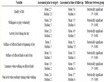
The created matrix 
is called , compound matrix of
 .
.
For example, if
 with indexed sets
 ,
,  and
and .
.
Then .
.
3. Auxiliary Results
We start with some basic facts on tridiagonal M-matrices. We can find the determinant of any  tridiagonal M-matrix
  by using the following recursion equation [8] [9] .

And we have the following proposition for finding the determinant of a  tridiagonal M-matrix
 .
.
Proposition 3.1 ([10] , formula 4.1) For any  tridiagonal M-matrix
  the following relation is true
 .
.
We will present now some of propositions of nonsingular totally nonnegative matrices which important for our work.
Proposition 3.2 [10] [11]
For any nonsingular totally nonnegative matrix , all principle minors are positive.
That is , for all
  and
and .
.
Proposition 3.3 ([7] , p. 21)
Let M be a nonsingular tridiagonal M-matrix, and  be the inverse of the matrix M then
 , when.
In the sequel we will make use the following lemma, see, e.g. [12] .
Lemma 3.4 (Sylvester Identity)
Partition square matrix  of order n,
  , as:
, as:
 ,
,
where  square matrix of order
  and
and ,
,  ,
,  and
and  are scalars.
Define the submatrices

If  is nonsingular, then

Lemma 3.5 ([11] , p.199) Let  be a square matrix of order
 , with
 . Then
 is totally nonnegative
 .
.
We now state an important result which links the determinant of M-matrix with the value of the elements of its inverse.
Lemma 3.6 [10] Let  be a tridiagonal matrix of order n, then we can find the elements of in-
verse matrix  by using the following formula
 .
.
4. Main Results
In this section, we present our results based on the inverse of tridiagonal M-matrices. Firstly we begin with the following theorem.
Theorem 4.1
Let  be strictly diagonally dominant M-matrix.
If  is the
  compound matrix of M then the matrix
  is totally nonnega-
tive matrix. Moreover,  where
where 
Proof: Let  be strictly diagonally dominant M-matrix.
Then  is totally nonnegative matrix. So is
 .
.
You can find this formula in ([7] , p. 21).
There is an explicit formula for the determinant of  given as

Multiply the first row by  and add it to the
  row to obtain

where ,
,
And now apply an induction argument to get the result.
Numerical Example: Let  be strictly diagonally dominant M-matrix, then
 and
and  is totally nonnegative.
Note that  and
and 

Numerically we can conclude the following fact.
Fact: For any  tridiagonal M-matrix
  the following formula is true.
 for
for
Moreover, 
To prove this result we use Theorem 4.1.
Suppose M is nonsingular then , so
, so

For example, when , the M-matrix of our form
 has an inverse given as


Similarly we can find .
.
Illustrative Example: Let  be a tridiagonal M-matrix and

Note that 
Observe that the error came from the rounded to the nearest part of 10,000.
Theorem 4.2 Let M be a strictly diagonally dominant M-matrix, if ,
,  ,
,  then
then

Proof:
Assume  and
and
 , , ,.
Note that  by previous fact, and by using Sylvester's identity, we have

Moreover we conclude the following theorem.
Theorem 4.3 Let M be the M-matrix defined above then

For example
 ,
,
Let  then
then 
 and
and
Now, we will perturb elements inside the diagonal band of the inverse of M-matrix without losing the nonnegativity property. We begin with the  element then generalize to other elements.
Theorem 4.4 Let M be a strictly diagonally dominant tridiagonal  -matrix. Then the matrix
is totally nonnegative for all .
.
Proof:
Let 
Be a nonsingular strictly diagonally dominant tridiagonal M-matrix then  is totally nonnegative.
By Lemma 3.5 and Proposition 3.2, we have
 is totally nonnegative
 .
.
By using the formula in Proposition 3.3
 .
.
Note that a similar result holds for decreasing the element  by considering the matrix
 , which reverses the matrix
  as the relation
 .
.
We can generalize this result for the other elements of diagonal.
Theorem 4.5 Assume M is a strictly diagonally dominant tridiagonal M-matrix. Then the matrix 
is totally nonnegative for all .
.
Proof: Suppose that  is not totally nonnegative for all
 , then there exist
 both contain
  such that
 .
.
To compute  expand the determinant along the
  row of
  then
then
 where
where ,
,  , and
, and  is some minor of
 .
.
Take the case when  odd. Thus,
  is a positive linear compination of minors of
  and hence is positive, which contradicts the assumption.
Now suppose  such that
  is totally nonnegative matrix.
Suppose that , then by Theorem 4.3.
 , since
which contradicts the nonnegativity of .
.
Numerical Example: Let  is strictly diagonally dominant tridiagonal M-matrix
 so
so
The matrices
 , ,
, ,
 , ,
, ,
 , , and
 ,.
,.
are TNN matrices.
Note that .
.
References
- McDonald, J.J., Nabben, R., Neumannand, M., Schneider, H. and Tsatsomeros, M.J. (1998) Inverse Tridiagonal Z-Matrices. Linear and Multilinear Algebra, 45, 75-97. http://dx.doi.org/10.1080/03081089808818578
- Berman, A. and Plemmons, R. (1979) Nonnegative Matrices in the Mathenlatical Sciences. Academic, New York.
- Peña, J.M. (1995) M-Matrices Whose Inverses Are Totally Positive. Linear Algebra and Its Applications, 221, 189- 193. http://dx.doi.org/10.1016/0024-3795(93)00244-T
- Ostrowski, A. (1937) Über die Determinanten mit überwiegender Hauptdiagonale. Commentarii Mathematici Helvetici, 10, 69-96. http://dx.doi.org/10.1007/BF01214284
- Minkowski, H. (1900) Zur Theorie der Einheiten in den algebraischen Zahlkörper. Nachrichten von der Königl. Gesellschaft der Wissenschaften und der Georg-Augusts-Universität zu Göttingen Mathematisch-Physikalische Klasse: Fachgruppe II, Nachrichten aus der Physik, Astronomie, Geophysik, Technik, 90-93.
- Minkowski, H. (1907) Diophantische Approximationen. Tuebner, Leipzig. http://dx.doi.org/10.1007/978-3-663-16055-7
- Horn, R. and Johnson, C. (1991) Topics in Matrix Analysis. Cambridge University Press, Cambridge. http://dx.doi.org/10.1017/CBO9780511840371
- Adm, M. and Garloff, J. (2014) Invariance of Total Nonnegativity of a Tridiagonal Matrix under Element-Wise Perturbation. Operators and Matrices, 8, 129-137. http://dx.doi.org/10.7153/oam-08-06
- Ando, T. (1987) Totally Positive Matrices. Linear Algebra and Its Applications, 90, 165-219. http://dx.doi.org/10.1016/0024-3795(87)90313-2
- Pinkus, A. (2010) Totally Positive Matrices. Cambridge Tracts in Mathematics (No. 181). Cambridge University Press, Cambridge.
- Fallat, S.M. and Johnson, C.R. (2011) Totally Nonnegative Matrices. Princeton University Press, Princeton, Oxford. http://dx.doi.org/10.1515/9781400839018
- Adam, M. and Garloff, J. (2013) Interval of Totally Nonnegative Matrices. Linear Algebra and Its Applications, 439, 3796-3806. http://dx.doi.org/10.1016/j.laa.2013.10.021