

Advances in Infectious Diseases Vol.05 No.01(2015), Article ID:54138,12
pages
10.4236/aid.2015.51001
Mathematical Analysis of Control Strategies of HCV in a Community with Inflow of Infected Immigrants
Neterindwa Ainea1*, Estomih S. Massawe1, Oluwole Daniel Makinde2, Lucy Namkinga3
1Mathematics Department, University of Dar es Salaam, Dar es Salaam, Tanzania
2Faculty of Military Science, Stellenbosch University, Cape Town, South Africa
3Department of Molecular Biology and Biotechnology, University of Dar es Salaam, Dar es Salaam, Tanzania
Email: *neteainea@gmail.com
Copyright © 2015 by authors and Scientific Research Publishing Inc.
This work is licensed under the Creative Commons Attribution International License (CC BY).
http://creativecommons.org/licenses/by/4.0/



Received 24 January 2015; accepted 15 February 2015; published 16 February 2015
ABSTRACT
In this paper, we derive and analyse rigorously a mathematical model of control strategies (scree- ning, education, health care and immunization) of HCV in a community with inflow of infected immigrants. Both qualitative and quantitative analysis of the model is performed with respect to stability of the disease free and endemic equilibria. The results show that the disease free equilibrium is locally stable at threshold parameter less than unity and unstable at threshold parameter greater than unity. Using Lyapunov method, endemic equilibrium is globally stable under certain conditions. Numerical simulation of the model is implemented to investigate the sensitivity of certain key parameters on the HCV model in a community with inflow of infected immigrants. However, analysis shows that screening, education, health care and immunization have the effect of reducing the transmission of the disease in the community.
Keywords:
HCV Disease, Infected Immigrants, Stability, Sensitivity Index, Lyapunov Method, Screening, Education, Health Care and Immunization

1. Introduction
Hepatitis C is a blood borne liver disease, caused by the Hepatitis C Virus (HCV), first identified by [1] . Moreover, the link between infectious diseases and screening must be understood in relation to infectives on the spread of HCV infections. [2] analysed the screening of HCV in a health maintenance Organization. Mathematical modelling of the spread of infectious diseases continues to become an important tool in understanding the dynamics of diseases and in decision making processes regarding diseases intervention programs for disease in many countries. For instance, [3] formulated and analysed a mathematical model on the effect of Treatment and Infected Immigrants on the spread of Hepatitis C Virus disease at Acute and Chronic stages. [4] considered SEI (Susceptible-Exposed-Infective) epidemic model with acute and chronic stages. [5] investigated the effects of a HCV educational intervention or a motivational intervention on alcohol use and sexual risk behaviours among injection drug users. [6] studied the potential impact of vaccination on the hep C virus epidemic in injection drug users. [7] presented the study on immunization strategies in chronic HCV infection. [8] reported that HCV patient education is associated with positive outcomes in various models of HCV care. However, in all the above studies, none of them incorporated the HCV infectiology and control strategies (screening, education, health care and immunization) in a community with inflow of infected immigrants. The aim of the paper is to have a deeper understanding of the effects of screening, education, health care and immunization in controlling the spread of HCV.
2. Model Formulation
A mathematical model is proposed and analysed to study the effect of screening,
education, health care and immunization on the spread of HCV disease in the community.
The model has five epidemiological classes: The susceptible , exposed individuals
 , the acute Infectives
 , the chronic infectives
 and recovered group
 .
Total population at time
.
Total population at time
 is given by:
 (1)
(1)
The interaction between the classes is being assumed as follows: Exposed individuals,
acute infected and chronic infected immigrants enter into the population with the
rates
 respectively. Susceptible individuals are infected with the HCV virus at a rate
 , where
 and
and
 are effective contact rate of individuals with acute and chronic hepatitis C respectively. It is
assumed that the rate of contact of susceptibles with chronic individuals is much
less than that of acute infectives
are effective contact rate of individuals with acute and chronic hepatitis C respectively. It is
assumed that the rate of contact of susceptibles with chronic individuals is much
less than that of acute infectives
 because at chronic stage, people become aware of their infection and may choose
to use control measures and change their behaviour and thus may contribute little
in spreading the infection. The control variable based on screening programme aimed
at, reduces the inflow of infected immigrants into the community at the rate
because at chronic stage, people become aware of their infection and may choose
to use control measures and change their behaviour and thus may contribute little
in spreading the infection. The control variable based on screening programme aimed
at, reduces the inflow of infected immigrants into the community at the rate
 and
and
 is the control variable based on education, health care and immunization to decrease
the infection contact rate.
is the control variable based on education, health care and immunization to decrease
the infection contact rate.
Taking into account the above considerations, we then have the following schematic flow diagram (Figure 1):

Figure 1. Model flowchart.
From the above flow chart, and with

the model will be governed by the following system of equations:
 (2)
(2)
with nonnegative initial conditions and .
.
where
 are
the effective contact rates of individuals with acute and HCV respectively,
are
the effective contact rates of individuals with acute and HCV respectively,
 are
the rates at which exposed, acute and Chronic infected immigrants enter into the
population respectively,
are
the rates at which exposed, acute and Chronic infected immigrants enter into the
population respectively,
 is
the recruitment rate,
is
the recruitment rate,
 is
the rate of progression to acute infected class from exposed class,
is
the rate of progression to acute infected class from exposed class,
 are
the rates at which acute and exposed infective develop chronic respectively,
are
the rates at which acute and exposed infective develop chronic respectively,
 are
the rates at which acute and chronic individuals recovered respectively,
are
the rates at which acute and chronic individuals recovered respectively,
 is
the death rate of acute infected group due to the disease,
is
the death rate of acute infected group due to the disease,
 is
the rate at which infectious humans after recovery become immediately susceptible
again,
is
the rate at which infectious humans after recovery become immediately susceptible
again,
 is
the natural death rate,
is
the natural death rate,
 is
the death rate of chronic infected group due to the disease,
is
the death rate of chronic infected group due to the disease,
 is
the screening rate of infected immigrants.
is
the screening rate of infected immigrants.
3. Model Analysis
The model system of Equations (2) will be analysed qualitatively to get insight
into its dynamical features which will give a better understanding of the effects
of screening, education, health care and immunization on the transmission of HCV
infection in the population with inflow of infected immigrants. The threshold which
governs elimination or persistence of HCV will be determined and studied. We begin
by finding the invariant region and show that all solutions of system (2) are positive .
.
3.1. Invariant Region
In this section, a region in which solutions of the model system (2) are uniformly bounded is the proper subset

Let
 be any solution with positive initial conditions. Then from Equation (2) it is noted
that in the absence of the disease related mortality (i.e.
be any solution with positive initial conditions. Then from Equation (2) it is noted
that in the absence of the disease related mortality (i.e. ),
the rate of change of the population is given by,
),
the rate of change of the population is given by,
 (3)
(3)
Using Birkhoff and Rota’s theorem [9] on the differential inequality (3), the following expression is obtained;
 (4)
(4)
where
 is the value evaluated at the initial conditions of the respective variables.
Thus, as
 in (4), the population size,
 ,
which implies that
,
which implies that
 In respectof this, all the feasible solutions of system (2) enter the region
 .
.
Hence,
 is
positively invariant and it issufficient to consider solutions in
is
positively invariant and it issufficient to consider solutions in .
.
Furthermore, existence, uniqueness and continuation of results for system (2) hold in this region.
Lemma 1: The region
 is positively invariant for the model system (2) with initial conditions in
 .
.
3.2. Positivity of Solutions
Lemma 2: Let the initial data be
 then, the solution set
 of the system (2) is positive

Proof:
From the first equation of the model system (2), we have


The Integration factor is ,
multiplying both sides by the integration factor and integrating leads to
,
multiplying both sides by the integration factor and integrating leads to


Equations for
 can be similarly be obtained.
Thus
 are positive
 .
.
3.3. The Disease Free Equilibrium Point (DFE)
In the absence of the disease, which implies that
 the disease free equilibrium points is given by

3.4. The Effective Reproductive Number Re
In this section, the threshold parameter that governs the spread of a disease which is called the effective reproduction number is determined. Mathematically, it is the spectral radius of the next generation matrix [10] .
This definition is given for the models that represent spread of infection in a population. It is obtained by taking the largest (dominant) Eigen value, (spectral radius) of
 (5)
(5)
where
 is the rate of appearance of new infection in compartment
 ,
,
 is
the transfer of individuals out of the compartment
is
the transfer of individuals out of the compartment
 by all other means and
 is the disease free equilibrium.
Therefore,
 (6)
(6)
and
 (7)
(7)
The partial derivatives if (6) and (7) with respect to
 gives
gives
 (8)
(8)
and
 (9)
(9)
In the absence of the disease and when ,
the matrix (8) becomes
,
the matrix (8) becomes
 (10)
(10)
Now, taking the inverse of matrix (9) leads to
 (11)
(11)
where

The spectral radius (dominant eigenvalue) of the matrix
 is
is

Hence, the effective reproduction number of the model system (2) is given by
 (12)
(12)
The effective reproduction number
 measures the average number of new infections generated by a typical infectious
individual in a community with inflow of infected immigrants when screening, education,
health care and immunization strategies are in place.
measures the average number of new infections generated by a typical infectious
individual in a community with inflow of infected immigrants when screening, education,
health care and immunization strategies are in place.
Theorem 1: The disease free equilibrium of the model system (2) is locally asymptotically
stable if
 and unstable if
 .
.
Theorem 1 implies that HCV can be eliminated from the community when
 if the initial size of the sub population of the model are in the basin of attraction
of the disease free equilibrium. That means if
if the initial size of the sub population of the model are in the basin of attraction
of the disease free equilibrium. That means if ,
then on average an infected individual produce less than one new infected individual
over the course of its infectious period and the infection cannot grow.
,
then on average an infected individual produce less than one new infected individual
over the course of its infectious period and the infection cannot grow.
From Equation (12), for
 to be less than 1 this will only be possible when
 (which implies HCV education, health care and immunization) are increased without
bound in collaboration with other intervention strategies to all people including
immigrants in a given locality which may result into the decreasing effect on
(which implies HCV education, health care and immunization) are increased without
bound in collaboration with other intervention strategies to all people including
immigrants in a given locality which may result into the decreasing effect on .
.
In the absence of interventions (screening, education, health care and immunization)
that is ,
,
 is
reduced to:
is
reduced to:

Thus .
Hence the presence of screening, education, health care and immunization can eradicate
the HCV infection if
.
Hence the presence of screening, education, health care and immunization can eradicate
the HCV infection if
 can be reduced to below unity.
3.5. Local Stability of Disease Free Equilibrium (DFE)
Local stability of disease free equilibrium ,
can be determined by the variational matrix
,
can be determined by the variational matrix
 of the model system (2). The Jacobian matrix at the steady states is given by;
 (13)
(13)
The local stability analysis of the Jacobian matrix (13) of the system (2) can be
done by the trace/determinant method. Where by matrix
 is locally asymptotically stable if and only if the trace of matrix
 is strictly negative and its determinant is strictly positive. Whose trace and determinant
are given by
is strictly negative and its determinant is strictly positive. Whose trace and determinant
are given by
 (14)
(14)
and

where ,
,
 ,
,
 ,
,
 ,
,
 ,
, .
.
Hence
 if
if

That is equivalent to

since

Thus,
 is
locally asymptotically stable if and only if
is
locally asymptotically stable if and only if .
These results are summarized with the theorem 1.
.
These results are summarized with the theorem 1.
3.6. The Endemic Equilibrium Point D
Endemic equilibrium point
 is a steady state solution in which the disease persists in the population (i.e.
 )
)
 (15)
(15)
where,


and
 is the solution of the quadratic polynomial
 (16)
(16)
where,


The equation,
 corresponds
to a situation when the disease persists (endemic). In case of backward bifurcation,
multiple endemic equilibrium must exist.
corresponds
to a situation when the disease persists (endemic). In case of backward bifurcation,
multiple endemic equilibrium must exist.
However it is important to note that
 is always positive if
 and negative if
 .
.
Theorem 2: The HCV model with screening, education, health care and immunization interventions have:
i) Precisely one unique endemic equilibrium if

ii) Precisely one unique endemic equilibrium if
 and
and
 or
or

iii) Precisely two endemic equilibrium if ,
,
 and
and .
.
iv) None otherwise.
Theorem 3: A unique endemic equilibrium point,
 exists
if and only if
exists
if and only if .
.
3.7. Global Stability of the Endemic Equilibrium Point D
The global stability of the endemic equilibrium
 is analysed using the following constructed Lyapunov function by [11]
Theorem 4: If ,
the endemic equilibrium
,
the endemic equilibrium
 of the model (2) is globally asymptotically stable.
Proof: To establish the global stability of the endemic equilibrium , we construct
the following Lyapunov function:
, we construct
the following Lyapunov function:

By direct calculating the derivative of
 along the solution of (2) we have;

or
 (17)
(17)
where,


Thus if
 then
then ;
Noting that
;
Noting that
 if and only if
 ;
; ;
; ;
; ;
; :
Therefore, the largest compact invariant set in
:
Therefore, the largest compact invariant set in
 is the singleton
  where
where
 is the endemic equilibrium of the system (2). By LaSalle’s invariant principle,
it implies that
is the endemic equilibrium of the system (2). By LaSalle’s invariant principle,
it implies that
 is globally asymptotically stable in
 if
if  .
.
3.8. Numerical Sensitivity Analysis
In determining how best to reduce human mortality and morbidity due to HCV, we calculate
the sensitivity indices of the basic reproduction number,
 to
the parameters in the model using approach of [12] . These indices are crucial in
determining the importance of each individual parameter in transmission dynamics
and prevalence of the disease. Sensitivity analysis determines parameters that have
a high impact on
to
the parameters in the model using approach of [12] . These indices are crucial in
determining the importance of each individual parameter in transmission dynamics
and prevalence of the disease. Sensitivity analysis determines parameters that have
a high impact on
 and should be targeted by intervention strategies. Sensitivity indices allow us
to measure the relative change in a state variablewhen a parameter changes [12]
. When a variable is a differentiable function of the parameter, the sensitivity
index may be alternatively defined using partial derivatives.
and should be targeted by intervention strategies. Sensitivity indices allow us
to measure the relative change in a state variablewhen a parameter changes [12]
. When a variable is a differentiable function of the parameter, the sensitivity
index may be alternatively defined using partial derivatives.
Numerical values of sensitivity indices of
 to parameter values for the HCV model, evaluated using the following estimated parameter
values:
to parameter values for the HCV model, evaluated using the following estimated parameter
values: ,
,
 ,
,
 ,
,
 ,
,
 ,
,
 ,
,
 ,
,
 ,
,
 ,
,
 and
and .
.
Definition 1: The normalised forward sensitivity index of a variable “ ” that depends
differentiable on a parameter “
” that depends
differentiable on a parameter “ ”
is defined as:
”
is defined as:
 (18)
(18)
Having an explicit formula for
 in Equation (18), we derive an analytical expression for the sensitivity of
 as
as
 to each of parameters involved in
 .
For example the sensitivity indices of
.
For example the sensitivity indices of
 with
with
respect to
 and
and
 are given by;
 and
and
Other indices

are obtained following the same method and tabulated as follows:
From Table 1, it can be observed that when the
parameters ,
,
 ,
,
 and
and
 are increased keeping the other parameters constant they increase the value of
 implying that they increase the endemicity of the dis- ease as they have positive
indices. While the parameters
implying that they increase the endemicity of the dis- ease as they have positive
indices. While the parameters ,
,
 ,
,
 ,
,
 ,
,
 ,
,
 and
and
 decrease the value of
 when they are increased while keeping the other parameters constant, implying that
they decrease the
when they are increased while keeping the other parameters constant, implying that
they decrease the
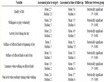
Table 1. Numerical values
of sensitivity indices of .
.
endemicity of the disease as they have negative indices.
The specific interpretation of each parameter shows that, the most sensitive parameter
is the control based on education, health care and immunization ,
followed by effective contact rate of individuals with chronic disease
,
followed by effective contact rate of individuals with chronic disease , then recovered
rate of chronic individuals due to treatment
, then recovered
rate of chronic individuals due to treatment ,
effective contact rate of individuals with acute
,
effective contact rate of individuals with acute ,
followed by recovery rate naturally from acute
,
followed by recovery rate naturally from acute ,
death rate of chronic infected
,
death rate of chronic infected ,
recovered rate of acute individuals due to treatment
,
recovered rate of acute individuals due to treatment ,
natural mortality rate
,
natural mortality rate ,
rate at which exposed develop chronic
,
rate at which exposed develop chronic ,
the rate at which acute infective are detected by a screening method from exposed
group
,
the rate at which acute infective are detected by a screening method from exposed
group ,
the rate at which screened develop to chronic
,
the rate at which screened develop to chronic ,
which is the least sensitive parameter.
,
which is the least sensitive parameter.
3.9. Numerical Simulations
In this section, we illustrate the analytical results of the study by carrying out
numerical simulations of the model system (2) using the following estimated parameter
values: ,
,
 ,
,
 ,
,
 ,
,
 ,
,
 ,
,
 ,
,
 ,
,
 ,
,
 ,
,
 ,
,
 ,
,
 ,
,
 ,
, .
.
Figures 2(a)-(d) show the proportion of HCV exposed, infective populations (acute, chronic) and proportion of HCV infectives all plotted against the proportion of susceptible population. This shows the dynamic beha-

 (a)
(b)
(a)
(b)
 (c)
(d)
(c)
(d)
Figure 2. Phase portrait of the dynamics of susceptibles and the infected and recovered population.
viour of the endemic equilibrium of the model system (2) using the estimated parameter values above.
The phase portrait in Figures 2(a)-(d) shows that for any initial starting point
or initial value, the solution curves tend to the endemic equilibrium point . Hence, we infer
that the system (2) is globally stable about the endemic equilibrium point
. Hence, we infer
that the system (2) is globally stable about the endemic equilibrium point
 for the set of parameters above.
In Figures 3(a)-(d), the variation of proportions of exposed, recovered, acute and
chronic infective populations for different rates of education, health care and
immunization
 is shown.
Figures 3(a)-(d), shows that the infected population decreases as the control strategies
(education, health care and immunization),
 increased.
This confirms that, if
increased.
This confirms that, if
 is not effective the disease will invade the population.
Figures 4(a)-(d) shows the variation of proportions of exposed, acute and chronic infective populations and recovered population for different rates of screening.
From Figures 4(a)-(d) we vary the screened rate of infected immigrants, and it is seen that as the degree of screening increases, the infected population decreases. The results further show that increasing the screening rate, decreases the severity of the epidemic. Once again this confirms that, screening can reduce the inflow of infected immigrants into the community.
 (a)
(a) (b)
(b) (c)
(c) (d)
(d)
Figure 3. Variation population
under different values of
 (education, health care and immunization).
 (a)
(a) (b)
(b) (c)
(c) (d)
(d)
Figure 4. Variation of
population under different values of
 (screening).
4. Discussions and Conclusion
In this paper, a mathematical model of control strategies of HCV in a community
with inflow of infected immigrants been established. Both qualitative and numerical
analysis of the model was done. The model incorporates the assumption that infected
immigrants enter in the community. It is shown that there exists a feasible region
where the model is well posed in which a unique disease free equilibrium point exists.
The disease free and endemic equilibrium points were obtained and their stabilities
investigated. The model showed that the disease free equilibrium is locally stable
at threshold parameter less than unity and unstable at threshold parameter greater
than unity. Using Lyapunov method, endemic equilibrium is globally stable under
certain conditions. A sensitivity analysis shows that the control based on education,
health care and immunization
 is the most sensitive parameter on
 and the least is
 .
A numerical study of the model has been conducted to see the effect of certain key
parameters on the spread of the disease. It was observed that the spread of the
disease decreases due to the presence of control strategies (screening, education,
health care and immunization). As the control strategies increase, the exposed,
acute and chronic infective individuals also decrease in the population. Finally,
from the analysis, it may be hypothesized that preventive measures, through reducing
rates of transmission of HCV are therefore necessary to the community. Since reduced
transmission leads to lower prevalence of the disease in the long-term, the national
health care to HCV should therefore seek to ensure that all people at risk or that
have been at risk in the past, have access to and are supported in the use of HCV
screening, education, health care immunization, regardless of their social and economic
status.
.
A numerical study of the model has been conducted to see the effect of certain key
parameters on the spread of the disease. It was observed that the spread of the
disease decreases due to the presence of control strategies (screening, education,
health care and immunization). As the control strategies increase, the exposed,
acute and chronic infective individuals also decrease in the population. Finally,
from the analysis, it may be hypothesized that preventive measures, through reducing
rates of transmission of HCV are therefore necessary to the community. Since reduced
transmission leads to lower prevalence of the disease in the long-term, the national
health care to HCV should therefore seek to ensure that all people at risk or that
have been at risk in the past, have access to and are supported in the use of HCV
screening, education, health care immunization, regardless of their social and economic
status.
References
- Choo, L., Kuo, G. and Weiner, A.J. (1989) Isolation of a cDNA Clone Derived from a Blood-Borne Non-A, Non-B Viral Hep Atitis Genome. PubMed, 244, 359-362.
- Fischer, L.R., Tope, D.H., Kathleen, S., Conboy, R.N., Hedblom, B.D., Ronberg, E., Shewmake, D.K. and Butter, J.C. (2000) Screening for Hepatitis C Virus in a Health Maintenance Organisation, American Medical Association.
- Ainea, N., Massawe, E.S. and Makinde, O.D. (2012) Modelling the Effect of Treatment and Infected Immigrants on the Spread of Hepatitis C Virus Disease with Acute and Chronic Stages. American Journal of Computational and Applied Mathematics, 1, 10-20. http://dx.doi.org/10.5923/j.ajcam.20120201.02
- Cai, L. and Li, X. (2008) A Note on Global Stability of an SEI Epidemic Model with Acute and Chronic Stages. Applied Maths and Computations, 196, 923-930. http://dx.doi.org/10.1016/j.amc.2007.07.024
- Zule, W.A., Costenbader, E.C, Coomes, C.M. and Wechsberg, W.M. (2009) Effects of a Hepatitis C Virus Educational in Tervention or a Motivational Intervention on Alcohol Use, Injection Drug Use, and Sexual Risk Behaviours among Injection Drug Users. American Journal of Public Health, 1, 180-186. http://dx.doi.org/10.2105/AJPH.2007.126854
- Hahn, J.A., Wylie, D., Dill, J., Sanchez, M.S., Lioyd-Smith, J.O., Pageshefer, K. and Getz, W.M. (2009) Potential Impact on Vaccination on the Hepatitis C Virus Epidemic in Injection Drug Users. PubMed, 1, 47-57.
- Encke, J., Findeklee, J., Geib, J., Pfaff, E. and Stremmel, W. (2005) Prophylactic and Therapeutic Vaccination with Dendritic Cells against Hepatitis C Virus Infection. Clinical and Experimental Immunology, 142, 362-369. http://dx.doi.org/10.1111/j.1365-2249.2005.02919.x
- Lubega, S., Agbim, U., Surjadi, M., Mahoney, M. and Khalili, M. (2013) Formal Hepatitis C Education Enhances HCV Care Coordination, Expedites HCV Treatment and Improves Antiviral Response Liver International. Liver International, 33, 999-1007. http://dx.doi.org/10.1111/liv.12150
- Michael, J. (2011) Mathematical Analysis of the Effect of Screening and Vaccination on the Dynamics of HIV/AIDS. MSc. Dissertation, University of Dar es Salaam, Dar es Salaam.
- Van den Driessche, P. and Watmough, J. (2002) Reproduction Numbers and Sub-Threshold Endemic Equilibria for Compartmental Models of Disease Transmission. Mathematical Bio-Sciences, 180, 29-48. http://dx.doi.org/10.1016/S0025-5564(02)00108-6
- Cai, L. and Li. Z. (2010) Analysis of a Simple Vector-Host Epidemic Model with Direct Transmissionl. College of Mathematics and Information Science, China.
- Chitnis, N., Hyman, J.M. and Cushing, J.M. (2008) Determining Important Parameters in the Spread of Malaria through the Sensitivity Analysis of a Mathematical Model. Bulletin of Mathematical Biology, 70, 1272-1296. http://dx.doi.org/10.1007/s11538-008-9299-0
NOTES

*Corresponding author.