

Open Journal of Statistics
Vol.06 No.02(2016), Article ID:65432,11 pages
10.4236/ojs.2016.62018
Equivalence between the Dependent Right Censorship Model and the Independent Right Censorship Model
Qiqing Yu1, Kai Yu2
1Department of Mathematical Sciences, SUNY, Binghamton, USA
2Department of Mathematics, University of Mississippi, Oxford, USA

Copyright © 2016 by authors and Scientific Research Publishing Inc.
This work is licensed under the Creative Commons Attribution International License (CC BY).
http://creativecommons.org/licenses/by/4.0/



Received 8 February 2016; accepted 9 April 2016; published 12 April 2016
ABSTRACT
Yu et al. (2012) considered a certain dependent right censorship model. We show that this model is equivalent to the independent right censorship model, extending a result with continuity restriction in Williams and Lagakos (1977). Then the asymptotic normality of the product limit estimator under the dependent right censorship model follows from the existing results in the literature under the independent right censorship model, and thus partially solves an open problem in the literature.
Keywords:
Constant-Sum Models, Right-Censoring, Dependent Censoring, Necessary and Sufficient Condition

1. Introduction
In this paper we study various dependent right censorship (RC) models and their relation to the independent RC model in the literature. The definitions of these RC models are given in Definition 1.
Right censored data occur quite often in industrial experiments and medical research. A typical example in medical research is a follow-up study; a patient is enrolled and has a certain treatment within the study period. If the patient dies within the study period, we observe the exact survival time T; otherwise, we only know that the patient survives beyond the censoring time R. Thus the observable random vector is , where
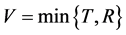 (
( ) and
) and , the indicator function of the event
 . Let
. Let 
be i.i.d. copies of . Let
. Let  be the cumulative distribution function (cdf) of T and
 . Denote FR, FV and
  the cdf’s of R, V and
 , respectively, and
  the conditional cdf of R given T and
 . Let fT (fR or
 ) be the density function of T (R or
 ) (with respect to (w.r.t.) some measure). The common right censorship model assumes T and R are independent (
 ). Then the likelihood (function) for RC data is often defined as
 (1)
(1)
(see [1] ), where  is a collection of all cdf’s if under the non-parametric set-up, or a parametric cdf family with a parameter, say
  and
and  is the parameter space,
  and f is the density of F. Recall that the formal definition of the likelihood (function) for a sample
  is
is ,
, . More- over, if
 , where
  does not depend on θ, and Λ2 is also called a likelihood. We shall call Λ the full likelihood and Λ2 a simplified one. Since our sample
 ,
,
 (2)
(2)
where
 (3)
(3)
and the integrals are Lebesgure integrals. We say that a function  is non-informative about the function
  with
with  if it is not assumed that H is a function of
  or θ. We shall further clarify what “non- informative” means in the next example.
Example 1.1. Consider 3 cases of right censoring:
Case (1).  with the parameter space
  (see Equation (1)).
Case (2).  with
with .
.
Case (3).  with parameters
 ,
,
 . FR is informative about
FT in cases (2) and (3), as it is a function of FT in case (2) and a function of  in case (3). However, FR is non-informative (not informative) about FT in case (1), as FT and FR are both independent parameters.
If , Λ in Equation (2) may be simplified as
  as in Equation (1) due to the non-informative property by the well-known result as follows.
Proposition 1.1. The full likelihood  can be simplified as
  (see Equation (1)) iff
 (4)
(4)
Example 1.1 (continued). In case (1),  is a likelihood function, as Equation (4) holds. In case (2),
  is informative about FT and condition Equation (4) fails.

 is not a likelihood, but can be viewed as a partial likelihood. The generalized maximum likelihood (GMLE)
 of ST based on
  is still the PLE, i.e.,
  , where
  is the i-th order statistic of
 ’s and
  is the δj that is associated with
 . The variance satisfies
  (if ST is continuous), while the GMLE based on Λ is
  (as
(as  and
and ) and
) and  by the delta method. Thus the PLE is not efficient. In case (3),
  is not a likelihood function. The full likelihood is
  (as
(as  ). If one treats
  as a (partial) likelihood, then its GMLE of ST is the PLE
 . Let
. Let ,
, . Then
 , i.e., the PLE is not consistent at 2. The GMLE
  based on Λ is
 .
.
Remark 1.1. Example 1.1 indicates that if Equation (4) is not valid then the MLE based on so-called “likelihood”  as in Equation (1) can be inconsistent, or can be less efficient than the MLE based on Λ due to loss of information on
 . However, it is difficult to verify Equation (4) in practical applications, thus people propose some sufficient conditions. A typical sufficient condition of Equation (4) is that
  and FR is non-informative about FT.
Williams and Lagakos (W&L) [2] point out that  is often un-realistic. They further propose a constant-sum model (which allows
 ) as follows.
 (5)
(5)
where
 (6)
(6)
In the literature, there are many studies on the asymptotic properties of the PLE by weakening the assumptions in the independent RC model over the years (see, e.g., [3] - [10] ). It is conceivable that the asymptotic properties of the PLE is difficult under the continuous constant-sum model in Equation (5). However, the next theorem makes it trivial.
W&L Theorem (Theorem 3.1 in [2] ). W&L (1977)). Suppose that  is a continuous random vector. Then Equation (5) holds iff
  a random vector
  such that (1)
 ,
,  (see Equation (6)) and
 , where (2)
  if
if , and (3)
  if
if .
.
By the W&L Theorem, one can easily make use of the existing results about the PLE under the assumption  to establish asymptotic properties of the PLE under the continuous constant-sum model. Indeed, by (2) and (3) of the W&L Theorem,
 (7)
(7)
Since , the PLE
  based on
  from
from  (see Equation (7)) satisfies
 a.s., where
  (see [10] ). By the W&L Theorem,
  and
and
Equation (7) holds, so  under the continuous RC model given in Equation (5), even if
 .
.
On the other hand, case (3) in Example 1.1 shows that the PLE can be inconsistent for  under a dependent RC model. Hence the W&L Theorem is quite significant. Yu et al. [11] show that the PLE is consistent under the dependent RC model considered in [12] - [15] , etc., which assumes A1 and A2 as follows.
A1  for all r, or equivalently,
  a.e. in t (w.r.t.
 ) on the set
 .
.
Notice that  is well defined if
  and undefined if
 . We define
  if
if . Notice that A1 says that
  is constant in
 , thus
  is well defined if
 .
.
A2  is non-informative about
 , with
 .
.
Definition 1. If  and FR is non-informative about FT, then we call the RC model the independent RC model. The dependent RC model considered in this paper assumes that A1 and A2 hold.
Next example and Example 3.1 in Section 3 are examples that satisfies A1 but .
.
Example 1.2. ,
,  and T has a binomial distribution (
 ) with parameter
 .
.
Yu et al. [11] show that A1 and A2 are the necessary and sufficient (N&S) condition of Equation (4) under the non-parametric set-up. Then we may ask the following questions:
1) Are A1 and A2 the N&S condition of Equation (4) under the parametric set-up?
2) What is the relation between the constant-sum model (5) and A1?
3) Can the W&L Theorem be extended by eliminating the continuity restriction?
We give answers to the 3 questions. In Section 2, we show that A1 and A2 are a sufficient condition for Equation (4) under both non-parametric set-up and non-parametric set-up (see Theorem 2.1). Our study suggests that the constant sum model (5) is a special case of A1. In Section 3, we extend the W&L Theorem to the case that A1 holds (rather than the case that Equation (5) holds), which allows  being discontinuous. As a consequence, we establish the asymptotic normality of the PLE under the dependent RC model and under certain regularity conditions, making use of the existing results in the literature about the PLE under the independent RC model. In Section 4, we show that under the parametric set-up, A1 and A2 are not a necessary condition of Equation (4). Section 5 is a concluding remark. Some detailed proofs are relegated to Appendix.
2. The Relation between Equation (4), Equation (5) and A1
We shall first show that A1 and A2 are a sufficient condition of Equation (4), extending a result in [11] under the non-parametric set-up. Then we shall show that if  is continuous, the constant sum model is the same as A1; otherwise, these two models are different.
Theorem 2.1. Equation (4) holds if A1 and A2 hold.
Proof. Since , it is non-informative about FT by A2. Moreover, by A1
 . Thus
 is non-informative about FT by A1 and A2, as
  and
and  are equivalent. Then Equation (4) holds. ,
The next example and lemma help us to understand the constant-sum model (5).
Example 2.1. Suppose ,
,  and
and . Then A1 holds, but not the constant-sum model assumption (5), as Equation (6) yields
 , and
, and  . Thus
 , violating Equation (5).
Lemma 2.1.  and
and , if
, if  is continuous, where
 .
.
Theorem 2.2. If  is continuous, then A1 and Equation (5) are equivalent.
The proofs of Lemma 2.1 and Theorem 2.2 are very technical but not difficult. For a better presentation, we relegate them to Appendix (see Section A.1 and Section A.2).
Remark 2.1. Example 2.1 shows that A1 is not a special case of Equation (5) (or the constant-sum model). However, if  is continuous, A1 and the constant-sum model are equivalent. Thus the continuous constant-sum model is a special case of A1. Since Yu et al. [11] show that under the non-parametric set-up, A1 and A2 are the N&S condition that Equation (4) holds, it is desirable to extend W&L Theorem to the model that assumes A1 rather than the constant-sum model by eliminating the continuity assumption.
3. Extension of the W&L Theorem
In the next theorem, we extend the W&L Theorem from the continuous constant-sum model to A1.
Theorem 3.1. A1 holds iff there exist extended random variables Z and Y such that 1)  and
and
 , where
 , 2)
, 2)  if
if , and 3)
  if
if .
.
In our theorem, there are two modifications to the W&L Theorem.
1) Equation (5) with continuous  is replaced by A1 without continuity assumptions.
2) The random vector is replaced by the extended random vector.
In fact, W&L Theorem is not accurate as stated, unless a random variable is allowed to take “values”  (see Examples 3.1 and 3.2 below). However, by the common definition of a random variable, it does not take values
 . Thus the random variables in their theorem should be referred to the extended random variables.
Example 3.1. Suppose that  and T has a uniform distribution
 , then A1 holds and
  is a continuous random vector, but
 . By Theorem 2.2, it satisfies the constant-sum model. Consequently, the assumptions in the W&L Theorem are satisfied. In particular, R does not take the value
 . If the W&L Theorem were correct, according to their definition, there would be a random variable Y with a cdf
  defined in Equation (6). However,
  for
for  (the proof is given in Appendix (see Section A.3)).
Thus  is not a proper cdf as claimed in the W&L Theorem. Y should be modified to be an extended
random variable such that 
Example 3.2. A random sample of complete data  from T which has the exponential distribution
  can be viewed as a special case of the RC data. But
  is not even defined for a random variable R. However, if we consider extended random variables in A1, that is, R may take values
 , then we can define
 . Since
 ,
, . Thus Theorem 3.1 is trivially true in such case.
Proof of Theorem 3.1. It suffice to show (Þ) part. Since  is a conditional distribution,
  defines a “cdf” on
 . Denote
  and let
  be the Borel s-field on Ω. Without loss of generality (WLOG), one can assume that
  is the probability space such that
 . Let W be the joint cdf defined by
 . By the Kolmogorov consistency theorem,
  induces a random vector
  on Ω by
 . Note that
 and
and . Verify that
  if
if ;
;  if
if . Verify that
  as
as . Thus con- ditions (1), (2) and (3) hold. ,
Remark 3.1. In the previous proof, let  be the support of
  and
and . Then
  may not be defined on A, but
  may be defined on A. Thus it is necessary to create a new random variable Z.
Corollary 3.1. If A1 holds then  and
and .
.
The asymptotic properties of the PLE under the continuous constant-sum model are obtained by making use of the W&L Theorem and the existing results in the literature on the PLE under the continuous independent RC
model. Denote  The consistency of the PLE under assumption A1 is es-
tablished in the literature as follows.
Theorem 3.2 (Yu et al. [11] ). Under A1, .
.
Now by Theorem 3.1 and Corollary 3.1, we can construct another proof of the consistency of the PLE as follows.
Corollary 3.2. Under A1,  where
where

Proof. Yu and Li [10] show that if , then
 , where
 Under A1,
  may not be true, but by Theorem 3.1,
 ,
,  ,
, . Thus the observation
 ’s are i.i.d. from
 , which can be viewed as being generated from
 , as well as
 . Thus replacing
  and
and 
by  and
and , respectively, in the previous equation yields
 . Now
. Now
since , the proof is done. ,
Remark 3.2. Notice that the statements in Theorem 3.2 is slightly different from the statements in Corollary 3.2. One is based on , and the other is based on
 .
.
The asymptotic normality of the PLE under A1 without continuity assumption has not been established in the literature. It can be done now by making use of Theorem 3.1 and the existing results in the literature on the PLE under the independent RC model. In particular, assuming T is continuous, Breslow and Crowley [3] and Gill [6] show that
 (8)
(8)
 (9)
(9)
Without continuity assumptions, Gu and Zhang [16] and Yu and Li [17] among others established asymptotic normality of the GMLE under the double censorship (DC) model. Since the independent RC model is a special
case of the DC model, their results imply that (8) and (9) also hold if 
 , and if
either  or
or . The next result follows from Theorem 3.1 and Corollary 3.1, which partially solves the open problem in [11] about the asymptotic normality of the PLE under the dependent RC model.
Theorem 3.3. Equations (8) and (9) are valid if A1 holds and if either T is continuous or (1)

 and (2) either
  or
or , where the random variable Y is defined in Theorem 3.1.
4. Are A1 and A2 the N&S Condition of Equation (4) under the Parametric Set-Up?
The answer to the question is “No” in general. We shall explain through several examples.
Example 4.1. Suppose that ,
,  ,
,  , and
, and

where  and
and . This defines a parametric family of dis- crete distribution functions FT. One can verify that possible observations Ii’s are
 ,
,  ,
,  ,
,  ,
, . Write
 , then
  is either Q or G in Equation (3). In particular,
  ,
,  , which lead to

Thus the parametric model satisfies the N&S condition Equation (4). But in view of , A1 fails. Note that the PLE maximizes
  over
over . It is important to notice that
  with
with  is not a likelihood. However,
  with
with  is a likelihood by Proposition 1.1. Ve-
rify that the PLE of , thus the PLE is not consistent,
but the MLE which maximizes  over
over  is consistent, as expected. In fact,

 yields
 .
.
 .
.
 .
.
 which is of the form
 .
.

Then the MLE is the one that . Verify that
 a.s.;
a.s.;
 a.s.;
a.s.;
 a.s.
a.s.

Since , the MLE
  a.s. as expected. That is, the MLE of p based on
 is consistent.
Example 4.2. Suppose that  and
and . This specifies a parametric family of discrete distributions with parameter
  subject to the constraint
  and
and . Then A1 and A2 are the N&S condition of Equation (4) (see Section A.4 in Appendix).
Remark 4.1. In Example 4.1, since A1 fails, the W&L Theorem does not hold.
Both Examples 4.1 and 4.2 are parametric cases, but A1 and A2 are the N&S condition of Equation (4) only in one case. In both cases the MLE’s based on the simplified likelihood  as in Equation (1) are consistent. They indicate that in general under the parametric set-up, A1 is not the necessary condition of Equation (4). Since the two examples are discrete case, we also discuss two continuous examples.
Example 4.3. Suppose that T is continuous,
 , and
, and .
.
This defines a parametric family of a continuous random variable with parameter p. The possible observations Ii’s are  and
and . A1 is violated due to the table for
 . The
. The  and
and  in Equation (3). satisfy


Thus both Q and G in Equation (4) are not functions of p or FT and Equation (4) holds. Hence in this example, A1 is not a necessary condition of Equation (4).
Example 4.4. Suppose that  and
and . Define
  as in Exam-
ple 4.3, then A1 fails and Equation (4) holds for the random vector . Now define
 ,
, . Then
  does not satisfy A1 but Equation (4) holds.
It shows that if , A1 is not a necessary condition of Equation (4) though Equation (4) can hold under proper assumptions on
 . The idea can be extended to the other continuous parametric families e.g.,
  , Weibull, Gamma etc.
5. Concluding Remark
We have established the equivalence between the standard RC model and the dependent RC model. The result simplifies the study on the properties of the estimators under the dependent RC model. The results in this paper may have applications in linear regression with right-censored data. For instance, the model assumption considered in [18] can be weekend. It is also of interest to study whether the result can be extended to the double censorship model [17] and the mixed interval censorship model [19] .
Acknowledgements
We thank the Editor and the referee for their valuable comments.
Cite this paper
Qiqing Yu,Kai Yu, (2016) Equivalence between the Dependent Right Censorship Model and the Independent Right Censorship Model. Open Journal of Statistics,06,209-219. doi: 10.4236/ojs.2016.62018
References
- 1. Cox, D.R. and Oakes, D. (1984) Analysis of Survival Data. Chapman & Hall, New York, 70-71.
- 2. Williams, J.S. and Lagakos, S.W. (1977) Models for Censored Survival Analysis: Constant-Sum and Variable-Sum Models. Biometrika, 64, 215-224.
http://dx.doi.org/10.2307/2335687 - 3. Breslow, N.E. and Crowley, J. (1974) A Large-Sample Study of the Life Table and Product Limit Estimates under Random Censorship. Annals of Statistics, 2, 437-453.
http://dx.doi.org/10.1214/aos/1176342705 - 4. Peterson, A.V. (1977) Expressing the Kaplan-Meier Estimator as a Function of the Empirical Subsurvival Functions. Journal of the American Statistical Association, 7, 854-858.
- 5. Phadia, E.G. and Van Ryzin, J. (1980) A Note on the Convergence Rates for the Product Limit Estimator. Annals of Statistics, 8, 673-678.
http://dx.doi.org/10.1214/aos/1176345017 - 6. Gill, R. (1983) Convergence of the Product Limit Estimator on the Entire Half Line. Annals of Statistics, 11, 49-59.
http://dx.doi.org/10.1214/aos/1176346055 - 7. Shorack, G.R. and Wellner, J.A. (1986) Empirical Processes with Applications to Statistics. Wiley, New York.
- 8. Stute, W. and Wang, J.L. (1993) The Strong Law under Random Censorship. Annals of Statistics, 21, 1591-1607.
http://dx.doi.org/10.1214/aos/1176349273 - 9. Wang, J.G. (1987) A Note on the Uniform Consistency of the Kaplan-Meier Estimator. Annals of Statistics, 15, 1313-1316.
http://dx.doi.org/10.1214/aos/1176350507 - 10. Yu, Q.Q. and Li, L.X. (1994) On the Strong Consistency of the Product Limit Estimator. Sankhya A, 56, 416-430.
- 11. Yu, Q.Q., Ai, X.S. and Yu, K. (2012) Asymptotic Properties of the Product-Limit-Estimator with Dependent Right Censoring. International Journal of Statistics and Management System, 7, 84-104.
- 12. Self, S.G. and Grossman, E.A. (1986) Linear Rank Tests for Interval-Censored Data with Application to PCB Levels in Adipose Tissue of Transformer Repair Workers. Biometrics, 42, 521-530.
http://dx.doi.org/10.2307/2531202 - 13. Heitjan, D.F. and Rubin, D.B. (1991) Ignorability and Coarse Data. Annals of Statistics, 19, 2244-2253.
http://dx.doi.org/10.1214/aos/1176348396 - 14. Gill, R., van der Laan, M.J. and Robins, J.M. (1997) Coarsening at Random: Characterization, Conjectures, Counter-Examples. In: Lin, D.Y. and Fleming, T.R., Eds., Proceedings of the First Seattle Symposium in Biostatistics: Survival Analysis, Lecture Notes in Statistics 123, Springer-Verlag, New York, 255-294.
http://dx.doi.org/10.1007/978-1-4684-6316-3_14 - 15. Gómez, R., Oller, G. and Calle, M.L. (2004) Interval Censoring: Model Characterizations for the Validity of the Simplified Likelihood. The Canadian Journal of Statistics, 32, 315-326.
http://dx.doi.org/10.2307/3315932 - 16. Gu, M.G. and Zhang, C.H. (1993) Asymptotic Properties of Self-Consistent Estimator Based on Doubly Censored Data. Annals of Statistics, 21, 611-624.
http://dx.doi.org/10.1214/aos/1176349140 - 17. Yu, Q.Q. and Li, L.X. (2001) Asymptotic Properties of the GMLE of Self-Consistent Estimators with Doubly-Censored Data. Acta Mathematica Sinica, 17, 581-594.
http://dx.doi.org/10.1007/s101140000039 - 18. Wang, Y.S., Chen, C.X. and Kong, F.H. (2010) Variance Estimation of the Buckley-James Estimator under Discrete Assumptions. Journal of Statistical Computation and Simulation, 81, 481-496.
http://dx.doi.org/10.1080/00949650903421085 - 19. Yu, Q.Q., Wong, G.Y.C. and Li, L.X. (2001) Asymptotic Properties of Self-Consistent Estimators with Mixed Interval-Censored Data. Annals of The Institute of Statistical Mathematics, 53, 469-486.
http://dx.doi.org/10.1023/A:1014656726982
Appendix
We shall give the proofs of Lemma 2.1 and Theorem 2.2 and the proofs in some examples of the paper here.
A1. Proof of Lemma 2.1
WLOG, one can assume that u satisfies . By Equation (6),
 .
.

If T is a continuous random variable, then the previous equation and Equation (6) yield
 ,
,
A2. Proof of Theorem 2.2
Assume that  is continuous. Then by Lemma 2.1, Equation (5) holds iff
  a.e. in u w.r.t.
 , iff
, iff  a.e. in u w.r.t.
 .
.
Since  is continuous,
 . By Lemma 2.1,
 ,
,
where . Thus, Equation (5) holds iff
  a.e. in u (w.r.t.
 );
);
iff  a.e. in u (w.r.t.
 );
);
iff  a.e. in u;
iff  a.e. in u (w.r.t.
 );
);
iff for almost all r (w.r.t. ),
),  is constant in t a.e. w.r.t.
  on
on ;
;
iff ,
,  is constant in t a.e. w.r.t.
  on
on  (which is A1). ,
A3. Proof of the Equation  for
for  in Example 3.1

A4. Proof of Example 4.2
If  is not constant a.e. (w.r.t.
 ) in
) in ,
,  such that
1) ,
,
2)  and
and .
.
3)  is fixed.


Thus , contradicting
  by assumption (2). ,