

Open Journal of Discrete Mathematics
Vol.06 No.02(2016), Article ID:65251,16 pages
10.4236/ojdm.2016.62004
Algebra and Geometry of Sets in Boolean Space
Vladimir Leontiev1, Garib Movsisyan2, Zhirayr Margaryan3
1Moscow State University, Moscow, Russia
2BIT Group, Moscow, Russia
3Yerevan State University, Yerevan, Armenia

Copyright © 2016 by authors and Scientific Research Publishing Inc.
This work is licensed under the Creative Commons Attribution International License (CC BY).
http://creativecommons.org/licenses/by/4.0/



Received 16 October 2015; accepted 28 March 2016; published 31 March 2016
ABSTRACT
In the present paper, geometry of the Boolean space Bn in terms of Hausdorff distances between subsets and subset sums is investigated. The main results are the algebraic and analytical expressions for representing of classical figures in Bn and the functions of distances between them. In particular, equations in sets are considered and their interpretations in combinatory terms are given.
Keywords:
Equations on Sets, Hausdorff Distance, Hamming Distance, Generating Function, Minkowski Sum, Sum of Sets

1. Distance between Subsets Bn
Let ,
,  and
and  be the set of all words of finite length in the alphabet B. For
  we take:

It is clear that  is the Hausdorff distance between the subsets
  and
and , and
, and is the Hamming distance between the points:
 , where
  and
and  is the addition operation with respect to mod 2.
The Hausdorff distance has essential role in many problems of discrete analysis [1] and thus has certain interest. On the other hand, there only are a few essential results concerning distances between the subsets , and their investigation offers significant difficulties.
First, we present the following simple properties of the Hausdorff distance:
1) ;
;
2) ;
;
3) Если , то
, то ;
;
4) , for
, for .
.
Let us note that, generally speaking, the Hausdorff distance does not satisfy the triangle inequality:
 (1)
(1)
which is demonstrated in the following picture:

But inequality (1) holds true if .
.
Distance between Spheres in Bn
Let  be a sphere of radius p with the center at
 . We take, for an arbitrary subset,
 :
:

Thus, we have the following two equvalent interpretations for :
:
1)  is the set of all points in
  which are at the distance
  from the set М;
2)  is the set of all points in
 , covered by the spheres of the radius p with the centers at points of the set M.
Examples.
1) , for an arbitrary point:
 ;
;
2) , for an arbitrary
 ;
;
3) If  and
and  then p is the radius of the covering of the set
  [2] .
[2] .
Theorem 1. .
.
Proof. We consider two cases.
a)  Then,
Then,

and, consequently,

b)  Let
Let  We present them in the form:
 where
where 
 where
where 
From here we have:

As  consequently we have:

Then, taking into account that:
 ,
,
we have:

The theorem is proved.
Let:

Taking into account that the sphere of the radius p with the center at  and the sphere of the radius q with the center at
  contain, respectively, as many points as:
 ,
,
we get the following corollary.
Corrollary. If , then:

The value of the function  for definite values of
  was calculated in [1] .
Theorem 2. If , then:

The general form of the standard generating function for the distance between the subsets  has the following form:
 (2)
(2)
The summation in (2) is over all pairs of the subsets  with
with 
Let us consider a few examples.
1) .
.
In this case, we have:

Thus,  , which is the well-known function of distribution of distances between the points in the space
  with the metrics of Hamming.
2) , and q is an arbitrary positive integer which does not exeed
 .
.
In this case:
 (3)
(3)
As:

for arbitrary points  and any subset
 , then we get from (3):

Then:
 (4)
(4)
Consequently, the distance between the zero point and an arbitrary subset Y equals the minimal weight of the points which are in Y.
Hence,  , if there are not points with
  in Y. The numbers of subsets Y with
  and the condition
  are found by the following formula:
 , (5)
, (5)
where 
where  is the cardinality of the sphere with the radius r in
From (5), we get the following statement:
Lemma1. If  is the number of the subsets of cardinality q (in
 ) having the distance to the zero point, then:

For 
Theorem 3. The following formula holds true:
 (6)
(6)
Proof. By definition:

From this and Lemma 1, taking into account (3) and (4), we get:

The theorem is proved.
If  is the generating function of the random value
  uniformly distributed on the pairs
 , where
 , then the following holds true.
Corollary 1. The following formula holds true:

Corollary 2. The following holds true:

Corollary 3. The formula for  follows from (6).
Proof. From (6) we get for p = 1:

Corollary 4. For q = 2, the following formula holds true:

Proof. By definition and from Corollary 2, we derive:
 (7)
(7)
Transforming the terms in (7), we get:
 (8)
(8)
Then, using the following formulas:


Let us “compress” the sum:

By definition, we have:

Furthermore, if:

then:

Further:

And:

From here it follows that 
Then:

Taking this and (8) into account, we get:

And the generating function:

can be expressed by the following parameters:
2) if  then the family of all subsets of cardinality p, having distances
  from M is expressed as
 . Indeed,
  contains all the points of
 , having distances
  from the set M.
Hence, the set  does not contain such points; consequently, for an arbitrary subset
 , the expression
  holds true.
The cardinality of this family is:
 .
.
2) The number of all m-element subsets having the distance r from M is:

Summarizing all the previous, we get the following statement.
Theorem 4. The following expression is true:

2. Sum of Sets in 
Let ; we take:

The operation “+” is defined in the family  of all subsets of
  and (
and ( , “+”) is a monoid with the neutral element
  [3] [4] .
Besides, the following inequality holds true:

Here both limits are reachable.
The properties of “+” are as follows:
1) 
2)  for all
 ;
;
3)  -associativity;
4)  -communacativity;
5)  -distributivity;
6) ;
;
7) .
.
Examples.
If X is a subspace in , then:
1) ;
;
2)  if
if 
Let the following holds true:
 .
.
Then 
Thus, there is certain analogy between the norm of the sum of points and the distance between those points, as well as between the norm of the sum of the sets and the distance between those sets.
In the general form, the following statement connecting the operations “∪” и+, is true:

2.1. Sum of Facets in Bn and the Distance between Them
A facet or interval in  is the set of points
  where the partial order
  is defined in the classic way [5] [6] :
 for
for 
Every interval J can be written in the form of a word of the length n, in the alphabet  the letters of which are ordered linearly:
Examples.
If  and
and  then every point of J can be presented by the word
 , which means the following: all the points which are obtained from the word
  by the substitution either 0 or 1 for a letter of the given word, are contained in the interval J. Consequently, the cardinality of the interval J is
  for the given case, i.e.
  Hence, each interval J has its corresponding code word
  in the alphabet A. The number of letters c in the code
  is the dimension of the interval J, i.e. is
  And the following formula is obvious:

If the operation “*” is introduced on the alphabet A:

then the sum  of the intervals
  and
and  is the Minkowski sum:
 .
.
Examples.
1) If  then
then  i.e.
i.e.  which corresponds to the definition of the sum
2) If , then
  for every interval
The distance between the intervals  and
and , having the codes
  and
and  -taking into account the introduced definitions-are calculated in the following way.
Let  be the number of occurrences of letter 1 in the code of the interval J.
Statement 1. 
Thus, the distance between the intervals  and
and  is the number of occurrences of letter 1 in the code of their sum.
Examples.
1) Let .
.
Then  and
and 
Let  be the family of all p-dimensional intervals of
  Then
Then 
Let us consider the direct product  and introduce uniform distribution on it with the generating function:
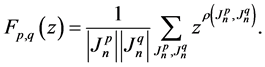
Theorem 5. The following formula is true:

where 
Let us consider the matrix  the rows of which are the codes
  of the intervals from the family
Lemma 2. The following expression is true:

where  is the number of zeros and, respectively, units in the i-th column of the matrix
Proof. According to the definition:
 (9)
(9)
where 
and  is the code of the interval
 .
.
It follows from (9):
 (10)
(10)
The internal sum in (10) equals the number of such pairs  in which one of
  is unit and the other is zero, i.e. is
  The Lemma is proved.
Example.
1) Let  be the family of all edges in
 . We consider the matrix of their codes:

The total number of the edges in  is
is . Each column of the matrix has the length 12, and
all letters of the alphabet  occur in equal number, 4 times. Therefore,
  ,
, 
From here, we get:

2) In the general form, if  is the family of all edges in
 , each column contains
  letters c and
 From here, we get:
 (11)
(11)
Thus, the sum of the pairwise distances between the intervals in  is calculated by formula (11).
2.2. The Sum of Spheres in Bn
In the general form, the following statement holds true.
Lemma 3. The following formula is true:

Proof. By definition:

Thus, the above introduced parameter  of the setМis rather easily expressed in the terms of the operation “+”.
Lemma4.  if
if .
.
Proof. If , then either v is at the distance
  from
from  or there is a point
  such that
 .
.
Then, from  it follows that
 , for all
 .
.
From here we get:

or:
 .
.
Hence, 
And if , then there is a point
  such that
 .
.
Hence, and, consequently,
  , that is,
  , and the proof is completed.
Theorem 6. The following expression is true:
 (12)
(12)
Proof. We have from Lemma 4:
 .
.
Then, we have from Lemma 3:

And the proof is over.
Formula (12) defines the rule of “addition” for arbitrary spheres in the space .
.
2.3. Sum of Layers in Bn
Let  be the p-th layer of the n-dimensional cube, or be the sphere of the radius p with the center at zero [7] [8] .
According to definition,  is the sum of the layers in
  or it is the sum of the points with the weights p and q. As
 , then all points from
  have weights from the interval
 .
.
Then, the following statement is true.
Lemma 5. The following expression holds true:

Proof. First, let us note the following.
If , and
, and , then
 . Consequently, every layer
  is invariant with respect to the operation of the symmetric group
  and, for
 , we have:
 , where
 .
.
In standard terms, the symmetric group  operates on
  and every layer is a transitive set or an orbit of action of the group
 .
.
If , then
 , where
 . Therefore, for each permutation
  we have:
  and we get:
 и
и .
.
Taking this into account, to describe the set  it is sufficient to describe only the weights of the points which are included into this sum. The minimal weight of these is
 .
.
We discuss the following outline:






Here  and the “block” of the first 2 units is shifted by a unit in each consecutive word. Thus, we get all weights:
In the general case, the situation is absolutely analogous, and the weights are arranged as follows:

for 
Here the condition for z holds true:
 .
.
Examples.
1) ;
;
2) ;
;
3) .
.
Theorem 7. The following expression is true:

where 
Proof. From Lemmas 3 and 5, we have:

The proof is over.
2.4. Sum of Subspaces in Bn
As usual, let  be the subspace generated by the vectors from the set X, or be the space “worn” on X.
Statement 2. ,
,
and:

Statement 3. Let 
And if:
 (13)
(13)
then the following equality is true:

Proof. We assume the contrary, that is, 
Then, we have:
 and
and .
.
Hence,  Consequently,
  That is,
This contradicts the initial condition and the proof is over.
The following example shows that condition (12) is not necessary.
Example.
Let Then
Then  although

3. Equations in Sets
The “simplest” equation by sets is the following:
 (14)
(14)
where .
.
Equation (14) always has the trivial solution:  where
where 
The significance of Equation (14) is explained by the following circumstances.
1) The standard problems of covering and partitioning in the Boolean space Bn [6] can be formulated as problems of describing the set of solutions of Equation (14).
2) For certain additional conditions, the solution of Equation (14) forms a perfect pair (perfect code) in the additive channel of communication [9] .
3) The set of all solutions of Equation (14) coincides with the class of equivalence of the additive channel of communication [3] .
Examples.
1) If , we can take
  as the solution
  for Equation (14).
2) If A is a subspace of , then Equation (14) has the following solution:
 .
.
The following statements are true:
Statement 4. If the equations  are solvable, then the equation
  also is solvable.
Proof. Let the pairs  be the solutions of the equations
  and
and , respectively. Then for the pairs
  we have
 as was required to be proved.
Statement 5. For  the equation:

has the solution 
Statement 6. For  and
and  the equation
  has the following solution:
 ,
,
where 
Statement 7. For , the equation
  has the following solution:
 where
where 
Statement 8. The sets of solutions  of the equations
  and
and  coincide for all
Below, when discussing Equation (14), without violating generality, we may assume  if necessary.
Statement 9. The equation  has no solution for
Proof. If  and
and , for
, for  we have
  and
and  or
or . Thus, X is an equidistant code [2] , therefore,
 . Consequently:

From here it follows that the equation  has no solution for
 , if
, if .
.
Statement 10. The equation  (in “facets”, i.e. X, A are facets in
 ) is solvable iff the code of the interval A does not contain the letter 1.
Let  be a solution of the equation
  As the following equality:

holds iff:
 и
и ,
,
then the following statement is true.
Statement 11. If  is a solution of the equation
 , then
  is a solution of the equation
  iff
iff  and
and .
.
Statement 12. If A is a subspace from  then every subset
  is a solution of the equa-
tion 
In an additive channel of communication [3] an equivalence class has a unique representation by transitive sets of certain “generating” channels. The problem is to order these transitive sets by cardinalities of “generating” channels.
Let 
We introduce the following parameters:
 ,
, 
Such definition of  is justified, because it is not always that the equation
  has solutions for instance, if
  or for
 ), though the equation
  always has a solution.
One can easily prove that:
 (15)
(15)
Statement 13. For the subspace  the following is true:
 .
.
Proof. It follows from (15) that it is sufficient to prove that the following equality is true:

Let  be a solution of the equation
  for which:
 (16)
(16)
On the other hand, it follows from Statement 11 that  is a solution of the equation
  and, consequently,
  Taking this and (16) into account, we get:

Theorem 8. The following estimations are true:
1)  for
for 
2)  for the subspace
  for
for 
Proof. We have:

From this and definition of addition of sets we get:

Consequently:

To prove the 2nd estimation, we consider such subspaces  for which the following is true:
 .
.
Let:

where ,
, 
Let us prove that .
.
We have:

As (Statement 12)  we get:

Then, using:

we get:

Hence, taking this and Statement 13 into account we get:

The statement is proved.
Examples.
1)  We have:

2) . We have:

but actually:

3)  We have:

We consider the set:

We have:  Hence,
4) 

We have:
 and
and .
.
But actually 
Suggestion. For each  the following is true:
 where
where 
Cite this paper
Vladimir Leontiev,Garib Movsisyan,Zhirayr Margaryan, (2016) Algebra and Geometry of Sets in Boolean Space. Open Journal of Discrete Mathematics,06,25-40. doi: 10.4236/ojdm.2016.62004
References
- 1. Nigmatulin, R.G. (1991) Complexity of Boolean Functions. Moscow, Nauka, 240 (in Russian).
- 2. McWilliams, F.J. and Sloane, N.J.A. (1977) The Theory of Error-Correcting Codes, Parts I and II. North-Holland Publishing Company, Amsterdam.
- 3. Leontiev, V.K. (2001) Selected Problems of Combinatorial Analysis. Bauman Moscow State Technical University, Moscow, 2001 (in Russian).
- 4. Leontiev, V.K. (2015) Combinatorics and Information. Moscow Institute of Physics and Technology (MIPT), Moscow, 2015 (in Russian).
- 5. Leontiev, V.K., Movsisyan, G.L. and Osipyan, A.A. (2014) Classification of the Subsets Bn, and the Additive Channels. Open Journal of Discrete Mathematics (OJDM), 4, 67-76.
- 6. Leontiev, V.K., Movsisyan, G.L., Osipyan, A.A. and Margaryan, Zh.G. (2014) On the Matrix and Additive Communication Channels. Journal of Information Security (JIS), 5, 178-191.
- 7. Leontiev, V.K., Movsisyan, G.L. and Margaryan, Zh.G. (2012) Constant Weight Perfect and D-Representable Codes. Proceedings of the Yerevan State University, Physical and Mathematical Sciences, 16-19.
- 8. Movsisyan, G.L. (1982) Perfect Codes in the Schemes Johnson. Bulletin of MSY, Computing Mathematics and Cybernetics, 1, 64-69 (in Russian).
- 9. Movsisyan, G.L. (2013) Dirichlet Regions and Perfect Codes in Additive Channel. Open Journal of Discrete Mathematics (OJDM), 3, 137-142.