

Open Journal of Discrete Mathematics
Vol.05 No.03(2015), Article ID:58086,4 pages
10.4236/ojdm.2015.53003
Independence Numbers in Trees
Min-Jen Jou1, Jenq-Jong Lin2
1Department of Information Technology, Ling Tung University, Taichung Taiwan
2Department of Finance, Ling Tung University, Taichung Taiwan
Email: mjjou@teamail.tu.edu.tw, jjlin@teamail.tu.edu.tw
Copyright © 2015 by authors and Scientific Research Publishing Inc.
This work is licensed under the Creative Commons Attribution International License (CC BY).
http://creativecommons.org/licenses/by/4.0/



Received 3 March 2015; accepted 14 July 2015; published 17 July 2015
ABSTRACT
The independence number  of a graph G is the maximum cardinality among all independent sets of G. For any tree T of order n ≥ 2, it is easy to see that
 . In addition, if there are duplicated leaves in a tree, then these duplicated leaves are all lying in every maximum independent set. In this paper, we will show that if T is a tree of order n ≥ 4 without duplicated leaves, then
 . Moreover, we constructively characterize the extremal trees T of order n ≥ 4, which are without duplicated leaves, achieving these upper bounds.
Keywords:
Independent Set, Independence Number, Tree

1. Introduction
All graphs considered in this paper are finite, loopless, and without multiple edges. For a graph G, we refer to  and
and  as the vertex set and the edge set, respectively. The cardinality of
  is called the order of G, denoted by
 . The (open) neighborhood
  of a vertex x is the set of vertices adjacent to x in G, and the close neighborhood
  is
is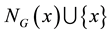 . A vertex x is said to be a leaf if
 . A vertex v of G is a support vertex if it is adjacent to a leaf in G. Two distinct vertices u and v are called duplicated if
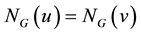 . Note that u and v are duplicated vertices in a tree, and then they are both leaves. The n-path
  is the path of order
 . For a subset
 , the induced subgraph induced by A is the graph
  with vertex set A and the edge set
 , the deletion of A from G is the graph
  by removing all vertices in A and all edges incident to these vertices and the complement of A is the set
 . For notation and terminology in graphs we follow [1] in general.
A set  is an independent set of G if no two vertices of I are adjacent in G. The independence number
  of G is the maximum cardinality among all independent sets of G. If I is an independent set of G with cardinality
 , we call I an
  -set of G. If I is an
  -set of G containing all leaves of G, we call I an
  -set of G.
The independence problem is to find an  -set in G. The problem is known to be NP-hard in many special classes of graphs. Over the past few years, several studies have been made on independence (see [2] -[6] ). For
any tree T of order , it is easy to see that
 . In addition, if there are duplicated leaves in a tree, then these duplicated leaves are all lying in every maximum independent set. In this paper, we will show that if T is a tree of order
  without duplicated leaves, then
 . Moreover, we constructively
characterize the extremal trees T of order , which are without duplicated leaves, achieving these upper bounds.
2. The Upper Bound
In this section, we will show a sharp upper bound on the independence number of a tree T without duplicated leaves.
Lemma 1 If H is an induced subgraph of G, then .
.
Proof. If S is an  -set of H, then S is an independent set of G. It follows that
 .
. 
Lemma 2 ([4] ) If T is a tree of order , then
 .
.
Lemma 3 ([5] ) If T is a tree of order , then there exists an
  -set of T.
Lemma 4 For an integer ,
, .
.
Proof. It is straightforward to check that  for
for . Let
. Let . Since Pn is a tree of order
 , by Lemma 2, we have that
 . Suppose that there exists an independent set I of Pn with
 , then there exists i,
  , such that
  and
and . This is a contradiction, therefore we obtain that
 .
. 
Theorem 1 If T is a tree of order  without duplicated leaves, then
 .
.
Proof. We prove it by induction on . By Lemma 4 and T is a tree without duplicated leaves, it’s true for all
 . For all
  we assume that the assertion is true for all
 . Suppose that T is a tree of order
  without duplicated leaves and x is a leaf lying on a longest path of T. Let
 . Since T has no duplicated leaves, this implies that
 , say
, say . Let
. Let , then T' is a tree of order
 . For the case in which T' has no duplicated leaves, by induction hypothesis, we have that
 . Since an
  -set of T', together with
 , form an
  -set of T. Therefore we obtain that
 . For the other case in which T' has duplicated leaves z and
 , then
  is a tree of order
  without duplicated leaves. By induction hypothesis, we have that
 . Since an
  -set of
 , together with
 , form an
  -set of T. Therefore, we obtain that
 . Hence we conclude that
 .
.
Note that the result in Theorem 1 is sharp and some such T are illustrated below.
3. Extremal Trees
Let  be the class of all trees T of order
  without duplicated leaves such that
 .
.
We will constructively characterize these extremal trees. Let  and
and , respectively, denote the collections of all leaves and all support vertices of T. First, we define four operations on a tree T of order
  as follows, where I is an
  -set of T.
Operation O1. Join a vertex  of
of  to a vertex
  of
of  such that
 , where
  (mod 3).
Operation O2. Join a vertex  of
of  to a vertex
  of
of  such that
 , where
  (mod 3).
Operation O3. Join a vertex u of  to a leaf
  of
of  (say
(say ) such that
 , where
  (mod 3).
Operation O4. Join a vertex  of T to a leaf v3 of P3 (say
 ) such that
 .
.
Lemma 5 Suppose that  for
for .If I is an
  -set of T, then

Proof. It’s true for all . So we assume that
 . Since I is an
  -set of T, this implies that
 . By Theorem 1, we have that

Hence we obtain that . Let
. Let . Note that
  and
and
 for every i. In addition,
  , these imply that
 . Thus we obtain that
 . It follows that

This completes the proof. 
Lemma 6 Let  be a tree of order
  with an
  -set I. Suppose that T' is obtained from T by Operation O1, then
  is a tree of order
  and
and  is an
is an  -set of T'.
Proof. Suppose that  is a tree of order
  (mod 3) with an
  -set I, by Lemma 5, then
 . Let T' be the tree obtained from T by Operation O1. Since
 , this implies that u is not a support vertex of T and T' is a tree of order
  without duplicated leaves. On the other hand,
  is an independent
set of  with
with  such that
 , where
  (mod 3). Hence
 . In conclusion,
  is a tree of order
  with an
  -set IO1.
Lemma 7 Let  be a tree of order
  with an
  -set I such that
 . If
. If  is obtained from T by Operation O2, then
  is a tree of order
  and
and  is an
is an  -set of
 .
.
Proof. Note that such a tree T exists, as, for instance, the tree in Figure 1 is as desired. If  is a tree of order
  (mod 3) with an
  -set I such that
 . Let T' be the tree obtained from T by Operation O2. Since u is not a support vertex of T, this implies that T' is a tree of order
  without duplicated leaves. And
  is an independent set of T' with
  such that
 , where
  (mod 3). Hence
 . In conclusion,
  is a tree of order
  with an
  -set IO2.
Lemma 8 Let  be a tree of order
  with an
  -set I. If T' is obtained from T by Operation O3, then
  is a tree of order
  and IO3 is an
  -set of T'.
Proof. Note that T' is a tree of order n + 2 without duplicated leaves. And IO3 is an independent set of T' with
 such that
 , where
  (mod 3). Hence
 . In conclusion,
  is a tree of order
  with an
  - set IO3.
Lemma 9 Let  be a tree of order
  with an
  -set I. If T' is obtained from T by Operation O4, then
  is a tree of order
  and IO4 is an
  -set of T'.
Proof. Note that T' is a tree of order  without duplicated leaves. And IO4 is an independent set of T' with
 such that
 . Hence
 . In conclusion,
  is a tree of order
  with an
  -set IO4.
Let  be the class of all trees obtained from
  or
or  by a finite sequence of Operations O1-O4. Suppose that
 , we will show that
 .
.
Theorem 2 T is in  if and only if T is in
 .
.

Figure 1. The trees T with .
.
Proof. If T is in , by Lemmas 6, 7, 8 and 9, then T is in
 . Now, we want to show the converse by contradiction. Suppose to the contrary that there exists a tree
  and
and  such that
  is as small as possible. We can see that
 . Let
. Let  be a longest path of T. Then
  and
and  is a tree of order
 . We consider two cases.
Case 1. T' has no duplicated leaves.
For an  -set I of T,
  is an independent set of T', this implies that
 . By
. By
Theorem 1, we have that . Then
  and
and  (mod 3). This follows that
 , where
 (mod 3), by hypothesis,
 . Note that T can be obtained from
  by Operation O3, this implies that
 , which is a contradiction.
Case 2. T' has duplicated leaves z and z'.
Let . Then
  is a tree of order
 . Since z' is a leaf of T, this implies that z and z' are in every
  -set of T. For an
  -set I of T,
  is an independent set of
 , thus
  . By Theorem 1, we have that
 . Then
 . This fol-
lows that , where
 , by hypothesis,
 . Note that T can be obtained from
  by Operation O4, this implies that
 , which is a contradiction.
By Cases 1 and 2, we conclude that T is in , then T is in
 .
. 
Now, we obtain the main theorem in this paper.
Theorem 3 Suppose that T is a tree of order  without duplicated leaves, then
 . Furthermore, the equality holds if and only if
 .
.
Cite this paper
Min-JenJou,Jenq-JongLin, (2015) Independence Numbers in Trees. Open Journal of Discrete Mathematics,05,27-31. doi: 10.4236/ojdm.2015.53003
References
- 1. Bondy, J.A. and Murty, U.S.R. (1976) Graph Theory with Application. North-Holland, New York.
- 2. Harant, J. (1998) A Lower Bound on the Independence Number of a Graph. Discrete Mathematics, 188, 239-243.
http://dx.doi.org/10.1016/S0012-365X(98)00048-X - 3. Hattingh, J.H., Jonack, E., Joubert, E.J. and Plummer, A.R. (2007) Total Restrained Domination in Trees. Discrete Mathematics, 307, 1643-1650.
http://dx.doi.org/10.1016/j.disc.2006.09.014 - 4. Jou, M.-J. (2010) Dominating Sets and Independent Sets in a Tree. Ars Combinatoria, 96, 499-504.
- 5. Jou, M.-J. (2010) Upper Domination Number and Domination Number in a Tree. Ars Combinatoria, 94, 245-250.
- 6. Luo, R. and Zhao, Y. (2006) A Note on Vizing’s Independence Number Conjecture of Edge Chromatic Critical Graphs, Discrete Mathematics, 306, 1788-1790.
http://dx.doi.org/10.1016/j.disc.2006.03.040