

Open Journal of Discrete Mathematics
Vol.05 No.01(2015), Article ID:53228,8 pages
10.4236/ojdm.2015.51001
Combinatorial Interpretation of Raney Numbers and Tree Enumerations
Chin Hee Pah1, Mohamed Ridza Wahiddin2
1Department of Computational and Theoretical Sciences, Faculty of Science, International Islamic University Malaysia, Kuantan, Malaysia
2Department of Computer Science, Faculty of ICT, International Islamic University Malaysia, Kuala Lumpur, Malaysia
Email: pahchinhee@iium.edu.my, mridza@iium.edu.my
Copyright © 2015 by authors and Scientific Research Publishing Inc.
This work is licensed under the Creative Commons Attribution International License (CC BY).
http://creativecommons.org/licenses/by/4.0/



Received 24 November 2014; revised 20 December 2014; accepted 3 January 2015
ABSTRACT
A new combinatorial interpretation of Raney numbers is proposed. We apply this combinatorial interpretation to solve several tree enumeration counting problems. Further a generalized Catalan triangle is introduced and some of its properties are proved.
Keywords:
Raney Numbers, Fuss-Catalan Numbers, Tree Enumeration, Network

1. Introduction
Interestingly Penson and Zyczkowski were the first who use the term Raney numbers [1] [2] and it is defined as
 where
where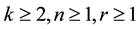 . Nevertheless, it is known that Raney’s lemma could be
used in counting problem associated with Catalan numbers [3] and a bijection exists between Raney path and plan multitree [4] .
These numbers do not form novel sequences, as the numbers were introduced earlier as a generalization of the binomial series [5] . Moreover, the sequence

is not included in OEIS database [6] before 2011. If we let , we obtain another known sequence, i.e.,
Fuss-Catalan numbers [7] [8] which is defined as . Although Fuss-Catalan numbers
were introduced earlier than Catalan numbers [9] , the Catalan numbers are more popular and widely used than the Fuss-Catalan numbers (see [10] [11] for details). Due to its self similar structure, the applications of Catalan numbers could be found in many physical problems, e.g., lattice model [12] , tree enumeration network [13] , and Hankel matrices in coding theory [14] . A tree is a connected graph with no cycles and for which only one shortest path exists from one node to another. Tree enumeration is an important tool to study network. These networks always grow in a power-law behavior which is often found in social network, subway system [15] , etc.
In this paper, we introduce Raney numbers  in the form of a non-linear recursion and then we pro- vide a combinatorial interpretation of Raney numbers. Using this combinatorial interpretation, we solve several tree enumeration counting problems in which we recover the well-known Fuss-Catalan numbers [16] , Catalan triangles [17] , and other less known numbers. Motivated by the connection between Raney numbers and Catalan triangles, a generalization of Catalan triangles is proposed and we prove some of their properties. Consequently these formulas generalize the properties of Catalan triangles. From the exact solution of these tree enumeration problems, we are able to find a sharp upper bound of the number of each tree enumeration problem. The upper bound is important in the contour method for lattice models and limit of the random graph.
2. Raney Numbers
Let  be the number of a
  -ary trees with labeled
  vertices (Figure 1), where

The Raney numbers are defined as follows:
 (1)
(1)
where . Therefore, the combinatorial interpretation is as follows:
  copies of
  -ary tree with total number of
  vertices.
Next, we let  be the generating function for
 , i.e.,

Then, the generating function of  is
is  and the Raney numbers satisfy the following formula [18] .
Lemma 1. Let  be the generating function of the Raney numbers. Then,
 (2)
(2)
Immediately, we obtain the following theorem.
Theorem 1. The binomial forms of the Raney numbers are given by
 (3)
(3)
From theorem (1), it is not difficult to deduce some of the properties of Raney numbers.
Corollary 1. For integer , we have
 (4)
(4)

Figure 1. A binary tree with 3 nodes, where the bottom vertex is the root.
 (5)
(5)
 (6)
(6)
 (7)
(7)
Corollary 2. We can write  in a nonlinear recursion as:
 (8)
(8)
where .
.
We recover the formula by joining the  copies of
  -ary tree with
  vertices which is also equivalent to a
  -ary tree with
  vertices and an additional root (see Figure 2):

Using binomial form of , one can obtain the following result.
Corollary 3. For a fixed integer , and
, and ,
,
 (9)
(9)
where  if
if .
.
For , we recover the identity of a generalized Ballot numbers:
 (10)
(10)
3. A Homogeneous k-Ary Tree
Unlike the usual  -ary tree, we define a homogeneous
  -ary tree as a graph with no cycles, in which each vertex emanates
  edges (see Figure 3 for k = 4). We fix a vertex namely
  as the root. Unlike the ordinary root in a
  -ary tree, this root has
  successors while other vertices have
  number of successors. Any vertex could be chosen to be the root since the graph is homogenous. For a given
  vertices, we may find how many connected sub-tree rooted at
 . This number is defined as
 .
.
Theorem 2. For , we can write
  in a nonlinear recursion of
  as:
as:
 (11)
(11)
Proof. We decompose the problem by finding out the number of  -ary tree of
  number of one copy of
  -ary tree with
  vertices, i.e.,
  , and another copy of
  -ary tree with
  vertices, i.e.
 .
.

Figure 2. Joining 4 rooted Cayley tree of order 4 where r = 4 and k = 4.

Figure 3. A homogenous graph where each vertex is connected to exactly 5 neighbours.
Since the former  must always include
 , its range should be from 1 to
 . Total
  is just the sum of all
  using the addition and multiplication principles.
Using Equation (8), we rewrite the formula above as
 (12)
(12)
This formula can also be obtained using  copies of
  -ary tree together with
  vertices and one center.
We then find the binomial form of .
.
Corollary 4. For ,
,  is expressed in binomial form as:
 (13)
(13)
Thus,  and
and  as in [19] and [20] , respectively. For k = 4,
coincides with one form of Raney numbers as mentioned above, i.e., . The numbers
  generate a lot of new sequences. For example, the sequence of
 , i.e.,

is not found in the OEIS database [6] .
From theorem (2), one can get

This formula can be also obtained easily by a different way:
1) Count the number of trees by joining the 2 copies of  tree, with total number of vertices
 .
.
2) Subtract those trees remunerate from  but doesn’t contain
 , that is, exactly the number
 .
.
Let the generating function of  be
be . Then we have the following result.
Corollary 5. For  and
and , the generating function,
  is
is
 (14)
(14)
where  is the generating function of
 .
.
Corollary 6. For ,
,
 (15)
(15)
or
 (16)
(16)
Using the binomial inequality in [21] and the binomial forms of  and
and , the following in- equality can be easily proved.
Corollary 7. For ,
,
 (17)
(17)
where  and
and .
.
For sufficiently large , a simpler form is produced as well, i.e.,
 . These results are conjectured in a weaker form in [20] , i.e.,
 .
.
4. Catalan Triangle
A Catalan triangle  is defined as follows [9] :

The Catalan triangle satisfies [9] :
 (18)
(18)
Using a property of Catalan numbers,  , where
 , we get another
form of , i.e.,
 (19)
(19)
where . From Equation (1), we immediately recover the Catalan triangle from the Raney numbers, i.e.,
 :
:
 (20)
(20)
We now consider the following problem as in [22] : Find out the number of all different connected sub-trees of a homogenous binary tree with  number of vertices, containing the given
  number of fixed vertices (where
 ). The condition,
  , is simply the number of vertices that covers the minimal component containing all
  vertices. The details of this problem and terminologies could be found in the original paper [22] . We denote the solution to this problem as
 . In this paper, we show that a solution to the case when the minimal component is “full”, is as below:

where  is the number of given vertices and
  is the number of fixed vertices in each of the connected sub- tree.
Now, we interpret and relate the problem above with the combinatorial interpretation of the Raney numbers through the following steps (see Figure 4):
1) Given  vertices;
2) Fill up all the interior points, i.e., ;
;
3) Fill up all the boundary points, i.e., ;
;
4) Then only  vertices are left;
5) Since each boundary point has 2 neighbours which is not an interior point, we have  boxes;
6) If  vertices are given, then there are
  boxes of binary tree to be filled.
As a result, the solution is
 (21)
(21)
Furthermore, it is natural to define a generalized Catalan triangle, i.e.,  -th Catalan triangle using Fuss- Catalan numbers instead of Catalan numbers as in Equation (19):
 (22)
(22)
where  if
if .
.
From the property of Fuss-Catalan numbers, i.e., corollary (2)

where , we find another form of
 ,
,
 (23)
(23)
where . Again, from Equation (1), we immediately have
 (24)
(24)
Lemma 2. Some properties of  -th Catalan triangles are as follows:
 (25)
(25)
 (26)
(26)
 (27)
(27)

Figure 4. 4 boundary points (solid circles) connected to full minimal component.
Using the binomial form of , one can show that:
Lemma 3. For  and
and 
 (28)
(28)
If , we recover

Based on the initial result, lemma (3), we prove the following assertion by mathematical induction with respect to .
.
Theorem 3. For fixed , where
 , and
, and ,
,
 (29)
(29)
where  if
if .
.
Proof. Assertion is true for . Assume that it is true for
 , we consider the following summations:


Hence, the assertion is true for any .
.
Corollary 8. For fixed , where
 , and
, and , we have
 (30)
(30)
For , we have the following simple result:
Corollary 9. For fixed , and
, and ,
,
 (31)
(31)
where  if
if .
.
5. Binomial Transformation of k-th Catalan Triangle
For  and
and , we define a new number
  as:
as:
 (32)
(32)
If , all the Fuss-Catalan numbers should start at 1, then we recover the previously defined
  -th Catalan triangle.
From the property of Fuss-Catalan numbers,  , where
 , we found another form of
 (33)
(33)
From Equation (1), we immediately have
 (34)
(34)
and for  we recover the same formula for
  -th Catalan triangle,

From theorem (3),  is obtained as a result of binomial transformation of
  -Catalan triangles.
Corollary 10. For fixed , where
 , and
, and ,
,
 (35)
(35)
where  if
if .
.
6. Conclusion
In this paper, we have introduced the combinatorial interpretation of Raney numbers to solve various tree enumeration counting problems. The upper bound of any  order tree enumeration is generally found to be
 . We have also shown how a new number
  may be derived from the binomial transformation
of  -th Catalan triangles.
Acknowledgements
This research is funded by the MOHE grant FRGS11-022-0170. The authors are grateful to anoymous referee’s suggestion and improvement of the presentation of this paper.
References
- Penson, K.A. and Zyczkowski, K. (2011) Product of Ginibre Matrices: Fuss-Catalan and Raney Distributions. Physical Review E, 83, Article ID: 061118. http://dx.doi.org/10.1103/PhysRevE.83.061118
- Mlotkowski, W., Penson, K.A. and Zyczkowski, K. (2013) Densities of the Raney Distributions. Documenta Mathematica, 18, 1573-1596.
- Jeurissen, R.H. (2008) Raney and Catalan. Discrete Mathematics, 308, 6298-6307. http://dx.doi.org/10.1016/j.disc.2007.11.068
- Dziemiaczuk, M. (2014) Enumerations of Plane Trees with Multiple Edges and Raney Lattice Paths. Discrete Mathematics, 337, 9-24. http://dx.doi.org/10.1016/j.disc.2014.07.024
- Gould, H.W. (1972) Combinatorial Identities: A Standardized Set of Tables Listing 500 Binomial Coefficient Summations. Morgantown.
- (2011) The On-Line Encyclopedia of Integer Sequences. Sequence A196678. http://oeis.org
- Graham, R.L., Knuth, D.E. and Patashnik, O. (1994) Concrete Mathematics. Addison-Wesley, Boston.
- Hilton, P. and Pedersen, J. (1991) Catalan Numbers, Their Generalization, and Their Uses. Mathematical Intelligencer, 13, 64-75. http://dx.doi.org/10.1007/BF03024089
- Koshy, T. (2008) Catalan Numbers with Applications. Oxford University Press, USA. http://dx.doi.org/10.1093/acprof:oso/9780195334548.001.0001
- Stanley, R.P. (2013) Catalan Addendum to Enumerative Combinatorics. Vol. 2.
- Stanley, R.P. (1999) Enumerative Combinatorics. Vol. 2, Cambridge University Press, Cambridge. http://dx.doi.org/10.1017/CBO9780511609589
- Baxter, R.J. (1982) Exactly Solved Models in Statistical Mechanics. Academic Press, London.
- Goltsev, A.V., Dorogovtsev, S.N. and Mendes, J.F.F. (2008) Critical Phenomena in Complex Networks. Reviews of Modern Physics, 80, 1275. http://dx.doi.org/10.1103/RevModPhys.80.1275
- Tamm, U. (2001) Some Aspects of Hankel Matrices in Coding Theory and Combinatorics. The Electronic Journal of Combinatorics, 8, 1-31.
- Lee, K., Jung, W.S., Park, J.S. and Choi, M.Y. (2000) Statistical Analysis of the Metropolitan Seoul Subway System: Network Structure and Passenger Flows. Physica A, 387, 6231-6234. http://dx.doi.org/10.1016/j.physa.2008.06.035
- Aval, J.C. (2008) Multivariate Fuss-Catalan Numbers. Discrete Mathematics, 308, 4660-4669. http://dx.doi.org/10.1016/j.disc.2007.08.100
- Shapiro, L.W. (1976) A Catalan Triangle. Discrete Mathematics, 14, 83-90. http://dx.doi.org/10.1016/0012-365X(76)90009-1
- Merlini, D., Sprugnoli, R. and Verri, M.C. (2006) Lagrange Inversion: When and How. Acta Applicandae Mathematica, 94, 233-249. http://dx.doi.org/10.1007/s10440-006-9077-7
- Pah, C.H. (2008) An Application of Catalan Number on Cayley Tree of Order 2: Single Polygon Counting. Bulletin of the Malaysian Mathematical Sciences Society, 31, 175-183.
- Pah, C.H. (2010) Single Polygon Counting on Cayley Tree of Order 3. Journal of Statistical Physics, 140, 198-207. http://dx.doi.org/10.1007/s10955-010-9989-5
- Sasvari, Z. (1999) Inequalities for Binomial Coefficients. Journal of Mathematical Analysis and Applications, 236, 223-226. http://dx.doi.org/10.1006/jmaa.1999.6420
- Mukhomedov, F., Pah, C.H. and Saburov, M. (2010) Single Polygon Counting for m Fixed Nodes in Cayley Tree: Two Extremal Cases. Preprint. http://arxiv.org/abs/1004.2305