

Applied Mathematics
Vol.06 No.08(2015), Article ID:57741,5 pages
10.4236/am.2015.68108
On the Non-Common Neighbourhood Energy of Graphs
Ahmad N. Al-Kenani1, Anwar Alwardi2, Omar A. Al-Attas1
1Department of Mathematics, King Abdulaziz University, Jeddah, Saudi Arabia
2Department of Studies in Mathematics, University of Mysore, Mysore, India
Email: aalkenani10@hotmail.com, a_wardi@hotmail.com, Omar_alattas30@hotmail.com
Copyright © 2015 by authors and Scientific Research Publishing Inc.
This work is licensed under the Creative Commons Attribution International License (CC BY).
http://creativecommons.org/licenses/by/4.0/



Received 20 May 2015; accepted 30 June 2015; published 3 July 2015
ABSTRACT
In this paper, we introduce a new type of graph energy called the non-common-neighborhood energy , NCN-energy for some standard graphs is obtained and an upper bound for
  is found when G is a strongly regular graph. Also the relation between common neigh- bourhood energy and non-common neighbourhood energy of a graph is established.
Keywords:
NCN-Eigenvalues (of Graph), NCN-Energy (of Graph), NCN-Adjacency Matrix (of Graph)

1. Introduction
Let G be a simple graph with n vertices, and let  be its adjacency matrix. The eigenvalues
 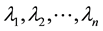 of
of  are the (ordinary) eigenvalues of the graph G [1] . Since
  is a symmetric matrix with zero trace, these eigenvalues are real with sum equal to zero.
The energy of the graph G is defined [2] as the sum of the absolute values of its eigenvalues:
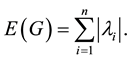
Details on the theory of graph energy can be found in the reviews [3] -[5] , whereas details on its chemical applications in the book [6] and in the review [7] . Let G be simple graph with vertex set .
.
For , the common neighborhood of the the vertices
  and
and , denoted by
 , is the set of
vertices, different from  and
and , which are adjacent to both
  and
and . The common-neighborhood matrix of G is then
 , where

The common-neighborhood energy (or, shorter, CN-energy) of the graph G is

where  are the eigenvalues of the
 , for more details about CN-energy, see [9]
Theorem 1. [8] For almost all n-vertex graphs

Theorem 1 immediately implies that almost all graphs are hyperenergetic, making any further search for them pointless.
In what follows we shall need a few auxiliary results.
Lemma 1. [1] Let G be a connected k-regular graph with n vertices and . Let
. Let  be its eigenvalues. Then the eigenvalues of the line graph of G are
 , and
, and  with multiplicity
 .
.
Lemma 2. [1] Let G be a graph with an adjacency matrix A and with eigenvalues , then the
 , for any polynomial
 ,
,  is an eigenvalue of
  and hence
 .
.
Corollary 1. [9] Let G be a connected k-regular graph and let  be its eigenvalues.
1) The common-neighborhood eigenvalues of the complement of G are

2) The common-neighborhood eigenvalues of the line graph  of G are

where the CN-eigenvalue  has multiplicity
 .
.
Definition. A strongly regular graph with parameters  is a k-regular graph with n vertices, such that any two adjacent vertices have
  common neighbors, and any two non-adjacent vertices have
  common neighbors.
2. Non-Common Neighbourhood Energy of Graphs
Definition. Let G be simple graph with vertex set . For
. For , the non-common neigh-
borhood set of the the vertices  and
and , denoted by
 , is the set of vertices, different from
  and
and
 , which are not adjacent to both
  and
and . The non-common neighborhood matrix of G is then
 , where

According to the above definition, the non-common neighborhood matrix is a real symmetric  matrix. Therefore its eigenvalues
  are real numbers. Since the trace of
  is zero, the sum of its eigenvalues is also equal to zero. the eigenvalues
  of the matrix
  are called the CNC- eigenvalues of G
Definition. The non-common neighborhood energy (or, shorter, CNC-energy) of the graph G is

We will Denote by  the unit matrix of order n, and by
  the square matrix of order n whose all elements are equal to unity. Let further 0 stand for a matrix (or pertinent dimension) whose all elements are equal to zero.
Proposition 2. , where
  is the complete graph of order n.
Proof. Observing that , we get
 .
.
Proposition 3.  , where
  is the complete bipartite graph of order
 .
.
Proof. First observe that if the vertices of  are labeled so that all vertices
  are adjacent to all vertices
 , then

Observing that  and
and , we have

Which implies .
.
Corollary 2. 
Proposition 4. , where
  is the complete bipartite graph of order
 .
.
Proposition 5. For any totally disconnected graph ,
, .
.
Proof. Observing that for any two vertices u and v in  there are
  vertices not adjacent to
both vertices u and v. Therefore , where
  is the adjacency matrix of the
complete graph with n vertices. Hence, .
.
The complete multipartite graph  is a graph on
  vertices. The set of vertices is
partitioned into parts of cardinalities ; an edge joins two vertices if and only if they belong to different parts. Thus
  is the complete graph
 . In the following proposition we get the CNC-energy of
the multipartite graph .
.
Proposition 6. Let  be The complete multipartite graph on
  vertices, where
 . Then,

Proof. Let  be a complete multipartite graph with
  vertices. From the definition
of complete multipartite graph we observe for any two distinct vertices  if they belong to the same partite set
  with
with , then
 . But if the two vertices belongs to different partite sets we have
 . Hence the NCN-matrix of
  is of the following form.

where  is the adjacency matrix of the complete graphs
 . Hence,

Corollary 3. For graph  we have,

Corollary 4. For any cocktail party graph G which is the complement of ,
,

The proof of the following result is straightforward.
Proposition 7. If the graph G consists of (disconnected) components , then

Theorem 8. Let G be a graph on n vertices, and let  is the adjacency matrix of G, and
 , where

and Let . Then,

Proof. Since  is equal to size of the set
 . Therefore
 and as we know that
 . Hence

Lemma 3. Let  be k-regular graph and
 , where

Then

Proof. Observing that if  is k-regular, then
 , where

Therefore,

Hence

Proposition 9. For any k-regular graph G,

Proof. By Theorem 8 and Lemma 3, we have

Hence

Theorem 10. For any graph G, .
.
Proof. Since  for
for  is the number of vertices which not adjacent to both
  and
and  and it is
equal to the number of vertices which adjacent to both  and
and  in
in , that means
 .
.
Theorem 11. Let G be a connected k-regular graph with eigenvalues . Then the NCN-eigenvalues
of G are .
.
Proof. Theorem 11 follows from Proposition 8 and Lemma 2 or by applying Theorem 10 and Corollary 1
Theorem 12. Let G be a connected k-regular graph and let  be its eigenvalues. Then The NCN- eigenvalues of the line graph
  of G are

Proof. Theorem 12 follows from Proposition 8 and Lemma 2 or by applying Theorem 10 and Corollary 1
Theorem 13. For any connected graph G,  if and only if G is complete multi bipartite graph
  for some positive integer
 , where
  for
for .
.
Proof. Let  for some positive integer
 , where
  for
for . Suppose that u and v any two vertices in G, if u and v adjacent, then does not exists any vertex in G which is not adjacent to both of u and v, similarly if u and v are not adjacent that means
  is zero matrix. Therefore
 and Corollary 2 are spacial cases of multi bipartite graph
  for some positive integer
 , where
  for
for .
.
Conversely, if G is connected graph and , then by Theorem 10
 . Therefore
 for some positive integers
 . Hence G is complete multi bipartite graph
for some positive integer , where
  for
for .
.
Lemma 4. If G is a strongly regular graph with parameters , then
 (1)
(1)
Proof. If  and
and  are adjacent vertices of G, then
 . If
. If  and
and  are non-adjacent ver-
tices of G, then . Since G has
  pairs of adjacent vertices, and
  pairs of
non-adjacent vertices,

from which Equation (1) follows straightforwardly.
Theorem 14. If G is a strongly regular graph with parameters , then
 (2)
(2)
Proof. follows an idea first used by Koolen and Moulton [10] [11] . Let  be the common neigh- borhood eigenvalues of G, and let
  be the greatest eigenvalue. Because the greatest ordinary eigenvalue of G is equal to k, by Theorem 14,
 .
.
The Cauchy-Schwarz inequality states that if  and
and  are n-vectors, then

Now, by setting  and
and ,
,  , in the above inequality, we obtain

Therefore

i.e.,

i.e.,

By using Lemma 4,

Acknowledgements
We thank the Editor and the referee for their comments.
References
- Cvetković, D., Doob, M. and Sachs, H. (1995) Spectra of Graphs―Theory and Application. Barth, Heidelberg.
- Gutman, I. (1978) The Energy of a Graph. Ber. Math. Stat. Sekt. Forschungsz. Graz, 103, 1-22.
- Gutman, I. (2001) The Energy of a Graph: Old and New Results. In: Betten, A., Kohnert, A., Laue, R. and Wassermann, A., Eds., Algebraic Combinatorics and Applications, Springer-Verlag, Berlin, 196-211. http://dx.doi.org/10.1007/978-3-642-59448-9_13
- Gutman, I. (2011) Hyperenergetic and Hypoenergetic Graphs. In: Cvetković, D. and Gutman, I., Eds., Selected Topics on Applications of Graph Spectra, Math. Inst., Belgrade, 113-135.
- Gutman, I., Li, X. and Zhang, J. (2009) Graph Energy. In: Dehmer, M. and Emmert-Streib, F., Eds., Analysis of Complex Networks. From Biology to Linguistics, Wiley-VCH, Weinheim, 145-174. http://dx.doi.org/10.1002/9783527627981.ch7
- Gutman, I. and Polansky, O.E. (1986) Mathematical Concepts in Organic Chemistry. Springer-Verlag, Berlin. http://dx.doi.org/10.1007/978-3-642-70982-1
- Gutman, I. (2005) Topology and Stability of Conjugated Hydrocarbons. The Dependence of Total p-Electron Energy on Molecular Topology. Journal of the Serbian Chemical Society, 70, 441-456.
- Nikiforov, V. (2007) The Energy of Graphs and Matrices. Journal of Mathematical Analysis and Applications, 326, 1472-1475. http://dx.doi.org/10.1016/j.jmaa.2006.03.072
- Alwardi, A., Soner, N.D. and Gutman, I. (2011) On the Common-Neighborhood Energy of a Graph. Bulletin T. CXLIII de l’Académie Serbe des Sciences et des Arts 2011 Classe des Sciences Mathématiques et Naturelles Sciences Mathé- matiques, 143, 49-59.
- Koolen, J. and Moulton, V. (2001) Maximal Energy Graphs. Advances in Applied Mathematics, 26, 47-52. http://dx.doi.org/10.1006/aama.2000.0705
- Koolen, J.H., Moulton, V. and Gutman, I. (2000) Improving the McClelland Inequality for Total p-Electron Energy. Chemical Physics Letters, 320, 213-216. http://dx.doi.org/10.1016/S0009-2614(00)00232-3